

The head of the UN's nuclear watchdog says Iran will begin offering its inspectors “less access”, but will still allow the agency to monitor its atomic programme.
Rafael Grossi, who arrived in Vienna late on Sunday night, was careful to say there would still be the same number of inspectors, but also “things we lose".
Mr Grossi did not give many details, but Iranian Foreign Minister Javad Zarif said that would include blocking the International Atomic Energy Agency from accessing footage on its cameras at nuclear sites.
Mr Grossi travelled to Tehran as Iran tries to pressure Europe and the Biden administration into returning to the 2015 nuclear deal, from which President Donald Trump withdrew America in 2018.
Mr Zarif, who under President Hassan Rouhani helped to reach the nuclear deal, said the IAEA's access to the cameras would be shut off.
“This is not a deadline for the world. This is not an ultimatum,” he told the government-run Press TV before he met Mr Grossi.
“This is an internal domestic issue between the Parliament and the government. We have a democracy.
"We are supposed to implement the laws of the country. And the Parliament adopted legislation, whether we like it or not.”
It was the highest-level acknowledgement yet of what Iran planned to do when it stopped following the “additional protocol", a confidential agreement between Tehran and the IAEA reached as part of the nuclear deal.
The IAEA has additional protocols with a number of countries it monitors.
Under the deal with Iran, the IAEA “collects and analyses hundreds of thousands of images captured daily by its sophisticated surveillance cameras", the agency said in 2017.
The agency said then that it had placed “2,000 tamper-proof seals on nuclear material and equipment".
Mr Zarif said on Sunday that authorities would be “required by law not to provide the tapes of those cameras".
It was not immediately clear if that also meant the cameras would be turned off entirely. He called that a “technical decision, that’s not a political decision".
“The IAEA certainly will not get footage from those cameras,” Mr Zarif said.
The IAEA did not respond to a request for comment on Mr Zarif’s statements, although Mr Grossi was expected to address them on his return to Vienna late on Sunday night.
The agency last week said the visit was aimed at finding “a mutually agreeable solution for the IAEA to continue essential verification activities in the country".
There are 18 nuclear centres and nine other locations in Iran under IAEA watch.
-
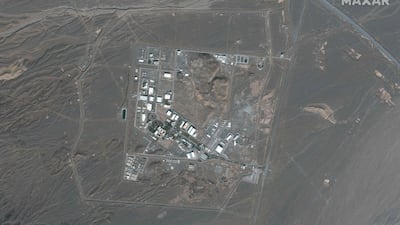
An overview of Iran's Natanz nuclear facility, south of the capital Tehran. Maxar Technologies / AFP -
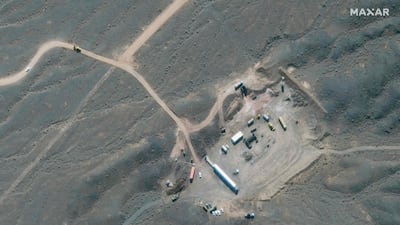
An overview of Iran's Natanz nuclear facility, south of the capital Tehran. Maxar Technologies / AFP -
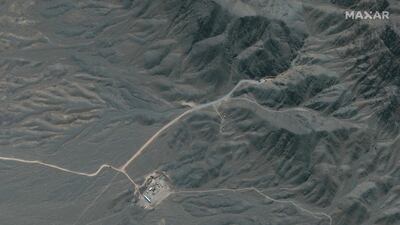
An overview of Iran's Natanz nuclear facility, south of the capital Tehran. Maxar Technologies / AFP -
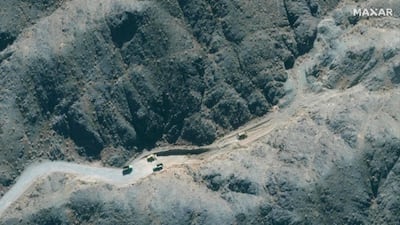
An overview of Iran's Natanz nuclear facility, south of the capital Tehran. Maxar Technologies / AFP


From Washington, US National Security Adviser Jake Sullivan said President Joe Biden remained willing to negotiate with Iran over a return to the nuclear deal, an offer earlier dismissed by Mr Zarif.
“He is prepared to go to the table to talk to the Iranians about how we get strict constraints back on their nuclear programme,” Mr Sullivan told CBS.
“That offer still stands because we believe diplomacy is the best way to do it.”
On US citizens being held by Iran, Mr Sullivan said: "We have begun to communicate with the Iranians on this issue."
Iranian Foreign Ministry spokesman Saeed Khatibzadeh told state TV late on Sunday night that “there are no direct talks between Iran and the US in any field."
But Mr Khatibzadeh said the Swiss embassy in Tehran, which has looked out for American interests since the 1979 hostage crisis, has passed messages between the countries on prisoner issues since Mr Biden took office.
Earlier on Sunday, Mr Grossi met Ali Akbar Salehi, head of Iran’s civilian nuclear programme.
“Iran and the IAEA held fruitful discussions based on mutual respect, the result of which will be released this evening,” Iran’s ambassador to the IAEA, Kazem Gharibabadi, later tweeted.
Iran’s Parliament in December approved a bill to suspend some UN inspections of its nuclear centres if European signatories did not provide relief from oil and banking sanctions by Tuesday.
Iran has slowly walked away from all the nuclear deal’s limits on its stockpile of uranium and has begun enriching up to 20 per cent.
It also has begun spinning advanced centrifuges barred by the deal, under which Iran limited its programme in exchange for the lifting of economic sanctions.
An escalating series of incidents since Mr Trump’s withdrawal has threatened the wider Middle East.
More than a year ago, a US drone strike killed a top Iranian general. Tehran responded with ballistic missiles that wounded dozens of American troops in Iraq.
A mysterious explosion, which Iran has described as sabotage, also struck Iran’s Natanz nuclear plant.
In November, Iranian scientist Mohsen Fakhrizadeh, who founded the country’s military nuclear programme about two decades earlier, was killed in an attack Tehran blames on Israel.
Mr Zarif brought up the attacks on Sunday, saying the IAEA must keep some of its information confidential for safety reasons.
“Some of them may have security ramifications for Iran, whose peaceful nuclear sites have been attacked,” he said.
“For a country whose nuclear scientists have been murdered in terrorist operations in the past, and now recently with Mr Fakhrizadeh, confidentiality is essential.”

