The US hopes that talks with Tehran about its nuclear programme will continue, despite Israel's attacks on Iran that have called into question the merit of negotiations.
Following Friday's strikes, Iran said it was withdrawing from the sixth round of nuclear negotiations that were due to take place in Oman on Sunday with US Special Middle East Envoy Steve Witkoff.
The talks were supposed to forestall military action against Iran by forcing it to give up all uranium enrichment capabilities and abandon its drive to develop a nuclear weapon. For weeks, US President Donald Trump sounded optimistic that a deal could be achieved, while also threatening dire consequences for Iran if it did not reach an agreement.
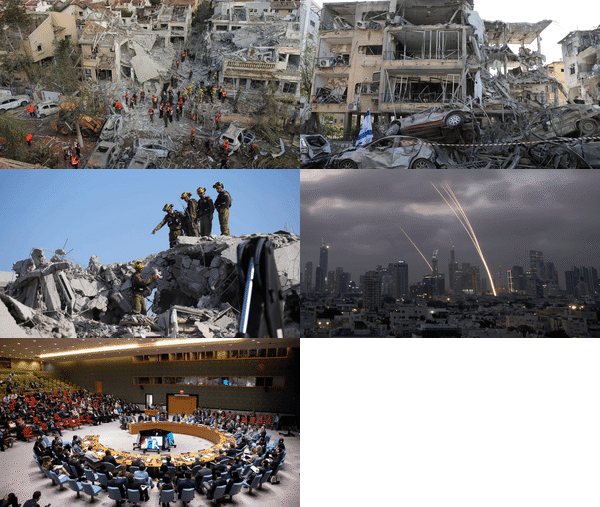
Ultimately, Israel rendered those talks moot by launching a “pre-emptive” strike against Iran's military leaders and its nuclear sites.
Despite those actions, Mr Trump insisted Iran possibly has a “second chance” to come to the negotiating table.
“Iran must make a deal, before there is nothing left, and save what was once known as the Iranian empire. No more death, no more destruction, just do it, before it is too late,” he wrote in a post on Truth Social.
Israel began striking Iranian targets in the early hours of Friday and continued its attacks throughout the day. Iran later responded, unleashing dozens of missiles at Israel.
Israel's strikes were far more extensive than those it conducted against Iran last year, and underscored the country’s growing assertiveness, as well as its military and intelligence capabilities.
Mossad released video that it claims shows its agents deployed in Iran.
Iranian President Masoud Pezeshkian said Iran will make Israel regret its attacks.
“The Iranian nation and the country's officials will not remain silent in the face of this crime, and the legitimate and powerful response of the Islamic Republic of Iran will make the enemy regret its foolish act,” Mr Pezeshkian said in a video statement aired on state TV.
Mr Trump later told Reuters that the US still has nuclear talks planned with Iran on Sunday but that he is not sure if they will take place.
“I tried to save Iran humiliation and death,” Mr Trump said, adding he is not concerned about a regional war breaking out as a result of Israel's strikes.
A US official told The National that Washington is planning for talks to continue.
“We still intend to have talks,” the official said, without specifying when these might occur.
Israel said it struck around 100 targets across Iranian cities on Friday morning, using 200 planes. The attacks caused oil prices to surge and investors to buy safe havens such as gold and US Treasuries.
When asked by NBC News why he thinks Iran would still want to hold talks, Mr Trump said Iranian representatives were calling him to suggest they still wanted a deal.
Alex Vatanka, a senior fellow at the Middle East Institute, said Iran might continue talks, provided the country's supreme leader, Ayatollah Ali Khamenei, is willing to do so.
He “has to make a decision” about how much he wants to respond, Mr Vatanka said.
“If he wants to step down, the obvious thing to do is to go back to the negotiations, to look for a way to either give up enrichment, temporarily or for good, or find a compromise somewhere between,” Mr Vatanka said.
“If you can avoid humiliating Ali Khamenei, if you think … he's going to stay in power, then don't humiliate him. Find a way for him to find it easy to come back and negotiate”.

Ten tax points to be aware of in 2026
1. Domestic VAT refund amendments: request your refund within five years
If a business does not apply for the refund on time, they lose their credit.
2. E-invoicing in the UAE
Businesses should continue preparing for the implementation of e-invoicing in the UAE, with 2026 a preparation and transition period ahead of phased mandatory adoption.
3. More tax audits
Tax authorities are increasingly using data already available across multiple filings to identify audit risks.
4. More beneficial VAT and excise tax penalty regime
Tax disputes are expected to become more frequent and more structured, with clearer administrative objection and appeal processes. The UAE has adopted a new penalty regime for VAT and excise disputes, which now mirrors the penalty regime for corporate tax.
5. Greater emphasis on statutory audit
There is a greater need for the accuracy of financial statements. The International Financial Reporting Standards standards need to be strictly adhered to and, as a result, the quality of the audits will need to increase.
6. Further transfer pricing enforcement
Transfer pricing enforcement, which refers to the practice of establishing prices for internal transactions between related entities, is expected to broaden in scope. The UAE will shortly open the possibility to negotiate advance pricing agreements, or essentially rulings for transfer pricing purposes.
7. Limited time periods for audits
Recent amendments also introduce a default five-year limitation period for tax audits and assessments, subject to specific statutory exceptions. While the standard audit and assessment period is five years, this may be extended to up to 15 years in cases involving fraud or tax evasion.
8. Pillar 2 implementation
Many multinational groups will begin to feel the practical effect of the Domestic Minimum Top-Up Tax (DMTT), the UAE's implementation of the OECD’s global minimum tax under Pillar 2. While the rules apply for financial years starting on or after January 1, 2025, it is 2026 that marks the transition to an operational phase.
9. Reduced compliance obligations for imported goods and services
Businesses that apply the reverse-charge mechanism for VAT purposes in the UAE may benefit from reduced compliance obligations.
10. Substance and CbC reporting focus
Tax authorities are expected to continue strengthening the enforcement of economic substance and Country-by-Country (CbC) reporting frameworks. In the UAE, these regimes are increasingly being used as risk-assessment tools, providing tax authorities with a comprehensive view of multinational groups’ global footprints and enabling them to assess whether profits are aligned with real economic activity.
Contributed by Thomas Vanhee and Hend Rashwan, Aurifer
THE BIO:
Favourite holiday destination: Thailand. I go every year and I’m obsessed with the fitness camps there.
Favourite book: Born to Run by Christopher McDougall. It’s an amazing story about barefoot running.
Favourite film: A League of their Own. I used to love watching it in my granny’s house when I was seven.
Personal motto: Believe it and you can achieve it.
KILLING OF QASSEM SULEIMANI
Results:
2.15pm: Handicap (PA) Dh60,000 1,200m.
Winner: AZ Dhabyan, Adam McLean (jockey), Saleha Al Ghurair (trainer).
2.45pm: Maiden (PA) Dh60,000 1,200m.
Winner: Ashton Tourettes, Sam Hitchcott, Ibrahim Aseel.
3.15pm: Conditions (PA) Dh60,000 2,000m.
Winner: Hareer Al Reef, Gerald Avranche, Abdallah Al Hammadi.
3.45pm: Maiden (PA) Dh60,000 1,700m.
Winner: Kenz Al Reef, Gerald Avranche, Abdallah Al Hammadi.
4.15pm: Sheikh Ahmed bin Rashid Al Maktoum Cup (TB) Dh 200,000 1,700m.
Winner: Mystique Moon, Sam Hitchcott, Doug Watson.
4.45pm: The Crown Prince Of Sharjah Cup Prestige (PA) Dh200,000 1,200m.
Winner: ES Ajeeb, Sam Hitchcott, Ibrahim Aseel.
RESULT
Wolves 1 (Traore 67')
Tottenham 2 (Moura 8', Vertonghen 90 1')
Man of the Match: Adama Traore (Wolves)
WHAT IS GRAPHENE?
It was discovered in 2004, when Russian-born Manchester scientists Andrei Geim and Kostya Novoselov were experimenting with sticky tape and graphite, the material used as lead in pencils.
Placing the tape on the graphite and peeling it, they managed to rip off thin flakes of carbon. In the beginning they got flakes consisting of many layers of graphene. But when they repeated the process many times, the flakes got thinner.
By separating the graphite fragments repeatedly, they managed to create flakes that were just one atom thick. Their experiment led to graphene being isolated for the very first time.
In 2010, Geim and Novoselov were awarded the Nobel Prize for Physics.