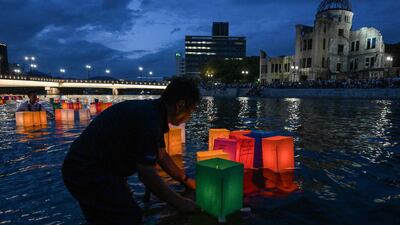
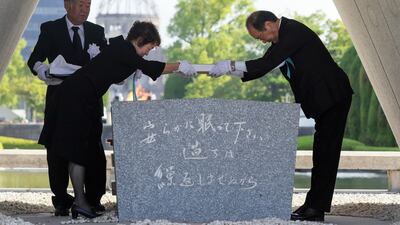
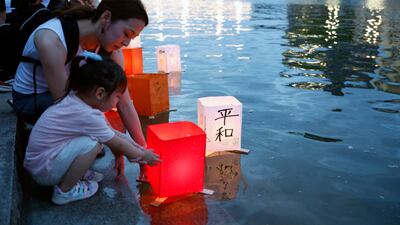
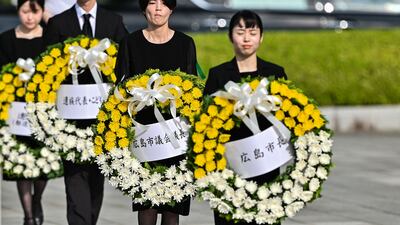
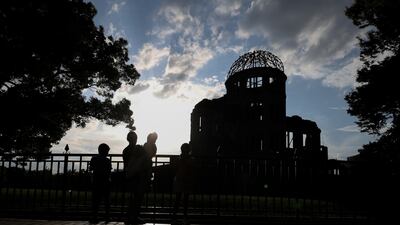
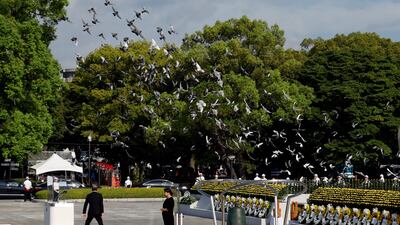
More than 110,000 people died within seconds after two atomic weapons were dropped by America on Japan in 1945, bringing about Japan's surrender days later and the end of the Second World War.
The bombing of Hiroshima on August 6 destroyed the city and ultimately killed 140,000 people due to the radiation fallout. A second bomb dropped three days later on Nagasaki claimed 70,000 lives.
Mercifully, there has never been a repeat.
That 80-year peace, marked this week with sombre ceremonies attended by ageing survivors, has largely been due to nuclear states accepting the concept of MAD, or “mutually assured destruction”, in which no one wins in a nuclear showdown.
But today, the language around using the weapons has become bolder.
There are several global fault lines where a nuclear detonation could happen, from Ukraine to India-Pakistan, Iran-Israel and the Korean peninsula, experts have told The National.
Arguably, the world took its eye off the issue in the post-Cold War years. Or the reality was that deterrence was doing its job. But today, nuclear use is more likely than it has been since 1945.
The nuclear treaties which held the two Cold War superpowers in check for decades are now receding. The 2010 New START treaty, between Russia and the US, limiting them each to 1,550 long-range missiles, will expire in seven months. The 1987 Intermediate Range Nuclear Forces Treaty, which eliminated weapons with ranges between 500km and 5,500km, was formally terminated in 2019.
Last week, US President Donald Trump announced that two nuclear ballistic submarines were being deployed to turn up the heat on Russia over a Ukraine ceasefire. Russia’s President Vladimir Putin has alluded to using nuclear weapons since the start of the Ukraine war in 2022.
More bombs
The world is heading towards what experts call a “fourth nuclear” age with a rapid build-up of arsenals, a breakdown in arms control and increased tension between nuclear powers.
The first age was the invention of the atomic bomb used against Japan, the second was the massive stockpiles during the 1960s and 1970s, and the third was the post-Cold War era when nuclear conflict appeared to be in abeyance.
Those Glasnost arms control treaties saw the number of warheads drop from 70,000 to less than 10,000 between 1986 and January this year. But they are on the rise again, and former US president Barack Obama’s vision of “a world without nuclear weapons” is receding.
China is forging ahead with its nuclear arsenal, building it up from a few hundred to potentially 1,000 warheads within five years. North Korea is boosting its nuclear programme with missiles that can reach California.
Europe is also rearming, with Britain increasing its number of warheads from 225 to 260. Rather than only having a submarine-launched deterrent, the UK might also purchase F-35A fighters capable of delivering a bomb by air.
America’s Minuteman III intercontinental ballistic missiles will be replaced with the Sentinel system, and the US Air Force will upgrade its B-2 Spirit bombers, which struck Iran’s nuclear programme in June, to the advanced stealth B-21 Raiders.
It is also developing the W93 warhead to be housed on its new Columbia-class submarines, the first addition to the US nuclear arsenal since the 1980s, after doubling the budget at Los Alamos National Laboratory in the last five years.
Israel, with an estimated 100 warheads, is currently the only nuclear-armed country in the Middle East, and it intends to ensure Iran does not follow suit.
Small yield
Nuclear warfare experts have concluded that, in 2025, nuclear arms control is in a parlous state.
The grim lessons of Hiroshima and Nagasaki “are fading into the background” 80 years on, said Dr Marion Messmer, nuclear proliferation expert at the Chatham House think tank.
“We're at a point where you have various voices advocating that nuclear war can be fought and escalation can be contained,” she said.
“But if you look at the impact of Hiroshima and Nagasaki, the radiation damage and long-term consequences survivors had to live with, that's a really dangerous path to go down.”
This is especially worrying when there is serious discussion about using low-yield weapons alongside the “feasibility of controlling a nuclear exchange”, said Darya Dolzikova, nuclear proliferation expert at the Rusi tank think.
“There is a valid question over whether nuclear use can stay limited, but that's a very hard thing to argue, as you run the risk of escalation fairly quickly. That limited nuclear use is unlikely to stay limited.”
The passage of time from the 1945 bombings made it easy to forget that “we are talking about inflicting a catastrophe on human beings”, she added. There has also been a “normalisation that we live in a nuclear world” with the number of global active warheads now at 9,614.
It is lamentable that the massive impact of a nuclear strike on civilians, something in the forefront of people’s minds during the Cold War, “appears to have been forgotten”, Dr Messmer said, “especially as we have so many different potential escalation pathways now”.
Leaking umbrella
There is also growing concern that America’s promise to protect its allies under a nuclear umbrella is weakening, leading those countries sheltering under it, such as South Korea and Japan, to seek their own weapons for deterrence against North Korea or China.
There is also a debate over whether Europe’s only nuclear powers, France and Britain, are enough to deter a Russian attack.
“It's unsurprising that both France and Britain have been in conversations about the value of enhancing Europe's own nuclear deterrence,” said Brig Ben Barry, nuclear proliferation expert at the IISS think tank. If the current outlook is bleak, the “only solace”, he argued, is that nuclear deterrence has prevented major war for the past 80 years, “but at the moment it’s as on edge as it's ever been”.
Hamish de Bretton Gordon, who commanded a British army specialist nuclear regiment, said: “We're arguably in the most precarious nuclear position that we have been in the last 80 years.
“There’s a lot of people now with their fingers on the red button.”
Positives
But there are some positives gained from the past eight decades, with at least three countries persuaded to give up weapons programmes. South Africa did so in 1989 as apartheid was ending. In 1994, Ukraine agreed to dismantle 1,700 warheads, which was then the world’s third-biggest stockpile, and, in 2003, Libyan leader Muammar Qaddafi agreed to terminate his nuclear programme.
However, the last two countries were invaded, with a big question mark over whether that would have happened if they had been nuclear-armed.
That reinforces the argument for America’s nuclear umbrella, said Brig Barry. But he also warned that if there is a limited nuclear exchange – and Armageddon does not ensue – other countries may decide they want their own.
“Especially if the US is less interested in deterring the foes of its allies, that will increase the anxiety of countries that might otherwise have foresworn nuclear weapons,” he added.
But Ms Dolzikova also argued that with the International Atomic Energy Agency retaining its role, “there are still tools available, and alarms in place” to prevent nuclear proliferation.
“We need to look at micro risk-reduction opportunities and making sure the lines of communication are open to ensure we don’t ever get a repeat of 1945,” she added.
The Settlers
Director: Louis Theroux
Starring: Daniella Weiss, Ari Abramowitz
Rating: 5/5
BLACKBERRY
%3Cp%3EDirector%3A%20Matt%20Johnson%3C%2Fp%3E%0A%3Cp%3EStars%3A%20Jay%20Baruchel%2C%20Glenn%20Howerton%2C%20Matt%20Johnson%3C%2Fp%3E%0A%3Cp%3ERating%3A%204%2F5%3C%2Fp%3E%0A
The specs: 2019 Mercedes-Benz C200 Coupe
Price, base: Dh201,153
Engine: 2.0-litre turbocharged four-cylinder
Transmission: Nine-speed automatic
Power: 204hp @ 5,800rpm
Torque: 300Nm @ 1,600rpm
Fuel economy, combined: 6.7L / 100km
Jetour T1 specs
Engine: 2-litre turbocharged
Power: 254hp
Torque: 390Nm
Price: From Dh126,000
Available: Now
THE SPECS – Honda CR-V Touring AWD
Engine: 2.4-litre 4-cylinder
Power: 184hp at 6,400rpm
Torque: 244Nm at 3,900rpm
Transmission: Continuously Variable Transmission (CVT)
0-100kmh in 9.4 seconds
Top speed: 202kmh
Fuel consumption: 6.8L/100km
Price: From Dh122,900
THE%20SWIMMERS
%3Cp%3E%3Cstrong%3EDirector%3A%20%3C%2Fstrong%3ESally%20El-Hosaini%3C%2Fp%3E%0A%3Cp%3E%3Cstrong%3EStars%3A%20%3C%2Fstrong%3ENathalie%20Issa%2C%20Manal%20Issa%2C%20Ahmed%20Malek%20and%20Ali%20Suliman%C2%A0%3C%2Fp%3E%0A%3Cp%3E%3Cstrong%3ERating%3A%20%3C%2Fstrong%3E4%2F5%3C%2Fp%3E%0A
Squads
India (for first three ODIs) Kohli (capt), Rohit, Rahul, Pandey, Jadhav, Rahane, Dhoni, Pandya, Axar, Kuldeep, Chahal, Bumrah, Bhuvneshwar, Umesh, Shami.
Australia Smith (capt), Warner, Agar, Cartwright, Coulter-Nile, Cummins, Faulkner, Finch, Head, Maxwell, Richardson, Stoinis, Wade, Zampa.
Ten tax points to be aware of in 2026
1. Domestic VAT refund amendments: request your refund within five years
If a business does not apply for the refund on time, they lose their credit.
2. E-invoicing in the UAE
Businesses should continue preparing for the implementation of e-invoicing in the UAE, with 2026 a preparation and transition period ahead of phased mandatory adoption.
3. More tax audits
Tax authorities are increasingly using data already available across multiple filings to identify audit risks.
4. More beneficial VAT and excise tax penalty regime
Tax disputes are expected to become more frequent and more structured, with clearer administrative objection and appeal processes. The UAE has adopted a new penalty regime for VAT and excise disputes, which now mirrors the penalty regime for corporate tax.
5. Greater emphasis on statutory audit
There is a greater need for the accuracy of financial statements. The International Financial Reporting Standards standards need to be strictly adhered to and, as a result, the quality of the audits will need to increase.
6. Further transfer pricing enforcement
Transfer pricing enforcement, which refers to the practice of establishing prices for internal transactions between related entities, is expected to broaden in scope. The UAE will shortly open the possibility to negotiate advance pricing agreements, or essentially rulings for transfer pricing purposes.
7. Limited time periods for audits
Recent amendments also introduce a default five-year limitation period for tax audits and assessments, subject to specific statutory exceptions. While the standard audit and assessment period is five years, this may be extended to up to 15 years in cases involving fraud or tax evasion.
8. Pillar 2 implementation
Many multinational groups will begin to feel the practical effect of the Domestic Minimum Top-Up Tax (DMTT), the UAE's implementation of the OECD’s global minimum tax under Pillar 2. While the rules apply for financial years starting on or after January 1, 2025, it is 2026 that marks the transition to an operational phase.
9. Reduced compliance obligations for imported goods and services
Businesses that apply the reverse-charge mechanism for VAT purposes in the UAE may benefit from reduced compliance obligations.
10. Substance and CbC reporting focus
Tax authorities are expected to continue strengthening the enforcement of economic substance and Country-by-Country (CbC) reporting frameworks. In the UAE, these regimes are increasingly being used as risk-assessment tools, providing tax authorities with a comprehensive view of multinational groups’ global footprints and enabling them to assess whether profits are aligned with real economic activity.
Contributed by Thomas Vanhee and Hend Rashwan, Aurifer
Mercer, the investment consulting arm of US services company Marsh & McLennan, expects its wealth division to at least double its assets under management (AUM) in the Middle East as wealth in the region continues to grow despite economic headwinds, a company official said.
Mercer Wealth, which globally has $160 billion in AUM, plans to boost its AUM in the region to $2-$3bn in the next 2-3 years from the present $1bn, said Yasir AbuShaban, a Dubai-based principal with Mercer Wealth.
“Within the next two to three years, we are looking at reaching $2 to $3 billion as a conservative estimate and we do see an opportunity to do so,” said Mr AbuShaban.
Mercer does not directly make investments, but allocates clients’ money they have discretion to, to professional asset managers. They also provide advice to clients.
“We have buying power. We can negotiate on their (client’s) behalf with asset managers to provide them lower fees than they otherwise would have to get on their own,” he added.
Mercer Wealth’s clients include sovereign wealth funds, family offices, and insurance companies among others.
From its office in Dubai, Mercer also looks after Africa, India and Turkey, where they also see opportunity for growth.
Wealth creation in Middle East and Africa (MEA) grew 8.5 per cent to $8.1 trillion last year from $7.5tn in 2015, higher than last year’s global average of 6 per cent and the second-highest growth in a region after Asia-Pacific which grew 9.9 per cent, according to consultancy Boston Consulting Group (BCG). In the region, where wealth grew just 1.9 per cent in 2015 compared with 2014, a pickup in oil prices has helped in wealth generation.
BCG is forecasting MEA wealth will rise to $12tn by 2021, growing at an annual average of 8 per cent.
Drivers of wealth generation in the region will be split evenly between new wealth creation and growth of performance of existing assets, according to BCG.
Another general trend in the region is clients’ looking for a comprehensive approach to investing, according to Mr AbuShaban.
“Institutional investors or some of the families are seeing a slowdown in the available capital they have to invest and in that sense they are looking at optimizing the way they manage their portfolios and making sure they are not investing haphazardly and different parts of their investment are working together,” said Mr AbuShaban.
Some clients also have a higher appetite for risk, given the low interest-rate environment that does not provide enough yield for some institutional investors. These clients are keen to invest in illiquid assets, such as private equity and infrastructure.
“What we have seen is a desire for higher returns in what has been a low-return environment specifically in various fixed income or bonds,” he said.
“In this environment, we have seen a de facto increase in the risk that clients are taking in things like illiquid investments, private equity investments, infrastructure and private debt, those kind of investments were higher illiquidity results in incrementally higher returns.”
The Abu Dhabi Investment Authority, one of the largest sovereign wealth funds, said in its 2016 report that has gradually increased its exposure in direct private equity and private credit transactions, mainly in Asian markets and especially in China and India. The authority’s private equity department focused on structured equities owing to “their defensive characteristics.”
MATCH INFO
England 2
Cahill (3'), Kane (39')
Nigeria 1
Iwobi (47')
BMW M5 specs
Engine: 4.4-litre twin-turbo V-8 petrol enging with additional electric motor
Power: 727hp
Torque: 1,000Nm
Transmission: 8-speed auto
Fuel consumption: 10.6L/100km
On sale: Now
Price: From Dh650,000
What can victims do?
Always use only regulated platforms
Stop all transactions and communication on suspicion
Save all evidence (screenshots, chat logs, transaction IDs)
Report to local authorities
Warn others to prevent further harm
Courtesy: Crystal Intelligence
Company%20profile
%3Cp%3E%3Cstrong%3ECompany%20name%3A%3C%2Fstrong%3E%20Fasset%0D%3Cbr%3E%3Cstrong%3EStarted%3A%20%3C%2Fstrong%3E2019%0D%3Cbr%3E%3Cstrong%3EFounders%3A%3C%2Fstrong%3E%20Mohammad%20Raafi%20Hossain%2C%20Daniel%20Ahmed%0D%3Cbr%3E%3Cstrong%3EBased%3A%3C%2Fstrong%3E%20Dubai%0D%3Cbr%3E%3Cstrong%3ESector%3A%20%3C%2Fstrong%3EFinTech%0D%3Cbr%3E%3Cstrong%3EInitial%20investment%3A%3C%2Fstrong%3E%20%242.45%20million%0D%3Cbr%3E%3Cstrong%3ECurrent%20number%20of%20staff%3A%3C%2Fstrong%3E%2086%0D%3Cbr%3E%3Cstrong%3EInvestment%20stage%3A%3C%2Fstrong%3E%20Pre-series%20B%0D%3Cbr%3E%3Cstrong%3EInvestors%3A%3C%2Fstrong%3E%20Investcorp%2C%20Liberty%20City%20Ventures%2C%20Fatima%20Gobi%20Ventures%2C%20Primal%20Capital%2C%20Wealthwell%20Ventures%2C%20FHS%20Capital%2C%20VN2%20Capital%2C%20local%20family%20offices%3C%2Fp%3E%0A
Results
57kg quarter-finals
Zakaria Eljamari (UAE) beat Hamed Al Matari (YEM) by points 3-0.
60kg quarter-finals
Ibrahim Bilal (UAE) beat Hyan Aljmyah (SYR) RSC round 2.
63.5kg quarter-finals
Nouredine Samir (UAE) beat Shamlan A Othman (KUW) by points 3-0.
67kg quarter-finals
Mohammed Mardi (UAE) beat Ahmad Ondash (LBN) by points 2-1.
71kg quarter-finals
Ahmad Bahman (UAE) defeated Lalthasanga Lelhchhun (IND) by points 3-0.
Amine El Moatassime (UAE) beat Seyed Kaveh Safakhaneh (IRI) by points 3-0.
81kg quarter-finals
Ilyass Habibali (UAE) beat Ahmad Hilal (PLE) by points 3-0