
The flight data and cockpit voice recorders on the Jeju Air plane that crashed on December 29 stopped recording about four minutes before it went off the runway and hit a concrete structure at South Korea's Muan International Airport, the Transport Ministry said on Saturday.
Authorities investigating the disaster that killed 179 people, the worst on South Korean soil, plan to analyse what caused the "black boxes" to stop recording.
Jeju Air Flight 7C2216 was arriving from Thailand when it belly-landed and exploded in a fireball after slamming into a localiser – a signal-transmitting device that guides aircraft to the runway.
The pilots had told air traffic control the plane suffered a bird strike and declared emergency about four minutes earlier. Only two crew members, sitting in the tail section, survived the crash.
The aircraft’s damaged flight data recorder was sent to the US National Transportation Safety Board laboratory for analysis, while the cockpit voice recorder was initially analysed in South Korea and then sent to the US safety regulator when data was found to be missing, the transport ministry said.
"The analysis revealed that both the CVR and FDR data were not recorded during the four minutes leading up to the aircraft's collision with the localiser," the ministry said.
"Plans are in place to investigate the cause of the data loss during the ongoing accident investigation."
-
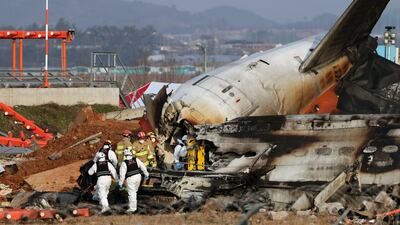
Firefighters work at the wreckage of a Jeju Air aircraft which crashed while landing at Muan International Airport in South Korea on Sunday morning. EPA -
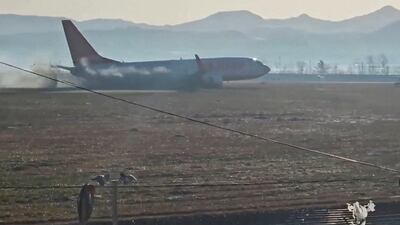
Black smoke emits from Jeju Air flight 7C2216 as it veers off the runway. Reuters -

The aircraft slams into a wall. Reuters -

The plane is engulfed in flames after hitting a wall. Reuters -
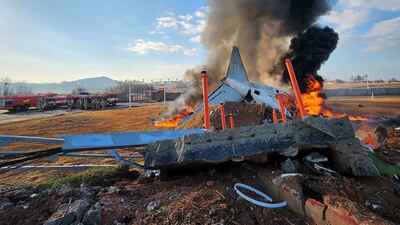
The plane came off the runway and struck a wall before bursting into flames, killing dozens. Yonhap / AFP -
Rescue personnel near the tail section of the aircraft after it crashed. AFP -
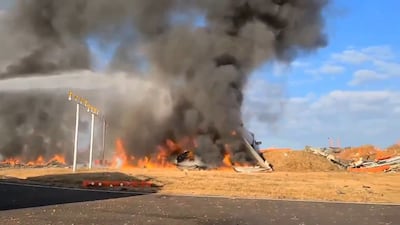
At least 47 died in the disaster, officials said. Yonhap / AFP -
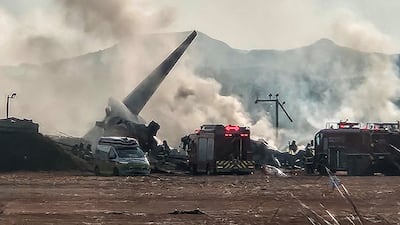
The tail appears to have snapped from the main body of the aircraft. Yonhap via Reuters -
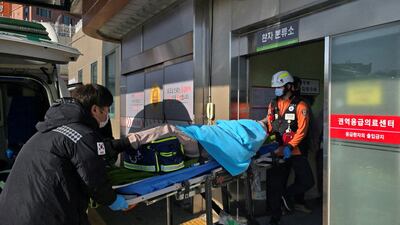
Passengers were seen being rushed to emergency wards in Muan in the far south of the country. Yonhap via Reuters -

Acting President Choi Sang-mok called for the mobilisation of all resources to save the surviving passengers. Reuters -
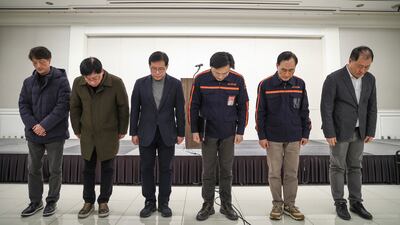
Jeju Air CEO Kim E-bae, fourth from left, and other executive members bow in apology ahead of a briefing in Seoul, South Korea. AP -
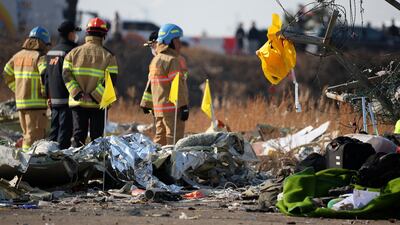
A life jacket hangs on a fence next to the wreckage. Reuters -
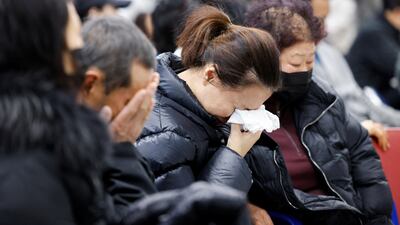
Relatives of passengers of the aircraft that crashed after it went off the runway. Reuters


The transport ministry said other data available would be used in the investigation.
Investigators have pointed to a bird strike, faulty landing gear and the structure at the end of the runway as possible problems.
This week, lead investigator Lee Seung-yeol told reporters that feathers were found in one of the plane's recovered engines, but cautioned that a bird strike does not lead to an immediate engine failure.
The pilots warned of a bird strike before pulling out of a first landing. But instead of making a full go-about, the Boeing 737-800 jet took a sharp turn and approached the airport's single runway from the opposite end, crash-landing without landing gear deployed.
Sim Jai-dong, a former Transport Ministry accident investigator, said the absence of data from the crucial final minutes was surprising and suggested that all power, including backup, may have been cut, which is rare.
Authorities have raided offices at Muan airport, a regional aviation office in the south-western city, and Jeju Air's office in the capital Seoul. They also barred the budget airline’s chief executive from leaving the country.
Rival parties formed a joint task force to probe the crash, while Transport Minister Park Sang-woo offered his resignation this week.
"As the minister responsible for aviation safety, I feel a heavy sense of responsibility regarding this tragedy," he said.
With reporting from agencies.

