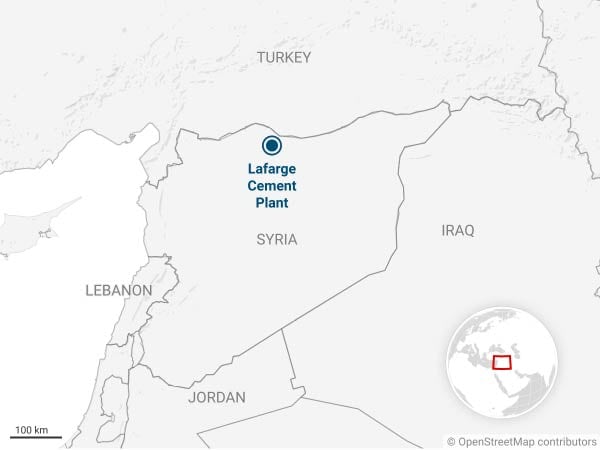
Decade-old allegations of spies and betrayal in the Syrian desert, involving one of the world's biggest corporations which stands accused of crimes against humanity, are to be played out in a Paris courtroom.
French cement manufacturer Lafarge and eight former executives and middlemen go on trial on November 4 in a case expected to last six weeks.
The trial is "unprecedented", former Lafarge communications director Philippe Hardouin, who recently published a book on the case, told The National.
The trial marks the first time that a private company in France is accused of financing terrorism. It is expected to be closely watched in France, where companies are tentatively returning to Syria for business, nearly a year after the fall of the Assad regime.
Contracts have yet to be signed, with businesses telling The National they are worried about banking compliance issues and fears of inadvertently sending funds to sanctioned individuals, many of whom have struck deals with Syria's new rulers. Lafarge has reportedly ruled out the possibility of a return because of the scandal caused by the trial.
In the dock
Among the defendants are former chief executive Bruno Lafont and former deputy chief operating officer Christian Herrault, as well as two former security managers of the Syrian plant: Jacob Waerness, who used to serve in Norway's elite police force, and Ahmad Jaloudi, a former colonel in the Jordanian army. Defendants also include Bruno Pescheux, director of the factory from 2008 to 2014; Frederic Jolibois, who succeeded him in 2014; and Syrian-American intermediary Amro Taleb.
On trial in their absence is Syrian businessman Firas Tlass, a former minority stakeholder in Lafarge's Syria subsidiary, who is accused of distributing the cash to rebel groups through his contacts in Syria. He has not set foot in France since an international arrest warrant was issued against him, according to Mr Hardouin, who spoke to him at length for his book.
Defendants all stand accused of financing terrorist groups, while Mr Lafont is additionally charged with non-respect of international financial sanctions.
They potentially face up to 10 years in prison if found guilty.
The case has returned the spotlight to the controversy surrounding the company's role and wider French involvement in Syria under the regime of Bashar Al Assad.
The defence has highlighted services rendered by Lafarge to French intelligence services, which were hungry at the time for information on rebel groups operating around the factory.
Judges have dismissed this argument, saying that no one forced Lafarge to stay in Syria, and it had the choice to leave. French energy giant Total exited Syria in late 2011, months after the start of the civil war.
Lafarge, by contrast, stayed on for nearly three more years, in increasingly dangerous circumstances.
Civil war
The Lafarge plant in Syria was in the north-west of the country near the Turkish border. It was inaugurated months before the start of the civil war in 2010 at a cost of about $680 million.
In the summer of 2012, the company started paying western-backed Kurdish forces that took over the area to keep the plant operating, according to reports. "It was clearly extortion, even if it was the 'good guys' that were doing the extortion," Mr Herrault told investigators at the start of the probe, according to Le Monde.
But the situation turned more dangerous after groups listed as terrorists by western and Arab states, including ISIS, swept across the area. Court documents show that Lafarge continued to pay until it was forced to leave when ISIS took over the plant in September 2014.
The court will have to consider whether those payments constitute terror financing and whether top executives such as Mr Lafont knew that those payments were happening.
In 2022, Lafarge was separately fined $778 million in the US Justice Department after pleading guilty to providing material support to ISIS and other terror groups. In a statement, it said: "We deeply regret that this conduct occurred."
Double standards
Lafarge has argued that payments originated from its subsidiary's accounts – Lafarge Cement Syria – and not the company’s account, and that it was not involved in the decisions made by the subsidiary’s executives, according to campaigners who filed a criminal complaint against Lafarge in 2016 after media reports emerged about the payments.
Large companies accused of human rights violations classically argue they are the acts of a few "bad apples", said two of the campaigners – the European Centre for Constitutional and Human Rights (ECCHR) and French association Sherpa – in a joint commentary published last week.
For years, it has been argued, there is a disparity between the French judiciary's treatment of people involved in Syria's civil war – such as a mother sentenced in 2017 to two years in prison for sending €2,800 ($3,220) to her son in Syria – and corporations active there.
"The case raises questions of corporate power, double standards, and the pursuit of accountability for those who enable or profit from grave human rights abuses in Syria and beyond," the ECCHR and Sherpa said.
Merger plan
One suggestion as to why Lafarge chose to prolong its stay in Syria is that a merger was ongoing with Swiss competitor Holcim, so it wanted its assets maximised. The merger was finalised in 2015.
Lafarge wanted the Syria plant to remain part of its assets as "each company took stock of its family jewels," even if the factory represented "very little on the scale of the group," Lafarge's former top security official, Jean-Claude Veillard, told French newspaper Le Parisien last year. Mr Veillard is the only defendant who has had charges against him dropped.
Mr Veillard also said Lafarge was worried about abandoning its employees. Former local staff turned against the company and joined the earlier stages of legal action in 2016, but, much to their disappointment, charges of endangering their lives were dropped in January 2024.
The staff told tales of kidnappings and threats against their lives as they continued work despite the fighting raging around them. Expats had been evacuated, but Syrians stayed.
Intelligence gathering
Lafarge's continued presence in Syria was allegedly a boon for French intelligence services. Reports suggest it hired people to collect information on foreign fighters fuelling the rise of extremist groups at the start of the civil war.
In his book, Mr Hardouin has suggested that the French state was more involved than it wants to admit. "Judges say that links between the French security services and Lafarge were simply circumstantial. That is entirely possible," he said.
Mr Hardouin, who left Lafarge in 2008, describes himself as a friend of Mr Lafont's, but said he did not set out to write his book to defend him. "What matters in my book is not whether I am friends with or have worked at Lafarge. What matters are the factual elements I talk about in the book and the questions they raise," he said.
If the company hoped to rely on ties to the French state for its defence, the approach has not worked. Though dismissed by judges, the allegations continue to hang over the case, triggering significant interest in France and highlighting the rarely discussed grey area of intelligence sharing between private companies and state security services operating in risky areas.
Mysterious Mr T
In his book, Mr Hardouin hints at intelligence rings operated in parallel at the factory. The first involved Mr Tlass, who is quoted as saying that his contact point was a DGSE agent referred to in court only as "Mr T".
Mister T was not interviewed by French police until 2021, during a brief stint working in the private sector. This timing conveniently blurs his alleged links to the DGSE, according to Mr Hardouin. "Evidence points to the fact that French state authorities and services tried to cover up their involvement in this case," he said.
In his deposition, which lasted under two hours, Mr T claimed that he was unaware that Mr Tlass used to be a minority stakeholder in Lafarge's Syria subsidiary or that Mr Tlass made payments to ISIS.
Mr Hardouin suggests it might have been expected that a French intelligence agent with experience in the Middle East would know more about Mr Tlass, whose family was part of the ruling elite.
His father, Mustafa Tlass, was Defence Minister for more than three decades. In 2012, France helped exfiltrate his brother Manaf Tlass, the first Syrian Republican Guard commander to publicly defect from the army of Mr Al Assad at the start of the civil war.
Mr Tlass, who fled Syria in 2012, has denied making payments direct to ISIS but has acknowledged paying "rebels". While he has refused to risk arrest in France, he has suggested being heard by judges by video-link – a suggestion which was not followed through, according to Mr Hardouin.
Lafarge 'served its country well'
Meanwhile, one of the Lafarge factory's ex-security managers, Mr Jaloudi, has told French media he drew a detailed map of Syria locating checkpoints controlled by Kurdish groups, ISIS, Ahrar Al Sham and the Syrian regime. This material ended up in the hands of an international anti-ISIS coalition.
Mr Jaloudi also said he formally identified in 2014 a French ISIS member named Kevin Guiavarch, despite this having nothing to do with Lafarge's operations. After his arrest, Guiavarch was sent back to France, where he was sentenced to 14 years in prison.
Mr Jaloudi has expressed pride in contributing to western efforts to fight terrorist groups and confusion about the accusations lodged against him by French investigative judges. Speaking to Le Monde in 2023, he said: "Everyone benefited from my intelligence work: the coalition against ISIS, the UN, NGOs. I am very proud of what I did."
In light of Lafarge's troubles, French companies might become more wary of collaborating with intelligence services, warned Mr Hardouin. "They understand now the extent to which it creates grey zones," he said. "This trial will be an important moment for them to position themselves."
One further thread from the intelligence community comes from Christophe Gomart, a former head of military intelligence and one-time special forces colleague of security chief Mr Veillard. In a 2023 French documentary on Lafarge, he said: "I can tell you that Lafarge employees served their country well."
About Proto21
Date started: May 2018
Founder: Pir Arkam
Based: Dubai
Sector: Additive manufacturing (aka, 3D printing)
Staff: 18
Funding: Invested, supported and partnered by Joseph Group
HIJRA
Starring: Lamar Faden, Khairiah Nathmy, Nawaf Al-Dhufairy
Director: Shahad Ameen
Rating: 3/5
Lexus LX700h specs
Engine: 3.4-litre twin-turbo V6 plus supplementary electric motor
Power: 464hp at 5,200rpm
Torque: 790Nm from 2,000-3,600rpm
Transmission: 10-speed auto
Fuel consumption: 11.7L/100km
On sale: Now
Price: From Dh590,000
Venue: Sharjah Cricket Stadium
Date: Sunday, November 25
Listen to Extra Time
TEACHERS' PAY - WHAT YOU NEED TO KNOW
Pay varies significantly depending on the school, its rating and the curriculum. Here's a rough guide as of January 2021:
- top end schools tend to pay Dh16,000-17,000 a month - plus a monthly housing allowance of up to Dh6,000. These tend to be British curriculum schools rated 'outstanding' or 'very good', followed by American schools
- average salary across curriculums and skill levels is about Dh10,000, recruiters say
- it is becoming more common for schools to provide accommodation, sometimes in an apartment block with other teachers, rather than hand teachers a cash housing allowance
- some strong performing schools have cut back on salaries since the pandemic began, sometimes offering Dh16,000 including the housing allowance, which reflects the slump in rental costs, and sheer demand for jobs
- maths and science teachers are most in demand and some schools will pay up to Dh3,000 more than other teachers in recognition of their technical skills
- at the other end of the market, teachers in some Indian schools, where fees are lower and competition among applicants is intense, can be paid as low as Dh3,000 per month
- in Indian schools, it has also become common for teachers to share residential accommodation, living in a block with colleagues
The%20Emperor%20and%20the%20Elephant
%3Cp%3E%3Cstrong%3EAuthor%3A%20%3C%2Fstrong%3ESam%20Ottewill-Soulsby%3C%2Fp%3E%0A%3Cp%3E%3Cstrong%3EPublisher%3A%20%3C%2Fstrong%3EPrinceton%20University%20Press%3C%2Fp%3E%0A%3Cp%3E%3Cstrong%3EPages%3A%20%3C%2Fstrong%3E392%3C%2Fp%3E%0A%3Cp%3E%3Cstrong%3EAvailable%3A%20%3C%2Fstrong%3EJuly%2011%3C%2Fp%3E%0A
Brief scores:
Toss: Sindhis, elected to field first
Pakhtoons 137-6 (10 ov)
Fletcher 68 not out; Cutting 2-14
Sindhis 129-8 (10 ov)
Perera 47; Sohail 2-18
About Housecall
Date started: July 2020
Founders: Omar and Humaid Alzaabi
Based: Abu Dhabi
Sector: HealthTech
# of staff: 10
Funding to date: Self-funded
About Takalam
Date started: early 2020
Founders: Khawla Hammad and Inas Abu Shashieh
Based: Abu Dhabi
Sector: HealthTech and wellness
Number of staff: 4
Funding to date: Bootstrapped
White hydrogen: Naturally occurring hydrogen
Chromite: Hard, metallic mineral containing iron oxide and chromium oxide
Ultramafic rocks: Dark-coloured rocks rich in magnesium or iron with very low silica content
Ophiolite: A section of the earth’s crust, which is oceanic in nature that has since been uplifted and exposed on land
Olivine: A commonly occurring magnesium iron silicate mineral that derives its name for its olive-green yellow-green colour
Company%C2%A0profile
%3Cp%3E%3Cstrong%3ECompany%20name%3A%20%3C%2Fstrong%3ELeap%0D%3Cbr%3E%3Cstrong%3EStarted%3A%20%3C%2Fstrong%3EMarch%202021%0D%3Cbr%3E%3Cstrong%3EFounders%3A%3C%2Fstrong%3E%20Ziad%20Toqan%20and%20Jamil%20Khammu%0D%3Cbr%3E%3Cstrong%3EBased%3A%3C%2Fstrong%3E%20Dubai%0D%3Cbr%3E%3Cstrong%3ESector%3A%20%3C%2Fstrong%3EFinTech%0D%3Cbr%3E%3Cstrong%3EInvestment%20stage%3A%20%3C%2Fstrong%3EPre-seed%0D%3Cbr%3E%3Cstrong%3EFunds%20raised%3A%3C%2Fstrong%3E%20Undisclosed%0D%3Cbr%3E%3Cstrong%3ECurrent%20number%20of%20staff%3A%20%3C%2Fstrong%3ESeven%3C%2Fp%3E%0A
Trolls World Tour
Directed by: Walt Dohrn, David Smith
Starring: Anna Kendrick, Justin Timberlake
Rating: 4 stars
PROFILE OF HALAN
Started: November 2017
Founders: Mounir Nakhla, Ahmed Mohsen and Mohamed Aboulnaga
Based: Cairo, Egypt
Sector: transport and logistics
Size: 150 employees
Investment: approximately $8 million
Investors include: Singapore’s Battery Road Digital Holdings, Egypt’s Algebra Ventures, Uber co-founder and former CTO Oscar Salazar
Jetour T1 specs
Engine: 2-litre turbocharged
Power: 254hp
Torque: 390Nm
Price: From Dh126,000
Available: Now
Five hymns the crowds can join in
Papal Mass will begin at 10.30am at the Zayed Sports City Stadium on Tuesday
Some 17 hymns will be sung by a 120-strong UAE choir
Five hymns will be rehearsed with crowds on Tuesday morning before the Pope arrives at stadium
‘Christ be our Light’ as the entrance song
‘All that I am’ for the offertory or during the symbolic offering of gifts at the altar
‘Make me a Channel of your Peace’ and ‘Soul of my Saviour’ for the communion
‘Tell out my Soul’ as the final hymn after the blessings from the Pope
The choir will also sing the hymn ‘Legions of Heaven’ in Arabic as ‘Assakiroo Sama’
There are 15 Arabic speakers from Syria, Lebanon and Jordan in the choir that comprises residents from the Philippines, India, France, Italy, America, Netherlands, Armenia and Indonesia
The choir will be accompanied by a brass ensemble and an organ
They will practice for the first time at the stadium on the eve of the public mass on Monday evening
The specs
Engine: 3.9-litre twin-turbo V8
Transmission: seven-speed
Power: 620bhp
Torque: 760Nm
Price: Dh898,000
On sale: now
Mercer, the investment consulting arm of US services company Marsh & McLennan, expects its wealth division to at least double its assets under management (AUM) in the Middle East as wealth in the region continues to grow despite economic headwinds, a company official said.
Mercer Wealth, which globally has $160 billion in AUM, plans to boost its AUM in the region to $2-$3bn in the next 2-3 years from the present $1bn, said Yasir AbuShaban, a Dubai-based principal with Mercer Wealth.
“Within the next two to three years, we are looking at reaching $2 to $3 billion as a conservative estimate and we do see an opportunity to do so,” said Mr AbuShaban.
Mercer does not directly make investments, but allocates clients’ money they have discretion to, to professional asset managers. They also provide advice to clients.
“We have buying power. We can negotiate on their (client’s) behalf with asset managers to provide them lower fees than they otherwise would have to get on their own,” he added.
Mercer Wealth’s clients include sovereign wealth funds, family offices, and insurance companies among others.
From its office in Dubai, Mercer also looks after Africa, India and Turkey, where they also see opportunity for growth.
Wealth creation in Middle East and Africa (MEA) grew 8.5 per cent to $8.1 trillion last year from $7.5tn in 2015, higher than last year’s global average of 6 per cent and the second-highest growth in a region after Asia-Pacific which grew 9.9 per cent, according to consultancy Boston Consulting Group (BCG). In the region, where wealth grew just 1.9 per cent in 2015 compared with 2014, a pickup in oil prices has helped in wealth generation.
BCG is forecasting MEA wealth will rise to $12tn by 2021, growing at an annual average of 8 per cent.
Drivers of wealth generation in the region will be split evenly between new wealth creation and growth of performance of existing assets, according to BCG.
Another general trend in the region is clients’ looking for a comprehensive approach to investing, according to Mr AbuShaban.
“Institutional investors or some of the families are seeing a slowdown in the available capital they have to invest and in that sense they are looking at optimizing the way they manage their portfolios and making sure they are not investing haphazardly and different parts of their investment are working together,” said Mr AbuShaban.
Some clients also have a higher appetite for risk, given the low interest-rate environment that does not provide enough yield for some institutional investors. These clients are keen to invest in illiquid assets, such as private equity and infrastructure.
“What we have seen is a desire for higher returns in what has been a low-return environment specifically in various fixed income or bonds,” he said.
“In this environment, we have seen a de facto increase in the risk that clients are taking in things like illiquid investments, private equity investments, infrastructure and private debt, those kind of investments were higher illiquidity results in incrementally higher returns.”
The Abu Dhabi Investment Authority, one of the largest sovereign wealth funds, said in its 2016 report that has gradually increased its exposure in direct private equity and private credit transactions, mainly in Asian markets and especially in China and India. The authority’s private equity department focused on structured equities owing to “their defensive characteristics.”
Day 5, Abu Dhabi Test: At a glance
Moment of the day When Dilruwan Perera dismissed Yasir Shah to end Pakistan’s limp resistance, the Sri Lankans charged around the field with the fevered delirium of a side not used to winning. Trouble was, they had not. The delivery was deemed a no ball. Sri Lanka had a nervy wait, but it was merely a stay of execution for the beleaguered hosts.
Stat of the day – 5 Pakistan have lost all 10 wickets on the fifth day of a Test five times since the start of 2016. It is an alarming departure for a side who had apparently erased regular collapses from their resume. “The only thing I can say, it’s not a mitigating excuse at all, but that’s a young batting line up, obviously trying to find their way,” said Mickey Arthur, Pakistan’s coach.
The verdict Test matches in the UAE are known for speeding up on the last two days, but this was extreme. The first two innings of this Test took 11 sessions to complete. The remaining two were done in less than four. The nature of Pakistan’s capitulation at the end showed just how difficult the transition is going to be in the post Misbah-ul-Haq era.
COMPANY PROFILE
Founders: Sebastian Stefan, Sebastian Morar and Claudia Pacurar
Based: Dubai, UAE
Founded: 2014
Number of employees: 36
Sector: Logistics
Raised: $2.5 million
Investors: DP World, Prime Venture Partners and family offices in Saudi Arabia and the UAE
Oppenheimer
%3Cp%3E%3Cstrong%3EDirector%3A%20%3C%2Fstrong%3EChristopher%20Nolan%3C%2Fp%3E%0A%3Cp%3E%3Cstrong%3EStars%3A%20%3C%2Fstrong%3ECillian%20Murphy%2C%20Emily%20Blunt%2C%20Robert%20Downey%20Jr%2C%20Florence%20Pugh%2C%20Matt%20Damon%3C%2Fp%3E%0A%3Cp%3E%3Cstrong%3ERating%3A%20%3C%2Fstrong%3E5%2F5%3Cbr%3E%3C%2Fp%3E%0A
Test series fixtures
(All matches start at 2pm UAE)
1st Test Lord's, London from Thursday to Monday
2nd Test Nottingham from July 14-18
3rd Test The Oval, London from July 27-31
4th Test Manchester from August 4-8
Abaya trends
The utilitarian robe held dear by Arab women is undergoing a change that reveals it as an elegant and graceful garment available in a range of colours and fabrics, while retaining its traditional appeal.
Results
2.30pm: Handicap (PA) Dh40,000 1,700m; Winner: AF Mezmar, Adam McLean (jockey), Ernst Oertel (trainer).
3pm: Maiden (PA) Dh40,000 2,000m; Winner: AF Ajwad, Tadhg O’Shea, Ernst Oertel.
3.30pm: Handicap (PA) Dh40,000 1,200m; Winner: Gold Silver, Sam Hitchcott, Ibrahim Aseel.
4pm: Maiden (PA) Dh40,000 1,000m; Winner: Atrash, Richard Mullen, Ana Mendez.
4.30pm: Gulf Cup Prestige (PA) Dh150,000 1,700m; Winner: AF Momtaz, Saif Al Balushi, Musabah Al Muhairi.
5pm: Handicap (TB) Dh40,000 1,200m; Winner: Al Mushtashar, Richard Mullen, Satish Seemar.
Arabian Gulf League fixtures:
Friday:
- Emirates v Hatta, 5.15pm
- Al Wahda v Al Dhafra, 5.25pm
- Al Ain v Shabab Al Ahli Dubai, 8.15pm
Saturday:
- Dibba v Ajman, 5.15pm
- Sharjah v Al Wasl, 5.20pm
- Al Jazira v Al Nasr, 8.15pm
Day 5, Abu Dhabi Test: At a glance
Moment of the day When Dilruwan Perera dismissed Yasir Shah to end Pakistan’s limp resistance, the Sri Lankans charged around the field with the fevered delirium of a side not used to winning. Trouble was, they had not. The delivery was deemed a no ball. Sri Lanka had a nervy wait, but it was merely a stay of execution for the beleaguered hosts.
Stat of the day – 5 Pakistan have lost all 10 wickets on the fifth day of a Test five times since the start of 2016. It is an alarming departure for a side who had apparently erased regular collapses from their resume. “The only thing I can say, it’s not a mitigating excuse at all, but that’s a young batting line up, obviously trying to find their way,” said Mickey Arthur, Pakistan’s coach.
The verdict Test matches in the UAE are known for speeding up on the last two days, but this was extreme. The first two innings of this Test took 11 sessions to complete. The remaining two were done in less than four. The nature of Pakistan’s capitulation at the end showed just how difficult the transition is going to be in the post Misbah-ul-Haq era.
What vitamins do we know are beneficial for living in the UAE
Vitamin D: Highly relevant in the UAE due to limited sun exposure; supports bone health, immunity and mood.
Vitamin B12: Important for nerve health and energy production, especially for vegetarians, vegans and individuals with absorption issues.
Iron: Useful only when deficiency or anaemia is confirmed; helps reduce fatigue and support immunity.
Omega-3 (EPA/DHA): Supports heart health and reduces inflammation, especially for those who consume little fish.