History professor Mostafa Hamarneh, a member of the Jordanian Senate, and former confidant of the late King Hussein, at his home south of Amman. Khaled Yacoub Oweis / The National

Former confidant of Jordan’s King Hussein calls for non-violent end to Israel-Gaza war


Khaled Yacoub Oweis
  • English
  • Arabic

Live updates: Follow the latest on Israel-Gaza

Arabs and Jews and all those who believe in coexistence must start working together to create a “paradigm shift" that alters a balance of power needed to end the Israel-Palestine conflict, Jordan senator Mustafa Hamarneh said.

The only way to save the region from the current “mess” is a bottom-up effort to amend the support Israel still has in western countries, Dr Hamarneh, a senior social sciences researcher and confidant of King Hussein, said in an interview at his villa near Amman on Thursday. A victory for the Democrats in the US presidential elections in November "would help build alliances in support of the Palestinians", he said.

Global public opinion has changed since that start of the Israel-Gaza war and a “re-evaluation of the Zionist narrative” in the United States, especially among US Jews, could help end the conflict peacefully, he said.

Dr Hamarneh is one of very few Jordanians still advocating engagement with Israelis. But the history professor is also a realist, cautioning that such non-violent coalition could take decades to become politically effective. While some Arab leftists and Israeli marxists "played with these ideas in the 1970s and 1980s", they remained non-starters, he said.

"The only people who are ready for this today are the Palestinians," Dr Hamarneh said. "And because of who they are and what they've been going through, they can lead this process."

When Dr Hamarneh helped King Hussein prepare for Jordan’s participation in the 1991 Madrid Conference, it was difficult to imagine that Israel's leadership could turn more right wing. The first Palestinian uprising was continuing as the meeting for a Middle East settlement convened in the Spanish capital. Israel’s prime minister, the Likud leader Yitzhak Shamir, participated because of pressure by US President George H.W Bush.

Washington wanted long-term stability in the region after a US-led coalition expelled Saddam Hussein’s forces from Kuwait in the Gulf War.

In 1992, Labour leader Yitzhak Rabin replaced Mr Shamir as prime minister. The two men had a long military and political career, but Mr Rabin grew more receptive to peace. He concluded the interim 1993 Oslo Accords with Yasser Arafat, and a peace treaty with Jordan a year later. Both agreements were a result of the Madrid process, although Oslo was negotiated in secret.

“Israel did produce peacemakers back then", compared to the current government, led by Prime Minister Benjamin Netanyahu, of "only murderers and killers", pursuing the Gaza war, Dr Hamarneh said.

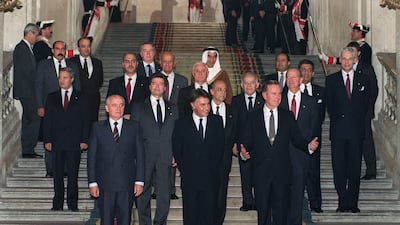
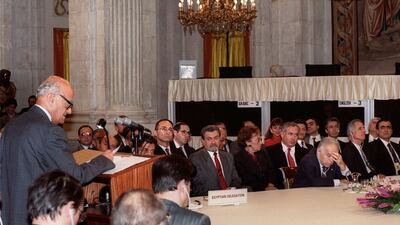
  • Heads of states and heads of delegations at the Middle East Peace Conference in Madrid on October 30, 1991. Pictured front row from left to right: Soviet President Mikhail Gorbachev, Spanish Prime Minister Felipe Gonzalez and US President George Bush. Second row from left to right: Syrian Foreign Minister Faruq Al Sharra, Lebanese Foreign Minister Faris Bouez, his Soviet counterpart Boris Dmitriyevich Pankin, Israeli Premier Itzhak Shamir, US State Secretary James Baker and his Egyptian counterpart Amr Moussa. AFP
    Heads of states and heads of delegations at the Middle East Peace Conference in Madrid on October 30, 1991. Pictured front row from left to right: Soviet President Mikhail Gorbachev, Spanish Prime Minister Felipe Gonzalez and US President George Bush. Second row from left to right: Syrian Foreign Minister Faruq Al Sharra, Lebanese Foreign Minister Faris Bouez, his Soviet counterpart Boris Dmitriyevich Pankin, Israeli Premier Itzhak Shamir, US State Secretary James Baker and his Egyptian counterpart Amr Moussa. AFP
  • Gorbachev delivers a speech. EPA
    Gorbachev delivers a speech. EPA
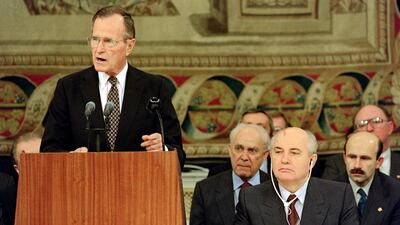
  • Bush addresses delegations as Gorbachev listens. AFP
    Bush addresses delegations as Gorbachev listens. AFP
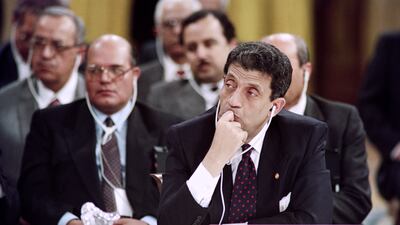
  • Former Egyptian Minister of Foreign Affairs Amr Moussa. AFP
    Former Egyptian Minister of Foreign Affairs Amr Moussa. AFP
  • Former Spanish president Felipe Gonzalez delivers the inaugural speech. AFP
    Former Spanish president Felipe Gonzalez delivers the inaugural speech. AFP
  • Head of medical services in the Gaza Strip from 1957 to 1960, Dr Haidar Abdel Shafi, addresses delegates. AFP
    Head of medical services in the Gaza Strip from 1957 to 1960, Dr Haidar Abdel Shafi, addresses delegates. AFP
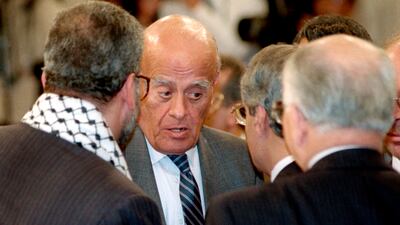
  • Former Palestinian negotiator Haidar Abdel Shafi. EPA
    Former Palestinian negotiator Haidar Abdel Shafi. EPA
  • Former Syrian Foreign Minister Faruq Al Shara. AFP
    Former Syrian Foreign Minister Faruq Al Shara. AFP
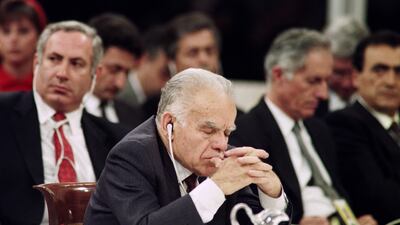
  • Former Israeli Prime Minister Yitzhak Shamir. AFP
    Former Israeli Prime Minister Yitzhak Shamir. AFP
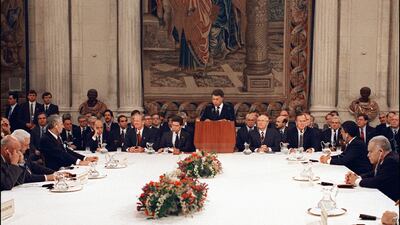
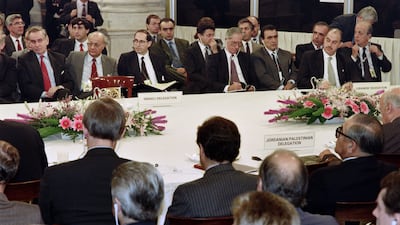
  • The Jordanian-Palestinian delegation (seen from back) faces the Israeli delegation. AFP
    The Jordanian-Palestinian delegation (seen from back) faces the Israeli delegation. AFP

Violence must stop

While the Boycott, Divestment, Sanctions (BDS) movement needs to be strengthened, as part of pressure on Israel to halt its use of violence, the Palestinian armed struggle would also need to stop to attract Israelis to the alliance, Dr Hamarneh said. After he advised King Hussein on the strategy for Madrid, Dr Hamarneh became head of the Centre of Strategic Studies at the University of Jordan, a position he held for 15 years.

After Mr Netanyahu formed his first government in the second half of the 1990s, most members of “the pro-peace camp in Jordan literally went underground", Dr Hamarneh said. "They could not defend their position vis-a-vis the Arab-Israeli conflict within the policies implemented by Netanyahu", who accelerated settlement expansion and land seizures.

Mr Netanyahu's ascendancy as the dominant political figure in Israel has tarnished the reputation of Israel as a whole, although the country is not monolithic, he said.

"If anybody today in Amman or Cairo invites Illan Pappe or Gideon Levy or Amira Hass, we'll be subjected to tremendous pressure and accusations of being zionists or imperialist lackeys," he said, referring to Mr Pappe, an Israeli historian whose 2006 book The Ethnic Cleansing of the Palestinians was translated to Arabic, and journalists Mr Levy and Ms Hass, who reported extensively on Palestinian plight.

“On the other hand, the Zionists used the bombings [by Hamas and other militant groups] as a further testament that the Arabs and the Palestinians don't want peace, but annihilation, which was not the case,” Dr Hamarneh said, cautioning that members of the traditional Left in Israel had also become wary of peace after the October 7 attack by Hamas on Israel, which killed 1,200 civilians.

The death toll from the Israeli invasion of Gaza stands at 42,000, according to health officials in the Hamas-ruled territory.

Dr Hamarneh, who has degrees in economics and history, and has taught in Washington, spoke in a straightforward voice. Opinion polls and data collection he conducted over 15 years at the Centre of Strategic Studies have become a rare independent barometer of conditions in the country.

In 2000, permanent status talks stipulated by the Oslo deal failed, following an impasse after deadlock between Yasser Arafat and Ehud Barack, then the Israeli prime minister. The second Palestinian uprising erupted in the same year and no progress has been made since.

“We need to move forward now, and all those people who share the same values of living in peace together need to form alliances to implement this vision,” Dr Hamarneh said. "Ultimately we will definitely be on the right side of history. Our message is a human, nonviolent and not rooted in any bigoted ideologies."

Real estate tokenisation project

Dubai launched the pilot phase of its real estate tokenisation project last month.

The initiative focuses on converting real estate assets into digital tokens recorded on blockchain technology and helps in streamlining the process of buying, selling and investing, the Dubai Land Department said.

Dubai’s real estate tokenisation market is projected to reach Dh60 billion ($16.33 billion) by 2033, representing 7 per cent of the emirate’s total property transactions, according to the DLD.

Mercer, the investment consulting arm of US services company Marsh & McLennan, expects its wealth division to at least double its assets under management (AUM) in the Middle East as wealth in the region continues to grow despite economic headwinds, a company official said.

Mercer Wealth, which globally has $160 billion in AUM, plans to boost its AUM in the region to $2-$3bn in the next 2-3 years from the present $1bn, said Yasir AbuShaban, a Dubai-based principal with Mercer Wealth.

Within the next two to three years, we are looking at reaching $2 to $3 billion as a conservative estimate and we do see an opportunity to do so,” said Mr AbuShaban.

Mercer does not directly make investments, but allocates clients’ money they have discretion to, to professional asset managers. They also provide advice to clients.

“We have buying power. We can negotiate on their (client’s) behalf with asset managers to provide them lower fees than they otherwise would have to get on their own,” he added.

Mercer Wealth’s clients include sovereign wealth funds, family offices, and insurance companies among others.

From its office in Dubai, Mercer also looks after Africa, India and Turkey, where they also see opportunity for growth.

Wealth creation in Middle East and Africa (MEA) grew 8.5 per cent to $8.1 trillion last year from $7.5tn in 2015, higher than last year’s global average of 6 per cent and the second-highest growth in a region after Asia-Pacific which grew 9.9 per cent, according to consultancy Boston Consulting Group (BCG). In the region, where wealth grew just 1.9 per cent in 2015 compared with 2014, a pickup in oil prices has helped in wealth generation.

BCG is forecasting MEA wealth will rise to $12tn by 2021, growing at an annual average of 8 per cent.

Drivers of wealth generation in the region will be split evenly between new wealth creation and growth of performance of existing assets, according to BCG.

Another general trend in the region is clients’ looking for a comprehensive approach to investing, according to Mr AbuShaban.

“Institutional investors or some of the families are seeing a slowdown in the available capital they have to invest and in that sense they are looking at optimizing the way they manage their portfolios and making sure they are not investing haphazardly and different parts of their investment are working together,” said Mr AbuShaban.

Some clients also have a higher appetite for risk, given the low interest-rate environment that does not provide enough yield for some institutional investors. These clients are keen to invest in illiquid assets, such as private equity and infrastructure.

“What we have seen is a desire for higher returns in what has been a low-return environment specifically in various fixed income or bonds,” he said.

“In this environment, we have seen a de facto increase in the risk that clients are taking in things like illiquid investments, private equity investments, infrastructure and private debt, those kind of investments were higher illiquidity results in incrementally higher returns.”

The Abu Dhabi Investment Authority, one of the largest sovereign wealth funds, said in its 2016 report that has gradually increased its exposure in direct private equity and private credit transactions, mainly in Asian markets and especially in China and India. The authority’s private equity department focused on structured equities owing to “their defensive characteristics.”

Key facilities
  • Olympic-size swimming pool with a split bulkhead for multi-use configurations, including water polo and 50m/25m training lanes
  • Premier League-standard football pitch
  • 400m Olympic running track
  • NBA-spec basketball court with auditorium
  • 600-seat auditorium
  • Spaces for historical and cultural exploration
  • An elevated football field that doubles as a helipad
  • Specialist robotics and science laboratories
  • AR and VR-enabled learning centres
  • Disruption Lab and Research Centre for developing entrepreneurial skills
UAE currency: the story behind the money in your pockets
How to watch Ireland v Pakistan in UAE

When: The one-off Test starts on Friday, May 11
What time: Each day’s play is scheduled to start at 2pm UAE time.
TV: The match will be broadcast on OSN Sports Cricket HD. Subscribers to the channel can also stream the action live on OSN Play.

Last five meetings

2013: South Korea 0-2 Brazil

2002: South Korea 2-3 Brazil

1999: South Korea 1-0 Brazil

1997: South Korea 1-2 Brazil

1995: South Korea 0-1 Brazil

Note: All friendlies

COMPANY PROFILE
Name: HyperSpace
 
Started: 2020
 
Founders: Alexander Heller, Rama Allen and Desi Gonzalez
 
Based: Dubai, UAE
 
Sector: Entertainment 
 
Number of staff: 210 
 
Investment raised: $75 million from investors including Galaxy Interactive, Riyadh Season, Sega Ventures and Apis Venture Partners
ALRAWABI%20SCHOOL%20FOR%20GIRLS
%3Cp%3ECreator%3A%20Tima%20Shomali%3C%2Fp%3E%0A%3Cp%3EStarring%3A%C2%A0Tara%20Abboud%2C%C2%A0Kira%20Yaghnam%2C%20Tara%20Atalla%3C%2Fp%3E%0A%3Cp%3ERating%3A%204%2F5%3C%2Fp%3E%0A
The biog

Profession: Senior sports presenter and producer

Marital status: Single

Favourite book: Al Nabi by Jibran Khalil Jibran

Favourite food: Italian and Lebanese food

Favourite football player: Cristiano Ronaldo

Languages: Arabic, French, English, Portuguese and some Spanish

Website: www.liliane-tannoury.com

UAE currency: the story behind the money in your pockets
Updated: October 14, 2024, 11:18 AM