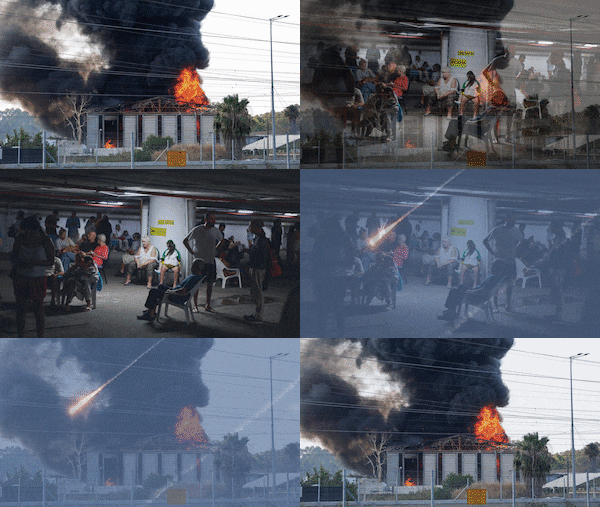
One in 10 Iranian missiles are cutting through Israeli air defences with a pan-Middle East exchange of attacks now becoming a battle of resources, experts have told The National.
Iran is thought to be deploying its hypersonic Fatah-1 missiles, capable of flying at up to 18,600kph while manoeuvring in flight, making them difficult to intercept.
A battle of numbers is also developing, with the amount of relevant missiles Iran has, estimated at about 2,000, compared to the stockpile of Israel’s interceptors that has rapidly been used up in four days of bombardment.
Crucial to the outcome of this long-range war will be which side has the most missiles. If Israel’s world-leading Iron Dome, Arrow and the David’s Sling layered system runs out of interceptors, then its cities and industrial centres will be vulnerable to Iran’s missile fleet.
But if Israel manages to fend off the offensive – it is estimated Tehran has used 280 of its total stockpile – there will be no deterrent from further attacks.
Israel on Monday claimed it had destroyed a third of all Iranian missile launchers and now “controls the skies over Tehran”, although experts say its own missile interceptor stocks are “running low”.
Bleed through
Key to Iran’s successes in penetrating defences has been the Fatah-1 missile that entered service only two years ago. The medium-range missile travels on a fixed trajectory until a few hundred kilometres from its target when its movable nozzle is initiated, increasing speed threefold to up to Mach 15, allowing it to change course frequently.
That tactic is designed to throw off the calculations of Israel’s long-range radars that can track the threats, predicting impact points.
The ability to intercept a fast-moving missile high in the atmosphere is “phenomenally complex”, said Nick Brown, director of equipment intelligence at Janes, the defence intelligence company. These missiles operate in what is called exo-atmospheric flight, or outside Earth's atmosphere.
“The pure physics of making an exo-atmospheric or very high-speed interception within the atmosphere – basically making sure your interceptor is going to be in the right place at the right time – is phenomenally complex,” Mr Brown told The National.
The defenders could likely to fire two or three interceptors for every incoming missile, for which, with each Arrow-3 costing $3 million, there is a finite amount.
While Israel has good protection around its major cities, as well as military sites and key national infrastructure, it cannot protect the entire country, hence why some towns have been hit.
And even with the missile defence, Tel Aviv and the northern industrial city of Haifa have been struck. “If Iran can get enough missiles in the air simultaneously, some of them will likely bleed through,” Mr Brown said.
Reduced stocks
To win the missile war and reduce the negative political impact of a high civilian death toll, Israel will be heavily reliant on its sophisticated layered defensive system.
The key defence against high-speed missiles are the Arrow-2 and Arrow-3 interceptors – the latter is an exo-atmospheric system – that can take out threats along the arc of a ballistic trajectory.
Dr Sidharth Kaushal, an expert on missile technology at the Rusi think tank, said Israel has achieved a “high success rate of around 90 per cent” and the number of missiles “leaking through the Israeli defensive system is not especially high”.
“No system provides preclusive defence and if a system is saturated with enough missiles, some will get through."
But he warned the interceptors themselves, especially the Arrow-2 local coverage weapons, had unknown stockpiles and “the fact that the US has deployed a destroyer to abet the defence and is apparently considering further deployments would suggest that there is a meaningful risk of Israeli interceptor stockpiles running low”.
Poor accuracy
Most of Iran’s arsenal is based on the Shahab-3, a ballistic missile that once fired follows the same trajectory making it easier to shoot down.
But if the Shahab pierces defences – its accuracy is also quite poor – it carries a devastating 1,200kg warhead that will impact at about 8,600kmh.
Another more effective ballistic missile introduced in 2020 is the Haj Qasem, named after assassinated former Islamic Revolutionary Guard Corps commander Qassem Suleimani, that Iran claims can penetrate advanced air defences and strike targets with precision. It travels at Mach 12 (14,800kph), with a 500kg warhead.
Endurance test
But the Israel air force is pounding Iran’s supplies, especially as it appears to have achieved air superiority over the country, with many missiles and their launchers now being pre-emptively struck. “As such, the outcome of the test of endurance between the two sides is not yet certain,” Dr Kaushal said.
However, without those air strikes it might be possible for Iran to overwhelm the enemy air defence systems, either “by the sheer number of attacks, or by attacking from different directions”, said Dr Marion Messmer, an expert on arms control at Chatham House think tank.
“That’s why we've seen differing success rates in terms of the interception, especially with the hypersonic glide vehicles, when they remain manoeuvrable in flight. But the fact is that Israel has managed to intercept a huge amount of these various attacks.”
The five pillars of Islam
1. Fasting
2. Prayer
3. Hajj
4. Shahada
5. Zakat
Recent winners
2002 Giselle Khoury (Colombia)
2004 Nathalie Nasralla (France)
2005 Catherine Abboud (Oceania)
2007 Grace Bijjani (Mexico)
2008 Carina El-Keddissi (Brazil)
2009 Sara Mansour (Brazil)
2010 Daniella Rahme (Australia)
2011 Maria Farah (Canada)
2012 Cynthia Moukarzel (Kuwait)
2013 Layla Yarak (Australia)
2014 Lia Saad (UAE)
2015 Cynthia Farah (Australia)
2016 Yosmely Massaad (Venezuela)
2017 Dima Safi (Ivory Coast)
2018 Rachel Younan (Australia)
A%20QUIET%20PLACE
%3Cp%3E%3Cstrong%3EStarring%3A%3C%2Fstrong%3E%20Lupita%20Nyong'o%2C%20Joseph%20Quinn%2C%20Djimon%20Hounsou%3C%2Fp%3E%0A%3Cp%3E%3Cstrong%3EDirector%3A%20%3C%2Fstrong%3EMichael%20Sarnoski%3C%2Fp%3E%0A%3Cp%3E%3Cstrong%3ERating%3A%3C%2Fstrong%3E%204%2F5%3C%2Fp%3E%0A
Results
%3Cp%3E%0D%3Cstrong%3EElite%20men%3C%2Fstrong%3E%0D%3Cbr%3E1.%20Amare%20Hailemichael%20Samson%20(ERI)%202%3A07%3A10%0D%3Cbr%3E2.%20Leornard%20Barsoton%20(KEN)%202%3A09%3A37%0D%3Cbr%3E3.%20Ilham%20Ozbilan%20(TUR)%202%3A10%3A16%0D%3Cbr%3E4.%20Gideon%20Chepkonga%20(KEN)%202%3A11%3A17%0D%3Cbr%3E5.%20Isaac%20Timoi%20(KEN)%202%3A11%3A34%0D%3Cbr%3E%3Cstrong%3EElite%20women%3C%2Fstrong%3E%0D%3Cbr%3E1.%20Brigid%20Kosgei%20(KEN)%202%3A19%3A15%0D%3Cbr%3E2.%20Hawi%20Feysa%20Gejia%20(ETH)%202%3A24%3A03%0D%3Cbr%3E3.%20Sintayehu%20Dessi%20(ETH)%202%3A25%3A36%0D%3Cbr%3E4.%20Aurelia%20Kiptui%20(KEN)%202%3A28%3A59%0D%3Cbr%3E5.%20Emily%20Kipchumba%20(KEN)%202%3A29%3A52%3C%2Fp%3E%0A
Know your Camel lingo
The bairaq is a competition for the best herd of 50 camels, named for the banner its winner takes home
Namoos - a word of congratulations reserved for falconry competitions, camel races and camel pageants. It best translates as 'the pride of victory' - and for competitors, it is priceless
Asayel camels - sleek, short-haired hound-like racers
Majahim - chocolate-brown camels that can grow to weigh two tonnes. They were only valued for milk until camel pageantry took off in the 1990s
Millions Street - the thoroughfare where camels are led and where white 4x4s throng throughout the festival
LAST 16 DRAW
Borussia Dortmund v PSG
Real Madrid v Manchester City
Atalanta v Valencia
Atletico Madrid v Liverpool
Chelsea v Bayern Munich
Lyon v Juventus
Tottenham v Leipzig
Napoli v Barcelona
ONCE UPON A TIME IN GAZA
Starring: Nader Abd Alhay, Majd Eid, Ramzi Maqdisi
Directors: Tarzan and Arab Nasser
Rating: 4.5/5
Recycle Reuse Repurpose
New central waste facility on site at expo Dubai South area to handle estimated 173 tonne of waste generated daily by millions of visitors
Recyclables such as plastic, paper, glass will be collected from bins on the expo site and taken to the new expo Central Waste Facility on site
Organic waste will be processed at the new onsite Central Waste Facility, treated and converted into compost to be re-used to green the expo area
Of 173 tonnes of waste daily, an estimated 39 per cent will be recyclables, 48 per cent organic waste and 13 per cent general waste.
About 147 tonnes will be recycled and converted to new products at another existing facility in Ras Al Khor
Recycling at Ras Al Khor unit:
Plastic items to be converted to plastic bags and recycled
Paper pulp moulded products such as cup carriers, egg trays, seed pots, and food packaging trays
Glass waste into bowls, lights, candle holders, serving trays and coasters
Aim is for 85 per cent of waste from the site to be diverted from landfill
Results
5.30pm: Maiden (TB) Dh82,500 (Turf) 1,400m; Winner: Mcmanaman, Sam Hitchcock (jockey), Doug Watson (trainer)
6.05pm: Handicap (TB) Dh87,500 (T) 1,400m; Winner: Bawaasil, Sam Hitchcott, Doug Watson
6.40pm: Handicap (TB) Dh105,000 (Dirt) 1,400m; Winner: Bochart, Fabrice Veron, Satish Seemar
7.15pm: Handicap (TB) Dh105,000 (T) 1,200m; Winner: Mutaraffa, Antonio Fresu, Musabah Al Muhairi
7.50pm: Longines Stakes – Conditions (TB) Dh120,00 (D) 1,900m; Winner: Rare Ninja, Royston Ffrench, Salem bin Ghadayer
8.25pm: Zabeel Trophy – Rated Conditions (TB) Dh120,000 (T) 1,600m; Winner: Alfareeq, Antonio Fresu, Musabah Al Muhairi
9pm: Handicap (TB) Dh105,000 (T) 2,410m; Winner: Good Tidings, Antonio Fresu, Musabah Al Muhairi
9.35pm: Handicap (TB) Dh92,500 (T) 2,000m; Winner: Zorion, Abdul Aziz Al Balushi, Helal Al Alawi
Teri%20Baaton%20Mein%20Aisa%20Uljha%20Jiya
%3Cp%3E%3Cstrong%3EDirectors%3A%3C%2Fstrong%3E%20Amit%20Joshi%20and%20Aradhana%20Sah%3C%2Fp%3E%0A%3Cp%3E%3Cstrong%3ECast%3A%3C%2Fstrong%3E%20Shahid%20Kapoor%2C%20Kriti%20Sanon%2C%20Dharmendra%2C%20Dimple%20Kapadia%2C%20Rakesh%20Bedi%3C%2Fp%3E%0A%3Cp%3E%3Cstrong%3ERating%3A%3C%2Fstrong%3E%204%2F5%3C%2Fp%3E%0A
More from Rashmee Roshan Lall
Defined benefit and defined contribution schemes explained
Defined Benefit Plan (DB)
A defined benefit plan is where the benefit is defined by a formula, typically length of service to and salary at date of leaving.
Defined Contribution Plan (DC)
A defined contribution plan is where the benefit depends on the amount of money put into the plan for an employee, and how much investment return is earned on those contributions.
List of UAE medal winners
Gold
Faisal Al Ketbi (Open weight and 94kg)
Talib Al Kirbi (69kg)
Omar Al Fadhli (56kg)
Silver
Zayed Al Kaabi (94kg)
Khalfan Belhol (85kg)
Zayed Al Mansoori (62kg)
Mouza Al Shamsi (49kg women)
Bronze
Yahia Mansour Al Hammadi (Open and 94kg)
Saood Al Hammadi (77kg)
Said Al Mazroui (62kg)
Obaid Al Nuaimi (56kg)
Bashayer Al Matrooshi (62kg women)
Reem Abdulkareem (45kg women)
Who's who in Yemen conflict
Houthis: Iran-backed rebels who occupy Sanaa and run unrecognised government
Yemeni government: Exiled government in Aden led by eight-member Presidential Leadership Council
Southern Transitional Council: Faction in Yemeni government that seeks autonomy for the south
Habrish 'rebels': Tribal-backed forces feuding with STC over control of oil in government territory