Mohammad Awana spoke quickly and repeated himself often, struggling to describe the scale of the loss he is facing.
“It’s gone, gone, gone, I’m telling you, everything burnt: forests, farmland, olive groves, vegetables. Even the animals weren’t spared,” he said.
The relentless wildfires that have ravaged Syria’s coastal region for the past week have taken a heavy toll on the 68-year-old farmer from Latakia. Syria's worst drought in decades and strong winds have fuelled the flames of the unprecedented blazes.
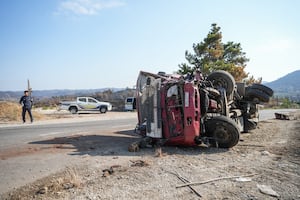
“Everything we’ve built over decades, forests that took hundreds of years to grow, gone,” Mr Awana added, standing at a distribution point where dozens of residents affected by the disaster were queuing for food parcels.
Like him, thousands of people have been left reeling from the fierce blazes in a region that relies heavily on farming for survival.
Mr Awana said he lost 3,000 square metres of land to the fires, “mostly olives and pomegranates, nothing is left”, he said. It will take years for the trees to recover.
Driving deep into northern Latakia governorate feels like reaching the end of the world. The once lush hills of Syria’s coast have been reduced to barren land. Mountains are covered in black dust, stripped of their vibrant green carpet, and crops lie in ashes.
“This is unprecedented in terms of size and intensity,” said Raed Saleh, Syria’s Minister of Disaster Management and Emergency Response, speaking to The National just a few hundred metres from a forest still ablaze. The area was cordoned off by security forces and civil defence teams due to the danger.
The flames have scorched more than 15,000 hectares of agricultural land and forests, Mr Saleh said, the equivalent of 150 square kilometres – an area larger than Paris.
“We’ve never seen anything like this before. Right now, I can’t estimate the cost of the losses,” he added.
Mr Saleh was the head of the White Helmets, the internationally recognised volunteer rescue organisation that operated in opposition-held parts of Syria, before being appointed as a minister in March. Since the fires broke out, he has remained stationed on the ground with civil defence teams.
The interview was repeatedly interrupted by the sound of landmines exploding in the burning brush.
“Do you hear that?” he said. “You have to see for yourself the level of danger our teams are facing. Their safety remains a priority, as well as of civilians.”
Landmines, extreme heat and lack of resources
On top of battling strong winds, rugged terrain and extreme heat, firefighters are dealing with the deadly legacy of war.
More than a decade of conflict has left Syria heavily contaminated with landmines and other explosive remnants, which have killed hundreds since the fall of Bashar Al Assad's regime in December 2024.
A threat to displaced civilians returning to their homes, these munitions are now a danger to firefighters as they detonate under intense heat.
Firefighters told The National that unexploded ordnance was the main obstacle hindering civil defence operations.
Rescue teams are also ill-equipped to deal with a disaster of this scale. The country is struggling after years of crippling western sanctions against the Assad regime, which were lifted only recently as the interim government led by former rebel fighters gained international recognition.
“Generally, the focus of our needs is on logistical support: diesel, firefighting hoses, spare parts, and bulldozers and heavy engineering equipment,” Mr Saleh said.
Crews from Turkey, Jordan, Lebanon and Iraq have been deployed in Latakia. Syrian authorities on Tuesday appealed to the EU for help. UN teams have been sent to the area to “determine the scale of the disaster”.
The challenges appear not to have affected the morale of the firefighters, who have been working relentlessly for days. Dozens of lorries were seen moving through the affected areas, amid shouts of civil defence teams wrapped in the heavy white smoke from the blazes they are battling.
'It was terrifying'
Mr Saleh said their efforts had stopped the blazes from reaching villages. “So far, there has been no threat to any residential areas,” he said.
Hussein Sbeih, 28, is among the residents who had to leave their village in a hurry. “It started as a small fire, which had ignited the day before. At the time it seemed under control, but suddenly, the entire area was on fire,” he said.
Mazraa Beit Sabeh, his village, was heavily affected, but the flames stopped short of reaching the houses. Most of the village fled on foot, although some residents stayed behind to help civil defence teams, he said.
“I was scared. It was terrifying. The most important thing was to get out safely,” Mr Sbeih said.
The blazes caused some injuries, but the land paid a heavy price.
Mr Sbeih estimated that the village lost about half its agricultural land. Most of the village's olive trees were reduced to ashes. The few that survived have turned yellow from the heat, their branches fading to the colour of straw. Some of them, he said, were 50 years old.

White hydrogen: Naturally occurring hydrogen
Chromite: Hard, metallic mineral containing iron oxide and chromium oxide
Ultramafic rocks: Dark-coloured rocks rich in magnesium or iron with very low silica content
Ophiolite: A section of the earth’s crust, which is oceanic in nature that has since been uplifted and exposed on land
Olivine: A commonly occurring magnesium iron silicate mineral that derives its name for its olive-green yellow-green colour
UAE currency: the story behind the money in your pockets
NATIONAL%20SELECTIONS
%3Cp%3E6.00pm%3A%20Heros%20de%20Lagarde%3Cbr%3E6.35pm%3A%20City%20Walk%3Cbr%3E7.10pm%3A%20Mimi%20Kakushi%3Cbr%3E7.45pm%3A%20New%20Kingdom%3Cbr%3E8.20pm%3A%20Siskany%3Cbr%3E8.55pm%3A%20Nations%20Pride%3Cbr%3E9.30pm%3A%20Ever%20Given%3C%2Fp%3E%0A
On the menu
First course
▶ Emirati sea bass tartare Yuzu and labneh mayo, avocado, green herbs, fermented tomato water
▶ The Tale of the Oyster Oyster tartare, Bahraini gum berry pickle
Second course
▶ Local mackerel Sourdough crouton, baharat oil, red radish, zaatar mayo
▶ One Flew Over the Cuckoo’s Nest Quail, smoked freekeh, cinnamon cocoa
Third course
▶ Bahraini bouillabaisse Venus clams, local prawns, fishfarm seabream, farro
▶ Lamb 2 ways Braised lamb, crispy lamb chop, bulgur, physalis
Dessert
▶ Lumi Black lemon ice cream, pistachio, pomegranate
▶ Black chocolate bar Dark chocolate, dates, caramel, camel milk ice cream
Tips to avoid getting scammed
1) Beware of cheques presented late on Thursday
2) Visit an RTA centre to change registration only after receiving payment
3) Be aware of people asking to test drive the car alone
4) Try not to close the sale at night
5) Don't be rushed into a sale
6) Call 901 if you see any suspicious behaviour
Duminy's Test career in numbers
Tests 46; Runs 2,103; Best 166; Average 32.85; 100s 6; 50s 8; Wickets 42; Best 4-47
How has net migration to UK changed?
The figure was broadly flat immediately before the Covid-19 pandemic, standing at 216,000 in the year to June 2018 and 224,000 in the year to June 2019.
It then dropped to an estimated 111,000 in the year to June 2020 when restrictions introduced during the pandemic limited travel and movement.
The total rose to 254,000 in the year to June 2021, followed by steep jumps to 634,000 in the year to June 2022 and 906,000 in the year to June 2023.
The latest available figure of 728,000 for the 12 months to June 2024 suggests levels are starting to decrease.
RESULTS
1.30pm Handicap (PA) Dh 50,000 (Dirt) 1,400m
Winner AF Almomayaz, Hugo Lebouc (jockey), Ali Rashid Al Raihe (trainer)
2pm Handicap (TB) Dh 84,000 (D) 1,400m
Winner Karaginsky, Tadhg O’Shea, Satish Seemar.
2.30pm Maiden (TB) Dh 60,000 (D) 1,200m
Winner Sadeedd, Ryan Curatolo, Nicholas Bachalard.
3pm Conditions (TB) Dh 100,000 (D) 1,950m
Winner Blue Sovereign, Clement Lecoeuvre, Erwan Charpy.
3.30pm Handicap (TB) Dh 76,000 (D) 1,800m
Winner Tailor’s Row, Royston Ffrench, Salem bin Ghadayer.
4pm Maiden (TB) Dh 60,000 (D) 1,600m
Winner Bladesmith, Tadhg O’Shea, Satish Seemar.
4.30pm Handicap (TB) Dh 68,000 (D) 1,000m
Winner Shanaghai City, Fabrice Veron, Rashed Bouresly.
More from Rashmee Roshan Lall
The President's Cake
Director: Hasan Hadi
Starring: Baneen Ahmad Nayyef, Waheed Thabet Khreibat, Sajad Mohamad Qasem
Rating: 4/5
The specs
- Engine: 3.9-litre twin-turbo V8
- Power: 640hp
- Torque: 760nm
- On sale: 2026
- Price: Not announced yet
UK’s AI plan
- AI ambassadors such as MIT economist Simon Johnson, Monzo cofounder Tom Blomfield and Google DeepMind’s Raia Hadsell
- £10bn AI growth zone in South Wales to create 5,000 jobs
- £100m of government support for startups building AI hardware products
- £250m to train new AI models
Quarter-finals
Saturday (all times UAE)
England v Australia, 11.15am
New Zealand v Ireland, 2.15pm
Sunday
Wales v France, 11.15am
Japan v South Africa, 2.15pm
Mercer, the investment consulting arm of US services company Marsh & McLennan, expects its wealth division to at least double its assets under management (AUM) in the Middle East as wealth in the region continues to grow despite economic headwinds, a company official said.
Mercer Wealth, which globally has $160 billion in AUM, plans to boost its AUM in the region to $2-$3bn in the next 2-3 years from the present $1bn, said Yasir AbuShaban, a Dubai-based principal with Mercer Wealth.
“Within the next two to three years, we are looking at reaching $2 to $3 billion as a conservative estimate and we do see an opportunity to do so,” said Mr AbuShaban.
Mercer does not directly make investments, but allocates clients’ money they have discretion to, to professional asset managers. They also provide advice to clients.
“We have buying power. We can negotiate on their (client’s) behalf with asset managers to provide them lower fees than they otherwise would have to get on their own,” he added.
Mercer Wealth’s clients include sovereign wealth funds, family offices, and insurance companies among others.
From its office in Dubai, Mercer also looks after Africa, India and Turkey, where they also see opportunity for growth.
Wealth creation in Middle East and Africa (MEA) grew 8.5 per cent to $8.1 trillion last year from $7.5tn in 2015, higher than last year’s global average of 6 per cent and the second-highest growth in a region after Asia-Pacific which grew 9.9 per cent, according to consultancy Boston Consulting Group (BCG). In the region, where wealth grew just 1.9 per cent in 2015 compared with 2014, a pickup in oil prices has helped in wealth generation.
BCG is forecasting MEA wealth will rise to $12tn by 2021, growing at an annual average of 8 per cent.
Drivers of wealth generation in the region will be split evenly between new wealth creation and growth of performance of existing assets, according to BCG.
Another general trend in the region is clients’ looking for a comprehensive approach to investing, according to Mr AbuShaban.
“Institutional investors or some of the families are seeing a slowdown in the available capital they have to invest and in that sense they are looking at optimizing the way they manage their portfolios and making sure they are not investing haphazardly and different parts of their investment are working together,” said Mr AbuShaban.
Some clients also have a higher appetite for risk, given the low interest-rate environment that does not provide enough yield for some institutional investors. These clients are keen to invest in illiquid assets, such as private equity and infrastructure.
“What we have seen is a desire for higher returns in what has been a low-return environment specifically in various fixed income or bonds,” he said.
“In this environment, we have seen a de facto increase in the risk that clients are taking in things like illiquid investments, private equity investments, infrastructure and private debt, those kind of investments were higher illiquidity results in incrementally higher returns.”
The Abu Dhabi Investment Authority, one of the largest sovereign wealth funds, said in its 2016 report that has gradually increased its exposure in direct private equity and private credit transactions, mainly in Asian markets and especially in China and India. The authority’s private equity department focused on structured equities owing to “their defensive characteristics.”
The%20specs
%3Cp%3E%3Cstrong%3EEngine%3A%3C%2Fstrong%3E%201.8-litre%204-cyl%20turbo%0D%3Cbr%3E%3Cstrong%3EPower%3A%20%3C%2Fstrong%3E190hp%20at%205%2C200rpm%0D%3Cbr%3E%3Cstrong%3ETorque%3A%3C%2Fstrong%3E%20320Nm%20from%201%2C800-5%2C000rpm%0D%3Cbr%3E%3Cstrong%3ETransmission%3A%20%3C%2Fstrong%3ESeven-speed%20dual-clutch%20auto%0D%3Cbr%3E%3Cstrong%3EFuel%20consumption%3A%3C%2Fstrong%3E%206.7L%2F100km%0D%3Cbr%3E%3Cstrong%3EPrice%3A%3C%2Fstrong%3E%20From%20Dh111%2C195%0D%3Cbr%3E%3Cstrong%3EOn%20sale%3A%20%3C%2Fstrong%3ENow%3C%2Fp%3E%0A