

The UN's World Food Programme says it is ready to deliver critical aid to more of the millions of civilians trapped by the wars in Sudan and Gaza, if access restrictions in those places are lifted.
In Sudan, where the UN estimates 30 million people – two thirds of the population − will need assistance this year, the WFP and other aid groups face challenges from intense fighting, threats to their workers and bureaucratic obstacles.
Despite this, WFP now manages reach more than five million people monthly in Sudan, nearly four times more than at the beginning of 2024. “That's compared to around one to two million only six months ago, and partly that is, of course, the changes in dynamics on the ground,” WFP deputy executive director Carl Skau told The National.
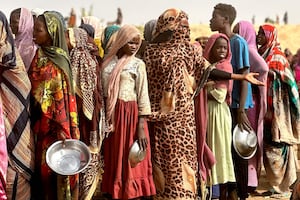
The war in Sudan has created the world's biggest humanitarian crisis, the UN has said. Tens of thousands of civilians have been killed and more than 12 million people forced to flee their homes, including about four million to neighbouring countries, since fighting between the Sudanese army and the paramilitary Rapid Support Forces broke out in April 2023.
On Thursday the deputy prosecutor for the International Criminal Court said investigations found evidence war crimes and crimes against humanity were continuing to take place in Sudan’s vast western Darfur region.
Nazhat Shameem Khan told the UN Security Council that the humanitarian crisis “has reached an intolerable state”, with famine escalating and hospitals, humanitarian convoys and other civilian infrastructure being attacked.
Although attempts to broker a ceasefire or humanitarian pauses have so far failed, Mr Skau said the WFP had been asked “to be ready with the commodities and with the trucks and the logistics, should there be agreement”, amid talks between the warring sides and the UN's Office for the Co-ordination of Humanitarian Affairs.
The UN agency has seen “progress in terms of more access” during the past few months, but the needs remain very high and access to conflict-impacted areas is still restricted, he said.
The WFP and other humanitarian agencies are also awaiting a positive outcome from ongoing negotiations on Gaza, where the 2.3 million population faces severe hunger and lack of basic necessities following widespread displacement and Israel's strict controls on the entry and movement of aid during more than 21 months of its war with Hamas.

People in Gaza “have never been more desperate, certainly on the food-security front” but the WFP is unable to distribute a “variety of commodities that are required to where they are needed, including in the north", said Mr Skau, who visited the Palestinian enclave this week.
“We had serious challenges including in the north, where there were reports of interference, so we have kind of since then been off and on, depending on where we feel we can make a difference,” Mr Skau said. “I don't want by any means to pretend that that this is enough or that it's done in the way that we always do, because it's just not enough.”
He said the WFP has sufficient aid waiting at delivery points outside Gaza to feed its population for two months, but needed to be given “full access” to the enclave.
“We need those routes. We need those entry points, but whether that will happen or not, that I can't say because I'm not privy to these negotiations,” he said, referring to ceasefire talks taking place in Qatar.
More financial support needed
The ability to deliver more aid brings with it the need to ensure sufficient funding, which is a challenge the WFP is facing in Sudan, Mr Skau said.
The UN agency said it has a shortfall in funding of $698 million out of the nearly $800 million it asked for from donors to help seven million people from May through to September of this year.
“There is one thing to run an operation serving one to two million people. It's completely different to do it for five million, and we would be ready and want to aim for even more,” he said.
The agency has had some “progress in terms of more access” during the past few months. However, the needs still remain very high and access to conflict-impacted areas is still restricted.
“More money is needed and focus needs to be on trying to address some of these pockets where there has not been access for quite some time and where we need a political agreement also to be able to cross the [combat] lines,” Mr Skau said.
In Gaza, the WFP is looking to shore up funding through private donors, he said. “We are now running into an issue of funding, no doubt, and we look to a broad set of donors to step forward to try to help alleviate what is just a terrible humanitarian situation.”

