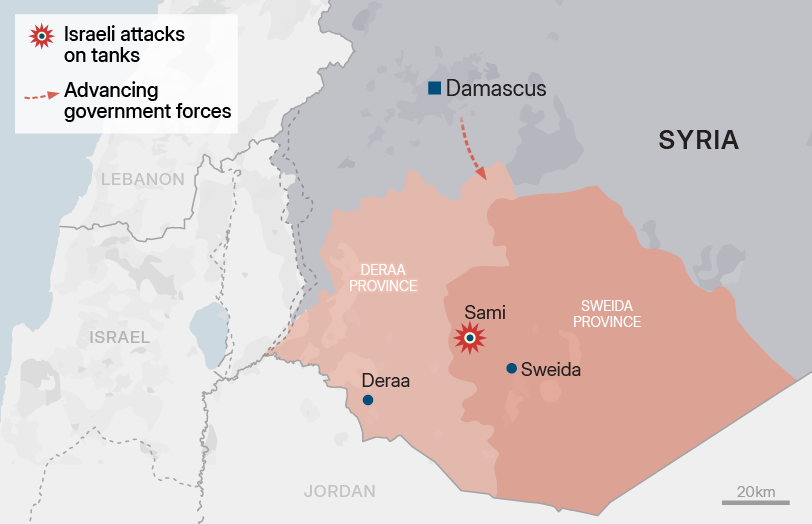
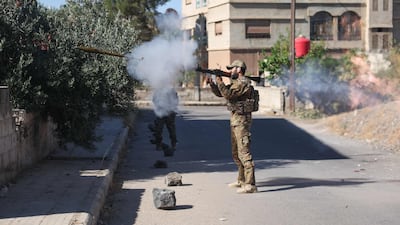
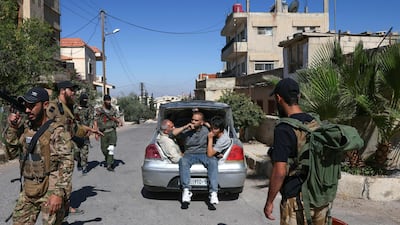
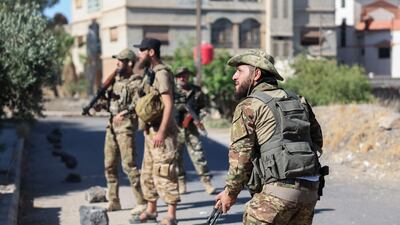
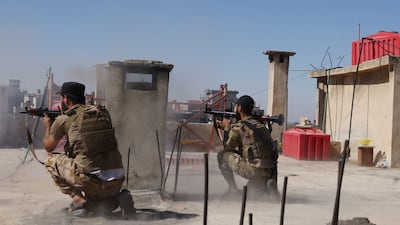
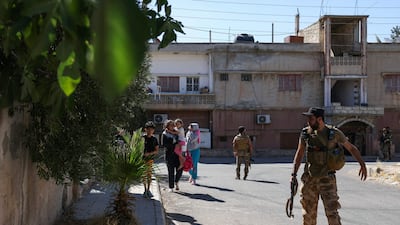
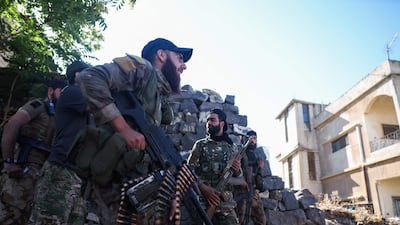
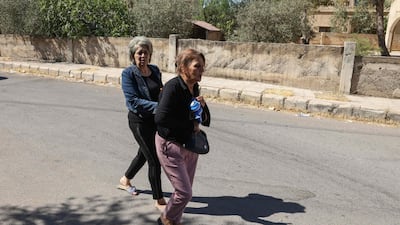
The once invincible Sweida in southern Syria – the centre of an uprising against French colonial rule a century ago – was counting its dead this week, after days of fighting.
A fragile ceasefire appeared to be holding yesterday, the second day without clashes in the city in the past week.
On Monday, Health Ministry teams were counting the dead and taking bodies to hospitals, where mortuaries were already full after the violence.
Dr Khaldoun, a Druze surgeon at the Sweida National Hospital, told The National that Syrian military and Interior Ministry forces who arrived in the city last week “supposedly to stop clashes and spread security, turned out to be monsters”.
More than 1,120 people were killed in the fighting, according to the UK-based Syrian Observatory for Human Rights. It said this included almost 300 civilians, many who had been summarily executed.
US diplomatic pressure on Syrian authorities helped bring a halt to the violence on Sunday. Israel said it launched air strikes on Damascus last week in defence of the Druze.
But the area, the heartland of the Druze minority – a sect dating back 1,000 years – remains under siege by the authorities.
Damascus said Druze militias killed hundreds of Sunnis in Sweida during the clashes, which were sparked by abductions in the city. Druze militias and Bedouin fighters were involved in the violence, before Syrian security troops arrived in the area.
Local officials said women were among those killed by snipers and other gunmen during assaults.
Dr Khaldoun said “medical teams were shot dead while trying to save people”.
He said the number of people who died receiving treatment at the hospital, as well as the number of bodies brought there, had reached 500.
Jiryes Al Ishaq, a Christian who lived on a farmland on the western outskirts of Sweida, said he fled the clashes and took shelter in the Greek Orthodox parish in the centre of the city.
“Pillage has been widespread but I don’t know what happened to my land,” he said.
“We are provided for at the parish, because the authorities have vowed not to harm [the compound], but the rest of the city is devastated.”
He referred to unconfirmed reports that government-allied militants had killed a Christian family of a dozen members in Sweida. The Syrian government has said that such killings would result in prosecutions.
Fighting in Sweida – in pictures
Sweida is home to 270,000 Druze, who comprise most members of the sect left in Syria after waves of emigration. There are an estimated one million Druze worldwide, mainly in Syria, Lebanon and Israel, plus the diaspora.
From 1925 to 1927, the Druze, led by Sultan Basha Al Atrash, mounted an uprising against French rule. That failed but it was instrumental in projecting the image of the Druze as being Syrians first in a predominantly Sunni country.
Sultan Al Atrash became a figure in the narrative of Arab nationalists across the Middle East. Bedouin tribes joined him in the uprising. Sunni merchants in Damascus financed the Druze armed struggle against the French, as thousands of Druze fighters were killed by superior firepower.
Sultan Al Atrash died in 1982. However, one of his daughters, Muntaha, led peaceful resistance in Sweida when the March protest movement broke out in Syria in 2011.
In the last 15 months of former president Bashar Al Assad’s rule – before he was ousted last December – Sweida renewed the civil disobedience movement, demanding the removal of
the regime. Among its leaders was Hikmat Al Hijri, the most senior of a triumvirate comprising the Druze spiritual leadership.
Suhail Thebian, a prominent Druze civil figure, had opposed the increased arming of the Druze under Mr Al Hijri, after the Assad regime fell.
But he said the community has had no option but to resist government forces, although the cost has been high.
“Sweida has become a disaster zone,” Mr Thebian said. “There is nothing more I can tell you. I have survived, for now”.
Mr Al Hijri had resisted attempts by the new Syrian government to control Sweida, saying new security forces should be drawn from residents of the province. He described the government as extremists and undemocratic.
So, when clashes began in Sweida last week between Druze and Bedouin fighters, Mr Al Hijri refused to have government forces in the city.
This set the scene for operation in which the government recruited Sunni auxiliaries from Sweida and elsewhere.
Even Druze who have been critical of Mr Al Hijri’s handling of the crisis said the violence in the city has raised concerns about the authorities.
“They have cut the internet to make it difficult to know and document the size of the atrocities they committed,” said Nawaf, another Druze doctor.
The city and nearby villages “have been devastated”, an engineer in Sweida said. “We can’t even reach them,” he added.
“Bodies are still lying in open fields. There are no vehicles, no gasoline. I went to the hospital, but it can’t receive anyone as it is now out of service.”
Key facilities
- Olympic-size swimming pool with a split bulkhead for multi-use configurations, including water polo and 50m/25m training lanes
- Premier League-standard football pitch
- 400m Olympic running track
- NBA-spec basketball court with auditorium
- 600-seat auditorium
- Spaces for historical and cultural exploration
- An elevated football field that doubles as a helipad
- Specialist robotics and science laboratories
- AR and VR-enabled learning centres
- Disruption Lab and Research Centre for developing entrepreneurial skills
About Karol Nawrocki
• Supports military aid for Ukraine, unlike other eurosceptic leaders, but he will oppose its membership in western alliances.
• A nationalist, his campaign slogan was Poland First. "Let's help others, but let's take care of our own citizens first," he said on social media in April.
• Cultivates tough-guy image, posting videos of himself at shooting ranges and in boxing rings.
• Met Donald Trump at the White House and received his backing.
COMPANY PROFILE
Name: HyperSpace
Started: 2020
Founders: Alexander Heller, Rama Allen and Desi Gonzalez
Based: Dubai, UAE
Sector: Entertainment
Number of staff: 210
Investment raised: $75 million from investors including Galaxy Interactive, Riyadh Season, Sega Ventures and Apis Venture Partners
What is Bitcoin?
Bitcoin is the most popular virtual currency in the world. It was created in 2009 as a new way of paying for things that would not be subject to central banks that are capable of devaluing currency. A Bitcoin itself is essentially a line of computer code. It's signed digitally when it goes from one owner to another. There are sustainability concerns around the cryptocurrency, which stem from the process of "mining" that is central to its existence.
The "miners" use computers to make complex calculations that verify transactions in Bitcoin. This uses a tremendous amount of energy via computers and server farms all over the world, which has given rise to concerns about the amount of fossil fuel-dependent electricity used to power the computers.
Tips to avoid getting scammed
1) Beware of cheques presented late on Thursday
2) Visit an RTA centre to change registration only after receiving payment
3) Be aware of people asking to test drive the car alone
4) Try not to close the sale at night
5) Don't be rushed into a sale
6) Call 901 if you see any suspicious behaviour
Company%20profile
%3Cp%3E%3Cstrong%3EName%3A%3C%2Fstrong%3E%20JustClean%3Cbr%3E%3Cbr%3E%3Cstrong%3EBased%3A%20%3C%2Fstrong%3EDubai%20with%20offices%20in%20other%20GCC%20countries%3Cbr%3E%3Cbr%3E%3Cstrong%3ELaunch%20year%3A%3C%2Fstrong%3E%202016%3Cbr%3E%3Cbr%3E%3Cstrong%3ENumber%20of%20employees%3A%3C%2Fstrong%3E%20160%2B%20with%2021%20nationalities%20in%20eight%20cities%3Cbr%3E%3Cstrong%3E%3Cbr%3ESector%3A%3C%2Fstrong%3E%20online%20laundry%20and%20cleaning%20services%3Cbr%3E%3Cbr%3E%3Cstrong%3EFunding%3A%20%3C%2Fstrong%3E%2430m%20from%20Kuwait-based%20Faith%20Capital%20Holding%20and%20Gulf%20Investment%20Corporation%3C%2Fp%3E%0A
Central%20Bank's%20push%20for%20a%20robust%20financial%20infrastructure
%3Cul%3E%0A%3Cli%3ECBDC%20real-value%20pilot%20held%20with%20three%20partner%20institutions%26nbsp%3B%3C%2Fli%3E%0A%3Cli%3EPreparing%20buy%20now%2C%20pay%20later%20regulations%26nbsp%3B%3C%2Fli%3E%0A%3Cli%3EPreparing%20for%20the%202023%20launch%20of%20the%20domestic%20card%20initiative%26nbsp%3B%3C%2Fli%3E%0A%3Cli%3EPhase%20one%20of%20the%20Financial%20Infrastructure%20Transformation%20(FiT)%20completed%3C%2Fli%3E%0A%3C%2Ful%3E%0A
Mercer, the investment consulting arm of US services company Marsh & McLennan, expects its wealth division to at least double its assets under management (AUM) in the Middle East as wealth in the region continues to grow despite economic headwinds, a company official said.
Mercer Wealth, which globally has $160 billion in AUM, plans to boost its AUM in the region to $2-$3bn in the next 2-3 years from the present $1bn, said Yasir AbuShaban, a Dubai-based principal with Mercer Wealth.
“Within the next two to three years, we are looking at reaching $2 to $3 billion as a conservative estimate and we do see an opportunity to do so,” said Mr AbuShaban.
Mercer does not directly make investments, but allocates clients’ money they have discretion to, to professional asset managers. They also provide advice to clients.
“We have buying power. We can negotiate on their (client’s) behalf with asset managers to provide them lower fees than they otherwise would have to get on their own,” he added.
Mercer Wealth’s clients include sovereign wealth funds, family offices, and insurance companies among others.
From its office in Dubai, Mercer also looks after Africa, India and Turkey, where they also see opportunity for growth.
Wealth creation in Middle East and Africa (MEA) grew 8.5 per cent to $8.1 trillion last year from $7.5tn in 2015, higher than last year’s global average of 6 per cent and the second-highest growth in a region after Asia-Pacific which grew 9.9 per cent, according to consultancy Boston Consulting Group (BCG). In the region, where wealth grew just 1.9 per cent in 2015 compared with 2014, a pickup in oil prices has helped in wealth generation.
BCG is forecasting MEA wealth will rise to $12tn by 2021, growing at an annual average of 8 per cent.
Drivers of wealth generation in the region will be split evenly between new wealth creation and growth of performance of existing assets, according to BCG.
Another general trend in the region is clients’ looking for a comprehensive approach to investing, according to Mr AbuShaban.
“Institutional investors or some of the families are seeing a slowdown in the available capital they have to invest and in that sense they are looking at optimizing the way they manage their portfolios and making sure they are not investing haphazardly and different parts of their investment are working together,” said Mr AbuShaban.
Some clients also have a higher appetite for risk, given the low interest-rate environment that does not provide enough yield for some institutional investors. These clients are keen to invest in illiquid assets, such as private equity and infrastructure.
“What we have seen is a desire for higher returns in what has been a low-return environment specifically in various fixed income or bonds,” he said.
“In this environment, we have seen a de facto increase in the risk that clients are taking in things like illiquid investments, private equity investments, infrastructure and private debt, those kind of investments were higher illiquidity results in incrementally higher returns.”
The Abu Dhabi Investment Authority, one of the largest sovereign wealth funds, said in its 2016 report that has gradually increased its exposure in direct private equity and private credit transactions, mainly in Asian markets and especially in China and India. The authority’s private equity department focused on structured equities owing to “their defensive characteristics.”
COMPANY%20PROFILE%20
%3Cp%3E%3Cstrong%3ECompany%20name%3A%20%3C%2Fstrong%3ENomad%20Homes%3Cbr%3E%3Cstrong%3EStarted%3A%20%3C%2Fstrong%3E2020%3Cbr%3E%3Cstrong%3EFounders%3A%20%3C%2Fstrong%3EHelen%20Chen%2C%20Damien%20Drap%2C%20and%20Dan%20Piehler%3Cbr%3E%3Cstrong%3EBased%3A%3C%2Fstrong%3E%20UAE%20and%20Europe%3Cbr%3E%3Cstrong%3EIndustry%3C%2Fstrong%3E%3A%20PropTech%3Cbr%3E%3Cstrong%3EFunds%20raised%20so%20far%3A%3C%2Fstrong%3E%20%2444m%3Cbr%3E%3Cstrong%3EInvestors%3A%3C%2Fstrong%3E%20Acrew%20Capital%2C%2001%20Advisors%2C%20HighSage%20Ventures%2C%20Abstract%20Ventures%2C%20Partech%2C%20Precursor%20Ventures%2C%20Potluck%20Ventures%2C%20Knollwood%20and%20several%20undisclosed%20hedge%20funds%3C%2Fp%3E%0A
MATCH INFO
Uefa Champions League final:
Who: Real Madrid v Liverpool
Where: NSC Olimpiyskiy Stadium, Kiev, Ukraine
When: Saturday, May 26, 10.45pm (UAE)
TV: Match on BeIN Sports
The Voice of Hind Rajab
Starring: Saja Kilani, Clara Khoury, Motaz Malhees
Director: Kaouther Ben Hania
Rating: 4/5
The%C2%A0specs%20
%3Cp%3E%3Cstrong%3EEngine%3A%3C%2Fstrong%3E%20Dual%20synchronous%20electric%20motors%20%20%0D%3Cbr%3E%3Cstrong%3EPower%3A%20%3C%2Fstrong%3E646hp%0D%3Cbr%3E%3Cstrong%3ETorque%3A%20%3C%2Fstrong%3E830Nm%0D%3Cbr%3E%3Cstrong%3ETransmission%3A%20%3C%2Fstrong%3ETwo-speed%20auto%20(rear%20axle)%3B%20single-speed%20auto%20(front)%20%0D%3Cbr%3E%3Cstrong%3EPrice%3A%20%3C%2Fstrong%3EFrom%20Dh552%2C311%3B%20Dh660%2C408%20(as%20tested)%0D%3Cbr%3E%3Cstrong%3EOn%20sale%3A%20%3C%2Fstrong%3Enow%3C%2Fp%3E%0A
THE SPECS
Engine: 3.6-litre V6
Transmission: eight-speed automatic
Power: 285bhp
Torque: 353Nm
Price: TBA
On sale: Q2, 2020
COMPANY%20PROFILE
%3Cp%3E%3Cstrong%3ECompany%3A%20%3C%2Fstrong%3EGrowdash%0D%3Cbr%3E%3Cstrong%3EStarted%3A%20%3C%2Fstrong%3EJuly%202022%0D%3Cbr%3E%3Cstrong%3EFounders%3A%20%3C%2Fstrong%3ESean%20Trevaskis%20and%20Enver%20Sorkun%0D%3Cbr%3E%3Cstrong%3EBased%3A%20%3C%2Fstrong%3EDubai%2C%20UAE%0D%3Cbr%3E%3Cstrong%3EIndustry%3A%20%3C%2Fstrong%3ERestaurant%20technology%0D%3Cbr%3E%3Cstrong%3EFunding%20so%20far%3A%3C%2Fstrong%3E%20%24750%2C000%0D%3Cbr%3E%3Cstrong%3EInvestors%3A%20%3C%2Fstrong%3EFlat6Labs%2C%20Plus%20VC%2C%20Judah%20VC%2C%20TPN%20Investments%20and%20angel%20investors%2C%20including%20former%20Talabat%20chief%20executive%20Abdulhamid%20Alomar%2C%20and%20entrepreneur%20Zeid%20Husban%3C%2Fp%3E%0A
Specs
Engine: Dual-motor all-wheel-drive electric
Range: Up to 610km
Power: 905hp
Torque: 985Nm
Price: From Dh439,000
Available: Now
The specs
Engine: 77.4kW all-wheel-drive dual motor
Power: 320bhp
Torque: 605Nm
Transmission: Single-speed automatic
Price: From Dh219,000
On sale: Now
Read more from Aya Iskandarani
States of Passion by Nihad Sirees,
Pushkin Press
Company%20profile
%3Cp%3E%3Cstrong%3EName%3A%20%3C%2Fstrong%3EPurpl%3C%2Fp%3E%0A%3Cp%3E%3Cstrong%3ECo-founders%3A%20%3C%2Fstrong%3EKarl%20Naim%2C%20Wissam%20Ghorra%2C%20Jean-Marie%20Khoueir%3C%2Fp%3E%0A%3Cp%3E%3Cstrong%3EBased%3A%20%3C%2Fstrong%3EHub71%20in%20Abu%20Dhabi%20and%20Beirut%3C%2Fp%3E%0A%3Cp%3E%3Cstrong%3EStarted%3A%20%3C%2Fstrong%3E2021%3C%2Fp%3E%0A%3Cp%3E%3Cstrong%3ENumber%20of%20employees%3A%20%3C%2Fstrong%3E12%3C%2Fp%3E%0A%3Cp%3E%3Cstrong%3ESector%3A%20%3C%2Fstrong%3EFinTech%3C%2Fp%3E%0A%3Cp%3E%3Cstrong%3EFunding%3A%20%3C%2Fstrong%3E%242%20million%26nbsp%3B%3C%2Fp%3E%0A
How to help
Send “thenational” to the following numbers or call the hotline on: 0502955999
2289 – Dh10
2252 – Dh 50
6025 – Dh20
6027 – Dh 100
6026 – Dh 200
Family reunited
Nazanin Zaghari-Ratcliffe was born and raised in Tehran and studied English literature before working as a translator in the relief effort for the Japanese International Co-operation Agency in 2003.
She moved to the International Federation of Red Cross and Red Crescent Societies before moving to the World Health Organisation as a communications officer.
She came to the UK in 2007 after securing a scholarship at London Metropolitan University to study a master's in communication management and met her future husband through mutual friends a month later.
The couple were married in August 2009 in Winchester and their daughter was born in June 2014.
She was held in her native country a year later.
THE BIO
Ms Davison came to Dubai from Kerala after her marriage in 1996 when she was 21-years-old
Since 2001, Ms Davison has worked at many affordable schools such as Our Own English High School in Sharjah, and The Apple International School and Amled School in Dubai
Favourite Book: The Alchemist
Favourite quote: Failing to prepare is preparing to fail
Favourite place to Travel to: Vienna
Favourite cuisine: Italian food
Favourite Movie : Scent of a Woman
The Vines - In Miracle Land
Two stars
MATCH INFO
Newcastle 2-2 Manchester City
Burnley 0-2 Crystal Palace
Chelsea 0-1 West Ham
Liverpool 2-1 Brighton
Tottenham 3-2 Bournemouth
Southampton v Watford (late)
Brahmastra%3A%20Part%20One%20-%20Shiva
%3Cp%3E%3Cstrong%3EDirector%3A%20%3C%2Fstrong%3EAyan%20Mukerji%3C%2Fp%3E%0A%3Cp%3E%3Cstrong%3EStars%3A%20%3C%2Fstrong%3ERanbir%20Kapoor%2C%20Alia%20Bhatt%20and%20Amitabh%20Bachchan%3C%2Fp%3E%0A%3Cp%3E%3Cstrong%3ERating%3A%3C%2Fstrong%3E%202%2F5%3C%2Fp%3E%0A
Company%C2%A0profile
%3Cp%3E%3Cstrong%3ECompany%20name%3A%20%3C%2Fstrong%3Eamana%3Cbr%3E%3Cstrong%3EStarted%3A%20%3C%2Fstrong%3E2010%3Cbr%3E%3Cstrong%3EFounders%3A%3C%2Fstrong%3E%20Karim%20Farra%20and%20Ziad%20Aboujeb%3Cbr%3E%3Cstrong%3EBased%3A%20%3C%2Fstrong%3EUAE%3Cbr%3E%3Cstrong%3ERegulator%3A%20%3C%2Fstrong%3EDFSA%3Cbr%3E%3Cstrong%3ESector%3A%20%3C%2Fstrong%3EFinancial%20services%3Cbr%3E%3Cstrong%3ECurrent%20number%20of%20staff%3A%20%3C%2Fstrong%3E85%3Cbr%3E%3Cstrong%3EInvestment%20stage%3A%20%3C%2Fstrong%3ESelf-funded%3Cbr%3E%3C%2Fp%3E%0A
How the UAE gratuity payment is calculated now
Employees leaving an organisation are entitled to an end-of-service gratuity after completing at least one year of service.
The tenure is calculated on the number of days worked and does not include lengthy leave periods, such as a sabbatical. If you have worked for a company between one and five years, you are paid 21 days of pay based on your final basic salary. After five years, however, you are entitled to 30 days of pay. The total lump sum you receive is based on the duration of your employment.
1. For those who have worked between one and five years, on a basic salary of Dh10,000 (calculation based on 30 days):
a. Dh10,000 ÷ 30 = Dh333.33. Your daily wage is Dh333.33
b. Dh333.33 x 21 = Dh7,000. So 21 days salary equates to Dh7,000 in gratuity entitlement for each year of service. Multiply this figure for every year of service up to five years.
2. For those who have worked more than five years
c. 333.33 x 30 = Dh10,000. So 30 days’ salary is Dh10,000 in gratuity entitlement for each year of service.
Note: The maximum figure cannot exceed two years total salary figure.
The biog
Favourite Quote: “Real victories are those that protect human life, not those that result from its destruction emerge from its ashes,” by The late king Hussain of Jordan.
Favourite Hobby: Writing and cooking
Favourite Book: The Prophet by Gibran Khalil Gibran