

Residents of Gaza city have received contradictory displacement orders from the Israeli military as it proceeds with its takeover of the enclave' main city, a campaign that critics say will have dire humanitarian consequences.
Army spokesman Lt Col Avichay Adraee ordered the city’s residents, numbering about 1.2 million people, on Wednesday to head south to “vast empty areas”. Residents have been left confused by a map that the spokesman published with the announcement, which marks safe areas that a separate interactive map on the military’s Arabic website marks as dangerous.
The Israeli military did not respond to a request to clarify the discrepancy.
Local authorities and humanitarian organisations also report that the areas the military has told people to flee to are full and do not have adequate services to sustain the displaced.
Lt Col Adraee said that anybody moving south “will receive the most abundant humanitarian aid", a claim that humanitarian sources told The National was highly unlikely.
The confusion highlights the danger of such a campaign in a densely populated area with few routes out, warnings about which the international community and humanitarian organisations have been repeating for weeks.
Israel’s government approved a plan to take over Gaza city on August 8, amid a UN-declared famine in the Gaza governorate of the strip, which includes Gaza city, last week, and expectations of it spreading to Deir Al Balah and Khan Younis further south by the end of September.
Gaza authorities said on Wednesday that 10 more people had starved to death in the strip, including two children.
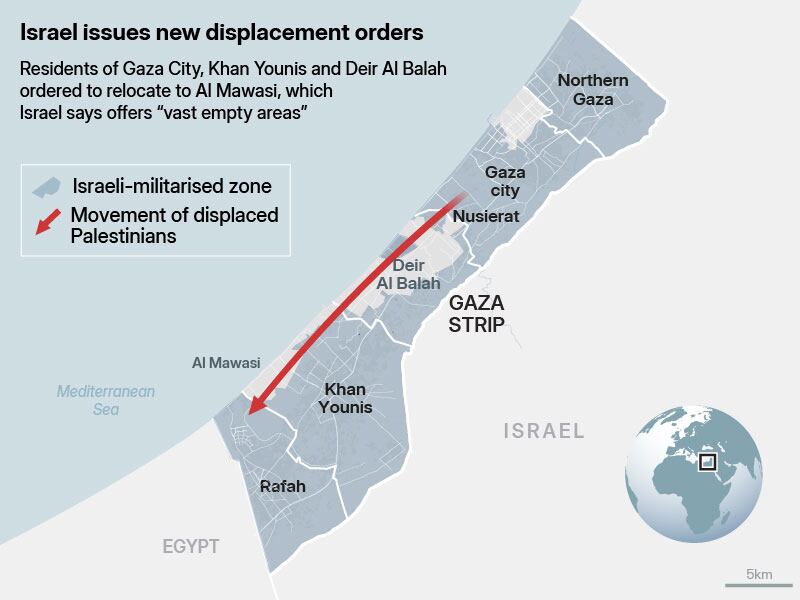
Nizar Ayash, Mayor of Deir Al Balah, one of the areas the Israeli military told Gaza city residents to move to, told Palestinian outlet SND News that the plan is unworkable.
Humanitarian sources said there is also a major shortage of tents and toilets, and that transportation costs from Gaza city to the new areas are too expensive for many.
“There is not a single place in Deir Al Balah that is capable of accommodating new displaced persons' tents,” Mr Ayash said. Shelling, collapsing infrastructure and a lack of key supplies, such as clean water, have increase pressure on residents, he explained. The same conditions exist in other areas the military ordered residents to go to, he added.
As a result, humanitarian agencies are noting increasing numbers of Gaza city residents who are planning to stay put and “die in dignity", rather than face the treacherous journey south to potentially unliveable conditions.
The Site Management Cluster, a group of humanitarian agencies working in Gaza, noted that a large number of displacement movements from August 24 to 27 were still taking place within Gaza city, rather than to areas further south as ordered by the Israeli military.

