The role of journalists in Gaza in wartime has always been to document the suffering of civilians and share it with the world. But since the current war began in October 2023, journalists have become targets themselves, not only of Israeli air strikes and incitement, but also of fear from the very people they aim to serve.
“People became worried about journalists from the first months of the war,” Abdallah Miqdad, 41, a correspondent for Al Arabi TV, told The National.
“Especially after targeting journalists, and even more so after the family of [Al Jazeera correspondent] Wael Al Dahdouh was killed. People began to believe that a journalist could be targeted at any time,” he said.
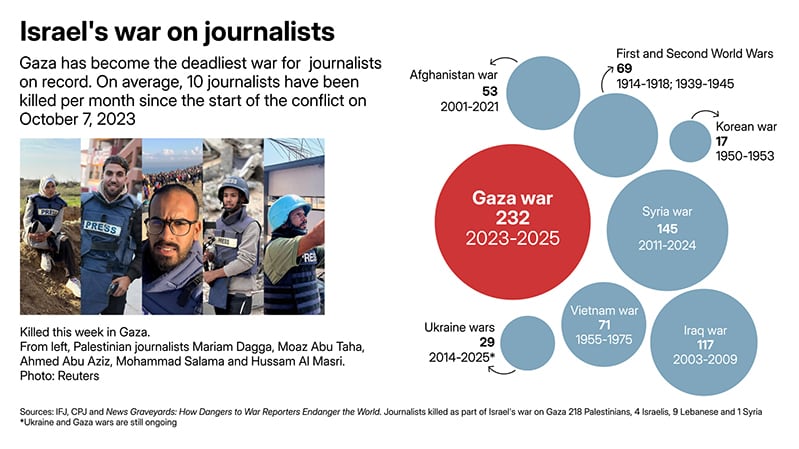
With foreign media barred from entering Gaza, local journalists are the main source of information on the deaths, destruction and displacement suffered by civilians in Israel's relentless targeting of homes, hospitals and schools to destroy the militant group Hamas. But with more than 230 killed so far – making this conflict one of the most lethal for journalists in modern history – ordinary Gazans now fear being in their presence.
In the most recent attack, five journalists were killed in an air strike on the Nasser Hospital in southern Gaza on August 25. The attack, which claimed 17 other lives, came two weeks after an Israeli air strike killed Al Jazeera reporter Anas Al Sharif and five other journalists in a tent near Al Shifa Hospital in Gaza city.
Miqdad said his flak jacket with the word "Press", once a symbol of credibility, has turned into a warning sign. “When people see me wearing it, they become afraid and uncomfortable dealing with me. Some are positive, but most are worried.”
That fear has had devastating personal consequences. After losing his home in the first days of the war, Miqdad tried to visit his displaced family members. But his family's hosts repeatedly refused him entry, fearing his presence might endanger them.
“Even when I tried to rent an office in Deir Al Balah, the owner stopped the deal when he found out we were journalists,” he recalled.
Abu Ahmad Mustafa, who lives in Gaza city and owns several apartments, said he refused to let them out to journalists because it worried the other tenants.
“I understand the role of journalists and how they put themselves at risk to show the world what is happening in Gaza. But the other residents in the building are afraid. They told me they would not stay if I rented to a journalist or others who have political affiliations,” Mr Mustafa told The National.
“Actually, because of our situation in Gaza, you have to be very careful about who you rent to in your neighbourhood. Before this war, people only worried about whether new tenants were connected to any political factions, since the Israeli army targeted apartments without regard for who was inside. Recently, however, people have also started to worry about journalists, because of the many incidents we’ve heard about where they were targeted.”
Anas Fateha, 31, a freelance photographer with Turkey’s Anadolu Agency, said that in his case, people's fear was compounded by defamatory allegations about his work.
“There is a clear fear among people towards journalists in Gaza,” he told The National. “This became worse after incitement campaigns. A major German newspaper, Bild, accused me of lying and distorting the truth. That changed how some people looked at me − they became hesitant to deal with me, even to speak to me.”
Fateha, however, refuses to abandon his duty. “Despite the looks, the pressure, the words of people, I have continued my work documenting events. My mission is to preserve the truth.”
He believes the only way forward is to rebuild trust through transparency, professionalism, and patience with communities who now fear the camera as much as air strikes.
Ahmad Al Areni, a freelance photojournalist, said the hostility can be brutal.
“People have started driving us away, telling us: ‘Go away so we don’t get killed because of you,’” he said. “During displacement, people told us: ‘Leave this place so they don’t bomb us and bomb you.’”
Al Areni said the absence of international protection for journalists is the central dilemma. “We consider ourselves martyrs. The fear around us is the result of journalism being neglected in this war. Any journalist could be targeted, any journalist could become a victim.”
What connects all these testimonies is a shared conclusion: that Israel has succeeded in reshaping the public perception of journalists.
“Journalists used to be appreciated for their work,” Miqdad said. “But after repeated targeting, people now see us as dangerous to be around. The journalist has become ostracised, not as someone who conveys suffering, but as someone who brings risk with him.”
This hostility has been echoed, and even legitimised, by Israeli media figures. Tsvi Yehezkeli, senior commentator on Israel’s i24 channel, openly justified the killing of five journalists at Nasser Hospital.
“If Israel has indeed decided to eliminate journalists, then better late than never,” Mr Yehezkeli said on air. “They are the spearhead of Hamas’s military wing, these so-called journalists. Israel did well to eliminate them. In my opinion, it was far too late, and there are still many of them causing damage.”
For Palestinian journalists, such statements are not just rhetoric. They become fuel for public suspicion, leaving them caught between the dangers of air strikes, political incitement, and the mistrust of their own communities.
“There is no safe place, and no respect for journalistic protections,” said Fateha. “But we continue. Because if we don’t tell the truth, it will be lost.”
Women & Power: A Manifesto
Mary Beard
Profile Books and London Review of Books
Sukuk
An Islamic bond structured in a way to generate returns without violating Sharia strictures on prohibition of interest.
The%20specs
%3Cp%3E%3Cstrong%3EPowertrain%3A%20%3C%2Fstrong%3ESingle%20electric%20motor%0D%3Cbr%3E%3Cstrong%3EPower%3A%20%3C%2Fstrong%3E201hp%0D%3Cbr%3E%3Cstrong%3ETorque%3A%20%3C%2Fstrong%3E310Nm%0D%3Cbr%3E%3Cstrong%3ETransmission%3A%20%3C%2Fstrong%3ESingle-speed%20auto%0D%3Cbr%3E%3Cstrong%3EBattery%3A%20%3C%2Fstrong%3E53kWh%20lithium-ion%20battery%20pack%20(GS%20base%20model)%3B%2070kWh%20battery%20pack%20(GF)%0D%3Cbr%3E%3Cstrong%3ETouring%20range%3A%20%3C%2Fstrong%3E350km%20(GS)%3B%20480km%20(GF)%0D%3Cbr%3E%3Cstrong%3EPrice%3A%20%3C%2Fstrong%3EFrom%20Dh129%2C900%20(GS)%3B%20Dh149%2C000%20(GF)%0D%3Cbr%3E%3Cstrong%3EOn%20sale%3A%3C%2Fstrong%3E%20Now%3C%2Fp%3E%0A
What are the influencer academy modules?
- Mastery of audio-visual content creation.
- Cinematography, shots and movement.
- All aspects of post-production.
- Emerging technologies and VFX with AI and CGI.
- Understanding of marketing objectives and audience engagement.
- Tourism industry knowledge.
- Professional ethics.
F1 line ups in 2018
Mercedes-GP Lewis Hamilton and Valtteri Bottas; Ferrari Sebastian Vettel and Kimi Raikkonen; Red Bull Daniel Ricciardo and Max Verstappen; Force India Esteban Ocon and Sergio Perez; Renault Nico Hülkenberg and Carlos Sainz Jr; Williams Lance Stroll and Felipe Massa / Robert Kubica / Paul di Resta; McLaren Fernando Alonso and Stoffel Vandoorne; Toro Rosso TBA; Haas F1 Romain Grosjean and Kevin Magnussen; Sauber TBA
PRO BASH
Thursday’s fixtures
6pm: Hyderabad Nawabs v Pakhtoon Warriors
10pm: Lahore Sikandars v Pakhtoon Blasters
Teams
Chennai Knights, Lahore Sikandars, Pakhtoon Blasters, Abu Dhabi Stars, Abu Dhabi Dragons, Pakhtoon Warriors and Hyderabad Nawabs.
Squad rules
All teams consist of 15-player squads that include those contracted in the diamond (3), platinum (2) and gold (2) categories, plus eight free to sign team members.
Tournament rules
The matches are of 25 over-a-side with an 8-over power play in which only two fielders allowed outside the 30-yard circle. Teams play in a single round robin league followed by the semi-finals and final. The league toppers will feature in the semi-final eliminator.
The biog
Mission to Seafarers is one of the largest port-based welfare operators in the world.
It provided services to around 200 ports across 50 countries.
They also provide port chaplains to help them deliver professional welfare services.
Citadel: Honey Bunny first episode
Directors: Raj & DK
Stars: Varun Dhawan, Samantha Ruth Prabhu, Kashvi Majmundar, Kay Kay Menon
Rating: 4/5
The alternatives
• Founded in 2014, Telr is a payment aggregator and gateway with an office in Silicon Oasis. It’s e-commerce entry plan costs Dh349 monthly (plus VAT). QR codes direct customers to an online payment page and merchants can generate payments through messaging apps.
• Business Bay’s Pallapay claims 40,000-plus active merchants who can invoice customers and receive payment by card. Fees range from 1.99 per cent plus Dh1 per transaction depending on payment method and location, such as online or via UAE mobile.
• Tap started in May 2013 in Kuwait, allowing Middle East businesses to bill, accept, receive and make payments online “easier, faster and smoother” via goSell and goCollect. It supports more than 10,000 merchants. Monthly fees range from US$65-100, plus card charges of 2.75-3.75 per cent and Dh1.2 per sale.
• 2checkout’s “all-in-one payment gateway and merchant account” accepts payments in 200-plus markets for 2.4-3.9 per cent, plus a Dh1.2-Dh1.8 currency conversion charge. The US provider processes online shop and mobile transactions and has 17,000-plus active digital commerce users.
• PayPal is probably the best-known online goods payment method - usually used for eBay purchases - but can be used to receive funds, providing everyone’s signed up. Costs from 2.9 per cent plus Dh1.2 per transaction.
Slow loris biog
From: Lonely Loris is a Sunda slow loris, one of nine species of the animal native to Indonesia, Malaysia, Thailand and Singapore
Status: Critically endangered, and listed as vulnerable on the International Union for Conservation of Nature red list due to growing demand in the global exotic pet trade. It is one of the most popular primate species found at Indonesian pet markets
Likes: Sleeping, which they do for up to 18 hours a day. When they are awake, they like to eat fruit, insects, small birds and reptiles and some types of vegetation
Dislikes: Sunlight. Being a nocturnal animal, the slow loris wakes around sunset and is active throughout the night
Superpowers: His dangerous elbows. The slow loris’s doe eyes may make it look cute, but it is also deadly. The only known venomous primate, it hisses and clasps its paws and can produce a venom from its elbow that can cause anaphylactic shock and even death in humans
Infiniti QX80 specs
Engine: twin-turbocharged 3.5-liter V6
Power: 450hp
Torque: 700Nm
Price: From Dh450,000, Autograph model from Dh510,000
Available: Now
SPEC%20SHEET%3A%20APPLE%20TV%204K%20(THIRD%20GENERATION)
%3Cp%3E%3Cstrong%3ECPU%3A%3C%2Fstrong%3E%20Apple%20A15%20Bionic%3C%2Fp%3E%0A%3Cp%3E%3Cstrong%3ECapacity%3A%3C%2Fstrong%3E%2064GB%2C%20Wi-Fi%20only%3B%20128GB%2C%20Wi-Fi%20%2B%20ethernet%3C%2Fp%3E%0A%3Cp%3E%3Cstrong%3EConnectivity%3A%3C%2Fstrong%3E%20Wi-Fi%206%2C%20Bluetooth%205.0%2C%20ethernet%20(Wi-Fi%20%2B%20ethernet%20model%20only)%2C%20IR%20receiver%3C%2Fp%3E%0A%3Cp%3E%3Cstrong%3EI%2FO%3A%3C%2Fstrong%3E%20HDMI%2C%20ethernet%20(128GB%20model%20only)%3B%20Siri%20remote%20(charging%20via%20USB-C)%3B%20accessibility%20features%3C%2Fp%3E%0A%3Cp%3E%3Cstrong%3EVideo%3A%3C%2Fstrong%3E%20SDR%2FDolby%20Vision%2FHDR10%2B%20up%20to%202160p%20%40%2060fps%3C%2Fp%3E%0A%3Cp%3E%3Cstrong%3EPeripherals%3A%3C%2Fstrong%3E%20Compatible%20with%20HD%2FUHD%20TVs%20via%20HDMI%2C%20Bluetooth%20keyboards%2C%20AirPods%3C%2Fp%3E%0A%3Cp%3E%3Cstrong%3EPhoto%3A%3C%2Fstrong%3E%20GIF%2C%20HEIF%2C%20JPEG%2C%20TIFF%3C%2Fp%3E%0A%3Cp%3E%3Cstrong%3EColour%3A%3C%2Fstrong%3E%20Black%3C%2Fp%3E%0A%3Cp%3E%3Cstrong%3EIn%20the%20box%3A%3C%2Fstrong%3E%20TV%204K%2C%20Siri%20remote%2C%20power%20cord%3C%2Fp%3E%0A%3Cp%3E%3Cstrong%3EPrice%3A%3C%2Fstrong%3E%20Dh529%2C%20Wi-Fi%20only%3B%20Dh599%2C%20Wi-Fi%20%2B%20ethernet%3C%2Fp%3E%0A
The Freedom Artist
By Ben Okri (Head of Zeus)
What is the definition of an SME?
SMEs in the UAE are defined by the number of employees, annual turnover and sector. For example, a “small company” in the services industry has six to 50 employees with a turnover of more than Dh2 million up to Dh20m, while in the manufacturing industry the requirements are 10 to 100 employees with a turnover of more than Dh3m up to Dh50m, according to Dubai SME, an agency of the Department of Economic Development.
A “medium-sized company” can either have staff of 51 to 200 employees or 101 to 250 employees, and a turnover less than or equal to Dh200m or Dh250m, again depending on whether the business is in the trading, manufacturing or services sectors.