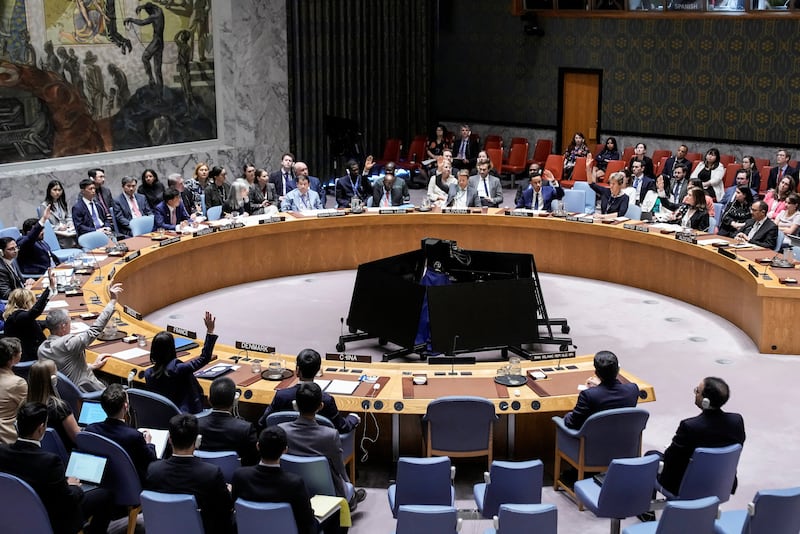
Iran has recalled its ambassadors in Germany, France and Britain for consultations over the reimposition of UN sanctions against Tehran, which came into effect on Saturday night.
The move to recall the diplomats was made “in response to the irresponsible action of the three European countries in misusing the snapback mechanism”, state-run Mehr news agency reported.
The snapback is a process whereby sanctions are being reinstated at the behest of the three European powers, also known as the E3, who say Tehran has failed to fulfil its obligations under a 2015 treaty to regulate its nuclear energy programme.
The measures will freeze Iranian assets abroad, ban arms sales to Tehran and curb development of its ballistic missile programme, further straining an economy already weakened by years of restrictions.
Britain, France and Germany triggered the 30-day snapback mechanism last month. The E3 say Iran is enriching uranium well beyond levels necessary for civilian use. Western powers have long suspected Tehran is seeking to build a nuclear bomb, a claim denied by Iran.
On Friday, the UN Security Council rejected a last-minute effort backed by Russia and China to delay the reimposition of the sanctions for six months.
The vote on a draft resolution failed to secure the minimum nine votes needed in the 15-member council. Nine members voted against, four in favour, while two abstained. The draft urged all parties to “immediately resume negotiations”.
European nations have said Iran must comply with a series of conditions. These include resumption of direct negotiations with the US over its nuclear programme and allowing UN inspectors to access nuclear sites. Tehran must also account for more than 400kg of highly enriched uranium that the UN's nuclear watchdog says it possesses.
Conflict over Iran's nuclear programme led to a 12-day war with Israel in June, which culminated in a US bombing of Iranian nuclear plants and an Iranian strike against a US airbase in Qatar.
Iranian Foreign Minister Abbas Araghchi said the E3’s efforts to revive the sanctions are “null and void” and carry no legal force, Mehr reported.
He told the Security Council that the US and its European allies bore full responsibility for any fallout from their decision to restore the sanctions.
“The developments we have witnessed set a dangerous precedent,” he said. “If agreements can be broken at will, no nation can trust international commitments.
“If unlawful measures are enforced by power instead of law, the Security Council risks losing credibility and authority.”
Iranian President Masoud Pezeshkian said the US and Israel were seeking to use the pressure at the Security Council to topple the Islamic republic's government.
“If the goal had been to resolve concerns on the nuclear programme, we could easily do that,” Mr Pezeshkian told reporters in New York. He said Iran will never pursue nuclear weapons.
Mr Pezeshkian said US demands that Tehran hand over its enriched uranium were "unacceptable".
He said Washington had asked Tehran to relinquish all of its enriched uranium in exchange for a three-month reprieve from sanctions.
The Iranian leader previously said France had made a similar proposal but offering only a one-month delay.
“Why would we put ourselves in such a trap and have a noose around our neck each month?” he said.
He also accused the US of pressing the Europeans not to reach a compromise.
Steve Witkoff, special envoy for US President Donald Trump, has said Washington does not want to hurt Iran and is open to further talks.
But Mr Pezeshkian said Mr Witkoff lacked seriousness, adding he had backtracked on agreements during earlier discussions.
UAE currency: the story behind the money in your pockets
Kanguva
Director: Siva
Stars: Suriya, Bobby Deol, Disha Patani, Yogi Babu, Redin Kingsley
The specs
A4 35 TFSI
Engine: 2.0-litre, four-cylinder
Transmission: seven-speed S-tronic automatic
Power: 150bhp
Torque: 270Nm
Price: Dh150,000 (estimate)
On sale: First Q 2020
A4 S4 TDI
Engine: 3.0-litre V6 turbo diesel
Transmission: eight-speed PDK automatic
Power: 350bhp
Torque: 700Nm
Price: Dh165,000 (estimate)
On sale: First Q 2020
The%20specs
%3Cp%3E%3Cstrong%3EEngine%3A%3C%2Fstrong%3E%20Twin-turbocharged%204-litre%20V8%0D%3Cbr%3E%3Cstrong%3EPower%3A%20%3C%2Fstrong%3E542bhp%0D%3Cbr%3E%3Cstrong%3ETorque%3A%20%3C%2Fstrong%3E770Nm%0D%3Cbr%3E%3Cstrong%3ETransmission%3A%20%3C%2Fstrong%3EEight-speed%20automatic%0D%3Cbr%3E%3Cstrong%3EPrice%3A%20%3C%2Fstrong%3EFrom%20Dh1%2C450%2C000%3Cbr%3E%3Cstrong%3EOn%20sale%3A%20%3C%2Fstrong%3ENow%3C%2Fp%3E%0A
T20 World Cup Qualifier fixtures
Tuesday, October 29
Qualifier one, 2.10pm – Netherlands v UAE
Qualifier two, 7.30pm – Namibia v Oman
Wednesday, October 30
Qualifier three, 2.10pm – Scotland v loser of qualifier one
Qualifier four, 7.30pm – Hong Kong v loser of qualifier two
Thursday, October 31
Fifth-place playoff, 2.10pm – winner of qualifier three v winner of qualifier four
Friday, November 1
Semi-final one, 2.10pm – Ireland v winner of qualifier one
Semi-final two, 7.30pm – PNG v winner of qualifier two
Saturday, November 2
Third-place playoff, 2.10pm
Final, 7.30pm
MATCH INFO
England 241-3 (20 ovs)
Malan 130 no, Morgan 91
New Zealand 165 all out (16.5ovs)
Southee 39, Parkinson 4-47
England win by 76 runs
Series level at 2-2
Key facilities
- Olympic-size swimming pool with a split bulkhead for multi-use configurations, including water polo and 50m/25m training lanes
- Premier League-standard football pitch
- 400m Olympic running track
- NBA-spec basketball court with auditorium
- 600-seat auditorium
- Spaces for historical and cultural exploration
- An elevated football field that doubles as a helipad
- Specialist robotics and science laboratories
- AR and VR-enabled learning centres
- Disruption Lab and Research Centre for developing entrepreneurial skills
Get inspired
Here are a couple of Valentine’s Day food products that may or may not go the distance (but have got the internet talking anyway).
Sourdough sentiments: Marks & Spencer in the United Kingdom has introduced a slow-baked sourdough loaf dusted with flour to spell out I (heart) you, at £2 (Dh9.5). While it’s not available in the UAE, there’s nothing to stop you taking the idea and creating your own message of love, stencilled on breakfast-inbed toast.
Crisps playing cupid: Crisp company Tyrells has added a spicy addition to its range for Valentine’s Day. The brand describes the new honey and chilli flavour on Twitter as: “A tenderly bracing duo of the tantalising tingle of chilli with sweet and sticky honey. A helping hand to get your heart racing.” Again, not on sale here, but if you’re tempted you could certainly fashion your own flavour mix (spicy Cheetos and caramel popcorn, anyone?).
'Fantastic Beasts: The Secrets of Dumbledore'
Rating: 3/5
Directed by: David Yates
Starring: Mads Mikkelson, Eddie Redmayne, Ezra Miller, Jude Law
Classification of skills
A worker is categorised as skilled by the MOHRE based on nine levels given in the International Standard Classification of Occupations (ISCO) issued by the International Labour Organisation.
A skilled worker would be someone at a professional level (levels 1 – 5) which includes managers, professionals, technicians and associate professionals, clerical support workers, and service and sales workers.
The worker must also have an attested educational certificate higher than secondary or an equivalent certification, and earn a monthly salary of at least Dh4,000.
Fourth-round clashes for British players
- Andy Murray (1) v Benoit Paire, Centre Court (not before 4pm)
- Johanna Konta (6) v Caroline Garcia (21), Court 1 (4pm)
MATCH INFO
Manchester United 1 (Rashford 36')
Liverpool 1 (Lallana 84')
Man of the match: Marcus Rashford (Manchester United)
The biog
Most memorable achievement: Leading my first city-wide charity campaign in Toronto holds a special place in my heart. It was for Amnesty International’s Stop Violence Against Women program and showed me the power of how communities can come together in the smallest ways to have such wide impact.
Favourite film: Childhood favourite would be Disney’s Jungle Book and classic favourite Gone With The Wind.
Favourite book: To Kill A Mockingbird for a timeless story on justice and courage and Harry Potters for my love of all things magical.
Favourite quote: “We make a living by what we get, but we make a life by what we give.” — Winston Churchill
Favourite food: Dim sum
Favourite place to travel to: Anywhere with natural beauty, wildlife and awe-inspiring sunsets.
Dust and sand storms compared
Sand storm
- Particle size: Larger, heavier sand grains
- Visibility: Often dramatic with thick "walls" of sand
- Duration: Short-lived, typically localised
- Travel distance: Limited
- Source: Open desert areas with strong winds
Dust storm
- Particle size: Much finer, lightweight particles
- Visibility: Hazy skies but less intense
- Duration: Can linger for days
- Travel distance: Long-range, up to thousands of kilometres
- Source: Can be carried from distant regions