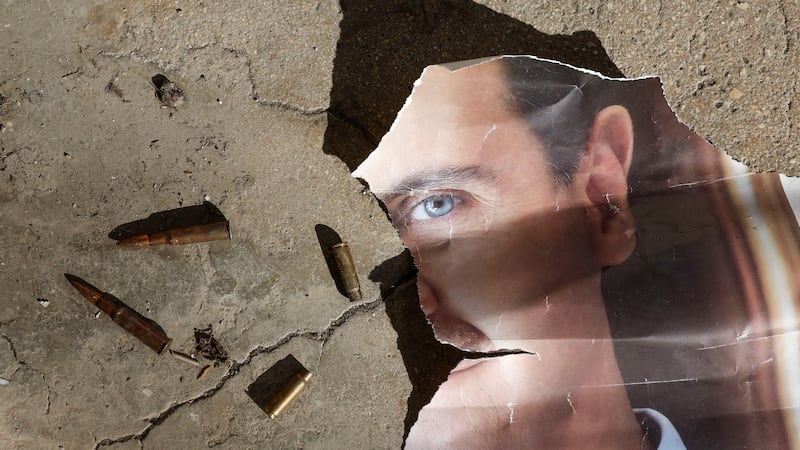

Syrian authorities have issued an arrest warrant for former president Bashar Al Assad on murder and torture charges, the first legal action against him by the country he ruled for 24 years. However, doubts are being cast about its efficacy.
Investigative judge Tawfiq Al Ali said the next move is to convince Interpol to adopt the warrant against Mr Al Assad, who is in Moscow, to "achieve justice for the victims and their relatives". Mr Al Ali told official media the charges, in connection with "events" in Deraa, are for murder, torture and incitement to commit murder. Deraa is the birthplace of the 2011 Syrian uprising.
Mr Al Ali said the charges against Mr Al Assad were brought under the Syrian criminal code, after it was established the former leader "is evading justice". The case was brought by unidentified individuals, as well as the state, he added.

A Syrian official involved in prosecuting alleged crimes of the former regime said the warrant was a "stopgap" measure until a legal mechanism was set up to seek justice against Mr Al Assad and his lieutenants.
"The current legal code has no provisions for crimes against humanity," the official said. "Assad under the current laws may also have immunity from prosecution."
A more "robust" effort to persecute Mr Al Assad, including help from Interpol, would be possible once laws were changed to remove loopholes and deal with the enormity of the alleged crimes committed during the 2011 to 2024 civil war, he said by phone from Damascus.
Mr Al Assad, whose forces crushed a peaceful revolt in Deraa, fled to Russia when Ahmad Al Shara, now Syrian President, led insurgents in a lightning, 11-day offensive that ended five decades of Assad family rule and ushered in the political ascendancy of Syria's Sunni majority.
In the past 10 months, the new government has captured hundreds of former officials and security operatives, but not the top echelons of the former regime, most of whom are in Russia.
However, revenge killings have been carried out almost daily in Syria against the lower ranks and those seen as having been collaborators. Mass killings have also taken place against Alawites, the minority to which Mr Al Assad belongs, and who underpinned the former dictatorship.
Syrian officials have been avoiding the mention of Mr Al Assad in public as they sought to establish ties with his former allies, including Russia, which was his most powerful backer and still has military bases in Syria.
In the last decade of the former regime, Syrian dissidents sought legal action against Mr Al Assad in western countries, but failed to achieve any results. His troops, as well as loyalist militias, killed thousands of civilians in the initial crackdown on the revolt in Deraa and the rest of Syria. By the end of 2011, Syria was in civil war.
In 2014, photos documenting the killing of thousands of political prisoners in Syrian jails were made public. They became known as the Caesar Photos, named after a defector from Mr Al Assad’s military, who was from Deraa.