

Pope Leo XIV has became the fifth holder of his office to visit Turkey, in the latest chapter in decades-old ties between the country and the Vatican.
Turkey has a “privileged place in the geography of papal journeys”, the Vatican press office said.
Pope Paul VI made the first papal visit to Turkey in 1967, seven years after modern diplomatic ties were established. On that trip, the pontiff returned to Turkey a flag taken from the Ottomans during a battle in 1571.


Pope John Paul II then visited in 1979, Pope Benedict XVI in 2006, and Pope Francis in 2014.
The visits have typically involved the leader of the world’s Catholics meeting senior Eastern Orthodox leaders, in a long process of improving ties since the two churches split in 1054. Bartholomew I of Constantinople, spiritual leader of Eastern Orthodox Christians worldwide, lives in Istanbul.
Pontiffs have also used visits to Turkey to build interfaith ties in a country whose 86 million population is overwhelmingly Muslim.
Papal visits to the Middle East - in pictures
-
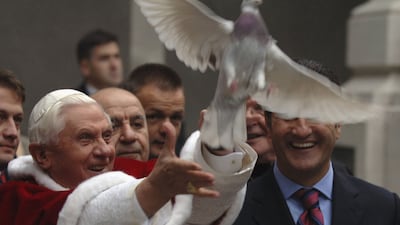
Pope Benedict XVI frees a dove during a visit to the Holy Spirit Cathedral in in Istanbul in December 2006. Getty Images -
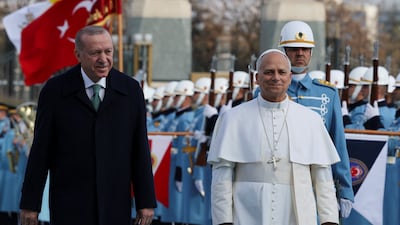
Pope Leo XIV and the Turkish President Tayyip Erdogan at the presidential palace in Ankara, Turkey. Reuters -
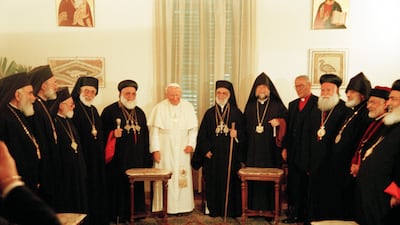
Pope John Paul II meets Orthodox Church dignitaries in Beirut during a visit to Lebanon in May 1997. Getty Images -
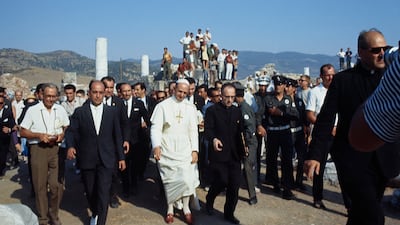
Pope Paul VI visiting the Basilica of St John in Ephesus, western Turkey, in July 1967. Getty Images -
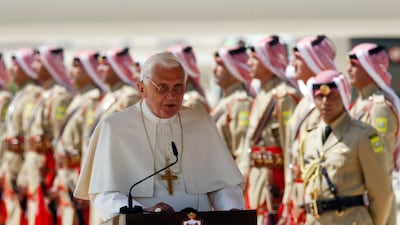
Pope Benedict XVI speaks at Queen Alia Airport during his visit to Jordan in May 2009. Getty Images -
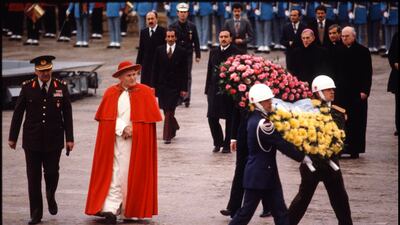
Pope John Paul II at the mausoleum of Mustafa Kemal Ataturk in Ankara, Turkey, in November 1979. Getty Images -
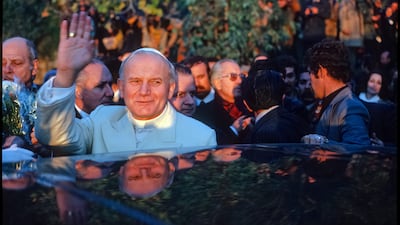
Pope John Paul II leaves the Shrine of Meryem Ana in Ephesus, Turkey, in November 1979. Getty Images -
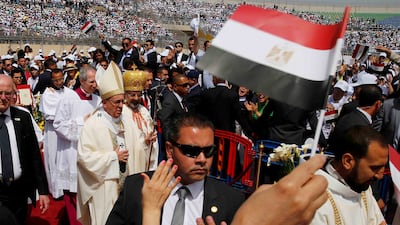
Pope Francis arrives at 30 June Stadium in Cairo to chair a mass during his visit to Egypt in April 2017. Getty Images -
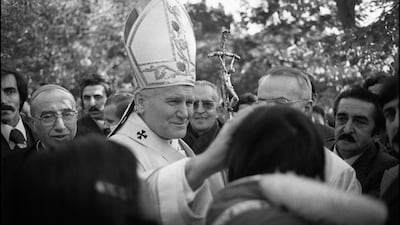
Pope John Paul II at the Shrine of Meryem Ana in Ephesus, Turkey, in November 1979. Getty Images -
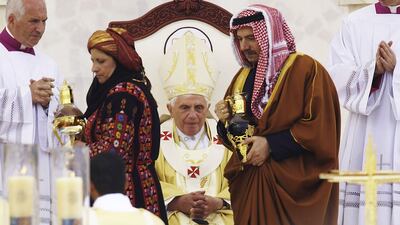
Pope Benedict XVI celebrates a mass in a football stadium in Amman, Jordan, in May 2009. Getty Images -
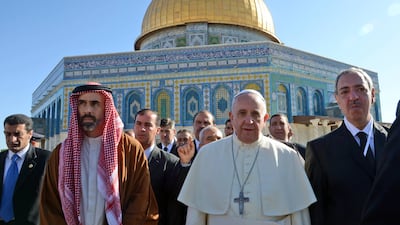
Pope Francis in Jerusalem on his visit to Israel in May 2014. Getty Images -
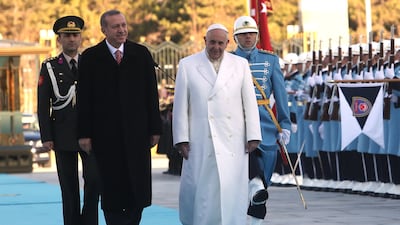
Pope Francis with Turkey's President Recep Tayyip Erdogan in Ankara in November 2014. Getty Images -
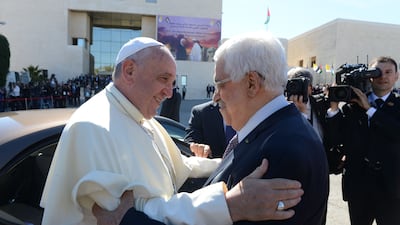
Palestinian President Mahmoud Abbas greets Pope Francis in Ramallah in the West Bank in May 2014. Getty Images -
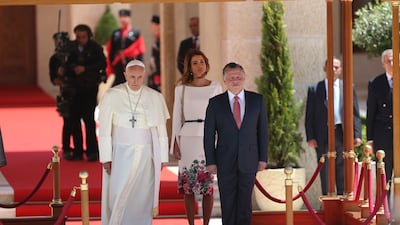
Pope Francis is welcomed by King Abdullah II and Queen Rania at the royal palace in Amman, Jordan in May 2014. Getty Images -
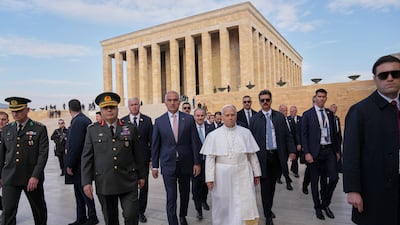
Pope Leo XIV arrives at the Ataturk Mausoleum in Ankara, Turkey. AP


Two previous popes have held silent prayers at the 17th century Blue Mosque, a symbol of Ottoman Empire power and today a tourist attraction, as well as a working place of Muslim worship. In 2006, Benedict XVI became the second pope to visit the Istanbul mosque. His predecessor, John Paul II, had visited the Ummayyad mosque in Damascus five years previously.
In 2014, Pope Francis visited the Blue Mosque, also known as the Sultan Ahmed Mosque. Under its domed ceiling, he clasped his hands and paused for two minutes as Grand Mufti of Istanbul Rahmi Yaran performed a Muslim prayer.
Pope Leo is scheduled to visit the Blue Mosque on Saturday morning and to hold silent prayers. Previous papal visits have seen demonstrators, mostly from Islamist or nationalist parties, against what they see as affronts to Turkey’s secularism and Muslim majority.

Unlike some of his predecessors, Pope Leo will not visit the nearby Hagia Sophia, built as a church in the 6th century. The site was converted into a mosque by the Ottomans and then into a museum during the secularising era of the 20th century Turkish Republic. President Recep Tayyip Erdogan’s government converted it back into a mosque in 2020, to widespread criticism from the Christian world. Pope Francis said he was “pained” by the decision.
Christians in Turkey report prejudice against them based on stereotypes and misinformation about their beliefs and ways of living. Attacks on the community are not unheard of. A deadly attack on a church in Istanbul last year was claimed by ISIS, and two members of the clergy were killed in the country in the 2000s.
Father Andrea Santoro was shot dead in the Black Sea coast city of Trabzon in 2006, and a bishop, Luigi Padovese, was fatally stabbed in south-eastern Hatay province in 2010.
The Catholic Church, which has 33,000 followers in Turkey, according to Vatican figures, does not have legal status in the country, complicating its operations. At the same time, Mr Erdogan’s government has made other gestures towards the wider Christian community, whose exact size is not known but which represents less than half a per cent of the overall population.
Last year, Mr Erdogan met Bartholomew I to discuss the reopening of a long-shuttered Orthodox theological school on an island in Istanbul. In 2023, his government opened the first new church in Turkey in a century, Mor Ephrem Syriac Orthodox Church in western Istanbul. Pope Leo will meet Syriac leaders at the place of worship on Saturday.
One former pope stands out in his relations with Turkey. Although he never visited the country as pontiff, Pope John XXIII lived in Istanbul as a papal representative for almost 10 years in the 1930s and 1940s. He built such good ties with the country that he later earned the nickname, the “Turcophile Pope”. His statue stands outside the St Anthony of Padua church on Istanbul’s Istiklal Avenue.
Leo's mass on Saturday will be a first for a pope in Turkey. Around 4,000 people will attend the session at Istanbul's Volkswagen Arena, where the Catholic leader will give readings and prayers in six languages, including Turkish, Arabic, Armenian and Aramaic, a language spoken by some Middle Eastern Christian communities.

