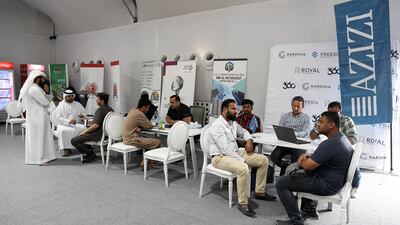
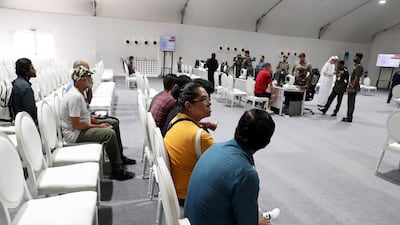
Authorities in the UAE have extended the exit pass validity for those seeking amnesty for their expired visas, giving them until October 31 to leave the country.
Earlier, amnesty seekers had 14 days from when an exit pass was issued to put their papers in order and leave the Emirates.
“We have extended the exit pass validity until the end of the amnesty … that's the end of October,” a senior General Directorate of Residency and Foreigners Affairs in Dubai (GDRFA) official told The National.
The exit pass gives visa overstayers enough time to plan their departure without incurring an overstay fine or ban during the amnesty programme. Anyone who has obtained can later re-enter the country if they find a job. “You won't face any ban and can come back anytime,” said Lt Col Salem Bin Ali, GDRFA director of customer happiness department.
Those wishing to stay and look for employment have two months from when they legalise their status to do so. “When you change the status you are in the clear," Lt Col Ali said.
Looming deadline
As the number of people granted amnesty at Dubai's Amer centres touched 27,173, GDRFA officials urged those planning to make their stay in the UAE legal to “hurry” before the October-end deadline.
“Today we are at day 24. Time is running out so we are asking people to hurry up,” Lt Col Ali said. “Some people might think they still have time to sort out their paperwork and change their status, but it's better to get started now.
“We need everyone to be happy and stay legally in the UAE.”
According to the data released on Tuesday, 19,772 people got their status legalised and 7,401 were handed exit passes at 86 Amer centres since the start of the amnesty initiative.
“We are committed to providing full support to anyone looking to regularise their status, whether through the services provided by Amer Centres or through our specialised teams,” said Lt Gen Mohamed Al Marri, director general of GDRFA Dubai.
The statistics for Al Awir Centre in Dubai were not released. An earlier report showed that 2,393 people had filed their applications at Al Awir Centre during the first seven days of the amnesty.
Passport validity requirement eased
People with one-month validity on their passports will be allowed to apply for amnesty, authorities have announced.
The Federal Authority for Identity and Citizenship, Customs and Ports Security said the earlier requirement for six-month passport validity has been changed to make it easier for visa overstayers as embassies currently take weeks to process new passports or renew travel documents.
Major General Suhail Al Khaili, director general of the ICP, said the amendment to accept passports with one-month validity will only be valid until October 31.
Where to apply for the amnesty
There are locations throughout the emirates where an application for amnesty can be processed.
In Abu Dhabi, people can apply at ICP centres in Al Dhafra, Sweihan, Al Maqam and Al Shahamah and private typing centres that are recognised by the ICP.
Typing centres typically perform administrative services, including application submissions.
In Dubai, amnesty services will be provided at its Amer service centres, and the centre for immigration violators in Al Awir.
Amnesty applications can be made at ICP centres throughout the rest of the Emirates.
Service centres will be operational daily throughout the amnesty from 8am until 8pm.
When does the amnesty end?
The amnesty is scheduled to end on October 31. However, an earlier nationwide initiative that was to run for three months was extended by several weeks.
The ICP said that during the amnesty “violators can regularise their status or leave the country without incurring fines”.
The initiative in 2018 led to long queues at immigration centres as people looked to resolve their residency status.
More than 105,000 people benefitted then from the UAE’s five-month visa amnesty programme.
There were 30,387 people who received exit permits after fines were waived, while 6,288 people received new residency visas and 18,530 people renewed their visas.
Another 35,549 permits were also issued for job seekers while 13,843 people changed their status from illegal to legal.

Watch: A Closer Look: UAE's visa amnesty explained
Dhadak 2
Director: Shazia Iqbal
Starring: Siddhant Chaturvedi, Triptii Dimri
Rating: 1/5
The%20specs
%3Cp%3E%3Cstrong%3EEngine%3A%20%3C%2Fstrong%3E3.6-litre%2C%20V6%0D%3Cbr%3E%3Cstrong%3ETransmission%3A%20%3C%2Fstrong%3Eeight-speed%20auto%0D%3Cbr%3E%3Cstrong%3EPower%3A%20%3C%2Fstrong%3E285hp%0D%3Cbr%3E%3Cstrong%3ETorque%3A%20%3C%2Fstrong%3E353Nm%0D%3Cbr%3E%3Cstrong%3EPrice%3A%20%3C%2Fstrong%3EDh159%2C900%0D%3Cbr%3E%3Cstrong%3EOn%20sale%3A%20%3C%2Fstrong%3Enow%3C%2Fp%3E%0A
Dengue%20fever%20symptoms
%3Cp%3EHigh%20fever%20(40%C2%B0C%2F104%C2%B0F)%3Cbr%3ESevere%20headache%3Cbr%3EPain%20behind%20the%20eyes%3Cbr%3EMuscle%20and%20joint%20pains%3Cbr%3ENausea%3Cbr%3EVomiting%3Cbr%3ESwollen%20glands%3Cbr%3ERash%26nbsp%3B%3C%2Fp%3E%0A
Ten tax points to be aware of in 2026
1. Domestic VAT refund amendments: request your refund within five years
If a business does not apply for the refund on time, they lose their credit.
2. E-invoicing in the UAE
Businesses should continue preparing for the implementation of e-invoicing in the UAE, with 2026 a preparation and transition period ahead of phased mandatory adoption.
3. More tax audits
Tax authorities are increasingly using data already available across multiple filings to identify audit risks.
4. More beneficial VAT and excise tax penalty regime
Tax disputes are expected to become more frequent and more structured, with clearer administrative objection and appeal processes. The UAE has adopted a new penalty regime for VAT and excise disputes, which now mirrors the penalty regime for corporate tax.
5. Greater emphasis on statutory audit
There is a greater need for the accuracy of financial statements. The International Financial Reporting Standards standards need to be strictly adhered to and, as a result, the quality of the audits will need to increase.
6. Further transfer pricing enforcement
Transfer pricing enforcement, which refers to the practice of establishing prices for internal transactions between related entities, is expected to broaden in scope. The UAE will shortly open the possibility to negotiate advance pricing agreements, or essentially rulings for transfer pricing purposes.
7. Limited time periods for audits
Recent amendments also introduce a default five-year limitation period for tax audits and assessments, subject to specific statutory exceptions. While the standard audit and assessment period is five years, this may be extended to up to 15 years in cases involving fraud or tax evasion.
8. Pillar 2 implementation
Many multinational groups will begin to feel the practical effect of the Domestic Minimum Top-Up Tax (DMTT), the UAE's implementation of the OECD’s global minimum tax under Pillar 2. While the rules apply for financial years starting on or after January 1, 2025, it is 2026 that marks the transition to an operational phase.
9. Reduced compliance obligations for imported goods and services
Businesses that apply the reverse-charge mechanism for VAT purposes in the UAE may benefit from reduced compliance obligations.
10. Substance and CbC reporting focus
Tax authorities are expected to continue strengthening the enforcement of economic substance and Country-by-Country (CbC) reporting frameworks. In the UAE, these regimes are increasingly being used as risk-assessment tools, providing tax authorities with a comprehensive view of multinational groups’ global footprints and enabling them to assess whether profits are aligned with real economic activity.
Contributed by Thomas Vanhee and Hend Rashwan, Aurifer
When Umm Kulthum performed in Abu Dhabi
Known as The Lady of Arabic Song, Umm Kulthum performed in Abu Dhabi on November 28, 1971, as part of celebrations for the fifth anniversary of the accession of Sheikh Zayed bin Sultan Al Nahyan as Ruler of Abu Dhabi. A concert hall was constructed for the event on land that is now Al Nahyan Stadium, behind Al Wahda Mall. The audience were treated to many of Kulthum's most well-known songs as part of the sold-out show, including Aghadan Alqak and Enta Omri.
Company%C2%A0profile
%3Cp%3E%3Cstrong%3ECompany%20name%3A%20%3C%2Fstrong%3Eamana%3Cbr%3E%3Cstrong%3EStarted%3A%20%3C%2Fstrong%3E2010%3Cbr%3E%3Cstrong%3EFounders%3A%3C%2Fstrong%3E%20Karim%20Farra%20and%20Ziad%20Aboujeb%3Cbr%3E%3Cstrong%3EBased%3A%20%3C%2Fstrong%3EUAE%3Cbr%3E%3Cstrong%3ERegulator%3A%20%3C%2Fstrong%3EDFSA%3Cbr%3E%3Cstrong%3ESector%3A%20%3C%2Fstrong%3EFinancial%20services%3Cbr%3E%3Cstrong%3ECurrent%20number%20of%20staff%3A%20%3C%2Fstrong%3E85%3Cbr%3E%3Cstrong%3EInvestment%20stage%3A%20%3C%2Fstrong%3ESelf-funded%3Cbr%3E%3C%2Fp%3E%0A
THE BIO
Favourite author - Paulo Coelho
Favourite holiday destination - Cuba
New York Times or Jordan Times? NYT is a school and JT was my practice field
Role model - My Grandfather
Dream interviewee - Che Guevara
Safety 'top priority' for rival hyperloop company
The chief operating officer of Hyperloop Transportation Technologies, Andres de Leon, said his company's hyperloop technology is “ready” and safe.
He said the company prioritised safety throughout its development and, last year, Munich Re, one of the world's largest reinsurance companies, announced it was ready to insure their technology.
“Our levitation, propulsion, and vacuum technology have all been developed [...] over several decades and have been deployed and tested at full scale,” he said in a statement to The National.
“Only once the system has been certified and approved will it move people,” he said.
HyperloopTT has begun designing and engineering processes for its Abu Dhabi projects and hopes to break ground soon.
With no delivery date yet announced, Mr de Leon said timelines had to be considered carefully, as government approval, permits, and regulations could create necessary delays.
Mercer, the investment consulting arm of US services company Marsh & McLennan, expects its wealth division to at least double its assets under management (AUM) in the Middle East as wealth in the region continues to grow despite economic headwinds, a company official said.
Mercer Wealth, which globally has $160 billion in AUM, plans to boost its AUM in the region to $2-$3bn in the next 2-3 years from the present $1bn, said Yasir AbuShaban, a Dubai-based principal with Mercer Wealth.
“Within the next two to three years, we are looking at reaching $2 to $3 billion as a conservative estimate and we do see an opportunity to do so,” said Mr AbuShaban.
Mercer does not directly make investments, but allocates clients’ money they have discretion to, to professional asset managers. They also provide advice to clients.
“We have buying power. We can negotiate on their (client’s) behalf with asset managers to provide them lower fees than they otherwise would have to get on their own,” he added.
Mercer Wealth’s clients include sovereign wealth funds, family offices, and insurance companies among others.
From its office in Dubai, Mercer also looks after Africa, India and Turkey, where they also see opportunity for growth.
Wealth creation in Middle East and Africa (MEA) grew 8.5 per cent to $8.1 trillion last year from $7.5tn in 2015, higher than last year’s global average of 6 per cent and the second-highest growth in a region after Asia-Pacific which grew 9.9 per cent, according to consultancy Boston Consulting Group (BCG). In the region, where wealth grew just 1.9 per cent in 2015 compared with 2014, a pickup in oil prices has helped in wealth generation.
BCG is forecasting MEA wealth will rise to $12tn by 2021, growing at an annual average of 8 per cent.
Drivers of wealth generation in the region will be split evenly between new wealth creation and growth of performance of existing assets, according to BCG.
Another general trend in the region is clients’ looking for a comprehensive approach to investing, according to Mr AbuShaban.
“Institutional investors or some of the families are seeing a slowdown in the available capital they have to invest and in that sense they are looking at optimizing the way they manage their portfolios and making sure they are not investing haphazardly and different parts of their investment are working together,” said Mr AbuShaban.
Some clients also have a higher appetite for risk, given the low interest-rate environment that does not provide enough yield for some institutional investors. These clients are keen to invest in illiquid assets, such as private equity and infrastructure.
“What we have seen is a desire for higher returns in what has been a low-return environment specifically in various fixed income or bonds,” he said.
“In this environment, we have seen a de facto increase in the risk that clients are taking in things like illiquid investments, private equity investments, infrastructure and private debt, those kind of investments were higher illiquidity results in incrementally higher returns.”
The Abu Dhabi Investment Authority, one of the largest sovereign wealth funds, said in its 2016 report that has gradually increased its exposure in direct private equity and private credit transactions, mainly in Asian markets and especially in China and India. The authority’s private equity department focused on structured equities owing to “their defensive characteristics.”
Profile
Company name: Jaib
Started: January 2018
Co-founders: Fouad Jeryes and Sinan Taifour
Based: Jordan
Sector: FinTech
Total transactions: over $800,000 since January, 2018
Investors in Jaib's mother company Alpha Apps: Aramex and 500 Startups
The%20specs%20
%3Cp%3E%3Cstrong%3EEngine%3A%20%3C%2Fstrong%3E2.0-litre%204cyl%20turbo%0D%3Cbr%3E%3Cstrong%3EPower%3A%20%3C%2Fstrong%3E261hp%20at%205%2C500rpm%0D%3Cbr%3E%3Cstrong%3ETorque%3A%20%3C%2Fstrong%3E400Nm%20at%201%2C750-4%2C000rpm%0D%3Cbr%3E%3Cstrong%3ETransmission%3A%20%3C%2Fstrong%3E7-speed%20dual-clutch%20auto%0D%3Cbr%3E%3Cstrong%3EFuel%20consumption%3A%20%3C%2Fstrong%3E10.5L%2F100km%0D%3Cbr%3E%3Cstrong%3EOn%20sale%3A%20%3C%2Fstrong%3ENow%0D%3Cbr%3E%3Cstrong%3EPrice%3A%20%3C%2Fstrong%3EFrom%20Dh129%2C999%20(VX%20Luxury)%3B%20from%20Dh149%2C999%20(VX%20Black%20Gold)%3C%2Fp%3E%0A
The%20Genius%20of%20Their%20Age
%3Cp%3EAuthor%3A%20S%20Frederick%20Starr%3Cbr%3EPublisher%3A%20Oxford%20University%20Press%3Cbr%3EPages%3A%20290%3Cbr%3EAvailable%3A%20January%2024%3C%2Fp%3E%0A
The specs: 2018 Dodge Durango SRT
Price, base / as tested: Dh259,000
Engine: 6.4-litre V8
Power: 475hp @ 6,000rpm
Torque: 640Nm @ 4,300rpm
Transmission: Eight-speed automatic
Fuel consumption, combined: 7.7L / 100km