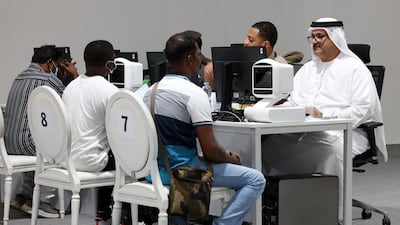
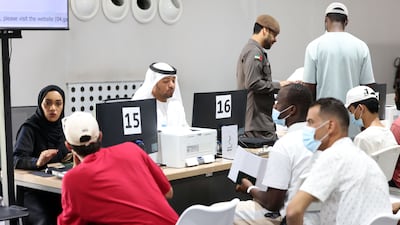
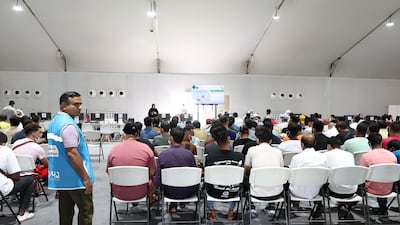
The number of immigration officers at Dubai's Al Awir Centre has been doubled in a bid to deal high numbers of visa amnesty seekers in the last few days of the initiative. With the deadline for the UAE visa amnesty on Thursday, the General Directorate of Residency and Foreigners Affairs in Dubai (GDRFA) advised any candidates who have not yet come forward to do so as soon as possible.
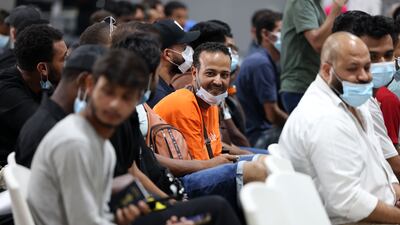
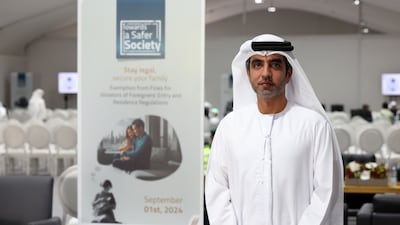
Amnesty seekers flocked to the centre – one of many ready to welcome overstayers across the UAE this week – on Monday as thousands sought to resolve visa-related issues in the final days of the initiative, which ends on October 31. Tens of thousands are seeking exit permits to leave the country and the GDRFA has implemented a special plan to handle the anticipated influx of applicants in the final days of the amnesty, Lt Col Salem bin Ali, director of the customer happiness department at the authority, told The National.
“We have doubled the number of officers as we expect many people to show up for the last week of the amnesty. It is normal and we’ve seen that in former amnesties,” Lt Col bin Ali said. He also confirmed there will be no extension.
Dubai's Al Awir Centre during the final days of the amnesty – in pictures
Every exit pass allows a 14-day window
Companies have been told to stop recruiting overstayers, as had been the case in the early days of the amnesty, as there is no longer enough time for the procedure to arrange an employment visa with so few days to go until the end of the initiative.
It is believed that many people have waited until the last days of the amnesty in the hope of getting a job opportunity in the country. Lt Col bin Ali assured them they can still return to find employment after leaving.
“If you cannot find a job, please leave the country, you can come back, you are most welcome anytime,” he said. “If someone gets an exit pass on October 31, then he or she has 14 days to leave the country without fines. Many are afraid they will not be able to return to the country if they leave but there is no ban on people getting the exit pass.”
He urged everyone with an Emirates ID to go directly to an Amer immigration centre to get an exit pass. Those without an Emirates ID can have their fingerprints done at Al Awir Centre and their exit pass should be processed within three days.
“With few days left, people should seize the opportunity. We are working in Al Awir Centre from 8am to 8pm,” Lt Col bin Ali added.
Plans to return
Innocent Chibuzo, 34, from Nigeria, decided to wait until the final week of the amnesty in the hope of finding employment before taking the decision to get an exit visa.
“I came on a visit visa in February 2020, a few days before the outbreak of Covid-19,” he told The National. “I couldn’t find a job and stayed illegally in the country.”
Mr Chibuzo has worked on a construction site in Abu Dhabi for the past four years but said he could not get an employment visa. In that time, he has accumulated fines of about Dh80,000.
“I kept searching for a job in the last two months in the hope of waiving the fines and stay legally in the UAE. But now I want to get an exit pass and leave the country without paying the visa fines,” he said. “I booked a flight on October 31 to return to Nigeria. “I want to return and apply for a job in a proper way.”
Eman Ganam, from Morocco, got her exit pass one year after her residency visa had expired.
“I worked in a coffee shop but had problems with my sponsor in Dubai. He cancelled my residency and I stayed illegally hoping to get a new job,” she said. “I've now got the exit pass. I’m planning to return to the UAE with an employment visa.”
What are the visa overstay rules?
The financial penalty has been standardised at Dh50 ($13.6) a day for tourists or residents who overstay their visas, following updates by the Federal Authority For Identity, Citizenship, Customs and Port Security (ICP) in October 2022.
Residency visa holders are given six months to leave the country or change their status by finding a job once their visa expires or is cancelled.
The amnesty supports those who remain in the country illegally beyond this grace period.
Where to apply for the amnesty
There are locations throughout the Emirates where an application for amnesty can be processed.
In Abu Dhabi, people can apply at ICP centres in Al Dhafra, Sweihan, Al Maqam and Al Shahamah and private typing centres that are recognised by the ICP.
Typing centres typically perform administrative services, including application submissions.
In Dubai, amnesty services will be provided at its Amer service centres, and the centre for immigration violators in Al Awir.
Amnesty applications can be made at ICP centres throughout the rest of the Emirates.
Service centres will be operational daily throughout the amnesty from 8am until 8pm.
Why is there a need for a visa amnesty?
Such amnesties provide a reprieve for those without valid documentation who could be reluctant to come forward due to concerns about potential fines or jail sentences.
This allows the government to ensure people are living in the Emirates legally, an important consideration against the backdrop of a population boom.
It is also a chance for many to grasp the chance of a new start – whether in the UAE or back in their home country.
Most residents living or working in the UAE would usually have a two or three-year visa in their passport. That has since been replaced with the Emirates ID.
In April 2022, visa changes were brought in by the UAE Cabinet and several more categories were added. This included an expansion of golden visas and the introduction of green visas, with several of the new categories aimed at self-employed people and business owners.
The new rules came into effect in September of that year.
Ten tax points to be aware of in 2026
1. Domestic VAT refund amendments: request your refund within five years
If a business does not apply for the refund on time, they lose their credit.
2. E-invoicing in the UAE
Businesses should continue preparing for the implementation of e-invoicing in the UAE, with 2026 a preparation and transition period ahead of phased mandatory adoption.
3. More tax audits
Tax authorities are increasingly using data already available across multiple filings to identify audit risks.
4. More beneficial VAT and excise tax penalty regime
Tax disputes are expected to become more frequent and more structured, with clearer administrative objection and appeal processes. The UAE has adopted a new penalty regime for VAT and excise disputes, which now mirrors the penalty regime for corporate tax.
5. Greater emphasis on statutory audit
There is a greater need for the accuracy of financial statements. The International Financial Reporting Standards standards need to be strictly adhered to and, as a result, the quality of the audits will need to increase.
6. Further transfer pricing enforcement
Transfer pricing enforcement, which refers to the practice of establishing prices for internal transactions between related entities, is expected to broaden in scope. The UAE will shortly open the possibility to negotiate advance pricing agreements, or essentially rulings for transfer pricing purposes.
7. Limited time periods for audits
Recent amendments also introduce a default five-year limitation period for tax audits and assessments, subject to specific statutory exceptions. While the standard audit and assessment period is five years, this may be extended to up to 15 years in cases involving fraud or tax evasion.
8. Pillar 2 implementation
Many multinational groups will begin to feel the practical effect of the Domestic Minimum Top-Up Tax (DMTT), the UAE's implementation of the OECD’s global minimum tax under Pillar 2. While the rules apply for financial years starting on or after January 1, 2025, it is 2026 that marks the transition to an operational phase.
9. Reduced compliance obligations for imported goods and services
Businesses that apply the reverse-charge mechanism for VAT purposes in the UAE may benefit from reduced compliance obligations.
10. Substance and CbC reporting focus
Tax authorities are expected to continue strengthening the enforcement of economic substance and Country-by-Country (CbC) reporting frameworks. In the UAE, these regimes are increasingly being used as risk-assessment tools, providing tax authorities with a comprehensive view of multinational groups’ global footprints and enabling them to assess whether profits are aligned with real economic activity.
Contributed by Thomas Vanhee and Hend Rashwan, Aurifer
Mercer, the investment consulting arm of US services company Marsh & McLennan, expects its wealth division to at least double its assets under management (AUM) in the Middle East as wealth in the region continues to grow despite economic headwinds, a company official said.
Mercer Wealth, which globally has $160 billion in AUM, plans to boost its AUM in the region to $2-$3bn in the next 2-3 years from the present $1bn, said Yasir AbuShaban, a Dubai-based principal with Mercer Wealth.
“Within the next two to three years, we are looking at reaching $2 to $3 billion as a conservative estimate and we do see an opportunity to do so,” said Mr AbuShaban.
Mercer does not directly make investments, but allocates clients’ money they have discretion to, to professional asset managers. They also provide advice to clients.
“We have buying power. We can negotiate on their (client’s) behalf with asset managers to provide them lower fees than they otherwise would have to get on their own,” he added.
Mercer Wealth’s clients include sovereign wealth funds, family offices, and insurance companies among others.
From its office in Dubai, Mercer also looks after Africa, India and Turkey, where they also see opportunity for growth.
Wealth creation in Middle East and Africa (MEA) grew 8.5 per cent to $8.1 trillion last year from $7.5tn in 2015, higher than last year’s global average of 6 per cent and the second-highest growth in a region after Asia-Pacific which grew 9.9 per cent, according to consultancy Boston Consulting Group (BCG). In the region, where wealth grew just 1.9 per cent in 2015 compared with 2014, a pickup in oil prices has helped in wealth generation.
BCG is forecasting MEA wealth will rise to $12tn by 2021, growing at an annual average of 8 per cent.
Drivers of wealth generation in the region will be split evenly between new wealth creation and growth of performance of existing assets, according to BCG.
Another general trend in the region is clients’ looking for a comprehensive approach to investing, according to Mr AbuShaban.
“Institutional investors or some of the families are seeing a slowdown in the available capital they have to invest and in that sense they are looking at optimizing the way they manage their portfolios and making sure they are not investing haphazardly and different parts of their investment are working together,” said Mr AbuShaban.
Some clients also have a higher appetite for risk, given the low interest-rate environment that does not provide enough yield for some institutional investors. These clients are keen to invest in illiquid assets, such as private equity and infrastructure.
“What we have seen is a desire for higher returns in what has been a low-return environment specifically in various fixed income or bonds,” he said.
“In this environment, we have seen a de facto increase in the risk that clients are taking in things like illiquid investments, private equity investments, infrastructure and private debt, those kind of investments were higher illiquidity results in incrementally higher returns.”
The Abu Dhabi Investment Authority, one of the largest sovereign wealth funds, said in its 2016 report that has gradually increased its exposure in direct private equity and private credit transactions, mainly in Asian markets and especially in China and India. The authority’s private equity department focused on structured equities owing to “their defensive characteristics.”
Results
5pm: Maiden (PA) Dh80,000 (Turf) 1,200m, Winner: ES Rubban, Antonio Fresu (jockey), Ibrahim Aseel (trainer)
5.30pm: Handicap (PA) Dh85,000 (T) 1,200m, Winner: Al Mobher, Sczcepan Mazur, Ibrahim Al Hadhrami
6pm: Handicap (PA) Dh80,000 (T) 2,200m, Winner: Jabalini, Tadhg O’Shea, Ibrahim Al Hadhrami
6.30pm: Wathba Stallions Cup (PA) Dh70,000 (T) 2,200m, Winner: AF Abahe, Tadgh O’Shea, Ernst Oertel
7pm: Handicap (PA) Dh85,000 (T) 1,600m, Winner: AF Makerah, Tadhg O’Shea, Ernst Oertel
7.30pm: Maiden (TB) Dh80,000 (T) 1,600m, Winner: Law Of Peace, Tadhg O’Shea, Satish Seemar
Lexus LX700h specs
Engine: 3.4-litre twin-turbo V6 plus supplementary electric motor
Power: 464hp at 5,200rpm
Torque: 790Nm from 2,000-3,600rpm
Transmission: 10-speed auto
Fuel consumption: 11.7L/100km
On sale: Now
Price: From Dh590,000
Dengue%20fever%20symptoms
%3Cul%3E%0A%3Cli%3EHigh%20fever%3C%2Fli%3E%0A%3Cli%3EIntense%20pain%20behind%20your%20eyes%3C%2Fli%3E%0A%3Cli%3ESevere%20headache%3C%2Fli%3E%0A%3Cli%3EMuscle%20and%20joint%20pains%3C%2Fli%3E%0A%3Cli%3ENausea%3C%2Fli%3E%0A%3Cli%3EVomiting%3C%2Fli%3E%0A%3Cli%3ESwollen%20glands%3C%2Fli%3E%0A%3Cli%3ERash%3C%2Fli%3E%0A%3C%2Ful%3E%0A%3Cp%3EIf%20symptoms%20occur%2C%20they%20usually%20last%20for%20two-seven%20days%3C%2Fp%3E%0A
UAE tour of the Netherlands
UAE squad: Rohan Mustafa (captain), Shaiman Anwar, Ghulam Shabber, Mohammed Qasim, Rameez Shahzad, Mohammed Usman, Adnan Mufti, Chirag Suri, Ahmed Raza, Imran Haider, Mohammed Naveed, Amjad Javed, Zahoor Khan, Qadeer Ahmed
Fixtures and results:
Monday, UAE won by three wickets
Wednesday, 2nd 50-over match
Thursday, 3rd 50-over match