

Experts from around the world will gather in Abu Dhabi next week for a key meeting on weather modification and water security.
The International Rain Enhancement Forum starts on January 28 and the three-day event features more than 50 high-profile global experts, policymakers and researchers.
Sessions this year will focus on how artificial intelligence can improve cloud seeding, the potential of drones in weather modification and bolstering water security.
The gathering, the seventh edition of the event, is being hosted by the UAE’s National Centre of Meteorology through its UAE Research Programme for Rain Enhancement Science (UAEREP).
“The event provides a global platform to discuss rain enhancement science and technology and examine solutions to tackle water security,” Alya Al Mazrouei, director of UAEREP, told The National.
“It brings together local and international experts from multiple sectors to address pressing water security challenges.”
-
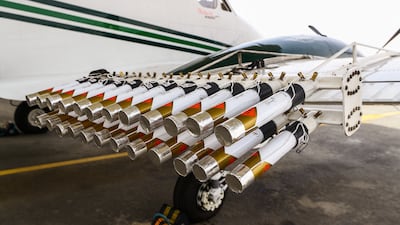
Hygroscopic (water-attracting) salt flares are attached to an aircraft at Al Ain International Airport before a cloud-seeding flight operated by the National Centre of Meteorology. The UAE has been leading the effort to seed clouds and increase precipitation, which remains at less than 100 millimetres a year on average. All photos by Reuters -
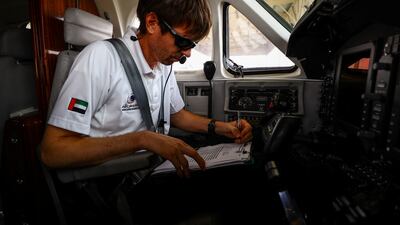
Pilot Michael Anstis writes a weather report before the cloud-seeding flight from Al Ain. -

An airport employee closes an aircraft door, with hygroscopic salt flares seen in the background, before the cloud-seeding flight. -
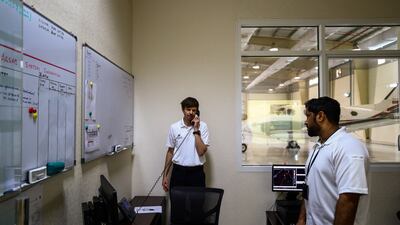
Pilots Michael Anstis and Ahmed Al Jaberi receive instructions before the flight. -

The control room at the National Centre of Meteorology in Abu Dhabi. -
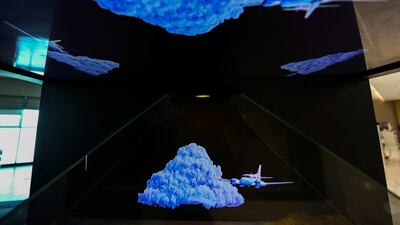
An explanatory hologram of the cloud-seeding process in the National Centre of Meteorology control room in Abu Dhabi. -
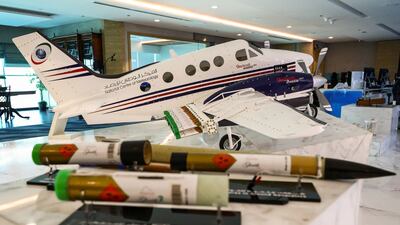
Cloud-seeding flares in the National Centre of Meteorology control room. -
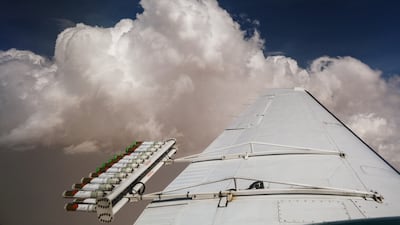
Hygroscopic salt flares are attached to an aircraft during a cloud-seeding flight between Al Ain and Al Hayer. At 9,000 feet above sea level, the plane releases the flares into the most promising white clouds, hoping to trigger rainfall. -

Hygroscopic salt flares are attached to an aircraft during a cloud-seeding flight. Scientists in Abu Dhabi combine shooting the flares with releasing salt nanoparticles, a newer technology, into the clouds to stimulate and accelerate the condensation process and hopefully produce droplets big enough to then fall as rain. -
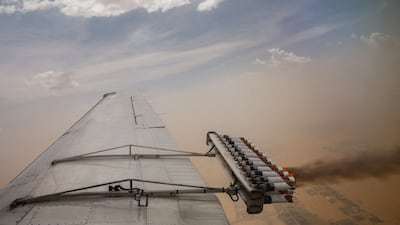
Flares are released during a cloud-seeding flight between Al Ain and Al Hayer. -
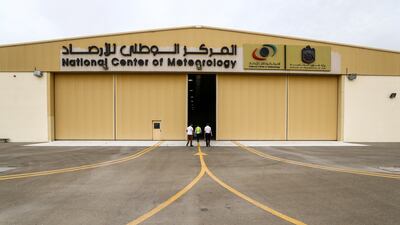
Employees walk towards a hangar at Al Ain International Airport after a cloud-seeding flight.


Water security in focus
The Middle East and North Africa region has major challenges in water security. According to UN data from 2018, the region has 11 of the 17 most water-stressed countries in the world.
Figures from the World Bank say about two billion people around the world lack access to safely managed drinking water.
Ms Al Mazrouei said these statistics underline the “urgent need” for weather modification experts and the global scientific community to tackle the issue.
“The forum serves as an important platform … to address pressing water security challenges,” Ms Al Mazrouei said.
UAEREP, which is overseen by the NCM, was founded in 2015 to try to address these issues by harnessing the best ideas from around the world to boost rainfall.
Since 2015, it has awarded Dh82.6 million in grants to researchers around the world.
Previous winners include efforts to use drones to seed clouds and the creation of artificial updrafts in clouds that can help in rain enhancement, and developing algorithms to pinpoint clouds with potential for yielding more rain.
The next cycle of awards will be launched on the event’s first day. Researchers from around the world have from January 28 to March 20, 2025, to submit their proposals. The awards will be announced in 2026.
UAE at forefront of responsible cloud seeding efforts
The UAE, an arid country that receives on average about 100mm of rain a year, has been at the forefront of cloud seeding efforts to address water security, help agriculture, and find another source to costly desalination.
When experts see a cloud that is suitable, a plane is dispatched to “seed” the cloud, typically with salt as it naturally attracts water. The objective is not to make it rain but enhance it.
Ms Al Mazrouei said studies had shown that cloud seeding was “viable and cost-effective” and had the potential to increase rainfall by about “10 to 25 per cent” but it “differs according to conditions”. She said the UAE’s programme used environmentally friendly materials. More research is needed into the topic.
-
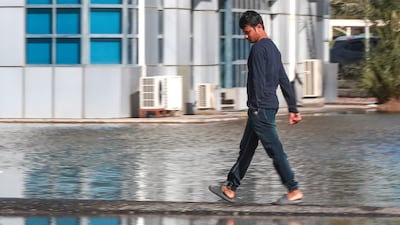
Floodwater in Mussaffah Industrial City, Abu Dhabi. Victor Besa / The National -

A lorry navigates a flooded section of Al Qudra Road after heavy rain in Dubai. Chris Whiteoak / The National -

Vehicles brave flooded Al Qudra Road in Dubai. Chris Whiteoak / The National -

Gridlock ensues on flooded Al Qudra Road in Dubai. Chris Whiteoak / The National -

Caution was urged by police following the heavy rain in Dubai that caused flooding on several roads. Chris Whiteoak / The National -
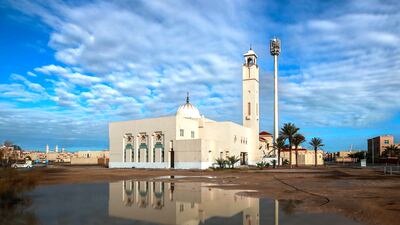
Floodwaters rise near a mosque in Khalifa City, Abu Dhabi. Victor Besa / The National -
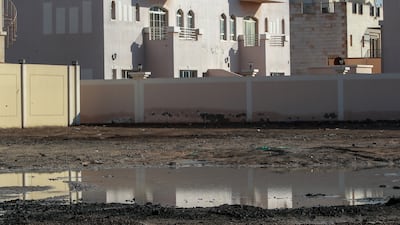
Floodwater creeps between homes in Khalifa City, Abu Dhabi. Victor Besa / The National -
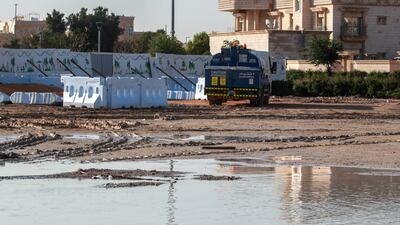
Stagnant floodwater in Khalifa City, Abu Dhabi. Victor Besa / The National -
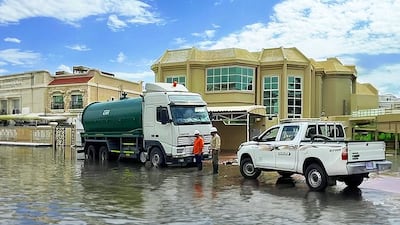
Dubai Municipality has responded to floods caused by the heavy rain. Photo: Dubai Municipality -

Dubai Municipality workers join the clean-up effort following bouts of heavy rain. Photo: Dubai Municipality


Dispersing the myths
Last April, when the UAE recorded its record heaviest rainfall many speculated that seeding could have played a role in the historic deluge.
The NCM told The National then no cloud seeding missions took place during the day of the torrential rain. It has previously said several times that it is too dangerous to use seeding planes during severe weather.
Experts also said that climate change also was likely to have intensified the storms.
Ms Al Mazrouei said some “myths” had circulated as seeding does not take place during extreme weather events.
“Before any operation, we see the water cells in our radars,” she said. “Then a decision is taken. When you have extreme [weather] … you don’t interfere.”
The forum runs in Abu Dhabi from January 28 to 30.

