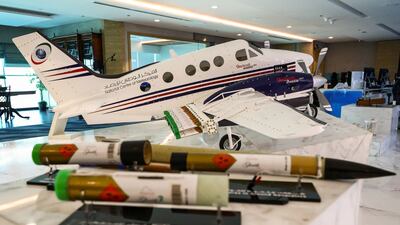
A cloud-seeding plane flies over the Sheikh Zayed Mosque in Abu Dhabi. Photo: National Centre of Meteorology and Seismology

Cloud-seeding must weather 'rampant' misinformation storm, expert warns


John Dennehy
  • English
  • Arabic

Cloud-seeding is a crucial tool in securing new supplies of freshwater, the process "100 per cent works" and it can help bolster water security, a leading US expert has told The National.

Kala Golden, cloud-seeding programme manager for the state of Idaho, was speaking on the sidelines of the International Rain Enhancement Forum in Abu Dhabi on Tuesday, and highlighted studies which found how effective it can be.

However, she warned that more research was needed, while misinformation about seeding is running rampant and needs to be tackled.

Idaho is a landlocked, mountainous state in the western US with water use driven by many factors including agriculture and, unlike the UAE which tries to generate more rain, the state is trying to encourage more snowfall. “We're seeing declining snowpacks and earlier melt-off, which is detrimental [for all industries],” Ms Golden told The National.

Kala Golden, cloud seeding programme manager for the state of Idaho. Photo: Kala Golden

The only option?

“What's the solution? Where are you going to get more water?" Ms Golden said. "You can't build a pipeline because it's not cost-effective and we're not near an ocean so you can't truck it in because of the quantities of water we use – cloud-seeding is the only mechanism we have to bring more water to our state."

The state's programme runs through the winter and tries to bolster snowfall in its basins, from where Idaho gets much of its water. When asked if seeding was effective, she said “100 per cent”.

She drew attention to a 2017 study in Idaho that captured on radar an unnatural zigzag pattern from an aircraft during a seeding mission. “As this aircraft was seeding, it was generating ice and they were able to measure the ice reflectivity from radar scans and quantify some of it,” she said.

Cloud seeding in the US

Map of states with active cloud seeding programmes in 2024. Source: US government accountability office report

“This one image is largely what we consider the ‘holy grail’ in wintertime seeding. The impact from that research was monumental. Cloud-seeding really just started to blow up across the western US because of that.”

Ms Golden said more studies were needed but some pinpointed increases in precipitation of up to 15 per cent.

The Idaho programme uses silver iodide rather than salt, which is what the UAE largely uses, but the aim is the same. “I like to tell people is that we're wringing more water out of the sky," Ms Golden said. "We just do it in the form of snow because, where we live, snowpack is our primary water storage. More snow means more water run-off.”

How important is the UAE's programme?

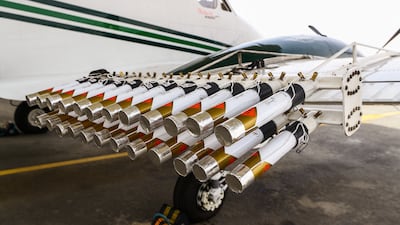
  • Hygroscopic (water-attracting) salt flares are attached to an aircraft at Al Ain International Airport before a cloud-seeding flight operated by the National Centre of Meteorology. The UAE has been leading the effort to seed clouds and increase precipitation, which remains at less than 100 millimetres a year on average. All photos by Reuters
    Hygroscopic (water-attracting) salt flares are attached to an aircraft at Al Ain International Airport before a cloud-seeding flight operated by the National Centre of Meteorology. The UAE has been leading the effort to seed clouds and increase precipitation, which remains at less than 100 millimetres a year on average. All photos by Reuters
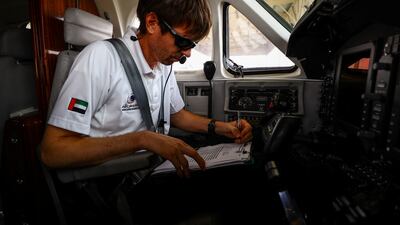
  • Pilot Michael Anstis writes a weather report before the cloud-seeding flight from Al Ain.
    Pilot Michael Anstis writes a weather report before the cloud-seeding flight from Al Ain.
  • An airport employee closes an aircraft door, with hygroscopic salt flares seen in the background, before the cloud-seeding flight.
    An airport employee closes an aircraft door, with hygroscopic salt flares seen in the background, before the cloud-seeding flight.
  • Pilots Michael Anstis and Ahmed Al Jaberi receive instructions before the flight.
    Pilots Michael Anstis and Ahmed Al Jaberi receive instructions before the flight.
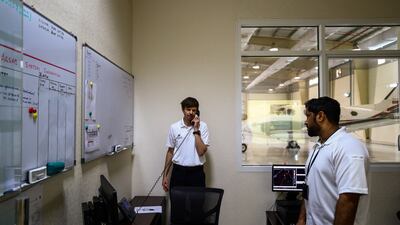
  • The control room at the National Centre of Meteorology in Abu Dhabi.
    The control room at the National Centre of Meteorology in Abu Dhabi.
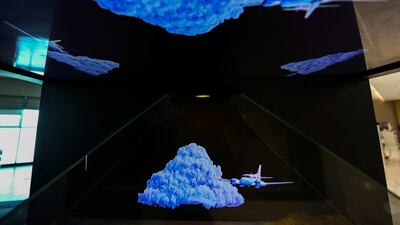
  • An explanatory hologram of the cloud-seeding process in the National Centre of Meteorology control room in Abu Dhabi.
    An explanatory hologram of the cloud-seeding process in the National Centre of Meteorology control room in Abu Dhabi.
  • Cloud-seeding flares in the National Centre of Meteorology control room.
    Cloud-seeding flares in the National Centre of Meteorology control room.
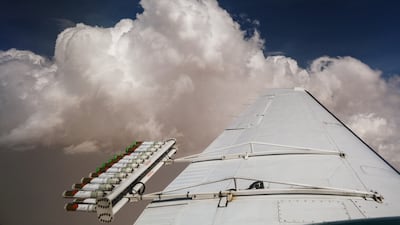
  • Hygroscopic salt flares are attached to an aircraft during a cloud-seeding flight between Al Ain and Al Hayer. At 9,000 feet above sea level, the plane releases the flares into the most promising white clouds, hoping to trigger rainfall.
    Hygroscopic salt flares are attached to an aircraft during a cloud-seeding flight between Al Ain and Al Hayer. At 9,000 feet above sea level, the plane releases the flares into the most promising white clouds, hoping to trigger rainfall.
  • Hygroscopic salt flares are attached to an aircraft during a cloud-seeding flight. Scientists in Abu Dhabi combine shooting the flares with releasing salt nanoparticles, a newer technology, into the clouds to stimulate and accelerate the condensation process and hopefully produce droplets big enough to then fall as rain.
    Hygroscopic salt flares are attached to an aircraft during a cloud-seeding flight. Scientists in Abu Dhabi combine shooting the flares with releasing salt nanoparticles, a newer technology, into the clouds to stimulate and accelerate the condensation process and hopefully produce droplets big enough to then fall as rain.
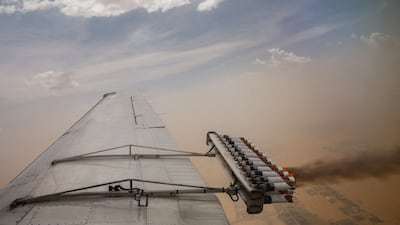
  • Flares are released during a cloud-seeding flight between Al Ain and Al Hayer.
    Flares are released during a cloud-seeding flight between Al Ain and Al Hayer.
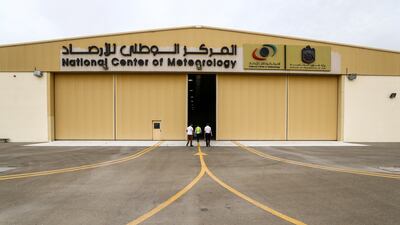
  • Employees walk towards a hangar at Al Ain International Airport after a cloud-seeding flight.
    Employees walk towards a hangar at Al Ain International Airport after a cloud-seeding flight.

Ms Golden’s comments came on the first day of a conference that, over the next few days, will feature scores of experts from across the world discussing weather modification and water security. The role of artificial intelligence in seeding was a major talking point on the first day but conversations also took place on water scarcity and security.

It is the seventh International Rain Enhancement Forum, which takes place every two years, and the UAE’s cloud-seeding programme, which Ms Golden described as a "global example", has been around since the 1990s. "More countries could learn from them and their advancements, and their willingness to collaborate and to support global water security,” she said.

One challenge Ms Golden flagged up was an increase in misinformation and disinformation in the past few years, fuelled largely by social media. “We've had accusations that we're starting hurricanes or controlling floods [or creating] chemtrails," she said. “I think that really draws attention to the fact there is a lot of misinformation."

Seeding efforts have also been challenged by some who say it amounts to overinterference with natural processes. Ms Golden says she has heard this criticism but highlights other interventions such as building dams.

“That's messing with the natural system,” she said, "there's lots of other examples. The biggest concerns we hear about are health concerns, which we feel like aren't warranted," she said, stating the programme disperses a small amount of silver iodide.

"It is unlikely that it could ever accumulate into an amount that could be detrimental ... but trying to communicate that to the public and help them understand that has been an uphill battle." However, more studies on its use and health impacts have been called for.

She also said politics can also come into the arena. Only last year the state of Tennessee banned "geoengineering", including seeding. “It's sort of a dangerous precedent – cloud-seeding aside – I feel, to be considering or setting policy without science and factually based information, but cloud-seeding is where we're seeing that happening right now."

The gathering in Abu Dhabi is being hosted by the National Centre of Meteorology (NCM) through its UAE Research Programme for Rain Enhancement Science.

Since that project was established in 2015, it has awarded Dh82.6 million ($22.5 million) in grants to researchers around the world. A new cycle of awards was launched on Monday, with researchers having until March 20, 2025, to submit their proposals.

Grants of Dh5.5 million for up to three winning project proposals are on offer, with those successful being announced next year. “Gathering the people here will push the science of cloud-seeding forward,” said Dr Abdulla Al Mandous, director general at the NCM. "The benefit from this gathering is for the whole world."

The forum continues in Abu Dhabi until Thursday.

While you're here
if you go

The flights

Etihad, Emirates and Singapore Airlines fly direct from the UAE to Singapore from Dh2,265 return including taxes. The flight takes about 7 hours.

The hotel

Rooms at the M Social Singapore cost from SG $179 (Dh488) per night including taxes.

The tour

Makan Makan Walking group tours costs from SG $90 (Dh245) per person for about three hours. Tailor-made tours can be arranged. For details go to www.woknstroll.com.sg

Ten tax points to be aware of in 2026

1. Domestic VAT refund amendments: request your refund within five years

If a business does not apply for the refund on time, they lose their credit.

2. E-invoicing in the UAE

Businesses should continue preparing for the implementation of e-invoicing in the UAE, with 2026 a preparation and transition period ahead of phased mandatory adoption. 

3. More tax audits

Tax authorities are increasingly using data already available across multiple filings to identify audit risks. 

4. More beneficial VAT and excise tax penalty regime

Tax disputes are expected to become more frequent and more structured, with clearer administrative objection and appeal processes. The UAE has adopted a new penalty regime for VAT and excise disputes, which now mirrors the penalty regime for corporate tax.

5. Greater emphasis on statutory audit

There is a greater need for the accuracy of financial statements. The International Financial Reporting Standards standards need to be strictly adhered to and, as a result, the quality of the audits will need to increase.

6. Further transfer pricing enforcement

Transfer pricing enforcement, which refers to the practice of establishing prices for internal transactions between related entities, is expected to broaden in scope. The UAE will shortly open the possibility to negotiate advance pricing agreements, or essentially rulings for transfer pricing purposes. 

7. Limited time periods for audits

Recent amendments also introduce a default five-year limitation period for tax audits and assessments, subject to specific statutory exceptions. While the standard audit and assessment period is five years, this may be extended to up to 15 years in cases involving fraud or tax evasion. 

8. Pillar 2 implementation 

Many multinational groups will begin to feel the practical effect of the Domestic Minimum Top-Up Tax (DMTT), the UAE's implementation of the OECD’s global minimum tax under Pillar 2. While the rules apply for financial years starting on or after January 1, 2025, it is 2026 that marks the transition to an operational phase.

9. Reduced compliance obligations for imported goods and services

Businesses that apply the reverse-charge mechanism for VAT purposes in the UAE may benefit from reduced compliance obligations. 

10. Substance and CbC reporting focus

Tax authorities are expected to continue strengthening the enforcement of economic substance and Country-by-Country (CbC) reporting frameworks. In the UAE, these regimes are increasingly being used as risk-assessment tools, providing tax authorities with a comprehensive view of multinational groups’ global footprints and enabling them to assess whether profits are aligned with real economic activity. 

Contributed by Thomas Vanhee and Hend Rashwan, Aurifer

Star%20Wars%3A%20Ahsoka%20
%3Cp%3E%3Cstrong%3EDirector%3A%3C%2Fstrong%3E%20Various%20%3Cbr%3E%3Cstrong%3EStarring%3A%3C%2Fstrong%3E%20Rosario%20Dawson%2C%20Natasha%20Liu%20Bordizzo%2C%20Lars%20Mikkelsen%20%3Cbr%3E%3Cstrong%3ERating%3A%3C%2Fstrong%3E%204%2F5%0D%3Cbr%3E%3C%2Fp%3E%0A
MATCH INFO

Liverpool 2 (Van Dijk 18', 24')

Brighton 1 (Dunk 79')

Red card: Alisson (Liverpool)

RESULT

RS Leipzig 3 

Marcel Sabitzer 10', 21'

Emil Forsberg 87'

Tottenham 0


Martin Sabbagh profile

Job: CEO JCDecaux Middle East

In the role: Since January 2015

Lives: In the UAE

Background: M&A, investment banking

Studied: Corporate finance

THREE
%3Cp%3EDirector%3A%20Nayla%20Al%20Khaja%3C%2Fp%3E%0A%3Cp%3EStarring%3A%20Jefferson%20Hall%2C%20Faten%20Ahmed%2C%20Noura%20Alabed%2C%20Saud%20Alzarooni%3C%2Fp%3E%0A%3Cp%3ERating%3A%203.5%2F5%3C%2Fp%3E%0A

England v South Africa schedule:

  • First Test: At Lord's, England won by 219 runs
  • Second Test: July 14-18, Trent Bridge, Nottingham, 2pm
  • Third Test: The Oval, London, July 27-31, 2pm
  • Fourth Test: Old Trafford, Manchester, August 4-8
Who's who in Yemen conflict

Houthis: Iran-backed rebels who occupy Sanaa and run unrecognised government

Yemeni government: Exiled government in Aden led by eight-member Presidential Leadership Council

Southern Transitional Council: Faction in Yemeni government that seeks autonomy for the south

Habrish 'rebels': Tribal-backed forces feuding with STC over control of oil in government territory

Updated: January 29, 2025, 9:07 AM