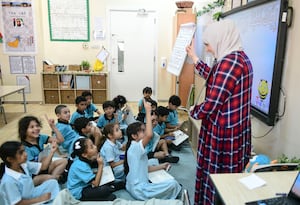
The UAE is home to some of the best private school brands in the world. That will soon include two campuses of the UK's renowned Harrow School.
But as the UAE experiences an influx of residents, particularly in Dubai and Abu Dhabi, securing places for children at the best schools has become competitive.
Whether you're new to the Emirates' education system and don't know where to start, or looking to switch your child's school, here's everything you need to know about getting a place.
How has demand changed over the past year?
There has been a significant increase in enrolments, driven by the high number of families moving to the UAE, notably from the UK, said Victoria Lumby, senior vice president of growth at Gems Education. “Year on year, our total enrolments have risen by approximately 5 per cent.”
To meet this rising demand, Gems Education has expanded capacity at some of its schools across Dubai and Abu Dhabi. It also opened Gems Education Founders School – Masdar City and Gems Education Founders School – Dubai South last year, with Gems Education School of Research and Innovation to follow next month.
Nikki Holman, head of admissions of UK curriculum schools at Taaleem, reported a similar increase.
“Over the past year, we have experienced accelerating demand across our school portfolio,” she said.
“New campuses such as Dubai British School Jumeira have reached high utilisation within their first year, and DBS Mira, set to open in August 2025, is already enrolling over 700 students, a record for a premium school in Dubai.”
How do I know if a school is good?
In Dubai, the Knowledge and Human Development Authority (KHDA) rates schools regularly with six rankings, from “very weak” to “outstanding”. The rankings are available to the public in the Education Directory on its website.
The Abu Dhabi Department of Education and Knowledge (Adek) does the same, and these ratings are also available on its website.
Inspection criteria include students' achievement and progress, teaching and learning quality, curriculum and resources, leadership, management, environment, and safety. The KHDA also measures well-being and inclusion.
“We advise families to visit schools, speak with leadership teams, try to meet parents already at the school and review KHDA or Adek inspection reports to understand the unique strengths of each school,” said Ms Holman.
How do I choose the right curriculum?
It's important to consider your children's learning needs, said Ms Holman. “For families who may return to their home country, choosing a familiar curriculum often supports continuity. Although the British curriculum is by far the most popular among families, the International Baccalaureate is widely recognised as a highly transportable curriculum for globally mobile families,” she added.
There are several curriculum frameworks to choose from in the UAE. Taaleem schools also offer American and French curriculums, while Gems Education also offers an Indian curriculum.
How much are fees?
Education institutions in Dubai and Abu Dhabi can vary widely when it comes to fees. In May, the KHDA announced that private schools in Dubai will be allowed to increase tuition fees by up to 2.35 per cent in the 2025-2026 academic year.
The fees can be found on each school's website. For example, following the price rise, at Kings' School Al Barsha in Dubai, Foundation Stage 1 costs Dh57,999, while Year 13 is Dh105,873.
Brighton College Abu Dhabi charges Dh50,830 for nursery and Dh80,780 for Year 13.
When should parents start the admissions process?
The earlier the better. “Choosing the right school for your child is a significant decision and one that should be made with careful consideration and time to explore all aspects of the school,” said Luke Steward, director of admissions and marketing at Swiss International Scientific School Dubai.
“Our admissions for the 2026/27 academic year will open once the current school year is under way, while we continue to accept applications for the current year where space is available.”
Most schools open admissions in January for the academic year beginning the following September, said Ms Holman. At Gems Education, schools accept applications a full year in advance and they are open during the summer for tours and support with applications, added Ms Lumby.
What is the admissions process?
The process is similar across schools. It often includes an online application form, an application fee and the submission of documents, such as passport copies, visa pages, Emirates ID and school reports, depending on the year group you're applying for.
An assessment appointment will follow and, if successful, an offer letter will be issued. The place will be reserved with a signed offer and deposit.
What should my child expect from the admissions test?
Tests depend on the grade and curriculum. They typically cover key subjects such as science, maths and English. In Abu Dhabi, children are accepted on a first-come, first-served basis and the tests are used to help determine their grade level. In Dubai, assessments are often prerequisites for elite schools and some carry a non-refundable fee of up to Dh1,000
What happens if we are put on the waiting list?
For many schools, being placed on a waiting list is common because year groups fill up fast, particularly in transitional years such as Foundation Stage or Year 1.
For example, Gems Education schools such as Jumeirah Primary School, Jumeirah College and Gems Education Wellington International School have waiting lists across all year groups. Others, such as Gems Education International School, only have them in some year groups.
Finding yourself on the waiting list can be unsettling for families, said Mr Steward of Swiss International Scientific School Dubai. “While there is often movement as family plans shift, we can never guarantee when a place will become available,” he added.
“We always recommend that families check in with our admissions office as early as possible to understand current availability. Staying in regular contact ensures you're well positioned if a space becomes available.”
At Gems Education, application fees need to be paid and assessments completed even if you're on the waiting list.
“Wait-listed families are then updated on a termly basis, but will need to reapply if they've been on the wait-list for over two years,” said Ms Lumby. “When a seat becomes available, students with siblings already attending the school are given priority; otherwise, it's first come, first served.”
What are common documentation issues?
One of the most important documents is a transfer certificate from your child's current school. “Depending on your country of origin, this may need to be attested,” said Mr Steward. “If this step is missed or not completed properly, it can cause delays in final enrolment.”
Beyond this, teacher recommendations are often required, which can be difficult to obtain during summer holidays.
“School reports are occasionally submitted in informal formats which can lead to delays,” added Mr Steward. “Wherever possible, we kindly ask families to provide official, signed and dated academic records.”
Remote assessments may also be required if the student cannot attend in person. “These require appropriate invigilation to be considered valid, which can be a challenge if your current school is closed or teachers are unavailable during holidays,” said Mr Steward.
Ms Holman also advised families to bring original birth certificates, immunisation records and previous school reports for the last two academic years.
What support do schools offer families who are new to the UAE?
Everything from personalised school tours to transition support, admissions consultations and a step-by-step onboarding process are offered, said Ms Holman.
“Our community-focused schools provide induction programmes for both students and parents, including orientation events, communication guidance and resources about life in the UAE.”
What should I do if my child has additional needs?
While inclusion services for children with physical or intellectual disabilities are mandatory as per the KHDA and Adek, provision widely varies, so parents should carry out detailed research to find the right fit, said Victoria McKeown, a neurodiversity specialist known as The Diverse Mind Coach.
“Try to get the school to offer a trial session. Very often, when they see what the child's needs are, they realise they can accommodate them because their needs aren't significant enough to need a huge amount of support,” she said.
If a school is insisting on a learning support assistant (LSA), which comes at an extra cost, parents need to advocate for themselves, Ms McKeown added. “Ask: what would the LSA be used for? How do you know my child will need this LSA, and also what would a phasing-out plan look like? How will we know when we don't need an LSA any more?”
Above all, it's important to decide whether the school will be able to meet your children's needs, said Ms McKeown.
Profile of Tarabut Gateway
Founder: Abdulla Almoayed
Based: UAE
Founded: 2017
Number of employees: 35
Sector: FinTech
Raised: $13 million
Backers: Berlin-based venture capital company Target Global, Kingsway, CE Ventures, Entrée Capital, Zamil Investment Group, Global Ventures, Almoayed Technologies and Mad’a Investment.
Results:
6.30pm: Al Maktoum Challenge Round-2 (PA) | Group 1 US$75,000 (Dirt) | 2,200 metres
Winner: Goshawke, Fernando Jara (jockey), Ali Rashid Al Raihe (trainer)
7.05pm: UAE 1000 Guineas (TB) | Listed $250,000 (D) | 1,600m
Winner: Silva, Oisin Murphy, Pia Brendt
7.40pm: Meydan Classic Trial (TB) | Conditions $100,000 (Turf) | 1,400m
Winner: Golden Jaguar, Connor Beasley, Ahmad bin Harmash
8.15pm: Al Shindagha Sprint (TB) | Group 3 $200,000 (D) | 1,200m
Winner: Drafted, Pat Dobbs, Doug Watson
8.50pm: Handicap (TB) | $175,000 (D) | 1,600m
Winner: Capezzano, Mickael Barzalona, Sandeep Jadhav
9.25pm: Handicap (TB) | $175,000 (T) | 2,000m
Winner: Oasis Charm, William Buick, Charlie Appleby
10pm: Handicap (TB) | $135,000 (T) | 1,600m
Winner: Escalator, Christopher Hayes, Charlie Fellowes
In-demand jobs and monthly salaries
- Technology expert in robotics and automation: Dh20,000 to Dh40,000
- Energy engineer: Dh25,000 to Dh30,000
- Production engineer: Dh30,000 to Dh40,000
- Data-driven supply chain management professional: Dh30,000 to Dh50,000
- HR leader: Dh40,000 to Dh60,000
- Engineering leader: Dh30,000 to Dh55,000
- Project manager: Dh55,000 to Dh65,000
- Senior reservoir engineer: Dh40,000 to Dh55,000
- Senior drilling engineer: Dh38,000 to Dh46,000
- Senior process engineer: Dh28,000 to Dh38,000
- Senior maintenance engineer: Dh22,000 to Dh34,000
- Field engineer: Dh6,500 to Dh7,500
- Field supervisor: Dh9,000 to Dh12,000
- Field operator: Dh5,000 to Dh7,000
KILLING OF QASSEM SULEIMANI
UAE currency: the story behind the money in your pockets
Mercer, the investment consulting arm of US services company Marsh & McLennan, expects its wealth division to at least double its assets under management (AUM) in the Middle East as wealth in the region continues to grow despite economic headwinds, a company official said.
Mercer Wealth, which globally has $160 billion in AUM, plans to boost its AUM in the region to $2-$3bn in the next 2-3 years from the present $1bn, said Yasir AbuShaban, a Dubai-based principal with Mercer Wealth.
“Within the next two to three years, we are looking at reaching $2 to $3 billion as a conservative estimate and we do see an opportunity to do so,” said Mr AbuShaban.
Mercer does not directly make investments, but allocates clients’ money they have discretion to, to professional asset managers. They also provide advice to clients.
“We have buying power. We can negotiate on their (client’s) behalf with asset managers to provide them lower fees than they otherwise would have to get on their own,” he added.
Mercer Wealth’s clients include sovereign wealth funds, family offices, and insurance companies among others.
From its office in Dubai, Mercer also looks after Africa, India and Turkey, where they also see opportunity for growth.
Wealth creation in Middle East and Africa (MEA) grew 8.5 per cent to $8.1 trillion last year from $7.5tn in 2015, higher than last year’s global average of 6 per cent and the second-highest growth in a region after Asia-Pacific which grew 9.9 per cent, according to consultancy Boston Consulting Group (BCG). In the region, where wealth grew just 1.9 per cent in 2015 compared with 2014, a pickup in oil prices has helped in wealth generation.
BCG is forecasting MEA wealth will rise to $12tn by 2021, growing at an annual average of 8 per cent.
Drivers of wealth generation in the region will be split evenly between new wealth creation and growth of performance of existing assets, according to BCG.
Another general trend in the region is clients’ looking for a comprehensive approach to investing, according to Mr AbuShaban.
“Institutional investors or some of the families are seeing a slowdown in the available capital they have to invest and in that sense they are looking at optimizing the way they manage their portfolios and making sure they are not investing haphazardly and different parts of their investment are working together,” said Mr AbuShaban.
Some clients also have a higher appetite for risk, given the low interest-rate environment that does not provide enough yield for some institutional investors. These clients are keen to invest in illiquid assets, such as private equity and infrastructure.
“What we have seen is a desire for higher returns in what has been a low-return environment specifically in various fixed income or bonds,” he said.
“In this environment, we have seen a de facto increase in the risk that clients are taking in things like illiquid investments, private equity investments, infrastructure and private debt, those kind of investments were higher illiquidity results in incrementally higher returns.”
The Abu Dhabi Investment Authority, one of the largest sovereign wealth funds, said in its 2016 report that has gradually increased its exposure in direct private equity and private credit transactions, mainly in Asian markets and especially in China and India. The authority’s private equity department focused on structured equities owing to “their defensive characteristics.”
The cost of Covid testing around the world
Egypt
Dh514 for citizens; Dh865 for tourists
Information can be found through VFS Global.
Jordan
Dh212
Centres include the Speciality Hospital, which now offers drive-through testing.
Cambodia
Dh478
Travel tests are managed by the Ministry of Health and National Institute of Public Health.
Zanzibar
AED 295
Zanzibar Public Health Emergency Operations Centre, located within the Lumumba Secondary School compound.
Abu Dhabi
Dh85
Abu Dhabi’s Seha has test centres throughout the UAE.
UK
From Dh400
Heathrow Airport now offers drive through and clinic-based testing, starting from Dh400 and up to Dh500 for the PCR test.
More on Quran memorisation:
World record transfers
1. Kylian Mbappe - to Real Madrid in 2017/18 - €180 million (Dh770.4m - if a deal goes through)
2. Paul Pogba - to Manchester United in 2016/17 - €105m
3. Gareth Bale - to Real Madrid in 2013/14 - €101m
4. Cristiano Ronaldo - to Real Madrid in 2009/10 - €94m
5. Gonzalo Higuain - to Juventus in 2016/17 - €90m
6. Neymar - to Barcelona in 2013/14 - €88.2m
7. Romelu Lukaku - to Manchester United in 2017/18 - €84.7m
8. Luis Suarez - to Barcelona in 2014/15 - €81.72m
9. Angel di Maria - to Manchester United in 2014/15 - €75m
10. James Rodriguez - to Real Madrid in 2014/15 - €75m
Learn more about Qasr Al Hosn
In 2013, The National's History Project went beyond the walls to see what life was like living in Abu Dhabi's fabled fort:
MATCH INFO
Manchester City 3
Danilo (16'), Bernardo Silva (34'), Fernandinho (72')
Brighton & Hove Albion 1
Ulloa (20')
The biog
Job: Fitness entrepreneur, body-builder and trainer
Favourite superhero: Batman
Favourite quote: We must become the change we want to see, by Mahatma Gandhi.
Favourite car: Lamborghini
Will the pound fall to parity with the dollar?
The idea of pound parity now seems less far-fetched as the risk grows that Britain may split away from the European Union without a deal.
Rupert Harrison, a fund manager at BlackRock, sees the risk of it falling to trade level with the dollar on a no-deal Brexit. The view echoes Morgan Stanley’s recent forecast that the currency can plunge toward $1 (Dh3.67) on such an outcome. That isn’t the majority view yet – a Bloomberg survey this month estimated the pound will slide to $1.10 should the UK exit the bloc without an agreement.
New Prime Minister Boris Johnson has repeatedly said that Britain will leave the EU on the October 31 deadline with or without an agreement, fuelling concern the nation is headed for a disorderly departure and fanning pessimism toward the pound. Sterling has fallen more than 7 per cent in the past three months, the worst performance among major developed-market currencies.
“The pound is at a much lower level now but I still think a no-deal exit would lead to significant volatility and we could be testing parity on a really bad outcome,” said Mr Harrison, who manages more than $10 billion in assets at BlackRock. “We will see this game of chicken continue through August and that’s likely negative for sterling,” he said about the deadlocked Brexit talks.
The pound fell 0.8 per cent to $1.2033 on Friday, its weakest closing level since the 1980s, after a report on the second quarter showed the UK economy shrank for the first time in six years. The data means it is likely the Bank of England will cut interest rates, according to Mizuho Bank.
The BOE said in November that the currency could fall even below $1 in an analysis on possible worst-case Brexit scenarios. Options-based calculations showed around a 6.4 per cent chance of pound-dollar parity in the next one year, markedly higher than 0.2 per cent in early March when prospects of a no-deal outcome were seemingly off the table.
Bloomberg
The biog
Name: Shamsa Hassan Safar
Nationality: Emirati
Education: Degree in emergency medical services at Higher Colleges of Technology
Favourite book: Between two hearts- Arabic novels
Favourite music: Mohammed Abdu and modern Arabic songs
Favourite way to spend time off: Family visits and spending time with friends
More from Rashmee Roshan Lall