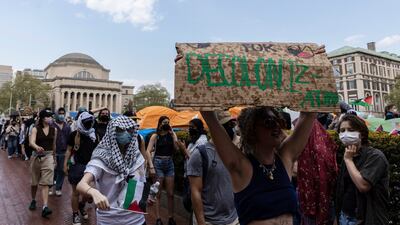
Pro-Palestine students celebrate a deal with the administration at Brown University in Providence, Rhode Island, in April. AFP

These US and Canadian universities have negotiated Israel divestment with Gaza protesters


Patrick deHahn
  • English
  • Arabic

Live updates: Follow the latest on Israel-Gaza

Student protesters on campuses across the US have been demanding their universities disclose financial investments and divest from companies or academic institutions connected to Israel's actions in the Palestinian territories.

Other protesters have included requests for their universities to call for a Gaza ceasefire, no policing on campuses, amnesty for those arrested during protests, and better services protecting and serving Muslim and Arab communities.

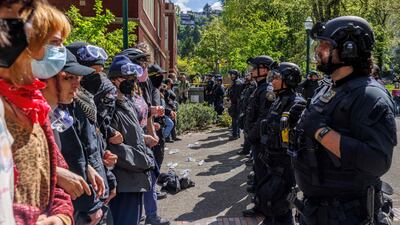
Amid widespread university-ordered police operations on pro-Palestine protest camps, some institutions have chosen to negotiate with students.

Columbia University in New York, where the protests first gathered steam, has said that it will not divest from Israel, although other institutions have proven more willing to negotiate.

But at Union Theological Seminary, an affiliated college, the board of trustees said it would support calls to divest from “companies substantially and intractably benefiting from the war in Palestine”.

Brown University, an Ivy League institution in Rhode Island, agreed to have its highest governing body vote on divestment in October, after protest organisers met administrators to discuss their demands.

“The devastation and loss of life in the Middle East has prompted many to call for meaningful change, while also raising real issues about how best to accomplish this,” Brown president Christina Paxson said on April 30.

“Brown has always prided itself on resolving differences through dialogue, debate and listening to each other.”

While the protest camp there has moved on, the Brown Divest Coalition said the fight continues.

“We will not let our agreement be used to pacify this movement,” it said in a post on X. “Rather, we will use it to fuel us further.”

On May 20, the New School's investment committee of the board of trustees at the university in New York agreed to vote in June on whether to "completely divest in companies" connected to Israel, after a student camp was cleared by police and the first faculty-led camp was set up in a campus building.

The University of Washington on May 17 agreed to improve transparency on its investment portfolio and meet student leaders to discuss how to approach divestment in the future.

The administration also said it would support scholarships for displaced students from Gaza, collaborate with Palestinian universities and look into whether existing study-abroad programmes exclude Arab students.

On May 14 at Harvard University, protesters ended their camp after president Alan Garber offered them a meeting with governing boards about questions on its investments and discuss their hopes for divestment.

Johns Hopkins University in Baltimore, Maryland, said on May 12 that it "promised a timely review of the protesters' key question of divestment" in return for an end to their protest camp.

On May 10, the University of Wisconsin-Madison agreed to let pro-Palestine students meet "relevant decision-makers" to discuss their "concerns and requests" on its endowment and investments.

At Evergreen State College in Washington, administrators said on May 8 that a committee would start to formulate strategies on “divestment from companies that profit from gross human rights violations and/or the occupation of Palestinian territories”.

On May 7, Sacramento State under California State University announced that it will no longer invest in "corporations that profit from genocide, ethnic cleansing and activities that violate fundamental human rights".

  • Students and activists protesting against the Gaza war face police after demonstrators were evicted from the library at Portland State University in Oregon. AFP
    Students and activists protesting against the Gaza war face police after demonstrators were evicted from the library at Portland State University in Oregon. AFP
  • A car is damaged after it was driven towards protesters at Portland State University. AFP
    A car is damaged after it was driven towards protesters at Portland State University. AFP
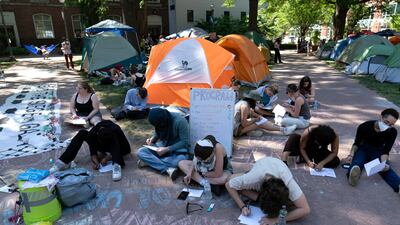
  • Students write letters in support of Palestinians in Gaza at an encampment at George Washington University, in Washington. AP
    Students write letters in support of Palestinians in Gaza at an encampment at George Washington University, in Washington. AP
  • Pro-Palestinian protesters confront a state trooper at the University of Texas in Austin. AFP
    Pro-Palestinian protesters confront a state trooper at the University of Texas in Austin. AFP
  • Texas State troopers stand guard at the University of Texas. AFP
    Texas State troopers stand guard at the University of Texas. AFP
  • A protester confronts University of Texas police. AFP
    A protester confronts University of Texas police. AFP
  • A demonstrator protests outside the encampment established in support of Palestinians in Gaza at Columbia University, in New York City. AFP
    A demonstrator protests outside the encampment established in support of Palestinians in Gaza at Columbia University, in New York City. AFP
  • A student protester flies a kite inside the protest encampment at Columbia University. AP
    A student protester flies a kite inside the protest encampment at Columbia University. AP
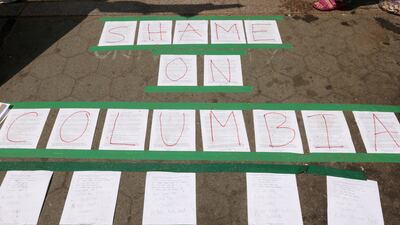
  • Students at Columbia University write a message as the conflict between Israel and Hamas continues. Reuters
    Students at Columbia University write a message as the conflict between Israel and Hamas continues. Reuters
  • Student protesters march round their encampment at Columbia University. AP
    Student protesters march round their encampment at Columbia University. AP
  • A student is arrested at a protest encampment on the Virginia Tech campus in Blacksburg. AP
    A student is arrested at a protest encampment on the Virginia Tech campus in Blacksburg. AP
  • Police move to bring down an encampment after several days of protests by pro-Palestinian activists on the Virginia Tech campus. AP
    Police move to bring down an encampment after several days of protests by pro-Palestinian activists on the Virginia Tech campus. AP
  • Vish Gill, a prominent figure at pro-Palestine protests, is arrested at Virginia Tech campus. AP
    Vish Gill, a prominent figure at pro-Palestine protests, is arrested at Virginia Tech campus. AP
  • Pro-Israel counter-protesters gather at a pro-Palestine demonstration at the University of California, Los Angeles. Reuters
    Pro-Israel counter-protesters gather at a pro-Palestine demonstration at the University of California, Los Angeles. Reuters
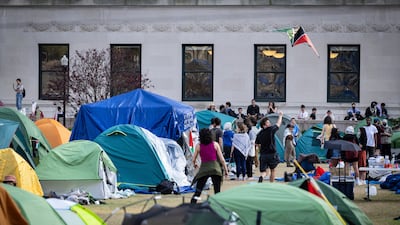
  • Pro-Palestine demonstrators gather on the campus of Columbia University. AP
    Pro-Palestine demonstrators gather on the campus of Columbia University. AP

Also on May 7, Occidental College in Los Angeles said it would call a special session of the investment committee of the board of trustees to consider the student divestment proposal, and hold an official board vote on the issue this June.

Protesters and Vassar College's president agreed on May 4 to have students present a proposal from divesting at a board of trustees meeting this May and in October.

The student protest group hopes to focus on "weapons and surveillance manufacturers, including those that supply Israel with the materials that carry out the genocide of the Palestinian people".

Rutgers University in New Jersey on May 2 agreed to most of the demands presented by protesters, except for divestment from Israel, which it said was already under review.

The president later said "divestment from Israel is wrong".

It also said a request to sever ties with Tel Aviv University is a “matter of scholarly inquiry”.

And the University of Minnesota on May 1 said it would disclose details on its financial holdings within weeks and that student protesters could speak with the board on divestment in a May meeting.

The university said it was open to hearing proposals on partnerships with Palestinian and Israeli universities.

Northwestern University in Illinois said on April 29 that it would provide opportunities for students to speak with the board of trustees' investment committee about their concerns and vowed to answer questions about university holdings in a timely manner.

While some view the move by these universities as successful, activist critics have argued that setting up committees to present proposals in the future is not directly meeting demands in a timely manner.

Divestment is not new to universities: Academic institutions have removed investments connected to apartheid in South Africa and to fossil fuel over climate change concerns.

On May 21, administrators and camp organisers at Ontario Tech University in Oshawa said that they had reached a divestment agreement, bringing the campus protests against investments connected to Israel's military to an end.

Ontario Tech is the first major educational institution in Canada to reach an agreement with protesters.

Columbia has drawn attention for requesting a police response twice and it has been clear in stating that it will not divest from Israel.

Columbia University president Nemat Shafik walks on campus in New York City. AFP

“While the university will not divest from Israel, the university offered to develop an expedited timeline for review of new proposals from the students by the advisory committee for socially responsible investing, the body that considers divestment matters,” president Nemat Shafik said in a statement on April 29.

“The university also offered to publish a process for students to access a list of Columbia’s direct investment holdings, and to increase the frequency of updates to that list of holdings.”

Internationally, Ireland's Trinity College Dublin reached an agreement with protesters to have them clear their camp on May 8 after it vowed to “complete a divestment from investments in Israeli companies that have activities in the occupied Palestinian territory and appear on the UN blacklist”.

The senate at the University of Barcelona also voted on May 8 to cut relations with Israel-linked companies and academic institutions “as a mechanism of pressure on the state of Israel until the genocide ends”.

Its motion still needs approval by the university board of directors and governing council.

Tomb%20Raider%20I%E2%80%93III%20Remastered
%3Cp%3EDeveloper%3A%20Aspyr%0D%3Cbr%3EPublisher%3A%20Aspyr%0D%3Cbr%3EConsole%3A%20Nintendo%20Switch%2C%20PlayStation%204%26amp%3B5%2C%20PC%20and%20Xbox%20series%20X%2FS%0D%3Cbr%3ERating%3A%203%2F5%3C%2Fp%3E%0A
Cricket World Cup League Two

Teams

Oman, UAE, Namibia

Al Amerat, Muscat


Results

Oman beat UAE by five wickets

UAE beat Namibia by eight runs

Namibia beat Oman by 52 runs

UAE beat Namibia by eight wickets


Fixtures

Saturday January 11 - UAE v Oman

Sunday January 12 – Oman v Namibia

History's medical milestones

1799 - First small pox vaccine administered

1846 - First public demonstration of anaesthesia in surgery

1861 - Louis Pasteur published his germ theory which proved that bacteria caused diseases

1895 - Discovery of x-rays

1923 - Heart valve surgery performed successfully for first time

1928 - Alexander Fleming discovers penicillin

1953 - Structure of DNA discovered

1952 - First organ transplant - a kidney - takes place 

1954 - Clinical trials of birth control pill

1979 - MRI, or magnetic resonance imaging, scanned used to diagnose illness and injury.

1998 - The first adult live-donor liver transplant is carried out

In numbers: PKK’s money network in Europe

Germany: PKK collectors typically bring in $18 million in cash a year – amount has trebled since 2010

Revolutionary tax: Investigators say about $2 million a year raised from ‘tax collection’ around Marseille

Extortion: Gunman convicted in 2023 of demanding $10,000 from Kurdish businessman in Stockholm

Drug trade: PKK income claimed by Turkish anti-drugs force in 2024 to be as high as $500 million a year

Denmark: PKK one of two terrorist groups along with Iranian separatists ASMLA to raise “two-digit million amounts”

Contributions: Hundreds of euros expected from typical Kurdish families and thousands from business owners

TV channel: Kurdish Roj TV accounts frozen and went bankrupt after Denmark fined it more than $1 million over PKK links in 2013 


Rock in a Hard Place: Music and Mayhem in the Middle East
Orlando Crowcroft
Zed Books

UAE currency: the story behind the money in your pockets
The specs: 2018 Nissan 370Z Nismo

The specs: 2018 Nissan 370Z Nismo
Price, base / as tested: Dh182,178
Engine: 3.7-litre V6
Power: 350hp @ 7,400rpm
Torque: 374Nm @ 5,200rpm
Transmission: Seven-speed automatic
​​​​​​​Fuel consumption, combined: 10.5L / 100km

The specs: 2019 Mini Cooper

Price, base: Dh141,740 (three-door) / Dh165,900 (five-door)
Engine: 1.5-litre four-cylinder (Cooper) / 2.0-litre four-cylinder (Cooper S)
Power: 136hp @ 4,500rpm (Cooper) / 192hp @ 5,000rpm (Cooper S)
Torque: 220Nm @ 1,480rpm (Cooper) / 280Nm @ 1,350rpm (Cooper S)
Transmission: Seven-speed automatic
Fuel consumption, combined: 4.8L to 5.4L / 100km

What are NFTs?

Are non-fungible tokens a currency, asset, or a licensing instrument? Arnab Das, global market strategist EMEA at Invesco, says they are mix of all of three.

You can buy, hold and use NFTs just like US dollars and Bitcoins. “They can appreciate in value and even produce cash flows.”

However, while money is fungible, NFTs are not. “One Bitcoin, dollar, euro or dirham is largely indistinguishable from the next. Nothing ties a dollar bill to a particular owner, for example. Nor does it tie you to to any goods, services or assets you bought with that currency. In contrast, NFTs confer specific ownership,” Mr Das says.

This makes NFTs closer to a piece of intellectual property such as a work of art or licence, as you can claim royalties or profit by exchanging it at a higher value later, Mr Das says. “They could provide a sustainable income stream.”

This income will depend on future demand and use, which makes NFTs difficult to value. “However, there is a credible use case for many forms of intellectual property, notably art, songs, videos,” Mr Das says.

MATCH INFO

Southampton 0
Manchester City 1
(Sterling 16')

Man of the match: Kevin de Bruyne (Manchester City)

The 10 Questions
  • Is there a God?
  • How did it all begin?
  • What is inside a black hole?
  • Can we predict the future?
  • Is time travel possible?
  • Will we survive on Earth?
  • Is there other intelligent life in the universe?
  • Should we colonise space?
  • Will artificial intelligence outsmart us?
  • How do we shape the future?
T20 World Cup Qualifier, Muscat

UAE FIXTURES

Friday February 18: v Ireland

Saturday February 19: v Germany

Monday February 21: v Philippines

Tuesday February 22: semi-finals

Thursday February 24: final 

Red Sparrow

Dir: Francis Lawrence

Starring: Jennifer Lawrence, Joel Egerton, Charlotte Rampling, Jeremy Irons

Three stars

What can you do?

Document everything immediately; including dates, times, locations and witnesses

Seek professional advice from a legal expert

You can report an incident to HR or an immediate supervisor

You can use the Ministry of Human Resources and Emiratisation’s dedicated hotline

In criminal cases, you can contact the police for additional support

England v South Africa Test series:

First Test: at Lord's, England won by 211 runs

Second Test: at Trent Bridge, South Africa won by 340 runs

Third Test: at The Oval, July 27-31

Fourth Test: at Old Trafford, August 4-8

Ten tax points to be aware of in 2026

1. Domestic VAT refund amendments: request your refund within five years

If a business does not apply for the refund on time, they lose their credit.

2. E-invoicing in the UAE

Businesses should continue preparing for the implementation of e-invoicing in the UAE, with 2026 a preparation and transition period ahead of phased mandatory adoption. 

3. More tax audits

Tax authorities are increasingly using data already available across multiple filings to identify audit risks. 

4. More beneficial VAT and excise tax penalty regime

Tax disputes are expected to become more frequent and more structured, with clearer administrative objection and appeal processes. The UAE has adopted a new penalty regime for VAT and excise disputes, which now mirrors the penalty regime for corporate tax.

5. Greater emphasis on statutory audit

There is a greater need for the accuracy of financial statements. The International Financial Reporting Standards standards need to be strictly adhered to and, as a result, the quality of the audits will need to increase.

6. Further transfer pricing enforcement

Transfer pricing enforcement, which refers to the practice of establishing prices for internal transactions between related entities, is expected to broaden in scope. The UAE will shortly open the possibility to negotiate advance pricing agreements, or essentially rulings for transfer pricing purposes. 

7. Limited time periods for audits

Recent amendments also introduce a default five-year limitation period for tax audits and assessments, subject to specific statutory exceptions. While the standard audit and assessment period is five years, this may be extended to up to 15 years in cases involving fraud or tax evasion. 

8. Pillar 2 implementation 

Many multinational groups will begin to feel the practical effect of the Domestic Minimum Top-Up Tax (DMTT), the UAE's implementation of the OECD’s global minimum tax under Pillar 2. While the rules apply for financial years starting on or after January 1, 2025, it is 2026 that marks the transition to an operational phase.

9. Reduced compliance obligations for imported goods and services

Businesses that apply the reverse-charge mechanism for VAT purposes in the UAE may benefit from reduced compliance obligations. 

10. Substance and CbC reporting focus

Tax authorities are expected to continue strengthening the enforcement of economic substance and Country-by-Country (CbC) reporting frameworks. In the UAE, these regimes are increasingly being used as risk-assessment tools, providing tax authorities with a comprehensive view of multinational groups’ global footprints and enabling them to assess whether profits are aligned with real economic activity. 

Contributed by Thomas Vanhee and Hend Rashwan, Aurifer

Updated: May 22, 2024, 9:12 PM