Doctors Without Borders staff and supporters gather in front of UN Headquarters to call on world leaders to take action and end what UN experts have a categorised as a genocide in Gaza. Doctors Without Borders / AP
Doctors Without Borders staff and supporters gather in front of UN Headquarters to call on world leaders to take action and end what UN experts have a categorised as a genocide in Gaza. Doctors Withou

UN General Assembly faces horror of Gaza, Trump’s return and a crisis of relevance


Adla Massoud
  • English
  • Arabic

Dozens of world leaders are set to descend on New York for the 80th UN General Assembly, convening under a cloud of geopolitical upheaval. Diplomats are already bracing for Gaza to dominate the agenda, while momentous changes in Syria and Israel's strikes against Iran and other countries will also loom large.

A French-Saudi conference on the two-state solution will be held on Monday and is expected to result in France, the UK and other nations formalising their recognition of Palestine. Last week, 142 countries in the UN General Assembly endorsed a French and Saudi road map for Palestinian statehood, despite Israeli and US objections.

The war, started by Hamas’s October 2023 attack on southern Israel, has dragged on for almost two years with no end in sight.

Israel’s continuing offensive has destroyed much of the Gaza Strip and left more than 65,000 dead. The conflict has fuelled global outrage. Yet despite countless Security Council debates, resolutions and mediation, the UN has failed to secure a ceasefire.

Palestinian President Mahmoud Abbas will not attend the UNGA in person after the US refused him a visa, sparking sharp criticism at the UN. Mr Abbas is expected to address the two-state summit and deliver his speech on Thursday next week by video link.

When asked by The National whether he agreed with US and Israeli assessments that the growing number of states recognising Palestine was a “gift to Hamas”, Secretary General Antonio Guterres said: “The two-state solution is not something that is in Hamas's programme. It is a gift to the Palestinian people that have suffered also a lot, also because of Hamas.”

Some diplomats stressed that the real priority should be what happens after the war ends, finding a concrete path towards a two-state solution, and cautioned against seeing the recognition conference as a final outcome rather than a step in the process.

Without enforcement, it was at risk of being another paper declaration, said one UN diplomat.

“A lot of focus will be on the day after and what is needed, not only to get to the two-state solution but also how it's managed.”

There will also be last-minute diplomacy in the hallways of the world body over Iran's nuclear programme, as it seeks to avoid a return of all UN Security Council sanctions on September 28.

Iranian President Masoud Pezeshkian and Foreign Minister Abbas Araghchi are both expected to attend the UNGA, which comes months after the US and Israel bombed Iranian nuclear facilities and military targets.

A Palestinian girl searches for items to salvage a waste dump in Gaza City on August 18, 2025. AFP

Israel’s Benjamin Netanyahu is set to arrive in New York on Thursday and deliver his address to the General Assembly on Friday before heading to Washington on Sunday.

Israel’s UN envoy Danny Danon told reporters on Thursday Prime Minister Benjamin Netanyahu will not be meeting Syria’s new leader Ahmad Al Shara during next week’s UN gathering, though he confirmed that talks regarding security are under way with Damascus.

“It will be interesting to hear the words of the new president of Syria when he comes to town next week, to hear his words about the future of the region,” he added.

Trump returns to the UN stage

US President Donald Trump’s return to the UN is also set to dominate this year’s high-level week in New York. While he has called the world body a place of “great potential”, he is expected to use his speech to press Mr Guterres to act more forcefully in quelling conflicts, defending state sovereignty and protecting free expression.

During his second term, Mr Trump has pulled the US out of Unesco, halted funding to the Palestinian relief agency UNRWA, frozen ties with the Human Rights Council, and moved to withdraw from the Paris climate pact and the World Health Organisation.

Those decisions have deepened humanitarian strains worldwide and raised questions over the UN’s future, pushing Mr Guterres to pursue cost-cutting and efficiency.

Mike Waltz, Mr Trump's nominee for US ambassador to the UN, still has not been confirmed by the Senate and it is unclear whether he will be before the General Assembly gets going.

Washington’s temporary UN envoy Dorothy Shea outlined US priorities before the assembly, calling for “transparent, accountable and results-driven” peacekeeping operations, with measurable progress and tighter budget controls.

Ms Shea warned that the US “will not tolerate efforts to suppress these freedoms whether through censorship, internet shutdowns or silencing political opposition”.

Mr Trump is due to deliver his General Assembly address on the morning of September 23, followed by a bilateral meeting with Mr Guterres.

  • Likened to diplomatic 'speed dating', UN General Assembly gives the world's top diplomats a chance to meet in person. The assembly has played host to a number of famous moments over the years. AP
    Likened to diplomatic 'speed dating', UN General Assembly gives the world's top diplomats a chance to meet in person. The assembly has played host to a number of famous moments over the years. AP
  • Libyan leader Muammar Qaddafi famously addressed the UNGA for more than 90 minutes in 2009. Photo: UN
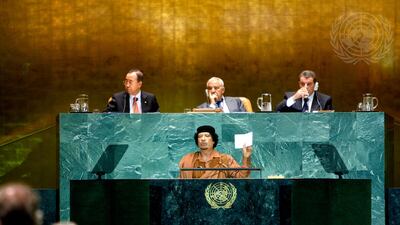
    Libyan leader Muammar Qaddafi famously addressed the UNGA for more than 90 minutes in 2009. Photo: UN
  • Venezuelan president Hugo Chavez said in 2006 that he could smell sulphur in the UN chamber after George W Bush spoke, likening the US leader to the 'Devil'. Photo: UN
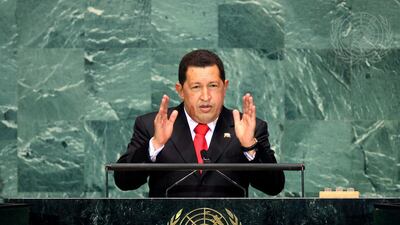
    Venezuelan president Hugo Chavez said in 2006 that he could smell sulphur in the UN chamber after George W Bush spoke, likening the US leader to the 'Devil'. Photo: UN
  • Mr Bush at UNGA in 2005. Photo: UN
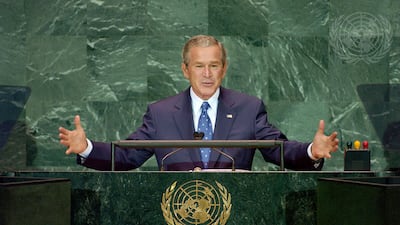
    Mr Bush at UNGA in 2005. Photo: UN
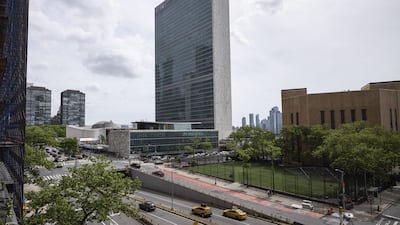
  • The UN Headquarters in New York. Residents of the Big Apple brace themselves for two weeks of traffic chaos as UNGA takes place. EPA
    The UN Headquarters in New York. Residents of the Big Apple brace themselves for two weeks of traffic chaos as UNGA takes place. EPA
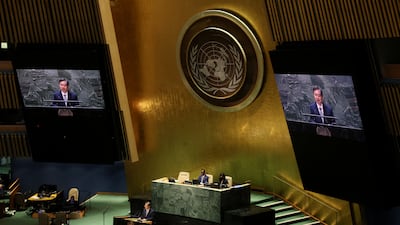
  • South Korean ambassador to the UN Cho Hyun speaking in the chamber. Reuters
    South Korean ambassador to the UN Cho Hyun speaking in the chamber. Reuters
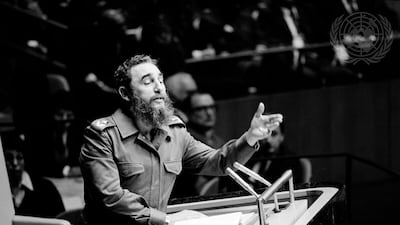
  • Cuban leader Fidel Castro addressing the General Assembly. Photo: UN
    Cuban leader Fidel Castro addressing the General Assembly. Photo: UN
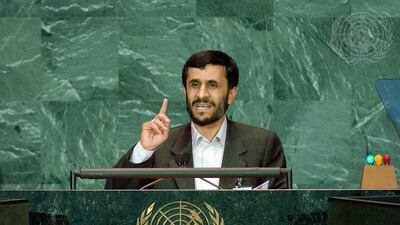
  • Former Iranian president Mahmoud Ahmadinejad in 2005. Photo: UN
    Former Iranian president Mahmoud Ahmadinejad in 2005. Photo: UN
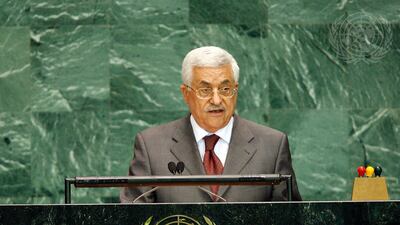
  • Mahmoud Abbas, President of the Palestinian National Authority, addresses UNGA. Photo: UN
    Mahmoud Abbas, President of the Palestinian National Authority, addresses UNGA. Photo: UN

A crisis of relevance

Beyond the Gaza war and Mr Trump’s showmanship lies a deeper question: where is the UN headed at 80?

Diplomats said a worsening “liquidity crisis” hangs over the General Assembly, the result of member states failing to pay their dues on time or in full.

As part of his UN80 initiative, Mr Guterres has proposed a 15 per cent cut to the regular budget starting in 2026, reducing it to $3.238 billion and eliminating 2,681 posts at the world body.

The cuts would affect all three pillars of the UN’s work: peace and security; human rights; and sustainable development – although programmes for the least developed countries would be protected.

Meanwhile, the UN’s humanitarian agencies are under immense strain. Funding is drying up as climate disasters multiply, refugee numbers reach historic highs, and the 2030 Sustainable Development Goals slip further out of reach.

The General Assembly is expected to vote on the budget plan before the end of the year.

GIANT REVIEW

Starring: Amir El-Masry, Pierce Brosnan

Director: Athale

Rating: 4/5

Mercer, the investment consulting arm of US services company Marsh & McLennan, expects its wealth division to at least double its assets under management (AUM) in the Middle East as wealth in the region continues to grow despite economic headwinds, a company official said.

Mercer Wealth, which globally has $160 billion in AUM, plans to boost its AUM in the region to $2-$3bn in the next 2-3 years from the present $1bn, said Yasir AbuShaban, a Dubai-based principal with Mercer Wealth.

Within the next two to three years, we are looking at reaching $2 to $3 billion as a conservative estimate and we do see an opportunity to do so,” said Mr AbuShaban.

Mercer does not directly make investments, but allocates clients’ money they have discretion to, to professional asset managers. They also provide advice to clients.

“We have buying power. We can negotiate on their (client’s) behalf with asset managers to provide them lower fees than they otherwise would have to get on their own,” he added.

Mercer Wealth’s clients include sovereign wealth funds, family offices, and insurance companies among others.

From its office in Dubai, Mercer also looks after Africa, India and Turkey, where they also see opportunity for growth.

Wealth creation in Middle East and Africa (MEA) grew 8.5 per cent to $8.1 trillion last year from $7.5tn in 2015, higher than last year’s global average of 6 per cent and the second-highest growth in a region after Asia-Pacific which grew 9.9 per cent, according to consultancy Boston Consulting Group (BCG). In the region, where wealth grew just 1.9 per cent in 2015 compared with 2014, a pickup in oil prices has helped in wealth generation.

BCG is forecasting MEA wealth will rise to $12tn by 2021, growing at an annual average of 8 per cent.

Drivers of wealth generation in the region will be split evenly between new wealth creation and growth of performance of existing assets, according to BCG.

Another general trend in the region is clients’ looking for a comprehensive approach to investing, according to Mr AbuShaban.

“Institutional investors or some of the families are seeing a slowdown in the available capital they have to invest and in that sense they are looking at optimizing the way they manage their portfolios and making sure they are not investing haphazardly and different parts of their investment are working together,” said Mr AbuShaban.

Some clients also have a higher appetite for risk, given the low interest-rate environment that does not provide enough yield for some institutional investors. These clients are keen to invest in illiquid assets, such as private equity and infrastructure.

“What we have seen is a desire for higher returns in what has been a low-return environment specifically in various fixed income or bonds,” he said.

“In this environment, we have seen a de facto increase in the risk that clients are taking in things like illiquid investments, private equity investments, infrastructure and private debt, those kind of investments were higher illiquidity results in incrementally higher returns.”

The Abu Dhabi Investment Authority, one of the largest sovereign wealth funds, said in its 2016 report that has gradually increased its exposure in direct private equity and private credit transactions, mainly in Asian markets and especially in China and India. The authority’s private equity department focused on structured equities owing to “their defensive characteristics.”

The%20specs
%3Cp%3E%3Cstrong%3EEngine%3A%3C%2Fstrong%3E%201.8-litre%204-cyl%20turbo%0D%3Cbr%3E%3Cstrong%3EPower%3A%20%3C%2Fstrong%3E190hp%20at%205%2C200rpm%0D%3Cbr%3E%3Cstrong%3ETorque%3A%3C%2Fstrong%3E%20320Nm%20from%201%2C800-5%2C000rpm%0D%3Cbr%3E%3Cstrong%3ETransmission%3A%20%3C%2Fstrong%3ESeven-speed%20dual-clutch%20auto%0D%3Cbr%3E%3Cstrong%3EFuel%20consumption%3A%3C%2Fstrong%3E%206.7L%2F100km%0D%3Cbr%3E%3Cstrong%3EPrice%3A%3C%2Fstrong%3E%20From%20Dh111%2C195%0D%3Cbr%3E%3Cstrong%3EOn%20sale%3A%20%3C%2Fstrong%3ENow%3C%2Fp%3E%0A
SPEC%20SHEET%3A%20APPLE%20M3%20MACBOOK%20AIR%20(13%22)
%3Cp%3E%3Cstrong%3EProcessor%3A%3C%2Fstrong%3E%20Apple%20M3%2C%208-core%20CPU%2C%20up%20to%2010-core%20CPU%2C%2016-core%20Neural%20Engine%3C%2Fp%3E%0A%3Cp%3E%3Cstrong%3EDisplay%3A%3C%2Fstrong%3E%2013.6-inch%20Liquid%20Retina%2C%202560%20x%201664%2C%20224ppi%2C%20500%20nits%2C%20True%20Tone%2C%20wide%20colour%3C%2Fp%3E%0A%3Cp%3E%3Cstrong%3EMemory%3A%3C%2Fstrong%3E%208%2F16%2F24GB%3C%2Fp%3E%0A%3Cp%3E%3Cstrong%3EStorage%3A%3C%2Fstrong%3E%20256%2F512GB%20%2F%201%2F2TB%3C%2Fp%3E%0A%3Cp%3E%3Cstrong%3EI%2FO%3A%3C%2Fstrong%3E%20Thunderbolt%203%2FUSB-4%20(2)%2C%203.5mm%20audio%2C%20Touch%20ID%3C%2Fp%3E%0A%3Cp%3E%3Cstrong%3EConnectivity%3A%3C%2Fstrong%3E%20Wi-Fi%206E%2C%20Bluetooth%205.3%3C%2Fp%3E%0A%3Cp%3E%3Cstrong%3EBattery%3A%3C%2Fstrong%3E%2052.6Wh%20lithium-polymer%2C%20up%20to%2018%20hours%2C%20MagSafe%20charging%3C%2Fp%3E%0A%3Cp%3E%3Cstrong%3ECamera%3A%3C%2Fstrong%3E%201080p%20FaceTime%20HD%3C%2Fp%3E%0A%3Cp%3E%3Cstrong%3EVideo%3A%3C%2Fstrong%3E%20Support%20for%20Apple%20ProRes%2C%20HDR%20with%20Dolby%20Vision%2C%20HDR10%3C%2Fp%3E%0A%3Cp%3E%3Cstrong%3EAudio%3A%3C%2Fstrong%3E%204-speaker%20system%2C%20wide%20stereo%2C%20support%20for%20Dolby%20Atmos%2C%20Spatial%20Audio%20and%20dynamic%20head%20tracking%20(with%20AirPods)%3C%2Fp%3E%0A%3Cp%3E%3Cstrong%3EColours%3A%3C%2Fstrong%3E%20Midnight%2C%20silver%2C%20space%20grey%2C%20starlight%3C%2Fp%3E%0A%3Cp%3E%3Cstrong%3EIn%20the%20box%3A%3C%2Fstrong%3E%20MacBook%20Air%2C%2030W%2F35W%20dual-port%2F70w%20power%20adapter%2C%20USB-C-to-MagSafe%20cable%2C%202%20Apple%20stickers%3C%2Fp%3E%0A%3Cp%3E%3Cstrong%3EPrice%3A%3C%2Fstrong%3E%20From%20Dh4%2C599%3C%2Fp%3E%0A
Timeline

2012-2015

The company offers payments/bribes to win key contracts in the Middle East

May 2017

The UK SFO officially opens investigation into Petrofac’s use of agents, corruption, and potential bribery to secure contracts

September 2021

Petrofac pleads guilty to seven counts of failing to prevent bribery under the UK Bribery Act

October 2021

Court fines Petrofac £77 million for bribery. Former executive receives a two-year suspended sentence 

December 2024

Petrofac enters into comprehensive restructuring to strengthen the financial position of the group

May 2025

The High Court of England and Wales approves the company’s restructuring plan

July 2025

The Court of Appeal issues a judgment challenging parts of the restructuring plan

August 2025

Petrofac issues a business update to execute the restructuring and confirms it will appeal the Court of Appeal decision

October 2025

Petrofac loses a major TenneT offshore wind contract worth €13 billion. Holding company files for administration in the UK. Petrofac delisted from the London Stock Exchange

November 2025

180 Petrofac employees laid off in the UAE

Updated: September 18, 2025, 11:43 PM