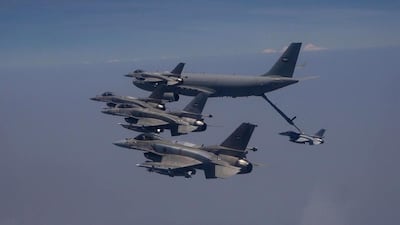
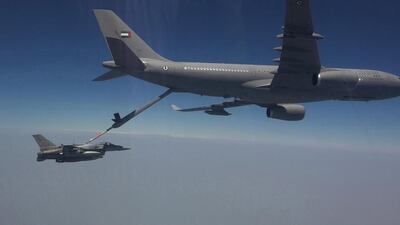
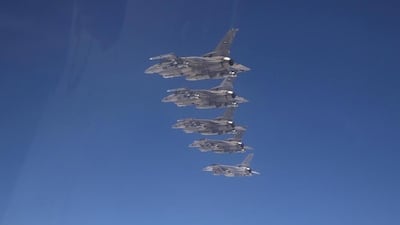
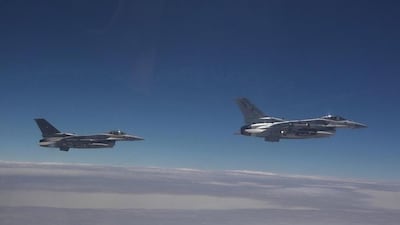
When Dr Anwar Gargash, senior diplomatic adviser to the UAE president, recently called for “clear, codified and unambivalent [security] commitments" from the US, he spoke for many in the Gulf. At the Abu Dhabi Strategic Debate in November, he reaffirmed that “our primary strategic security relationship remains unequivocally with the United States", but added we need to “find a way to ensure that we can rely on this relationship”.
For Washington's key strategic partners in the Middle East – the UAE, Saudi Arabia and Israel – American reliability has become the key question. The strength and power of the US military force posture in the region, especially in and around the Gulf, is beyond doubt and hasn't changed much over the past 20 years. However, for at least the past decade, a series of US decisions have raised doubts about American reliability and Washington’s long-term commitment to the region, particularly given rhetoric about a "pivot to Asia" and "great power competition” with China.
The failure in 2012 of the Obama administration to enforce its red line against the use of chemical weapons by the Syrian regime, the Trump administration declining to respond to the Iranian attacks against Saudi Aramco facilities in 2019 and, most recently, a belated and insufficient response by the Biden administration to deadly Houthi rocket attacks in Abu Dhabi in January were all discernible inflection points promoting these misgivings. And there were many others.
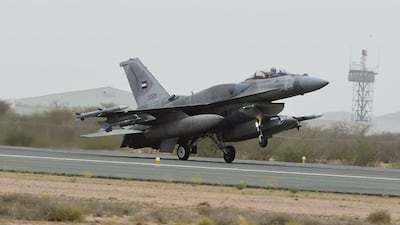
But in the wake of the Ukraine war, and what amounts to a new campaign of containment and deterrence against Iran given the failure of the nuclear negotiations, the Biden administration has sent much more positive signals. In early November, Saudi Arabia alerted the US to a potential Iranian plan to strike the kingdom to distract from continued unrest in Iran. US fighter jets were scrambled in an aggressive show of force that appears to have succeeded in deterring the attack.
But beyond such prompt and robust responses, questions about the long-term US security commitment in the Gulf region are most persuasively answered by a game-changing military surveillance system that is being developed for and rolled out in the Gulf, and relies on regional partnerships.
Fifteen months ago, a dramatic breakthrough in unmanned surveillance systems made this possible. In addition to well-established aerial and underwater unmanned systems, ground-breaking surface-level technology has enabled the establishment of an unprecedented complete, three-dimensional and real-time maritime surveillance regime.
The US military has created “Task Force 59” to lead the project. As detailed by Vice Admiral Brad Cooper, commander of the US Naval Forces Central Command, at the recent UAE Security Forum, it will involve combined unmanned surveillance systems in the air as well as underwater and on the water’s surface to survey and track any vessel or object in the Gulf. Using artificial intelligence, the data produced by high-tech cameras and other sensors will be continuously processed. If anything unusual is detected, further investigation by other drones would be triggered, and humans would be quickly brought in to judge what is being detected.
The strength and power of the US military force posture in the region is beyond question
The system being developed in the Gulf is hardly just American. It is also regional and international. Gulf countries will be deeply involved, as will the UK and France. The plan is that by the end of summer 2023, at least 100 unmanned systems will be operating on the surface waters of the Gulf at any given moment – 20 per cent US and 80 per cent regional or international. These systems will all be linked in real time by satellite and the American systems will be controlled by operators in California.
The US interest in the region isn't altruistic. Strategic calculations are always based on national interests. But the US focus on the Gulf region, plus the Arabian and Red Sea areas, certainly should help to address many of the doubts raised by so many about the sustainability and reliability of the long-term US security commitment.
Three of the world's most crucial strategic chokepoints lie in these waters: the Strait of Hormuz, the Suez Canal and Bab El Mandeb at the mouth of the Red Sea. Maritime security connected to those chokepoints involves a staggering percentage of the world's commercial shipping and, of course, seaborne energy exports.
Indeed, as the US begins to focus on "great power competition" with China, one of its biggest points of leverage is the fact that – along with its regional and international partners – the US has the ability to maintain security in the waterways that provide over 30 per cent of China's annual energy consumption.
The US military has been clear that this technology will be developed and deployed first in the Arabian Gulf and the Red Sea, but is likely to be utilised in a similar fashion in key maritime security areas around the world where possible and as needed.
The political and strategic implications of this project are huge.
First, it demonstrates that the US is in the region to stay. It is preparing for a long-term, abiding and potent regional presence, and is certainly not in the early stages of a "long goodbye", as so many argue.
Second, it demonstrates how central its regional partners have become to US strategic thinking. It is no longer a matter of the US maintaining a military presence in the Gulf to protect supposedly dependent and vulnerable allies. The relationship is being mutually reconceptualised, and this ground-breaking project foregrounds and depends upon regional partners in a co-operative venture that is far more mutual and equitable.
What Task Force 59, based in Bahrain, heralds is a new era in which Gulf countries come into their own as medium-level powers and full partners with western allies such as the US, the UK and France. It's no good yearning for the fully developed equivalent of a Nato Article 5 trigger that guarantees that any attack on a Gulf Arab country will be treated as equivalent to an attack on the US. While that’s not going to happen, a new strategic framework agreement that adds greater clarity to the commitment is being seriously discussed and would be extremely useful.
Seeking greater clarity about what would trigger a US military response is wise. But it's also necessary to recognise what on-the-ground developments, such as Task Force 59, signify: Washington is in the region to stay and is quietly building a coalition, with ground-breaking technology and unprecedented co-ordination, that’s dedicated to Gulf security and stability.
UAE currency: the story behind the money in your pockets
Inside%20Out%202
%3Cp%3E%3Cstrong%3EDirector%3A%C2%A0%3C%2Fstrong%3EKelsey%20Mann%3C%2Fp%3E%0A%3Cp%3E%3Cstrong%3EStarring%3A%3C%2Fstrong%3E%C2%A0Amy%20Poehler%2C%20Maya%20Hawke%2C%20Ayo%20Edebiri%3C%2Fp%3E%0A%3Cp%3E%3Cstrong%3ERating%3A%20%3C%2Fstrong%3E4.5%2F5%3C%2Fp%3E%0A
Mercer, the investment consulting arm of US services company Marsh & McLennan, expects its wealth division to at least double its assets under management (AUM) in the Middle East as wealth in the region continues to grow despite economic headwinds, a company official said.
Mercer Wealth, which globally has $160 billion in AUM, plans to boost its AUM in the region to $2-$3bn in the next 2-3 years from the present $1bn, said Yasir AbuShaban, a Dubai-based principal with Mercer Wealth.
“Within the next two to three years, we are looking at reaching $2 to $3 billion as a conservative estimate and we do see an opportunity to do so,” said Mr AbuShaban.
Mercer does not directly make investments, but allocates clients’ money they have discretion to, to professional asset managers. They also provide advice to clients.
“We have buying power. We can negotiate on their (client’s) behalf with asset managers to provide them lower fees than they otherwise would have to get on their own,” he added.
Mercer Wealth’s clients include sovereign wealth funds, family offices, and insurance companies among others.
From its office in Dubai, Mercer also looks after Africa, India and Turkey, where they also see opportunity for growth.
Wealth creation in Middle East and Africa (MEA) grew 8.5 per cent to $8.1 trillion last year from $7.5tn in 2015, higher than last year’s global average of 6 per cent and the second-highest growth in a region after Asia-Pacific which grew 9.9 per cent, according to consultancy Boston Consulting Group (BCG). In the region, where wealth grew just 1.9 per cent in 2015 compared with 2014, a pickup in oil prices has helped in wealth generation.
BCG is forecasting MEA wealth will rise to $12tn by 2021, growing at an annual average of 8 per cent.
Drivers of wealth generation in the region will be split evenly between new wealth creation and growth of performance of existing assets, according to BCG.
Another general trend in the region is clients’ looking for a comprehensive approach to investing, according to Mr AbuShaban.
“Institutional investors or some of the families are seeing a slowdown in the available capital they have to invest and in that sense they are looking at optimizing the way they manage their portfolios and making sure they are not investing haphazardly and different parts of their investment are working together,” said Mr AbuShaban.
Some clients also have a higher appetite for risk, given the low interest-rate environment that does not provide enough yield for some institutional investors. These clients are keen to invest in illiquid assets, such as private equity and infrastructure.
“What we have seen is a desire for higher returns in what has been a low-return environment specifically in various fixed income or bonds,” he said.
“In this environment, we have seen a de facto increase in the risk that clients are taking in things like illiquid investments, private equity investments, infrastructure and private debt, those kind of investments were higher illiquidity results in incrementally higher returns.”
The Abu Dhabi Investment Authority, one of the largest sovereign wealth funds, said in its 2016 report that has gradually increased its exposure in direct private equity and private credit transactions, mainly in Asian markets and especially in China and India. The authority’s private equity department focused on structured equities owing to “their defensive characteristics.”
Mohammed bin Zayed Majlis
Dhadak 2
Director: Shazia Iqbal
Starring: Siddhant Chaturvedi, Triptii Dimri
Rating: 1/5
READ MORE ABOUT CORONAVIRUS
MATCH INFO
Uefa Champions League semi-final, first leg
Bayern Munich v Real Madrid
When: April 25, 10.45pm kick-off (UAE)
Where: Allianz Arena, Munich
Live: BeIN Sports HD
Second leg: May 1, Santiago Bernabeu, Madrid
CREW
%3Cp%3E%3Cstrong%3EDirector%3A%20%3C%2Fstrong%3ERajesh%20A%20Krishnan%3C%2Fp%3E%0A%3Cp%3E%3Cstrong%3EStarring%3A%20%3C%2Fstrong%3ETabu%2C%20Kareena%20Kapoor%20Khan%2C%20Kriti%20Sanon%26nbsp%3B%3C%2Fp%3E%0A%3Cp%3E%3Cstrong%3ERating%3A%3C%2Fstrong%3E%203.5%2F5%3C%2Fp%3E%0A
Islamophobia definition
A widely accepted definition was made by the All Party Parliamentary Group on British Muslims in 2019: “Islamophobia is rooted in racism and is a type of racism that targets expressions of Muslimness or perceived Muslimness.” It further defines it as “inciting hatred or violence against Muslims”.
Favourite things
Luxury: Enjoys window shopping for high-end bags and jewellery
Discount: She works in luxury retail, but is careful about spending, waits for sales, festivals and only buys on discount
University: The only person in her family to go to college, Jiang secured a bachelor’s degree in business management in China
Masters: Studying part-time for a master’s degree in international business marketing in Dubai
Vacation: Heads back home to see family in China
Community work: Member of the Chinese Business Women’s Association of the UAE to encourage other women entrepreneurs
Seemar’s top six for the Dubai World Cup Carnival:
1. Reynaldothewizard
2. North America
3. Raven’s Corner
4. Hawkesbury
5. New Maharajah
6. Secret Ambition
The%20specs
%3Cp%3E%3Cstrong%3EEngine%3A%20%3C%2Fstrong%3E2.3-litre%204cyl%20turbo%0D%3Cbr%3E%3Cstrong%3EPower%3A%20%3C%2Fstrong%3E299hp%20at%205%2C500rpm%0D%3Cbr%3E%3Cstrong%3ETorque%3A%20%3C%2Fstrong%3E420Nm%20at%202%2C750rpm%0D%3Cbr%3E%3Cstrong%3ETransmission%3A%20%3C%2Fstrong%3E10-speed%20auto%0D%3Cbr%3E%3Cstrong%3EFuel%20consumption%3A%20%3C%2Fstrong%3E12.4L%2F100km%0D%3Cbr%3E%3Cstrong%3EOn%20sale%3A%20%3C%2Fstrong%3ENow%0D%3Cbr%3E%3Cstrong%3EPrice%3A%20%3C%2Fstrong%3EFrom%20Dh157%2C395%20(XLS)%3B%20Dh199%2C395%20(Limited)%3C%2Fp%3E%0A
Blonde
%3Cp%3E%3Cstrong%3EDirector%3A%20%3C%2Fstrong%3EAndrew%20Dominik%3Cbr%3E%3Cstrong%3EStars%3A%20%3C%2Fstrong%3EAna%20de%20Armas%2C%20Adrien%20Brody%2C%20Bobby%20Cannavale%3Cbr%3E%3Cstrong%3ERating%3A%20%3C%2Fstrong%3E3%2F5%3Cbr%3E%3C%2Fp%3E%0A
The Light of the Moon
Director: Jessica M Thompson
Starring: Stephanie Beatriz, Michael Stahl-David
Three stars
The Africa Institute 101
Housed on the same site as the original Africa Hall, which first hosted an Arab-African Symposium in 1976, the newly renovated building will be home to a think tank and postgraduate studies hub (it will offer master’s and PhD programmes). The centre will focus on both the historical and contemporary links between Africa and the Gulf, and will serve as a meeting place for conferences, symposia, lectures, film screenings, plays, musical performances and more. In fact, today it is hosting a symposium – 5-plus-1: Rethinking Abstraction that will look at the six decades of Frank Bowling’s career, as well as those of his contemporaries that invested social, cultural and personal meaning into abstraction.
Unresolved crisis
Russia and Ukraine have been locked in a bitter conflict since 2014, when Ukraine’s Kremlin-friendly president was ousted, Moscow annexed Crimea and then backed a separatist insurgency in the east.
Fighting between the Russia-backed rebels and Ukrainian forces has killed more than 14,000 people. In 2015, France and Germany helped broker a peace deal, known as the Minsk agreements, that ended large-scale hostilities but failed to bring a political settlement of the conflict.
The Kremlin has repeatedly accused Kiev of sabotaging the deal, and Ukrainian officials in recent weeks said that implementing it in full would hurt Ukraine.
UAE%20PREMIERSHIP
%3Cp%3E%3Cstrong%3EFinal%3A%3C%2Fstrong%3E%20Dubai%20Hurricanes%20v%20Jebel%20Ali%20Dragons%0D%3Cbr%3E%0DSaturday%2C%208.15pm%2C%20Al%20Ain%20Amblers%0D%3C%2Fp%3E%0A%3Cp%3E%3Cstrong%3ESemi-final%20results%3C%2Fstrong%3E%0D%3Cbr%3EDubai%20Exiles%2020-26%20Dubai%20Hurricanes%0D%3Cbr%3EDubai%20Tigers%2032-43%20Jebel%20Ali%20Dragons%0D%3C%2Fp%3E%0A%3Cp%3E%3Cstrong%3ETable%3C%2Fstrong%3E%0D%3Cbr%3E1%20Dubai%20Tigers%2C%2033%20points%0D%3Cbr%3E2%20Dubai%20Exiles%2C%2024%20points%0D%3Cbr%3E3%20Dubai%20Hurricanes%2C%2018%20points%0D%3Cbr%3E4%20Jebel%20Ali%20Dragons%2C%2014%20points%0D%3Cbr%3E5%20Abu%20Dhabi%20Harlequins%2C%2014%20points%3C%2Fp%3E%0A
Teri%20Baaton%20Mein%20Aisa%20Uljha%20Jiya
%3Cp%3E%3Cstrong%3EDirectors%3A%3C%2Fstrong%3E%20Amit%20Joshi%20and%20Aradhana%20Sah%3C%2Fp%3E%0A%3Cp%3E%3Cstrong%3ECast%3A%3C%2Fstrong%3E%20Shahid%20Kapoor%2C%20Kriti%20Sanon%2C%20Dharmendra%2C%20Dimple%20Kapadia%2C%20Rakesh%20Bedi%3C%2Fp%3E%0A%3Cp%3E%3Cstrong%3ERating%3A%3C%2Fstrong%3E%204%2F5%3C%2Fp%3E%0A
The Gentlemen
Director: Guy Ritchie
Stars: Colin Farrell, Hugh Grant
Three out of five stars
Email sent to Uber team from chief executive Dara Khosrowshahi
From: Dara
To: Team@
Date: March 25, 2019 at 11:45pm PT
Subj: Accelerating in the Middle East
Five years ago, Uber launched in the Middle East. It was the start of an incredible journey, with millions of riders and drivers finding new ways to move and work in a dynamic region that’s become so important to Uber. Now Pakistan is one of our fastest-growing markets in the world, women are driving with Uber across Saudi Arabia, and we chose Cairo to launch our first Uber Bus product late last year.
Today we are taking the next step in this journey—well, it’s more like a leap, and a big one: in a few minutes, we’ll announce that we’ve agreed to acquire Careem. Importantly, we intend to operate Careem independently, under the leadership of co-founder and current CEO Mudassir Sheikha. I’ve gotten to know both co-founders, Mudassir and Magnus Olsson, and what they have built is truly extraordinary. They are first-class entrepreneurs who share our platform vision and, like us, have launched a wide range of products—from digital payments to food delivery—to serve consumers.
I expect many of you will ask how we arrived at this structure, meaning allowing Careem to maintain an independent brand and operate separately. After careful consideration, we decided that this framework has the advantage of letting us build new products and try new ideas across not one, but two, strong brands, with strong operators within each. Over time, by integrating parts of our networks, we can operate more efficiently, achieve even lower wait times, expand new products like high-capacity vehicles and payments, and quicken the already remarkable pace of innovation in the region.
This acquisition is subject to regulatory approval in various countries, which we don’t expect before Q1 2020. Until then, nothing changes. And since both companies will continue to largely operate separately after the acquisition, very little will change in either teams’ day-to-day operations post-close. Today’s news is a testament to the incredible business our team has worked so hard to build.
It’s a great day for the Middle East, for the region’s thriving tech sector, for Careem, and for Uber.
Uber on,
Dara
The Vile
Starring: Bdoor Mohammad, Jasem Alkharraz, Iman Tarik, Sarah Taibah
Director: Majid Al Ansari
Rating: 4/5
The biog
Name: Capt Shadia Khasif
Position: Head of the Criminal Registration Department at Hatta police
Family: Five sons and three daughters
The first female investigator in Hatta.
Role Model: Father
She believes that there is a solution to every problem
The specs: 2018 Jeep Compass
Price, base: Dh100,000 (estimate)
Engine: 2.4L four-cylinder
Transmission: Nine-speed automatic
Power: 184bhp at 6,400rpm
Torque: 237Nm at 3,900rpm
Fuel economy, combined: 9.4L / 100km
The candidates
Dr Ayham Ammora, scientist and business executive
Ali Azeem, business leader
Tony Booth, professor of education
Lord Browne, former BP chief executive
Dr Mohamed El-Erian, economist
Professor Wyn Evans, astrophysicist
Dr Mark Mann, scientist
Gina MIller, anti-Brexit campaigner
Lord Smith, former Cabinet minister
Sandi Toksvig, broadcaster
What drives subscription retailing?
Once the domain of newspaper home deliveries, subscription model retailing has combined with e-commerce to permeate myriad products and services.
The concept has grown tremendously around the world and is forecast to thrive further, according to UnivDatos Market Insights’ report on recent and predicted trends in the sector.
The global subscription e-commerce market was valued at $13.2 billion (Dh48.5bn) in 2018. It is forecast to touch $478.2bn in 2025, and include the entertainment, fitness, food, cosmetics, baby care and fashion sectors.
The report says subscription-based services currently constitute “a small trend within e-commerce”. The US hosts almost 70 per cent of recurring plan firms, including leaders Dollar Shave Club, Hello Fresh and Netflix. Walmart and Sephora are among longer established retailers entering the space.
UnivDatos cites younger and affluent urbanites as prime subscription targets, with women currently the largest share of end-users.
That’s expected to remain unchanged until 2025, when women will represent a $246.6bn market share, owing to increasing numbers of start-ups targeting women.
Personal care and beauty occupy the largest chunk of the worldwide subscription e-commerce market, with changing lifestyles, work schedules, customisation and convenience among the chief future drivers.
UAE currency: the story behind the money in your pockets
Teachers' pay - what you need to know
Pay varies significantly depending on the school, its rating and the curriculum. Here's a rough guide as of January 2021:
- top end schools tend to pay Dh16,000-17,000 a month - plus a monthly housing allowance of up to Dh6,000. These tend to be British curriculum schools rated 'outstanding' or 'very good', followed by American schools
- average salary across curriculums and skill levels is about Dh10,000, recruiters say
- it is becoming more common for schools to provide accommodation, sometimes in an apartment block with other teachers, rather than hand teachers a cash housing allowance
- some strong performing schools have cut back on salaries since the pandemic began, sometimes offering Dh16,000 including the housing allowance, which reflects the slump in rental costs, and sheer demand for jobs
- maths and science teachers are most in demand and some schools will pay up to Dh3,000 more than other teachers in recognition of their technical skills
- at the other end of the market, teachers in some Indian schools, where fees are lower and competition among applicants is intense, can be paid as low as Dh3,000 per month
- in Indian schools, it has also become common for teachers to share residential accommodation, living in a block with colleagues
Scoreline:
Manchester City 1
Jesus 4'
Brighton 0
Manchester City (0) v Liverpool (3)
Uefa Champions League, quarter-final, second leg
Where: Etihad Stadium
When: Tuesday, 10.45pm
Live on beIN Sports HD
Explainer: Tanween Design Programme
Non-profit arts studio Tashkeel launched this annual initiative with the intention of supporting budding designers in the UAE. This year, three talents were chosen from hundreds of applicants to be a part of the sixth creative development programme. These are architect Abdulla Al Mulla, interior designer Lana El Samman and graphic designer Yara Habib.
The trio have been guided by experts from the industry over the course of nine months, as they developed their own products that merge their unique styles with traditional elements of Emirati design. This includes laboratory sessions, experimental and collaborative practice, investigation of new business models and evaluation.
It is led by British contemporary design project specialist Helen Voce and mentor Kevin Badni, and offers participants access to experts from across the world, including the likes of UK designer Gareth Neal and multidisciplinary designer and entrepreneur, Sheikh Salem Al Qassimi.
The final pieces are being revealed in a worldwide limited-edition release on the first day of Downtown Designs at Dubai Design Week 2019. Tashkeel will be at stand E31 at the exhibition.
Lisa Ball-Lechgar, deputy director of Tashkeel, said: “The diversity and calibre of the applicants this year … is reflective of the dynamic change that the UAE art and design industry is witnessing, with young creators resolute in making their bold design ideas a reality.”
UAE currency: the story behind the money in your pockets
ENGLAND%20SQUAD
%3Cp%3EFor%20Euro%202024%20qualifers%20away%20to%20Malta%20on%20June%2016%20and%20at%20home%20to%20North%20Macedonia%20on%20June%2019%3A%3C%2Fp%3E%0A%3Cp%3E%3Cstrong%3EGoalkeepers%3C%2Fstrong%3E%20Johnstone%2C%20Pickford%2C%20Ramsdale.%0D%3Cbr%3E%0D%3Cbr%3E%3Cstrong%3EDefenders%3C%2Fstrong%3E%20Alexander-Arnold%2C%20Dunk%2C%20Guehi%2C%20Maguire%2C%20%20Mings%2C%20Shaw%2C%20Stones%2C%20Trippier%2C%20Walker.%0D%3Cbr%3E%0D%3Cbr%3E%3Cstrong%3EMidfielders%3C%2Fstrong%3E%20Bellingham%2C%20Eze%2C%20Gallagher%2C%20Henderson%2C%20%20Maddison%2C%20Phillips%2C%20Rice.%0D%3Cbr%3E%0D%3Cbr%3E%3Cstrong%3EForwards%20%3C%2Fstrong%3EFoden%2C%20Grealish%2C%20Kane%2C%20Rashford%2C%20Saka%2C%20Wilson.%3C%2Fp%3E%0A
The five pillars of Islam
1. Fasting
2. Prayer
3. Hajj
4. Shahada
5. Zakat