On the night of August 4 two years ago, I lost contact with my anxious parents, who left just days earlier to perform Hajj, and my brother based in the Middle East, who was worried whether we had stocked up on essentials to survive an impending lockdown. This was just hours before the Indian government removed the autonomous status of Jammu-Kashmir on August 5 and downgraded the state into two union territories: Jammu-Kashmir and Ladakh. Overnight all phone and internet services were abruptly shut down. It was a traumatic, uncertain night for every family in Kashmir.
Next morning, more than seven million people in the region woke up to a military siege, as Indian Home Minister Amit Shah stood up in Parliament and announced the revocation of Article 370 that had guaranteed special status to the state for the past 70 years. Amid pronouncements of "Naya Kashmir" – New Kashmir – that would be “fully integrated” into the Indian union, an unprecedented military rule was imposed in the two territories. Communication lines stayed shut for about six months. People were suddenly disconnected from one another and from the outside world. Unable to call or send text messages, unaware of one another's condition and indefinitely confined to their homes, people prepared for the worst.
The state's political leaders, including three former chief ministers, were detained for about six months in heavily guarded government hotels and guesthouses. Most of the frontline and second-rung leadership of Hurriyat Conference, an umbrella group of parties that support the cause of Kashmiri separatism, were kept behind bars or under house detentions. Hundreds of youth were detained and booked under such laws as the Public Safety Act and the Unlawful Activities Prevention Act to prevent possible protests.
-
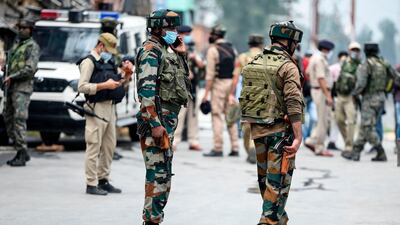
Security personnel stand guard near the site where suspected militants fired at police near Nowgam bypass in Srinagar. At least two policemen were killed and another wounded after militants allegedly opened fire on police party in Nowgam area, local media reported on August 14. AFP -

Security personnel and police on patrol in Srinagar. AFP -
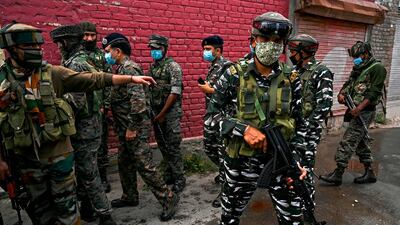
Inspector-General Vijay Kumar said militants sprayed bullets at the police from a narrow lane. AFP -
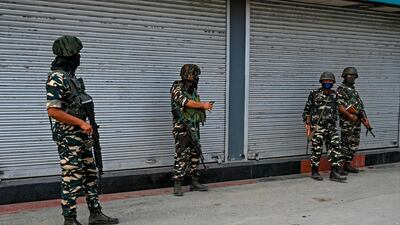
Reinforcements of counterinsurgency police and soldiers were searching the area for the attackers. AFP -
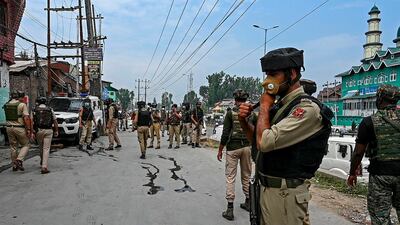
Security personnel gather near the site where suspected militants fired at police near Nowgam bypass in Srinagar. AFP -
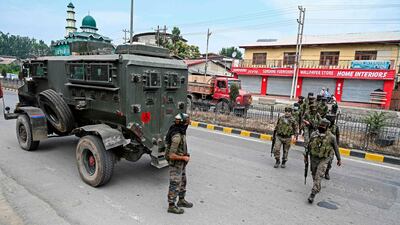
None of the rebel groups that have been fighting against Indian rule since 1989 immediately claimed responsibility for the attack. AFP -
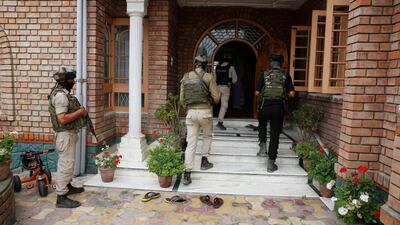
Indian policemen enter homes in Kashmir searching for Anti-India rebels accused of firing on a police convoy in Srinagar, EP -
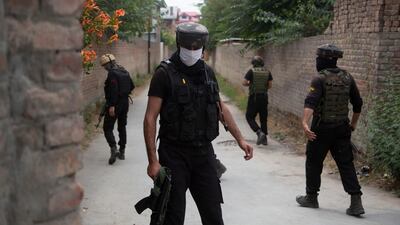
Members of special Operations Group (SOG) of Jammu and Kashmir police examine at the site of the attack. AP Photo


Two teams of foreign envoys have visited the region over the past two years. In October 2019, a team of 23 members of the European Parliament made a "private visit", facilitated by an NGO. New Delhi distanced itself from that tour but arranged another two-day visit, welcoming 15 envoys from Africa and Latin America last year. Kashmir's detained leaders called the latter trip a "guided tour" and an attempt to give the impression of normality.
Economically, the region has suffered considerably from back-to-back lockdowns. The six-month-long political lockdown was followed by one to contain the spread of Covid-19 in March last year. They prompted Kashmir's trade bodies to issue what was essentially a distress message, published in local newspapers, and warned of "selling false dreams of development" at a time when local businesses, entrepreneurs and traders were suffering heavy losses.
These extended lockdowns have also disrupted the lives of children. Confined to their homes, they have been deprived of formal schooling for almost two years. But frequent internet shutdowns and high-speed internet restrictions, lifted only earlier this year, have denied them the chance to learn online, too.
During this period, Kashmir has been subjected to some political changes as well.
New Delhi has extended a series of central laws and amended some state laws to make it easier for non-Kashmiri residents and soldiers posted in region to apply for domicile rights. A recent report by the Jammu-Kashmir government confirms more than four million domicile certificates have been issued since August 2019. Kashmiris fear that a relaxation in land laws – purportedly to encourage investment from outside the region, as part of the government's new industrial policy – may lead to demographic changes, with an emphasis on Hindu cultural prominence.

Whether these fears are well-founded or not, New Delhi is seeking some sort of normality in the region. In what some see as a reversal from its earlier stance, the government invited 14 of Kashmir's top leaders for talks on June 24.
It is not officially confirmed whether the meeting, attended by leaders who had been detained for several months for opposing the abrogation of Article 370, was convened after the government was encouraged by the Biden administration to do so. But earlier that month, Dean Thompson, the US's acting assistant secretary of state for South and Central Asia, did tell a congressional hearing that "there are other electoral steps we’d like to see them [India] take and that we have encouraged them to do and will continue to do so".
The softening in New Delhi's stance certainly followed a border ceasefire jointly announced by India and Pakistan along the Kashmir border in February. Jammu-Kashmir has for seven decades been a divided and disputed territory, with both countries claiming it to be theirs. The ceasefire has been welcomed by all Kashmiris, especially those living along the de facto boundary – called the Line of Control – who have been caught in the crossfire for decades. It, however, remains to be seen how long the fragile peace will last.
New Delhi says it wants to hold assembly elections in Jammu-Kashmir, complete the delimitation exercise – which is the process of demarcating the boundaries of parliamentary or assembly constituencies – and restart the political process that has been stalled since August 2019. Bringing on board Kashmir's political parties is key to legitimising this process and addressing international concerns, while, at the same time, normalising its "irreversible" decision to remove Article 370.

However, plenty of distance still remains between what New Delhi and Kashmir want strategically. There has been little follow-up to the June 24 meeting, which has raised questions and concerns in Kashmir's political circles. The Indian government has also remained non-committal about providing a date by which to restore statehood, instead using phrases such as “in due course” and "at an appropriate time”.
What then is the way forward? Releasing all political and some civilian prisoners and restoring statehood as promised could be a welcome starting point. There is also the question of Article 370, the restoration of which political forces such as the five-party People's Alliance for Gupkar Declaration, which attended the June 24 meeting, continue to call for. Interviews of 180 Kashmiris conducted by the Delhi-based think tank Observer Research Foundation reveal that the annulment of the article has made them lose their trust in the territory's pro-establishment political class. There is concern that they will settle for New Delhi's eventual restoration of statehood in return for sacrificing calls for the return of the autonomous status.
Tackling the situation in Kashmir, including its erstwhile special status, is key not only to improving India-Pakistan relations but also easing ongoing India-China tensions; Beijing remains opposed to the downgrading of Ladakh, originally a part of a united Jammu-Kashmir, into a union territory. India and China engaged in a deadly border stand-off that began in May last year along the Line of Actual Control in eastern Ladakh, but no resolution has been found yet.
New Delhi may find that normalising the post-August 5 status quo may not be sustainable in the long run. Corrective steps are, therefore, necessary to create a favourable environment required for the resumption of dialogue in order to help resolve the Kashmir dispute and bring about lasting peace in South Asia.