

"We are facing crimes against humanity. We are facing a humanitarian catastrophe. Yet the world has ignored us. They have closed their eyes." Such was the plaintive cry of Dr Sasa, minister for international co-operation in Myanmar's shadow National Unity Government (NUG), in a recent interview. He was referring to the situation in his country after the military ousted the incoming democratically elected administration headed by Aung San Suu Kyi on February 1, since which, according to the UN Special Rapporteur Thomas Andrews, more than 1,100 people have been killed, over 8,000 arbitrarily detained, and at least another 230,000 forcibly displaced.
Dr Sasa is correct, if one were to go by the nugatory coverage of the trial of Ms Suu Kyi on what are widely considered to be trumped-up charges, including inciting public unrest and corruption. There was a time when the military's treatment of Ms Suu Kyi – they kept her under house arrest for a total of 15 years and allegedly even attempted to assassinate her – provoked international outrage. But the legions of human rights defenders are not flocking to the former democracy activist's banner any more.
At one level, this seems unfortunate. "Junta-controlled military forces had killed protesters in the street, murdered civilians in their homes, beaten individuals to death and tortured people to death in their homes," said Mr Andrews in a submission to the UN's Human Rights Council late last month. "The junta also continued to deny the existence of the Rohingya ethnic minority while denying them citizenship, freedom of movement and other fundamental rights."

The problem is that similar atrocities and far, far worse occurred while Ms Suu Kyi was the country's de facto head of government from 2016 to 2021. Her dwindling band of apologists may point out that it was not her, but the military – over which she had no effective control – that committed what most of the world believes to be acts of ethnic cleansing against the Muslim Rohingya minority in western Myanmar between 2016 and 2019.
But Ms Suu Kyi as good as denied that such events took place at the International Court of Justice in The Hague in 2019, labelling accusations of genocide as “incomplete and misleading”. She and her National League for Democracy (NLD) administration were complicit in these crimes. The relative lack of sympathy for Myanmar's democracy movement – even though the NLD won an overwhelming majority of the vote in both 2015 and 2020 – is therefore hardly surprising.
Ah, some will say, but the NUG is different. It is far more inclusive, both of the country’s numerous armed ethnic groups and now, potentially, of the Rohingya too. Indeed, in June, it did promise a new citizenship act that would base “citizenship on birth in Myanmar or birth anywhere as a child of Myanmar citizens”. But this is all too convenient. The NUG is dominated by the NLD. When it was in government, the latter had every opportunity to stop or attempt to stop the slaughter of the Rohingya. To reach out a bloody hand to them now may be too little, too late. One has to ask how genuine the move is, in any case. Would the NLD have extended citizenship rights if the military had not taken over? Given its past record, that seems extremely unlikely.
-
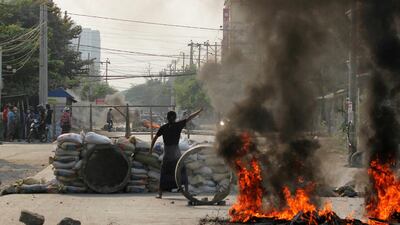
A demonstrator gestures near a barricade during a protest against the military coup in Mandalay, Myanmar. Reuters -
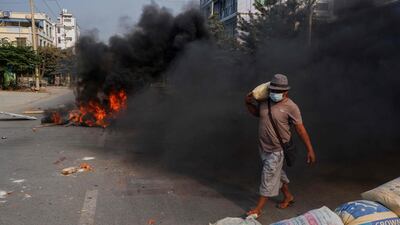
A man carries a sandbag to erect a makeshift barricade, as security forces stage a crackdown on demonstrations by protesters against the military coup, in Mandalay. AFP -

Demonstrators are seen behind barricades during a protest against the military coup in Mandalay. Reuters -
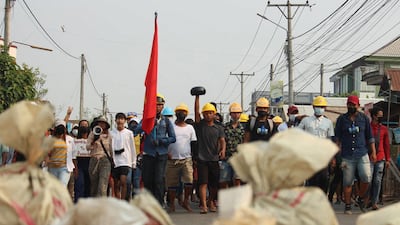
Protesters take part in a demonstration against the military coup in the coastal city of Dawei. AFP -
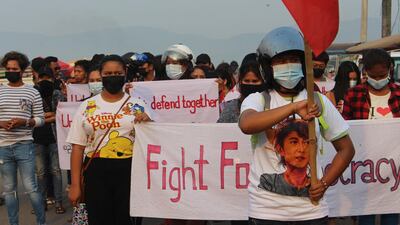
Protesters take part in a demonstration against the military coup in the coastal city of Dawei. AFP -
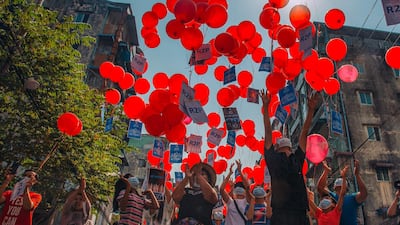
Residents release balloons with messages relating to "R2P", or the "Responsibility to Protect" principle that the international community is justified in taking action against a state that is deemed to have failed to protect its population from atrocities, in Yangon's Hlaing township. AFP -
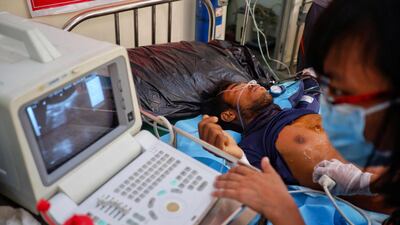
A resident receives medical attention after being injured during a crackdown by security forces on demonstrations by protesters against the military coup, in Mandalay. AFP -
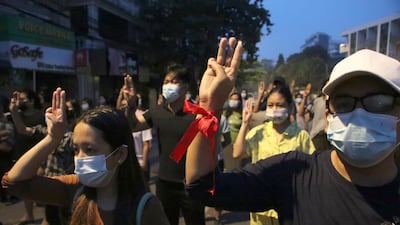
Anti-coup protesters flash three-fingered gesture, a symbol of resistance, during a rally outside their homes in downtown Yangon, Myanmar. AP Photo -

A demonstrator looks on along burning debris during a protest against the military coup in Mandalay. EPA -
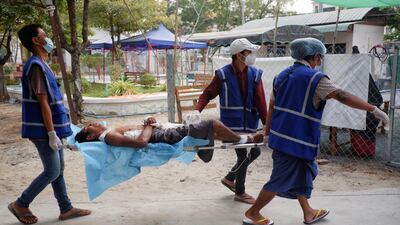
Medical volunteers carry an injured protester who was shot during a demonstration against the military coup in Mandalay. Reuters -
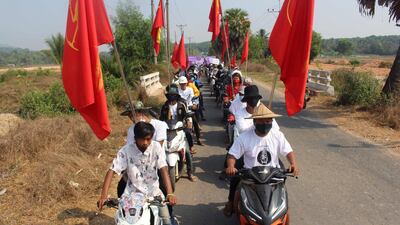
Protesters with flags take part in a demonstration against the military coup as they ride scooters through a rural part of Launglone township in Myanmar's Dawei district. AFP -
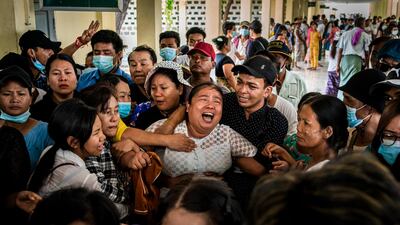
The mother of Aung Kaung Htet wails while mourning during a funeral for Aung, 15, who was killed when military junta forces opened fire on anti-coup protesters in Yangon. Getty Images -
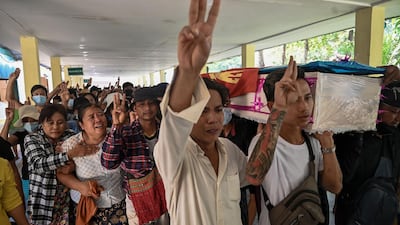
Mourners hold up the three-finger salute as they carry the coffin during the funeral of teenage protester Aung Kaung Htet in Yangon. AFP -
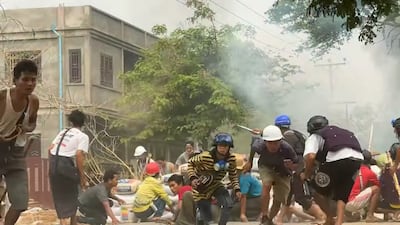
Protesters take cover during clashes with security forces in Monywa. Reuters -
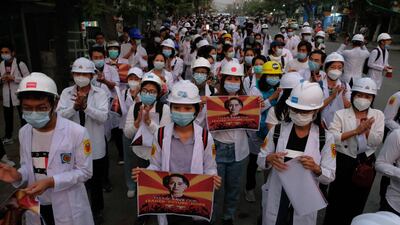
Medical staff and students take part in an early morning protest against the military coup and crackdown by security forces on demonstrations in Mandalay. AFP


And here is the really unpalatable issue. Speakers at the UN Human Rights Council called for “the military regime to respect the will of the people expressed in the November 2020 election”, and that is a sentiment with which I would agree in theory. Regular readers will know that I have always argued for the rights of people to choose representatives of whatever stripe they will, regardless of whether I or anyone else disapprove of their politics. But there is a limit. And when the democratically expressed will of the people is to return to power a party of genocide enablers, I find myself well past that limit. Clearly I am not alone – hence the apparent reluctance of democracy champions around the world to rally to the NLD-led NUG’s side.
So here is my prediction: Dr Sasa is right. As long as the disruption and violence in Myanmar are contained within its borders, the world will to all intents and purposes continue to ignore the junta’s suspension of democracy. Of course there will be debates and resolutions passed at the UN and elsewhere, the Association of South-East Asian Nations – of which Myanmar is a member – will continue to attempt to broker a solution, probably fruitlessly, and China will carry on keeping its options open by maintaining relations with both the military and the NLD. The junta will have to manage border issues; 15,000 people have already crossed into India since the coup. They’ll have to live with sanctions and a shredded economy. However, they can also scan the horizon and see that there is no state with the appetite to take the kind of intervention necessary to force them from power.
The world has lived with Myanmar being an authoritarian military regime for most of its post-independence existence. It can and will do so again. If the country’s pro-democracy movement wants to ask why, they have only themselves to blame, for they have stripped themselves of whatever moral authority they once possessed. After all, the difference between those “complicit in genocide and responsible for genocide” – as the former UN special rapporteur Yanghee Lee said – is only a matter of degree. So why, some would ask, should they come to the aid of one set of pariahs over another?

