

A huge sphere hanging from the roof sits at the heart of the Glasgow venue for Cop26, the latest round of the UN negotiations to keep global warming to just 1.5°C above the pre-Industrial Revolution levels.
It is a giant bulb of Mother Earth hovering over the delegates, designed to inspire as the two weeks of intense negotiations play out in the Scottish city. The sphere invokes the Overview Effect, which describes the inspiration that grips astronauts when they view the planet from space for the first time, as a fragile ball that ought to be protected.
The UN climate change process has now been going on for more than a quarter of a century. It has certain structural priorities that have driven progress in that time. The search for justice between the Global North and the Global South as climate solutions are rolled out is, for example, a predominant concern for many of the thousands of delegates.
In Glasgow, efforts to reach the 1.5°C target is led by the process of countries setting target dates to declare that their economies can reach net-zero carbon status. Beyond that, it is clear the UN process is capturing more and more of the forces around climate change.
Finance has powered ahead to make ambitious declarations. Businesses seek a place at a table that is the preserve of diplomats. Health and resilience demand a place in the deliberations. Education and culture can channel the coming changes.
The approach taken by the UK, host of the summit, has benefited from more and more countries setting a target date. That work is bending the trajectory of the rising temperatures. The International Energy Agency (IEA) has provided a useful chart that shows that the announcements leading up to and in Glasgow have pushed the projected temperature rise down to 1.8°C above the historic level.

The IEA report indicates that the gap can be closed further, even if the negotiators cannot claim to have eliminated it when Cop26 wraps up on November 12. It recommends a surge in clean electrification, better efforts to exploit energy efficiency, bearing down on methane emissions and enhanced energy innovation.
The IEA cites progress in electric cars, which use 70 per cent less energy to travel one kilometre than conventional automobiles. It also sets out the need for rapid decarbonisation of the electricity sector. This, it says, requires a significant surge in the deployment of low emissions generation technology.
To get there would mean to significantly increase the use of renewables. One of the big announcements, made by the UAE last week, was that of a new platform to boost investment in renewables in less developed countries.
The share of renewables in the national plans translates into a gain from 30 per cent of global capacity to 45 per cent. The IEA says a further bumping up, to 60 per cent, will be required for the international community to meet the net-zero targets that have been announced.
To circle back to the Overview Effect, it is clear that Cop26 and its predecessors have driven progress. There is much more happening in sight.
-

US climate envoy John Kerry attends the Regional Climate Dialogue in Abu Dhabi on Sunday. This is Mr Kerry's first visit to the Middle East, and Asia, since being appointed to the role. Courtesy: Office of the UAE Special Envoy for Climate Change -

US climate envoy John Kerry attends the Regional Climate Dialogue in Abu Dhabi on Sunday. This is Mr Kerry's first visit to the Middle East, and Asia, since being appointed to the role. Courtesy: Office of the UAE Special Envoy for Climate Change -

Alok Sharma, President of Cop26, attends the Regional Climate Dialogue in Abu Dhabi. -
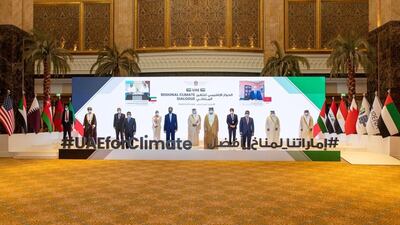
The pledge issued at the end of the Regional Climate Dialogue vowed to help the most vulnerable. -
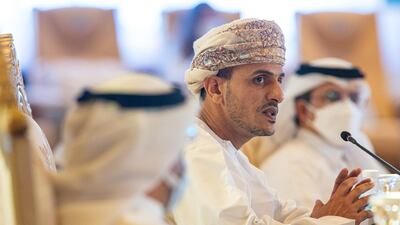
Delegates at the talks in Abu Dhabi. -
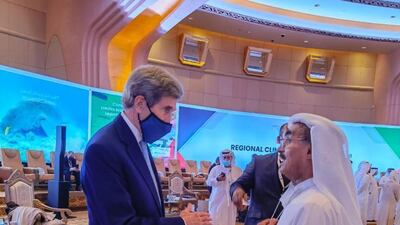
Abdullah Al Nuaimi, UAE Minister of Climate Change and Environment and John Kerry, US climate envoy at the dialogue. -
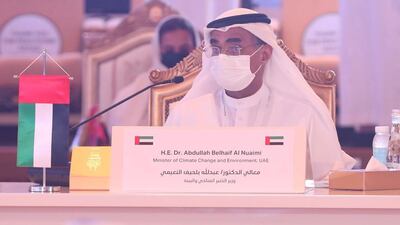
Abdullah Al Nuaimi, UAE Minister of Climate Change and Environment, at the Regional Climate Dialogue. -
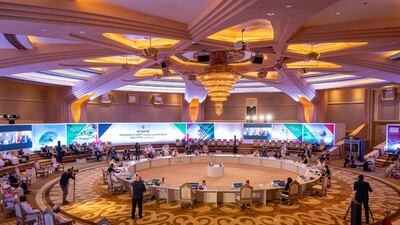
The dialogue comes during a critical year in the global fight to halt rising temperatures. Courtesy: Office of the UAE Special Envoy for Climate Change -
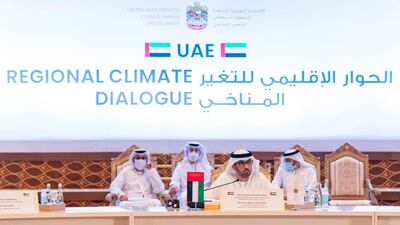
The UAE's Special Envoy for Climate Change, Dr Sultan Al Jaber, at the Regional Climate Dialogue. Courtesy: Office of the UAE Special Envoy for Climate Change -
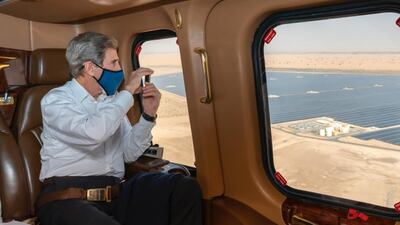
US climate envoy John Kerry is given a helicopter tour of Noor solar park, outside Abu Dhabi on Saturday. Courtesy: Office of the UAE Special Envoy for Climate Change -
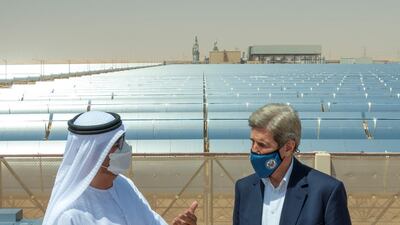
John Kerry speaks with Dr Sultan Al Jaber at Abu Dhabi's Shams 1 solar park on Saturday. The National -
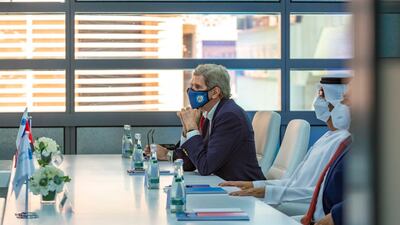
This is John Kerry's first visit to the Middle East since being appointed US climate envoy. The National -
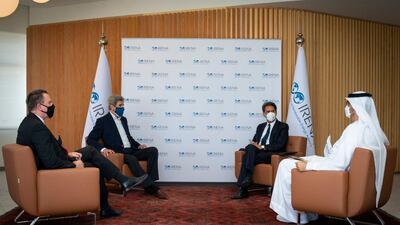
Mr Kerry has vowed to make up for the 'lost years' of the Donald Trump presidency and put the US at the forefront of efforts to protect the environment. The National -
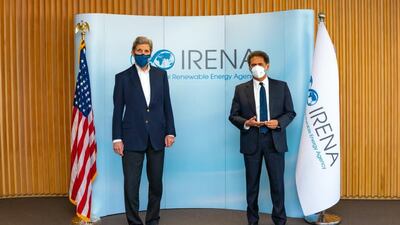
John Kerry meets Francesco La Camera, director general of International Renewable Energy Agency, which has its global headquarters in Abu Dhabi. The National -
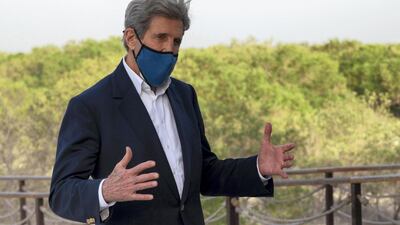
US climate envoy John Kerry visits Jubail Mangrove Park. Courtesy Office of the UAE Special Envoy for Climate Change -
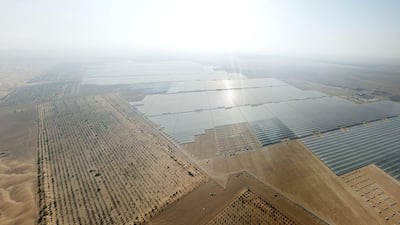
An aerial image of Abu Dhabi's Noor solar park. Its 3.2 million panels make it the largest single-site solar park in the world. Courtesy: Noor Abu Dhabi -
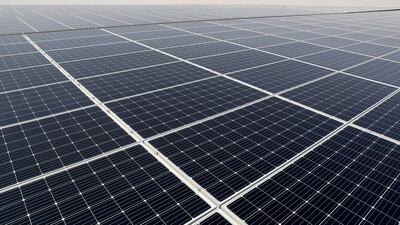
Arrayed panels at Abu Dhabi's Noor solar park. Pawan Singh / The National


One of the headline-catching announcements last week was the establishment of the Glasgow Financial Alliance for Net-Zero, chaired by Michael Bloomberg, the businessman and former New York City mayor, and Mark Carney, the former Bank of England governor. This alliance brings together financial institutions that command assets of £130 trillion (almost $176tn).
Not all of those resources will go into fighting climate change. It is a fair bet, however, that increased sums from these firms are going to benefit the fight. When Egypt and, in all likelihood, the UAE host the Cop process in 2022 and 2023, there are plenty of foundations to be built on coming out of Glasgow.
Already the UN Climate Change Secretariat has reduced its estimate of the increase in global carbon emissions by 2030 to 13.7 per cent, down from the 16 per cent that grabbed the headlines a few weeks ago.
Adair Turner, the chairman of the UK’s Energy Transitions Commission, has said the commitments announced last week deliver 40 per cent of the cuts needed to meet the target. There are more announcements on the way in steel, aviation and shipping.
In a nutshell, the growth of Cop process is gathering momentum to address climate change from many different places. That can only be a good thing.

