We live in a time not only of increasing contestation but of looming confrontation. Next month, US President Joe Biden will host the first of two Summits for Democracy, which aim to rejuvenate democratic systems and also combat "authoritarian leaders… reaching across borders to undermine democracies", according to the White House. It doesn't have to be mentioned that China and Russia are the targets.
Tensions are rising. Countless western politicians and top military brass have been warning over the past few months about the likelihood of war over Taiwan. A full-blown conflagration in Ukraine can now not be ruled out. "The sabre-rattling has to be taken seriously," cautions the Carnegie Endowment for International Peace in a paper this week. Ethiopia is on the brink of all-out civil war. Nigeria is said to be threatened by insurgency and possible secessionism. Commentators, including my colleague Hussein Ibish, have raised the possibility of a coup in Washington after the next presidential election.
Amidst all these rising tensions, the spirit of compromise is woefully absent. Perhaps that is partly because for many these disputes are said to be about principles – of territorial integrity, or of systems of government – which cannot be eroded. To do otherwise, goes the accusation, smacks of appeasement. That is a tough smear to shrug off, as no one wishes to be placed alongside the company of – to give a historical example – inter-war leaders who are deemed to have accommodated Germany before the Second World War broke out. That is how pejorative the term has become.
But compromise is not appeasement. It is compromise that has kept the peace over Taiwan, as the Harvard professor Graham Allison wrote recently in The National Interest. "When the United States and China established formal relations under presidents Richard Nixon and Jimmy Carter, statesmen recognised that the issue of Taiwan was irresolvable – but not unmanageable. The diplomatic framework they created wrapped irreconcilable differences in strategic ambiguity that has given all parties five decades of peace in which individuals on both sides of the strait have seen greater increases in their well-being than in any equivalent period in their history."
It is compromise that – recent border clashes aside – has stopped China and India going to war again over a large area of disputed territories, and compromise is the only workable solution to the several competing claims in the South China Sea.
Compromise is not weakness. However, it does, perhaps, necessarily involve understanding the motivations and principles of others, even if you disagree with their validity. For decades, this allowed for bipartisanship in the US Senate. Party did not always come first, and personal friendships flourished across the aisles. Similarly, in the UK during the 1960s, the Conservative right-winger Enoch Powell and the socialist Michael Foot allied to torpedo what they both saw as a flawed attempt to reform the House of Lords.
-

-

Participants dance at a gathering to watch the announcement of the 2022 Winter Olympics. Mark Schiefelbein / AP Photo -

Fireworks explode behind a skiing sculpture to celebrate Beijing being chosen to host the 2022 Winter Olympic. Jason Lee / Reuters -

A young boy in a dragon costume parades among volunteers in Beijing after the announcement that Beijing had been named to host the 2022 Winter Olympic Games. Fred Dufour / AFP -

Members of the delegation from Beijing 2022 Winter Olympics candidate city react after the city was elected to host the 2022 Olympic Winter Games. Vincent Thian / AP Photo -

People cheer as they watch on a screen the IOC announcing Beijing as the winner city for the 2022 Winter Olympics bid. Stringer / Reuters -

People celebrate after Beijing was chosen to host the 2022 Winter Olympics. Damir Sagolj / Reuters -

A message of congratulation is projected onto the Bird’s Nest Olympic Stadium as people gather after Beijing was chosen to host the 2022 Winter Olympics. Damir Sagolj / Reuters -

People gather to celebrate as Beijing is announced as the host city for the 2022 Winter Olympic Games. AFP -
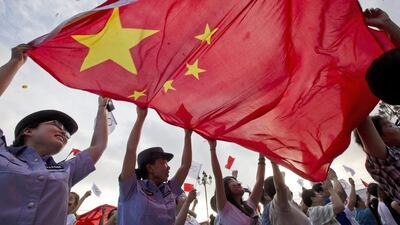
Policewomen wave a Chinese national flag to celebrate as Beijing is announced as the host city for the 2022 Winter Olympics. Ng Han Guan / AP Photo -

People celebrate after Beijing was chosen to host the 2022 Winter Olympics. Damir Sagolj / Reuters


To understand is not to condone. But to take the case of China, a failure to appreciate how the "century of humiliation" has contributed to a perfectly natural sense of nationalism, and that the country should not be denied its rightful place as a great power, places blinders over western critics who see only aggression. If I had grown up in China, for instance, I would not necessarily be a communist but I would certainly be angry at the thought that the old colonial powers were once again ganging up to contain the country. Compromise was one of the results of Monday night's virtual meeting between Mr Biden and Chinese President Xi Jinping, with the two leaders agreeing to ensure that their "simple, straightforward competition" does not veer into conflict.
Likewise with Ukraine, if the West persists in trying to embrace Kiev within the arms of both the EU and Nato, it would betray a foolish and dangerous disregard of how Russian President Vladimir Putin views his neighbour and former Soviet Socialist Republic. In 2008, Mr Putin told then US president George W Bush: "You have to understand, George, that Ukraine is not even a country. Part of its territory is in Eastern Europe and the greater part was given to us." His words were taken by the West to be a nationalist eccentricity. But Mr Putin showed he truly meant it in an essay he published this summer, in which he wrote that Russians and Ukrainians were "one people" and that "the wall that has emerged in recent years between Russia and Ukraine, between the parts of what is essentially the same historical and spiritual space, to my mind is our great common misfortune and tragedy".
Being sensible does not mean giving in to Moscow's ambitions – whatever they may be. But a suitable compromise might involve western powers simultaneously guaranteeing Ukraine's independence and giving an unbreakable commitment that it would never be allowed to join either the EU or Nato.
Compromise is what allows Spain to continue to claim the Rock of Gibraltar and the Philippines part of Sabah on the island of Borneo; and for the UK and Malaysia, respectively, to deny both claims and maintain the status quo. Compromise long allowed (until a constitutional amendment in 1999) the Republic of Ireland to claim the whole island as its "national territory", while accepting that Northern Ireland was de facto part of the UK.
Compromise dials down confrontation and reduces the risk of hard clashes. Its absence leads to hyper-partisanship and the disappearance of any common ground. We could do with a lot more of it today, and no, it is not an admission of defeat. Far better to see it as the 18th-century British statesman Edmund Burke did: "All government, indeed every human benefit and enjoyment, every virtue, and every prudent act, is founded on compromise and barter."