Hussein Ibish is a senior resident scholar at the Arab Gulf States Institute and a US affairs columnist for The National
December 05, 2021
The Nobel laureate may have turned 80 this summer, but in many ways it is still Bob Dylan’s America.
The singer-songwriter bounded onto the stage in Washington last Thursday with astounding energy, engagement, bonhomie and performative power. His singing was his best in decades – robust, precisely phrased, often delicate and almost always clearly intelligible, the last often not true in recent years. The Covid-19 lockdown was clearly good for his long-suffering larynx.
Dylan delivered a dazzlingly noteworthy and timely set of songs steeped in “Americana”, a musical genre he essentially invented in his legendary, and long-withheld, 1967 recordings known as The Basement Tapes.
Americana was more broadly popularised by the 1968 album released by The Band, Dylan’s then backing group, entitled Music from Big Pink (the nickname for the house in which Dylan’s “basement tapes” were recorded). Those recordings were so consequential that they totally reoriented the careers of many well-known performers, such as the British musician Eric Clapton. Along with Dylan’s closely related and stripped-down 1967 album John Wesley Harding, these “tapes” established a robust alternative to the (arguably overblown) psychedelic rock music of The Beatles’ album Sgt Pepper’s Lonely Hearts Club Band and innumerable imitations.
Another and still-ongoing Dylan deep-dive into the American songbook and cultural bayou decades later in his career commenced with his 2001 album Love and Theft. That title, tellingly, was adopted from a book by the historian Eric Lott that investigates how white Americans have engaged with, mimicked and suppressed black culture, especially music. That’s a theme close to Dylan’s own career and concerns. After all, the young Dylan began as both a champion of African-American civil rights and a keen student and, indeed, thief, of blues songs and styles (among countless others).
On Thursday night, his songs were largely performed in the “Chicago blues” musical style, which he hasn’t employed so powerfully since his earliest electric performances highlighted by Chicago blues guitarist Mike Bloomfield. Would a young Dylan be denounced and cancelled for appropriation if he repeated that career path today? Perhaps. But clearly the old man is beyond such attacks.
In his early 20s, Dylan emerged as a symbol of the budding counterculture of the early 1960s. Then he famously alienated much of his folk music and left-wing fan-base by morphing into a rock musician specialising in highly personal, often obscure, songs that did little to inspire social protest.
In a 1966 Manchester show, a spectator notoriously summed up the outrage over this supposed betrayal by shouting “Judas” at Dylan before he and his band launched into a blistering version of Like a Rolling Stone, his new hit at the time and arguably his most vicious song of contempt. For a songwriter steeped in Biblical symbolism, though to an extent not recognised yet then, “Judas” was a pointed barb indeed.
From then, Dylan performed innumerable self-reinventions while remaining the artist of his generation most successfully expressing and shaping American culture and also straddling popular and fine arts.
Yet, he remains mysterious. In Brownsville Girl, one of his best songs of the 1980s, he wrote: “The only thing we knew for sure about Henry Porter is that his name wasn’t Henry Porter.” Much the same can be said of the man born Robert Zimmerman in Duluth, Minnesota, and has been a master of personal obfuscation ever since. The only thing we know for sure about him is that his name isn’t Bob Dylan.
US singer-songwriter Bob Dylan won the 2016 Nobel Prize in Literature. Getty Images
Dylan performs during the 21st Vieilles Charrues Festival in Carhaix-Plouguer, France. AFP
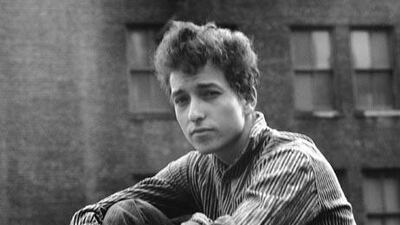
Dylan in his younger years. AFP
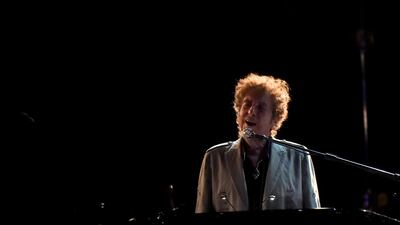
The musician performs during the Firefly Music Festival in Dover, Delaware, US on June 17, 2017. Reuters
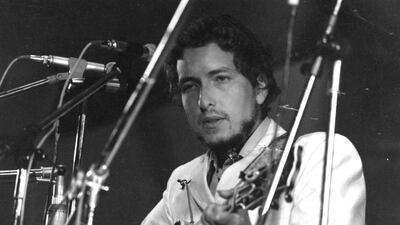
The pop culture figure performed at the Isle of Wight Festival in 1969, instead of at Woodstock. Getty Images
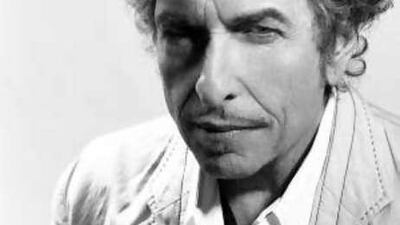
The singer embraces his own mortality with a compelling sense of dread. AP
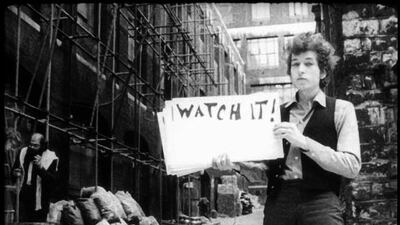
Dylan in the 1967 film Don't Look Back. Photo: Pennebaker Films
Dylan appears on stage at the Ullevi Stadium in Gothenburg, Sweden, on June 9, 1984. AFP
Like many American heroes, Dylan exemplifies the archetype of self-reinvention, except that he, along with a few others, has adopted it as a continuous process. Just when you think you have him figured out, “the carpet too is moving under you”, as he explained in his key 1965 song It’s All Over Now, Baby Blue.
Dylan’s most startling metamorphosis came in the late 1970s, when he horrified much of his established audience by re-emerging as a fundamentalist, literalist and apocalyptic born-again Christian.
Initially, he even refused to perform his earlier works and harangued stunned audiences with fire-and-brimstone sermons about an immanent day of judgement and the agonising eternal punishments awaiting infidels. Yet, those concerts, and some of the songs, were among his best, and well-attuned to the era of then president Ronald Reagan, if not his pre-existing fan-base.
These fundamentalist passions appeared to fade, along with record sales, after a few years, and under heavy pressure from his recording company, Columbia. Yet, a strong Biblical pretext was evident in the album John Wesley Harding, and a more overtly Christian legacy has been very slowly re-emerging in Dylan’s more recent releases.
This was unmistakable at the Washington concert. In perfect sync with America today, the show might as well have been entitled “The Sacred and the Profane”, as Dylan carefully oscillated between songs with worldly and identifiably Christian themes. This pattern fits perfectly into the zeitgeist of an America that is torn between politically empowered fundamentalists and a largely moderate and secular public.
Among the more unusual aspects of the concert – not only for Dylan but for any well-established performer – was a striking lack of any classics, hits or golden oldies. The lone exception, perhaps, was Gotta Serve Somebody, one of his best Christian fundamentalist songs, but which was probably included more for thematic than nostalgic purposes.
The set showed Dylan far more upfront about his distinctively Christian sentiments than at any time since the early 1980s, but thankfully without the fundamentalist tones. The ongoing American racial reckoning, religious passions and ambivalence, and the ageing yet often surprisingly robust quality of American society, were all enacted on stage by this now-elderly savant.
In the early 1960s, in many ways Dylan was America. And, decades later and in many other ways, he still is. Sixty years ago, an almost impossibly young Dylan seemingly emerged from “nowhere” – geographically and culturally – to express and define a suddenly transforming national culture. He retains an uncanny ability to channel a reviving, and as he portrays it, dynamic and still potent America.
Dylan’s Washington concert seemed anything but a swansong. Instead, it felt like another new beginning for one old man and the country he still seems able to instinctively express and embody.
Soft power was first mentioned in 1990 by former US Defence Secretary Joseph Nye. He believed that there were alternative ways of cultivating support from other countries, instead of achieving goals using military strength. Soft power is, at its root, the ability to convince other states to do what you want without force. This is traditionally achieved by proving that you share morals and values.
Islamophobia definition
A widely accepted definition was made by the All Party Parliamentary Group on British Muslims in 2019: “Islamophobia is rooted in racism and is a type of racism that targets expressions of Muslimness or perceived Muslimness.” It further defines it as “inciting hatred or violence against Muslims”.
Family reunited
Nazanin Zaghari-Ratcliffe was born and raised in Tehran and studied English literature before working as a translator in the relief effort for the Japanese International Co-operation Agency in 2003.
She moved to the International Federation of Red Cross and Red Crescent Societies before moving to the World Health Organisation as a communications officer.
She came to the UK in 2007 after securing a scholarship at London Metropolitan University to study a master's in communication management and met her future husband through mutual friends a month later.
The couple were married in August 2009 in Winchester and their daughter was born in June 2014.
Uefa Champions League semi-finals, first leg
Liverpool v Roma When: April 24, 10.45pm kick-off (UAE) Where: Anfield, Liverpool Live: BeIN Sports HD Second leg: May 2, Stadio Olimpico, Rome
MOUNTAINHEAD REVIEW
Starring: Ramy Youssef, Steve Carell, Jason Schwartzman
Director: Jesse Armstrong
Rating: 3.5/5
How does ToTok work?
The calling app is available to download on Google Play and Apple App Store
To successfully install ToTok, users are asked to enter their phone number and then create a nickname.
The app then gives users the option add their existing phone contacts, allowing them to immediately contact people also using the application by video or voice call or via message.
Users can also invite other contacts to download ToTok to allow them to make contact through the app.
Strait of Hormuz
Fujairah is a crucial hub for fuel storage and is just outside the Strait of Hormuz, a vital shipping route linking Middle East oil producers to markets in Asia, Europe, North America and beyond.
The strait is 33 km wide at its narrowest point, but the shipping lane is just three km wide in either direction. Almost a fifth of oil consumed across the world passes through the strait.
Iran has repeatedly threatened to close the strait, a move that would risk inviting geopolitical and economic turmoil.
Last month, Iran issued a new warning that it would block the strait, if it was prevented from using the waterway following a US decision to end exemptions from sanctions for major Iranian oil importers.
This article is part of a guide on where to live in the UAE. Our reporters will profile some of the country’s most desirable districts, provide an estimate of rental prices and introduce you to some of the residents who call each area home.
Joker: Folie a Deux
Starring: Joaquin Phoenix, Lady Gaga, Brendan Gleeson