Russian soldiers wearing chemical protection suits train at a research institute outside Moscow in 2010. AFP


Will Biden repeat Obama's 'red line' threat in Ukraine?


  • English
  • Arabic

April 15, 2022

Claims that Russia may have resorted to using chemical weapons during an attack against Ukrainian positions raises important questions about how the West might respond to any further escalation in the conflict.

To date, Nato leaders have been determined not to enter the war for fear of becoming involved in a military confrontation with Russia, a development that could have catastrophic consequences for the rest of Europe.

Nato Secretary General Jens Stoltenberg neatly summed up the continent's dilemma following a recent meeting between members of the security umbrella, when he warned that the alliance was treading a fine line between providing Kyiv with military support it needed, but not to the extent that it risked provoking a direct conflict with Moscow.

The West may be keeping Moscow guessing as to how they might react to any given situation

It is for this reason that the alliance has been reluctant to provide Ukraine with offensive weaponry, such as tanks and warplanes, preferring instead to concentrate on defensive measures, including anti-tank and anti-aircraft missiles. The Neptune anti-ship missile, believed to have struck Russia's Black Sea flagship Moskva, is a Ukrainian-made weapon based on a Soviet-era anti-ship missile.

But while western leaders are taking extreme caution to prevent the conflict from spreading beyond Ukraine's borders, the issue of chemical weapons – and whether Russian forces might be tempted to employ them as they intensify their efforts to capture the Donbas region of eastern Ukraine – presents a completely different set of challenges.

A decade ago, during the Syrian civil war, the possibility that the Assad regime might use chemical weapons against rebel forces was deemed by the Obama administration and its western allies, such as the UK, to be a "red line" that, if crossed, would prompt a military response.

But when forces loyal to Syrian President Bashar Al Assad were accused of using chemical weapons in an attack on the Damascus suburb of Ghouta in August 2013, the West's failure to respond by launching military strikes seriously damaged its international credibility.

The Ukraine conflict is different in nature, but the issue of chemical weapons is one that western policymakers cannot simply ignore.

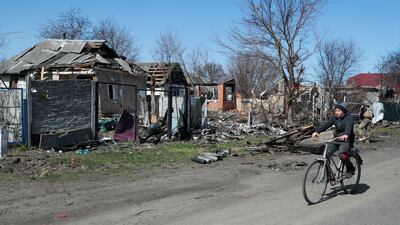
  • A boy rides a bicycle past a house that was damaged by shelling in Andriivka village, not far from Kyiv. EPA
    A boy rides a bicycle past a house that was damaged by shelling in Andriivka village, not far from Kyiv. EPA
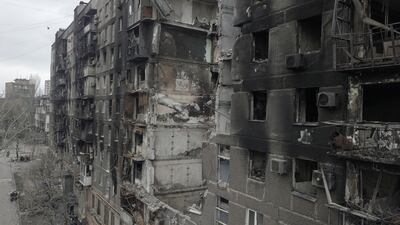
  • A destroyed residential building in Mariupol, south-eastern Ukraine. Reuters
    A destroyed residential building in Mariupol, south-eastern Ukraine. Reuters
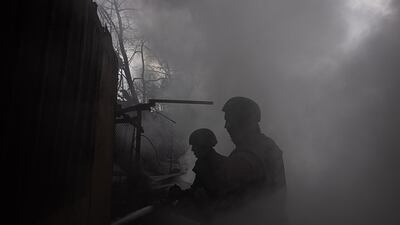
  • Firefighters at work on the outskirts of Kharkiv, north-east Ukraine. EPA
    Firefighters at work on the outskirts of Kharkiv, north-east Ukraine. EPA
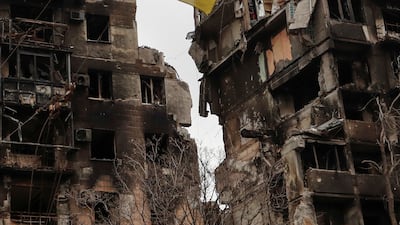
  • A torn Ukrainian flag in front of a ruined Mariupol apartment building. Reuters
    A torn Ukrainian flag in front of a ruined Mariupol apartment building. Reuters
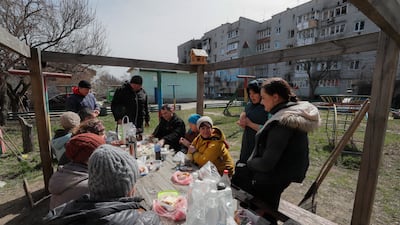
  • Residents who cleared debris after Russian shelling eat lunch outside a damaged building in Makariv, near Kyiv. EPA
    Residents who cleared debris after Russian shelling eat lunch outside a damaged building in Makariv, near Kyiv. EPA
  • Children play with a therapeutic dog at a shelter organised by volunteers in Zaporizhzhya, Ukraine. Reuters
    Children play with a therapeutic dog at a shelter organised by volunteers in Zaporizhzhya, Ukraine. Reuters
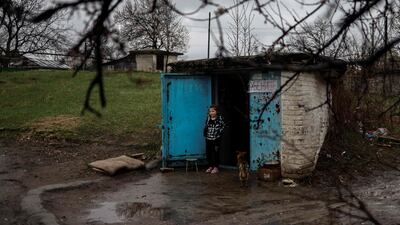
  • A girl stands by the door of a bunker in Severodonetsk, in eastern Ukraine's Donbas region, as Russian troops intensify a campaign to take the strategic port city of Mariupol. AFP
    A girl stands by the door of a bunker in Severodonetsk, in eastern Ukraine's Donbas region, as Russian troops intensify a campaign to take the strategic port city of Mariupol. AFP
  • A firefighter at work following a missile attack near Kharkiv International Airport. Reuters
    A firefighter at work following a missile attack near Kharkiv International Airport. Reuters
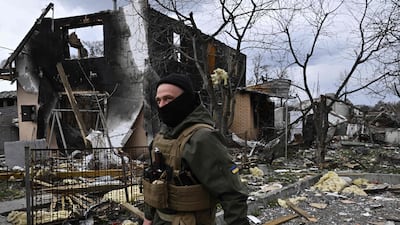
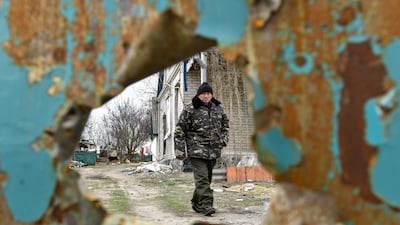
  • A Ukrainian fighter walks in front of a destroyed house in Bohdanivka village, north-east of Kyiv. AFP
    A Ukrainian fighter walks in front of a destroyed house in Bohdanivka village, north-east of Kyiv. AFP
  • Two women hug outside a heavily damaged apartment block following an artillery attack in Kharkiv. Reuters
    Two women hug outside a heavily damaged apartment block following an artillery attack in Kharkiv. Reuters
  • Ukrainian soldiers guard the village of Barvinkove, as Russia's invasion on Ukraine continues. Reuters
    Ukrainian soldiers guard the village of Barvinkove, as Russia's invasion on Ukraine continues. Reuters
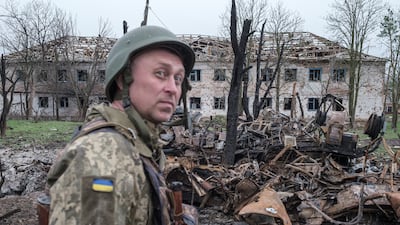
  • Leonid Serdiuchenko, a Ukrainian commander, stands next to destroyed vehicles outside Barvinkove. Reuters
    Leonid Serdiuchenko, a Ukrainian commander, stands next to destroyed vehicles outside Barvinkove. Reuters
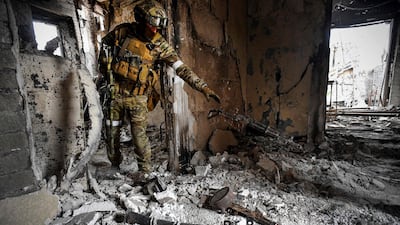
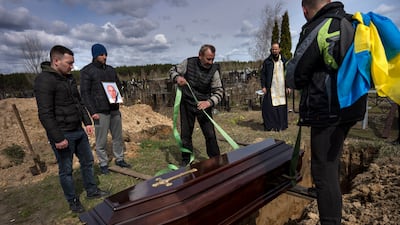
  • A woman carries the portrait of Dmytro Stefienko, 32, a civilian killed during the war, during his funeral in Bucha, Ukraine. AP
    A woman carries the portrait of Dmytro Stefienko, 32, a civilian killed during the war, during his funeral in Bucha, Ukraine. AP
  • A Russian soldier collects weapons from inside the Mariupol drama theatre in Ukraine. AFP
    A Russian soldier collects weapons from inside the Mariupol drama theatre in Ukraine. AFP
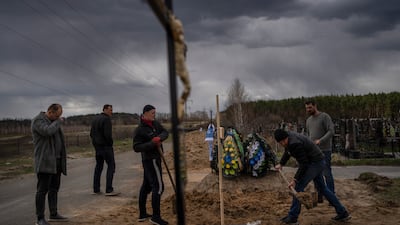
  • Relatives and friends attend the funeral of Andriy Matviychuk, 37, who served as a territorial defence soldier, who was captured and killed by the Russian army in Bucha, Ukraine. AP
    Relatives and friends attend the funeral of Andriy Matviychuk, 37, who served as a territorial defence soldier, who was captured and killed by the Russian army in Bucha, Ukraine. AP
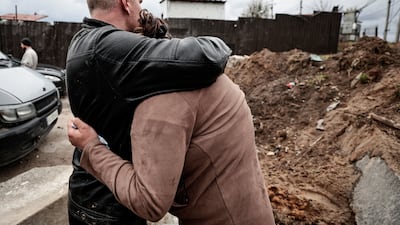
  • Anatoliy Morykin, 45, left, mourns the death of his mother, Valentyna Morykina, 82, who died in a retirement home in Bucha during the Russian invasion. AP
    Anatoliy Morykin, 45, left, mourns the death of his mother, Valentyna Morykina, 82, who died in a retirement home in Bucha during the Russian invasion. AP
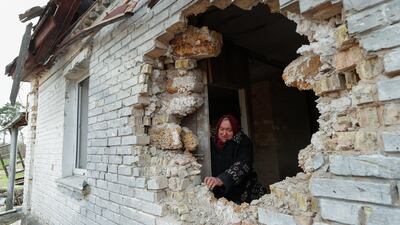
  • Nadiya, 65, shows a hole in a wall of a building after shelling in Zalissya, Ukraine. EPA
    Nadiya, 65, shows a hole in a wall of a building after shelling in Zalissya, Ukraine. EPA
  • A booby trap found by locals near their home in Zalissya. EPA
    A booby trap found by locals near their home in Zalissya. EPA
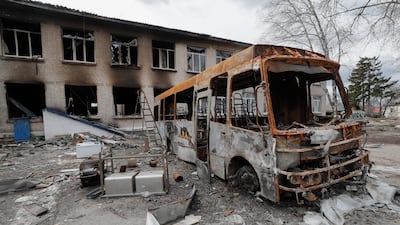
  • Debris of a school bus near a damaged school that was a base for Russian troops in Bohdanivka, Ukraine. EPA
    Debris of a school bus near a damaged school that was a base for Russian troops in Bohdanivka, Ukraine. EPA
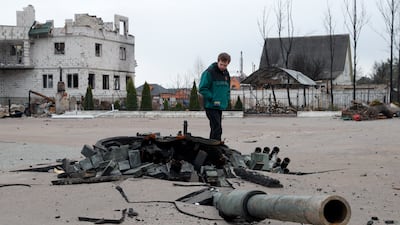
  • A man examines the debris of a destroyed Russian tank in Bohdanivka. EPA
    A man examines the debris of a destroyed Russian tank in Bohdanivka. EPA
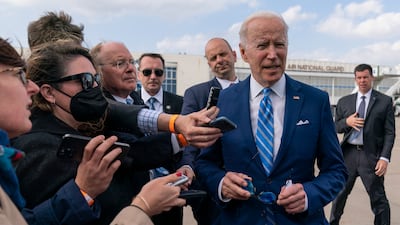
  • President Joe Biden speaks to the media before boarding Air Force One at Des Moines International Airport, en route to Washington. AP
    President Joe Biden speaks to the media before boarding Air Force One at Des Moines International Airport, en route to Washington. AP
  • Valentina Saroyan sits in the basement of a school in Yahidne, near Chernihiv, Ukraine. AP
    Valentina Saroyan sits in the basement of a school in Yahidne, near Chernihiv, Ukraine. AP
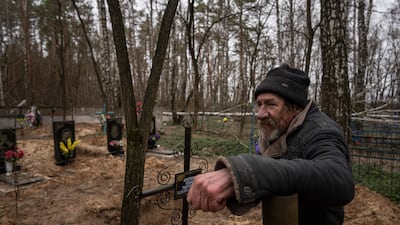
  • Vasyl Cherepenko stands next to a mass grave at a cemetery in Yahidne, near Dnipro, Ukraine. AP
    Vasyl Cherepenko stands next to a mass grave at a cemetery in Yahidne, near Dnipro, Ukraine. AP
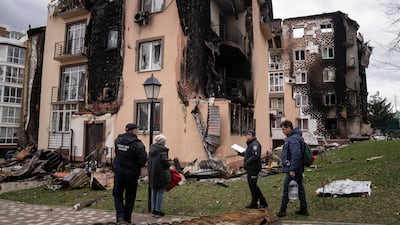
  • Oksana, second from left, and Yevhen, right, talk with police officers next to their apartment building damaged by shelling in Irpin, Ukraine. AP
    Oksana, second from left, and Yevhen, right, talk with police officers next to their apartment building damaged by shelling in Irpin, Ukraine. AP
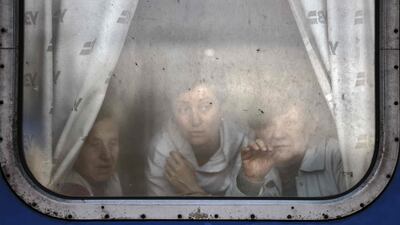
  • Women bid farewell to relatives as they leave the Slovyansk central station in the Donbas region. AFP
    Women bid farewell to relatives as they leave the Slovyansk central station in the Donbas region. AFP
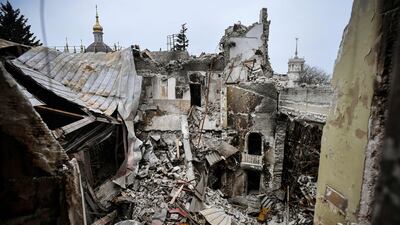
  • The partially destroyed Mariupol drama theatre in Ukraine, hit on March 16 by an air strike. AFP
    The partially destroyed Mariupol drama theatre in Ukraine, hit on March 16 by an air strike. AFP
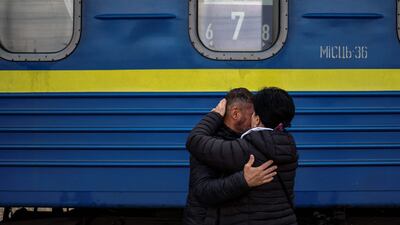
  • A man embraces his wife as she prepares to board a train at Slovyansk central station in the Donbas region. AFP
    A man embraces his wife as she prepares to board a train at Slovyansk central station in the Donbas region. AFP
  • A woman walks through a damaged apartment building after a Russian attack in Kharkiv, Ukraine. AP
    A woman walks through a damaged apartment building after a Russian attack in Kharkiv, Ukraine. AP
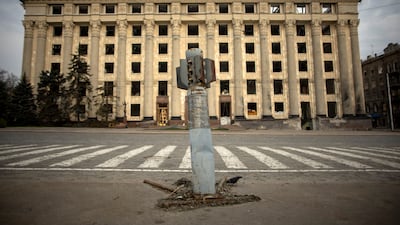
  • A missile pierces the road in front of the Kharkiv Regional State Administration building amid Russia's attack on Ukraine. Reuters
    A missile pierces the road in front of the Kharkiv Regional State Administration building amid Russia's attack on Ukraine. Reuters
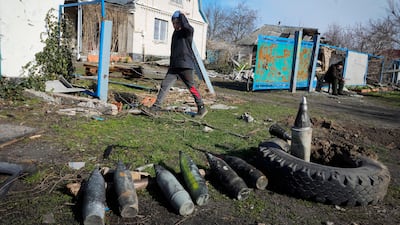
  • A boy walks by unexploded Russian shells in the village of Andriyivka close to Kyiv, Ukraine. AP
    A boy walks by unexploded Russian shells in the village of Andriyivka close to Kyiv, Ukraine. AP
  • Ukrainian tanks move down a street in Irpin, on the outskirts of Kyiv. AP
    Ukrainian tanks move down a street in Irpin, on the outskirts of Kyiv. AP
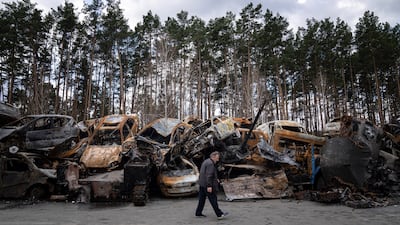
  • A man walks past a storage place for burned armed vehicles and cars, on the outskirts of Kyiv. AP
    A man walks past a storage place for burned armed vehicles and cars, on the outskirts of Kyiv. AP
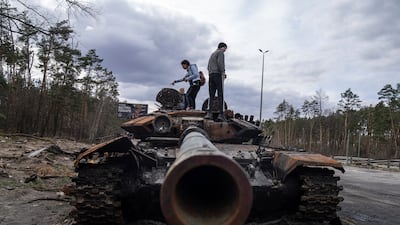
  • Local residents stand on top of a Russian tank on the outskirts of Kyiv. AP
    Local residents stand on top of a Russian tank on the outskirts of Kyiv. AP
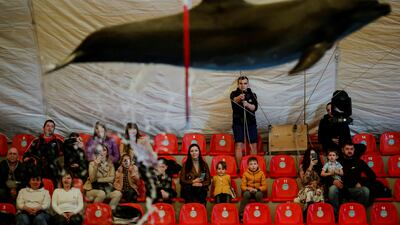
  • Ukrainian families, who have fled Kherson amid the Russian invasion, watch a dolphin show at a hotel in Odesa, Ukraine. Reuters
    Ukrainian families, who have fled Kherson amid the Russian invasion, watch a dolphin show at a hotel in Odesa, Ukraine. Reuters
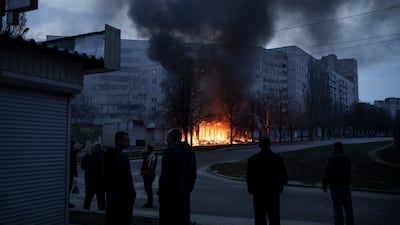
  • Residents stand outside their apartments as shops burn after a Russian attack in Kharkiv, Ukraine. AP
    Residents stand outside their apartments as shops burn after a Russian attack in Kharkiv, Ukraine. AP
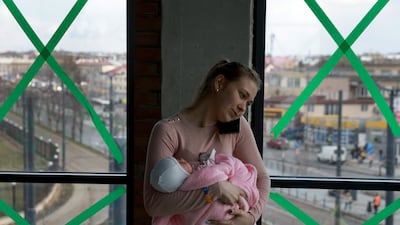
  • Irina Szymanska holds her baby in a temporary shelter at the central train station for displaced people heading to Poland in Lviv, Ukraine. Getty Images
    Irina Szymanska holds her baby in a temporary shelter at the central train station for displaced people heading to Poland in Lviv, Ukraine. Getty Images
  • A man walks in his yard, damaged by shelling, in the village of Andriivka, Ukraine. EPA
    A man walks in his yard, damaged by shelling, in the village of Andriivka, Ukraine. EPA
  • Sixty-two-year-old Luba hugs a Ukrainian servicewoman in Andriivka. EPA
    Sixty-two-year-old Luba hugs a Ukrainian servicewoman in Andriivka. EPA
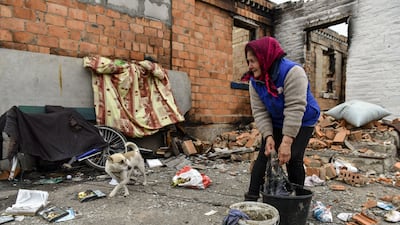
  • A woman washes clothes in the yard of a ruined house in Andriivka. EPA
    A woman washes clothes in the yard of a ruined house in Andriivka. EPA
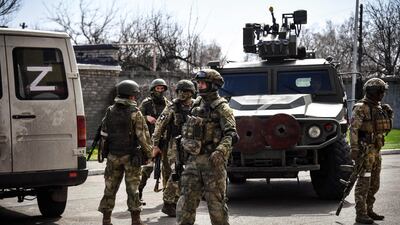
  • Russian soldiers patrol a street in Volnovakha, in the self-proclaimed Donetsk People's Republic. The picture was taken during a trip organised by the Russian military. AFP
    Russian soldiers patrol a street in Volnovakha, in the self-proclaimed Donetsk People's Republic. The picture was taken during a trip organised by the Russian military. AFP
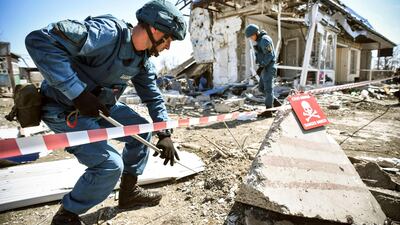
  • Russian mine clearers search for explosive objects in a building the Russian authorities say was damaged by Ukrainian shelling. AFP
    Russian mine clearers search for explosive objects in a building the Russian authorities say was damaged by Ukrainian shelling. AFP
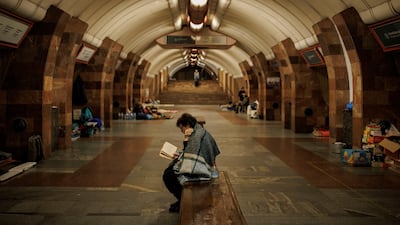
  • A woman reads a book as residents find shelter from shelling in a metro station in Kharkiv. Reuters
    A woman reads a book as residents find shelter from shelling in a metro station in Kharkiv. Reuters
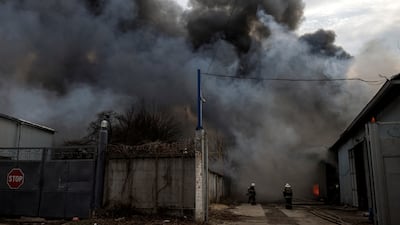
  • Firefighters try to contain a fire at a plant in Kharkiv following Russian shelling. Reuters
    Firefighters try to contain a fire at a plant in Kharkiv following Russian shelling. Reuters
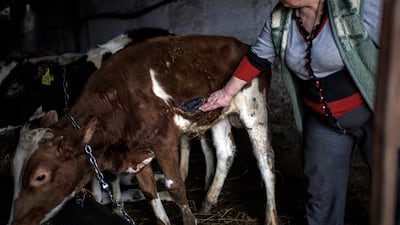
  • Farm owner Zlobina Lubov tends to her animals in the village of Malaya Rohan, Ukraine. Reuters
    Farm owner Zlobina Lubov tends to her animals in the village of Malaya Rohan, Ukraine. Reuters
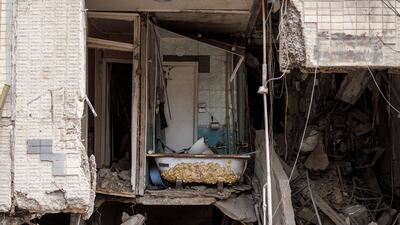
  • A bathtub is seen inside a building that was heavily damaged by shelling in Kharkiv. Reuters
    A bathtub is seen inside a building that was heavily damaged by shelling in Kharkiv. Reuters
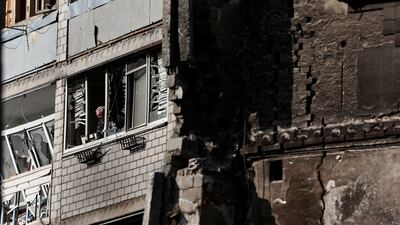
  • A man looks out of his window, amid Russia's invasion of Ukraine, in Borodianka. Reuters
    A man looks out of his window, amid Russia's invasion of Ukraine, in Borodianka. Reuters
  • Soldiers 'came to my house and said go to the basement' Zinaida Makishaiva, 82, said, before they started to shoot around her. 'God saved my life,' she said. Reuters
    Soldiers 'came to my house and said go to the basement' Zinaida Makishaiva, 82, said, before they started to shoot around her. 'God saved my life,' she said. Reuters
  • A mother waits for police officers to exhume the body of her son from a well at a fuel station in Buzova, Kyiv region. According to the head of the village, he was killed by Russian soldiers. Reuters
    A mother waits for police officers to exhume the body of her son from a well at a fuel station in Buzova, Kyiv region. According to the head of the village, he was killed by Russian soldiers. Reuters

To date, they have declined to be drawn on whether they would consider the use of such weapons against Ukrainian forces to be the proverbial red line that obliges them to act. Speaking after a meeting of Nato leaders in March, US President Joe Biden simply stated that his country and its allies would respond "in kind" if such weapons were used, without providing precise details.

Indeed, the longer the conflict continues, there is a deepening understanding among western leaders that, rather than stating their intentions in public, it is to their advantage to introduce a degree of ambiguity in their statements, thereby keeping Moscow guessing as to how they might react to any given situation.

The West's dilemma was brought into focus this week after unconfirmed reports of a possible attack taking place against Ukrainian forces defending the besieged city of Mariupol.

A video published online by Ukraine's Azov Regiment, which is playing a key role in Mariupol’s defence, claimed that a Russian drone had dropped some form of poisonous material on Azov fighters and civilians in the city. The report claimed victims experienced difficulty breathing, muscular function problems, pain and irritation to throat and lungs, and racing heartbeat.

Three people required medical attention, although no one was badly injured, with the worst-affected casualty said to be an elderly civilian.

Concerns that banned weapons might have been used at Mariupol deepened after Eduard Basurin, the leader of Russian separatist forces in the region, had claimed that the only way to defeat the Azov forces was to "bring in chemical troops".

Victims of a suspected chemical weapons attack in Khan Sheikhoun, in the northern province of Idlib, Syria, in 2017. AP Photo

The West was quick to take the reports at face value, with British Foreign Secretary Liz Truss issuing a warning. "Any use of such weapons would be a callous escalation in this conflict and we will hold [Russian President Vladimir] Putin and his regime to account." In Washington, US Secretary of State Antony Blinken claimed that the US had "credible information" that Russia could use some form of "chemical agents" in its efforts to capture Mariupol.

"We have credible information that Russian forces may use a variety of riot control agents, including tear gas mixed with chemical agents, that would cause stronger symptoms to weaken and incapacitate entrenched Ukrainian fighters and civilians, as part of the aggressive campaign to take Mariupol," Mr Blinken said.

To date, there has been no independent confirmation whether last week's alleged attack contained a chemical agent. There is also a chance the report could have been a propaganda exercise on the part of Ukraine's highly effective information warfare centre.

Nevertheless, the incident will have concentrated the minds of western leaders.

The Russian military, it is alleged, has allowed for the use of banned weaponry before – including supposedly in Syria, where chemical weapons of varying descriptions were used against civilian targets in cities such as Aleppo. Moscow has long denied doing so, but human rights groups have accused Syrian government forces fighting alongside the Russians of launching co-ordinated chemical attacks against opposition-controlled parts of the country's north.

Whether or not such tactics will be used in Ukraine, the West is yet unclear about how its leaders might respond without provoking an even bigger conflict with Moscow.

Day 2, stumps

Pakistan 482

Australia 30/0 (13 ov)

Australia trail by 452 runs with 10 wickets remaining in the innings

The candidates

Dr Ayham Ammora, scientist and business executive

Ali Azeem, business leader

Tony Booth, professor of education

Lord Browne, former BP chief executive

Dr Mohamed El-Erian, economist

Professor Wyn Evans, astrophysicist

Dr Mark Mann, scientist

Gina MIller, anti-Brexit campaigner

Lord Smith, former Cabinet minister

Sandi Toksvig, broadcaster


The%20specs
%3Cp%3E%3Cstrong%3EEngine%3A%3C%2Fstrong%3E%201.8-litre%204-cyl%20turbo%0D%3Cbr%3E%3Cstrong%3EPower%3A%20%3C%2Fstrong%3E190hp%20at%205%2C200rpm%0D%3Cbr%3E%3Cstrong%3ETorque%3A%3C%2Fstrong%3E%20320Nm%20from%201%2C800-5%2C000rpm%0D%3Cbr%3E%3Cstrong%3ETransmission%3A%20%3C%2Fstrong%3ESeven-speed%20dual-clutch%20auto%0D%3Cbr%3E%3Cstrong%3EFuel%20consumption%3A%3C%2Fstrong%3E%206.7L%2F100km%0D%3Cbr%3E%3Cstrong%3EPrice%3A%3C%2Fstrong%3E%20From%20Dh111%2C195%0D%3Cbr%3E%3Cstrong%3EOn%20sale%3A%20%3C%2Fstrong%3ENow%3C%2Fp%3E%0A
The Specs

Price, base Dh379,000
Engine 2.9-litre, twin-turbo V6
Gearbox eight-speed automatic
Power 503bhp
Torque 443Nm
On sale now

FROM%20THE%20ASHES
%3Cp%3EDirector%3A%20Khalid%20Fahad%3C%2Fp%3E%0A%3Cp%3EStarring%3A%20Shaima%20Al%20Tayeb%2C%20Wafa%20Muhamad%2C%20Hamss%20Bandar%3C%2Fp%3E%0A%3Cp%3ERating%3A%203%2F5%3C%2Fp%3E%0A
Top%2010%20most%20competitive%20economies
%3Cp%3E1.%20Singapore%0D%3Cbr%3E2.%20Switzerland%0D%3Cbr%3E3.%20Denmark%0D%3Cbr%3E4.%20Ireland%0D%3Cbr%3E5.%20Hong%20Kong%0D%3Cbr%3E6.%20Sweden%0D%3Cbr%3E7.%20UAE%0D%3Cbr%3E8.%20Taiwan%0D%3Cbr%3E9.%20Netherlands%0D%3Cbr%3E10.%20Norway%0D%3Cbr%3E%3C%2Fp%3E%0A
The five pillars of Islam

1. Fasting 

2. Prayer 

3. Hajj 

4. Shahada 

5. Zakat 

Emiratisation at work

Emiratisation was introduced in the UAE more than 10 years ago

It aims to boost the number of citizens in the workforce particularly in the private sector.

Growing the number of Emiratis in the workplace will help the UAE reduce dependence on overseas workers

The Cabinet in December last year, approved a national fund for Emirati jobseekers and guaranteed citizens working in the private sector a comparable pension

President Sheikh Khalifa has described Emiratisation as “a true measure for success”.

During the UAE’s 48th National Day, Sheikh Khalifa named education, entrepreneurship, Emiratisation and space travel among cornerstones of national development

More than 80 per cent of Emiratis work in the federal or local government as per 2017 statistics

The Emiratisation programme includes the creation of 20,000 new jobs for UAE citizens

UAE citizens will be given priority in managerial positions in the government sphere

The purpose is to raise the contribution of UAE nationals in the job market and create a diverse workforce of citizens

Race card

1.30pm: Handicap (PA) Dh 50,000 (Dirt) 1,400m

2pm: Handicap (TB) Dh 84,000 (D) 1,400m

2.30pm: Maiden (TB) Dh 60,000 (D) 1,200m

3pm: Conditions (TB) Dh 100,000 (D) 1.950m

3.30pm: Handicap (TB) Dh 76,000 (D) 1,800m

4pm: Maiden (TB) Dh 60,000 (D) 1,600m

4.30pm: Handicap (TB) Dh 68,000 (D) 1,000m

Cultural fiesta

What: The Al Burda Festival
When: November 14 (from 10am)
Where: Warehouse421,  Abu Dhabi
The Al Burda Festival is a celebration of Islamic art and culture, featuring talks, performances and exhibitions. Organised by the Ministry of Culture and Knowledge Development, this one-day event opens with a session on the future of Islamic art. With this in mind, it is followed by a number of workshops and “masterclass” sessions in everything from calligraphy and typography to geometry and the origins of Islamic design. There will also be discussions on subjects including ‘Who is the Audience for Islamic Art?’ and ‘New Markets for Islamic Design.’ A live performance from Kuwaiti guitarist Yousif Yaseen should be one of the highlights of the day. 

MATCH INFO

Chelsea 4 (Mount 18',Werner 44', Hudson-Odoi 49', Havertz 85')

Morecambe 0

THREE
%3Cp%3EDirector%3A%20Nayla%20Al%20Khaja%3C%2Fp%3E%0A%3Cp%3EStarring%3A%20Jefferson%20Hall%2C%20Faten%20Ahmed%2C%20Noura%20Alabed%2C%20Saud%20Alzarooni%3C%2Fp%3E%0A%3Cp%3ERating%3A%203.5%2F5%3C%2Fp%3E%0A
Company%20profile
%3Cp%3E%3Cstrong%3ECompany%20name%3A%3C%2Fstrong%3E%20FinFlx%3C%2Fp%3E%0A%3Cp%3E%3Cstrong%3EStarted%3A%3C%2Fstrong%3E%20January%202021%3C%2Fp%3E%0A%3Cp%3E%3Cstrong%3EFounders%3A%3C%2Fstrong%3E%20Amr%20Yussif%20(co-founder%20and%20CEO)%2C%20Mattieu%20Capelle%20(co-founder%20and%20CTO)%3C%2Fp%3E%0A%3Cp%3E%3Cstrong%3EBased%20in%3A%3C%2Fstrong%3E%20Dubai%3C%2Fp%3E%0A%3Cp%3E%3Cstrong%3EIndustry%3A%3C%2Fstrong%3E%20FinTech%3C%2Fp%3E%0A%3Cp%3E%3Cstrong%3EFunding%20size%3A%3C%2Fstrong%3E%20%241.5m%20pre-seed%3C%2Fp%3E%0A%3Cp%3E%3Cstrong%3EInvestors%3A%3C%2Fstrong%3E%20Venture%20capital%20-%20Y%20Combinator%2C%20500%20Global%2C%20Dubai%20Future%20District%20Fund%2C%20Fox%20Ventures%2C%20Vector%20Fintech.%20Also%20a%20number%20of%20angel%20investors%3C%2Fp%3E%0A
'Falling%20for%20Christmas'
%3Cp%3EDirector%3A%20Janeen%20Damian%3Cbr%3E%3Cbr%3EStars%3A%20Lindsay%20Lohan%2C%20Chord%20Overstreet%2C%20Jack%20Wagner%2C%20Aliana%20Lohan%3Cbr%3E%3Cbr%3ERating%3A%201%2F5%3C%2Fp%3E%0A
Scores

Day 2

New Zealand 153 & 56-1
Pakistan 227

New Zealand trail by 18 runs with nine wickets remaining

Mercer, the investment consulting arm of US services company Marsh & McLennan, expects its wealth division to at least double its assets under management (AUM) in the Middle East as wealth in the region continues to grow despite economic headwinds, a company official said.

Mercer Wealth, which globally has $160 billion in AUM, plans to boost its AUM in the region to $2-$3bn in the next 2-3 years from the present $1bn, said Yasir AbuShaban, a Dubai-based principal with Mercer Wealth.

Within the next two to three years, we are looking at reaching $2 to $3 billion as a conservative estimate and we do see an opportunity to do so,” said Mr AbuShaban.

Mercer does not directly make investments, but allocates clients’ money they have discretion to, to professional asset managers. They also provide advice to clients.

“We have buying power. We can negotiate on their (client’s) behalf with asset managers to provide them lower fees than they otherwise would have to get on their own,” he added.

Mercer Wealth’s clients include sovereign wealth funds, family offices, and insurance companies among others.

From its office in Dubai, Mercer also looks after Africa, India and Turkey, where they also see opportunity for growth.

Wealth creation in Middle East and Africa (MEA) grew 8.5 per cent to $8.1 trillion last year from $7.5tn in 2015, higher than last year’s global average of 6 per cent and the second-highest growth in a region after Asia-Pacific which grew 9.9 per cent, according to consultancy Boston Consulting Group (BCG). In the region, where wealth grew just 1.9 per cent in 2015 compared with 2014, a pickup in oil prices has helped in wealth generation.

BCG is forecasting MEA wealth will rise to $12tn by 2021, growing at an annual average of 8 per cent.

Drivers of wealth generation in the region will be split evenly between new wealth creation and growth of performance of existing assets, according to BCG.

Another general trend in the region is clients’ looking for a comprehensive approach to investing, according to Mr AbuShaban.

“Institutional investors or some of the families are seeing a slowdown in the available capital they have to invest and in that sense they are looking at optimizing the way they manage their portfolios and making sure they are not investing haphazardly and different parts of their investment are working together,” said Mr AbuShaban.

Some clients also have a higher appetite for risk, given the low interest-rate environment that does not provide enough yield for some institutional investors. These clients are keen to invest in illiquid assets, such as private equity and infrastructure.

“What we have seen is a desire for higher returns in what has been a low-return environment specifically in various fixed income or bonds,” he said.

“In this environment, we have seen a de facto increase in the risk that clients are taking in things like illiquid investments, private equity investments, infrastructure and private debt, those kind of investments were higher illiquidity results in incrementally higher returns.”

The Abu Dhabi Investment Authority, one of the largest sovereign wealth funds, said in its 2016 report that has gradually increased its exposure in direct private equity and private credit transactions, mainly in Asian markets and especially in China and India. The authority’s private equity department focused on structured equities owing to “their defensive characteristics.”

Why are asylum seekers being housed in hotels?

The number of asylum applications in the UK has reached a new record high, driven by those illegally entering the country in small boats crossing the English Channel.

A total of 111,084 people applied for asylum in the UK in the year to June 2025, the highest number for any 12-month period since current records began in 2001.

Asylum seekers and their families can be housed in temporary accommodation while their claim is assessed.

The Home Office provides the accommodation, meaning asylum seekers cannot choose where they live.

When there is not enough housing, the Home Office can move people to hotels or large sites like former military bases.

Results:

CSIL 2-star 145cm One Round with Jump-Off

1.           Alice Debany Clero (USA) on Amareusa S 38.83 seconds

2.           Anikka Sande (NOR) For Cash 2 39.09

3.           Georgia Tame (GBR) Cash Up 39.42

4.           Nadia Taryam (UAE) Askaria 3 39.63

5.           Miriam Schneider (GER) Fidelius G 47.74

World record transfers

1. Kylian Mbappe - to Real Madrid in 2017/18 - €180 million (Dh770.4m - if a deal goes through)
2. Paul Pogba - to Manchester United in 2016/17 - €105m
3. Gareth Bale - to Real Madrid in 2013/14 - €101m
4. Cristiano Ronaldo - to Real Madrid in 2009/10 - €94m
5. Gonzalo Higuain - to Juventus in 2016/17 - €90m
6. Neymar - to Barcelona in 2013/14 - €88.2m
7. Romelu Lukaku - to Manchester United in 2017/18 - €84.7m
8. Luis Suarez - to Barcelona in 2014/15 - €81.72m
9. Angel di Maria - to Manchester United in 2014/15 - €75m
10. James Rodriguez - to Real Madrid in 2014/15 - €75m

Updated: April 15, 2022, 4:00 AM