Dr James Zogby is the president of the Arab American Institute and a columnist for The National
April 18, 2022
A terrible and tragic drama is playing out across Israel and Palestine. It is a dance of death with Israelis and Palestinians engaged, each in their own way, in destructive violence.
The US media has focused on the 14 Israelis killed in recent weeks. But Palestinians have disproportionately been the victims of violence with more than 70 killed in the past few months and many more wounded, as Israeli forces have conducted night raids into Palestinian villages and responded to protesters with live fire. During this same time, hundreds of Palestinians have been arrested and detained, many without charges.
One could rattle off the Israeli provocations – from land theft and seizures of Palestinian homes to nightly acts of violence by Israeli settlers – or the Palestinian stabbings or shootings of Israelis at bus stops or check points. But whatever the provocations or intentions, nothing good will come from this violence. Nothing ever does.
If we should have learnt anything from this conflict, it is that just as Palestinian violence has not ended the Israeli occupation or its repression, nor has more Israeli repression or violence ended the Palestinians’ resistance to the occupation. If anything, the violence has produced the opposite. During the past several decades, the occupation has intensified and Israeli politics have become so hardline that it is impossible to even imagine a governing coalition that would be inclined to act with justice toward Palestinians. At the same time, the brutality and acquisitiveness of the occupation has hardened Palestinian attitudes, strengthened extremist currents and driven some to carry out violent acts of desperation.
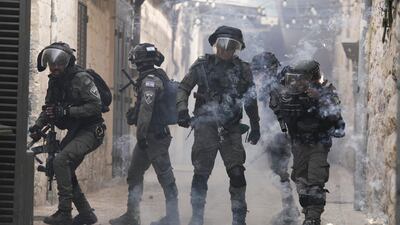
Palestinians launch fireworks at Israeli police at Al Aqsa Mosque in the Old City of Jerusalem. AP
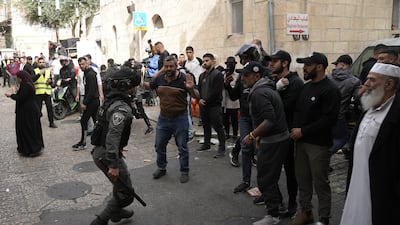
Israel police have words with a Palestinian worshipper. AP
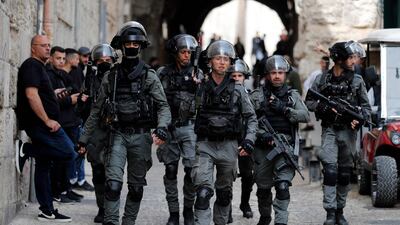
Officers try to disperse Palestinians in the Al Aqsa Mosque compound. AP
Paramedics carry an injured Palestinian. AP
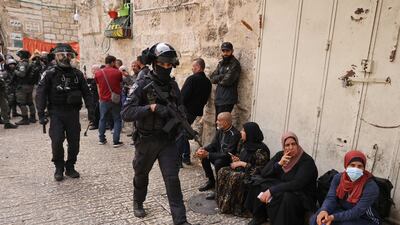
Israeli border police on patrol at the Lion's Gate in Jerusalem's Old City, as Palestinians wait to be allowed to enter the Al Aqsa Mosque compound. AFP
Israel's Foreign Ministry tweeted video purportedly showing masked Palestinians throwing objects inside the mosque. AFP
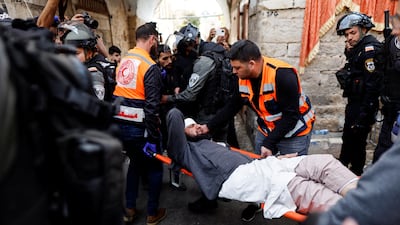
An injured man is stretchered to safety. The foreign ministry denied reports on social media that police had entered the mosque building itself during the violence. Reuters
Compounding this tragic dance of death are those who cheer the violence or seek to justify it. During this past bloody week, some Arab commentators praised the spate of Palestinian attacks on Israelis calling them “heroic acts of resistance", gloating that the killings had caused the Israelis to “cower in fear”. Supporters of Israel, on the other hand, applauded the repression, urging more forceful measures to “crack down” on Palestinians. Some called for more mass arrests or intensified settlement development, arguing that only tougher measures would put an end to the violence. Both views are dead wrong.
But it continues, with no lessons learnt and the behaviours of both sides playing into the fears of the other, setting the stage for yet another round of anger, revenge and violence.
During the second intifada, I warned that because violence was a dead end (literally), a new strategy was needed – a strategy that defines a goal and then develops a series of tactics that will lead to that goal. I understood that Palestinian anger was real and justified. But revenge is not a strategy. It might make some feel momentary satisfaction, but history has demonstrated that because the occupier has a monopoly on force, when it responds, it does so disproportionately, taking hundreds of lives for each one lost.
Violence begets more violence. One Palestinian leader noted to me: “When we use stones, they shoot us. When we use guns, they bring heavy weapons. And when we fire rockets, they bomb us with jets.” The lesson: when the tactics used don’t advance your goal, they do not constitute a strategy.
Back then, I also noted that Palestinian leadership also had no discernable strategy. Calls for a new UN resolution would never provide a solution because the US, for reasons of domestic politics, would block it. Relying on the EU was also pointless because the EU was weak and indecisive and had proven itself incapable of acting independently. The Russians, Chinese and the “non-aligned” might be counted on to pass resolutions denouncing the occupation, but because they had no interest in a direct confrontation with the US, their resolutions weren’t worth the paper they were printed on. And appeals to international law or “legitimacy” were hollow since there was no enforcement mechanism in place.
Revenge isn’t a strategy, but neither is complaining about injustice or passing toothless resolutions. Israel will not change by itself, nor will the US or the UN. Therefore, Palestinians must identify what they can change and lay out a path to produce that change. That’s the definition of a strategy.
Martin Luther King once observed that when confronting a more powerful foe, one must never play into their strength. Instead, use “jiu-jitsu” by turning their power into a weakness. What I proposed then and propose again is a mass non-violent resistance campaign. Imagine the power of a peaceful march of tens of thousands of unarmed, non-rock throwing Palestinians converging on Jerusalem saying: “Let my people pray.” Or marching from the refugee camps saying: “Let my people go home.”
It should be a time for religious celebration in Palestine and Israel. Reuters
Palestinians have tried such an approach in the past, for example, at Al Aqsa in July 2017. And instances of nonviolent resistance are in evidence across Palestine on a weekly basis. What is needed is to grow and sustain such an effort, making it the new definition of Palestinian resistance. It will require the combined support of the Palestinian leadership acting to project this new strategy and imposing the necessary discipline to control any counter-productive violence.
Consider how it would play out. The Israeli hardliners are likely to attempt to provoke violence. They may shoot demonstrators and make more arrests. But if the non-violence continues, it will put the Israeli government in a bind that neither their military might, nor their hasbara campaigns will be able to conquer. They won’t be able to claim victimhood. And they will not be able to defeat an empowered Palestinian constituency. Such a campaign will have a transformative impact on Israeli and US politics. That’s the strength of non-violence. It turns the tables, making the powerful weak and the oppressed stronger.
It will no doubt be hard to do. But it should be tried because what’s been done to date isn’t working and a new approach is desperately needed.
More than 2.2 million Indian tourists arrived in UAE in 2023 More than 3.5 million Indians reside in UAE Indian tourists can make purchases in UAE using rupee accounts in India through QR-code-based UPI real-time payment systems Indian residents in UAE can use their non-resident NRO and NRE accounts held in Indian banks linked to a UAE mobile number for UPI transactions
BMW M5 specs
Engine: 4.4-litre twin-turbo V-8 petrol enging with additional electric motor
Power: 727hp
Torque: 1,000Nm
Transmission: 8-speed auto
Fuel consumption: 10.6L/100km
On sale: Now
Price: From Dh650,000
Our family matters legal consultant
Name: Hassan Mohsen Elhais
Position: legal consultant with Al Rowaad Advocates and Legal Consultants.
Trump v Khan
2016: Feud begins after Khan criticised Trump’s proposed Muslim travel ban to US
2017: Trump criticises Khan’s ‘no reason to be alarmed’ response to London Bridge terror attacks
2019: Trump calls Khan a “stone cold loser” before first state visit
2019: Trump tweets about “Khan’s Londonistan”, calling him “a national disgrace”
2022: Khan’s office attributes rise in Islamophobic abuse against the major to hostility stoked during Trump’s presidency
July 2025 During a golfing trip to Scotland, Trump calls Khan “a nasty person”
Sept 2025 Trump blames Khan for London’s “stabbings and the dirt and the filth”.
Dec 2025 Trump suggests migrants got Khan elected, calls him a “horrible, vicious, disgusting mayor”
The company offers payments/bribes to win key contracts in the Middle East
May 2017
The UK SFO officially opens investigation into Petrofac’s use of agents, corruption, and potential bribery to secure contracts
September 2021
Petrofac pleads guilty to seven counts of failing to prevent bribery under the UK Bribery Act
October 2021
Court fines Petrofac £77 million for bribery. Former executive receives a two-year suspended sentence
December 2024
Petrofac enters into comprehensive restructuring to strengthen the financial position of the group
May 2025
The High Court of England and Wales approves the company’s restructuring plan
July 2025
The Court of Appeal issues a judgment challenging parts of the restructuring plan
August 2025
Petrofac issues a business update to execute the restructuring and confirms it will appeal the Court of Appeal decision
October 2025
Petrofac loses a major TenneT offshore wind contract worth €13 billion. Holding company files for administration in the UK. Petrofac delisted from the London Stock Exchange
Tuan Phan of SimplyFI.org lists five signs you have been mis-sold to:
1. Your pension fund has been placed inside an offshore insurance wrapper with a hefty upfront commission.
2. The money has been transferred into a structured note. These products have high upfront, recurring commission and should never be in a pension account.
3. You have also been sold investment funds with an upfront initial charge of around 5 per cent. ETFs, for example, have no upfront charges.
4. The adviser charges a 1 per cent charge for managing your assets. They are being paid for doing nothing. They have already claimed massive amounts in hidden upfront commission.
5. Total annual management cost for your pension account is 2 per cent or more, including platform, underlying fund and advice charges.
UAE SQUAD
Ali Khaseif, Mohammed Al Shamsi, Fahad Al Dhanhani, Khalid Essa, Bandar Al Ahbabi, Salem Rashid, Shaheen Abdulrahman, Khalifa Al Hammadi, Mohammed Al Attas, Walid Abbas, Hassan Al Mahrami, Mahmoud Khamis, Alhassan Saleh, Ali Salmeen, Yahia Nader, Abdullah Ramadan, Majed Hassan, Abdullah Al Naqbi, Fabio De Lima, Khalil Al Hammadi, Khalfan Mubarak, Tahnoun Al Zaabi, Muhammed Jumah, Yahya Al Ghassani, Caio Canedo, Ali Mabkhout, Sebastian Tagliabue, Zayed Al Ameri
MATCH INFO
Uefa Champions League final:
Who: Real Madrid v Liverpool Where: NSC Olimpiyskiy Stadium, Kiev, Ukraine When: Saturday, May 26, 10.45pm (UAE) TV: Match on BeIN Sports
ODI: Tim Paine (capt), Aaron Finch (vice-capt), Ashton Agar, Alex Carey, Josh Hazlewood, Travis Head, Nathan Lyon, Glenn Maxwell, Shaun Marsh, Jhye Richardson, Kane Richardson, D’Arcy Short, Billy Stanlake, Marcus Stoinis, Andrew Tye.
T20: Aaron Finch (capt), Alex Carey (vice-capt), Ashton Agar, Travis Head, Nic Maddinson, Glenn Maxwell, Jhye Richardson, Kane Richardson, D’Arcy Short, Billy Stanlake, Marcus Stoinis, Mitchell Swepson, Andrew Tye, Jack Wildermuth.