Dr Justin Thomas is a chartered health psychologist with the British Psychological Society, the author of 'Psychological Well-being in the Gulf States' and a columnist for The National
April 18, 2022
Fasting in Ramadan can promote psychological well-being. There are numerous research studies making this case. But how does that work, exactly? How could refraining from food during daylight hours improve well-being? As a psychologist, and having fasted during Ramadan for more than two decades, I think I can provide some insights into the possible mechanisms of action.
My first experience fasting during Ramadan came when I was in college. I was not a Muslim at the time, but most of my close friends were. They didn't appear to be particularly religious outside of Ramadan. Still, when the holy month rolled around, they dropped their bad habits and kept the daytime fast. Their transformation impressed me, and it was with a mixture of solidarity and curiosity that I decided to join them.
I found fasting difficult at first, but it helped that my friends and I were in it together. The fasting got easier as the month went on and eventually, there was a feeling of being at ease with the emptiness and a sense of mastery and self-discipline. Just as important, I also saw the positive behavioural impacts that fasting had on us in different ways. One friend was calmer and more reflective, another was able to kick bad habits, and all of us became closer.
Shortly after my dummy-run, I became a Muslim. The next time Ramadan rolled around, I was immersed in the real deal, the complete package: fasting, reading the Quran, having night prayers and more. It was transformative and character building and quite unlike anything else I had ever experienced.
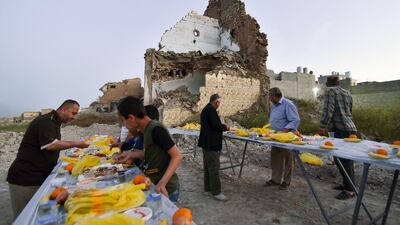
Iraqis in Mosul share a collective iftar, the evening meal that will end the daily Ramadan fast. AFP
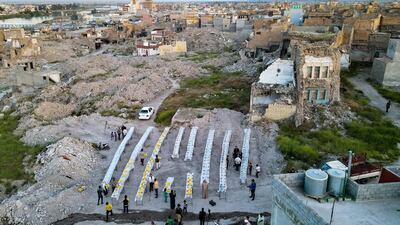
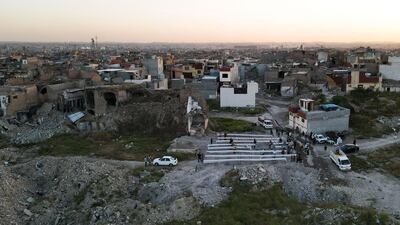
Iraqis set tables before a collective iftar on the second day of Ramadan in the war-ravaged old part of the northern city of Mosul. AFP
Iraqis in Mosul share a collective iftar, the evening meal that will end the daily fast. AFP
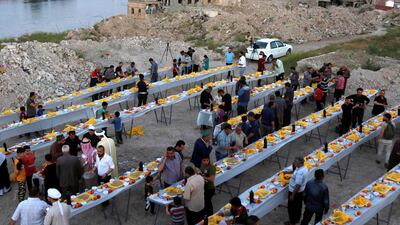
People gather to break their fast in Mosul, Iraq. Reuters
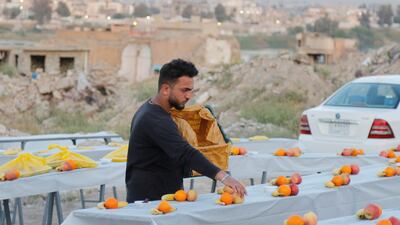
A man prepares food for iftar meals in Mosul, Iraq. Reuters
Iraqis set tables before a collective iftar on the second day of Ramadan in the war-ravaged old part of the northern city of Mosul. AFP
Over the years, I have noticed many similarities between Ramadan and the ideas being promoted by psychologists and psychotherapists. For example, the well-being benefits of the holy month are highly resonant with the Social Comparison Theory. This idea suggests that our self-image and self-evaluations are shaped by comparing ourselves with others.
When we evaluate ourselves against one another – and we do – we tend to make "upward" or "downward" comparisons. Upward comparisons – focusing on people who are, for example, more intelligent, more attractive and wealthier – can leave us feeling inadequate. Unsurprisingly, the tendency to make frequent upward social comparisons is predictive of depression.
By contrast, downward comparison – focusing on people who have less – leaves us feeling fortunate. For example, fasting can focus the mind on food poverty, famine victims and those who regularly experience thirst and hunger even after the sunsets. Such downward social comparisons make some of us more grateful for what we have. Gratitude frequently leads to pro-social behaviours (for example, charitable giving) aimed at relieving the suffering of others.
The idea that gratitude is good for mental health has been well established. Gratitude is a pleasant and powerful social emotion – a gateway emotion that opens the door to other pleasant emotions, such as joy, contentment and excitement. A study published in the neuroscience journal Cerebral Cortex identified links between the experience of gratitude and the neurochemical dopamine, also known as the “pleasure hormone”. Simply pondering the question, "What am I grateful for?" increased dopamine, even if the question was left unanswered.
Anyone who has ever broken a difficult day-long fast will know that overwhelming sense of gratitude that occurs as they savour the first sip of a drink or bite of food. Even plain old, precious water tastes delightful. Gratitude is undoubtedly one of Ramadan's greatest gifts.
Ramadan is not just about fasting, though; it is also a month of additional Quranic recitation and reading.
Another obvious way the holy month promotes psychological well-being lies in the actual content of the Quran. Islam's sacred scripture covers areas as diverse as dietary practice, inheritance law, eschatology (the part of theology concerned with death and the final destiny of the soul and of humankind), and everything in between. However, throughout the text, repeated attention is given to major psychological themes such as patience, forgiveness, acceptance and hope. For many, the Quran provides the ultimate form of bibliotherapy – using the written word to promote mental health.
A final aspect of Ramadan that helps promote psychological well-being must be the shared nature of the experience.
Yemenis breaking fast. EPA
More than a billion other people are engaged in the same activity, leading to a strong sense of social identity and belonging. Research has underscored the importance of social identity and belonging in promoting well-being and recovery. This "belonging effect" has become widely known as the "social cure". Essentially this is the idea that strengthening social identity (for example, joining a club or playing a team sport) can accelerate illness recovery, promote resilience and reduce relapse.
There are numerous studies supporting the well-being benefits of social identity and belonging. The findings suggest that the more profound the sense of belonging to a valued social group, the better the outcomes are for various physical and mental health conditions, including depression.
Ramadan, however, is not a panacea. Mental illness prevention and psychological well-being promotion are not the holy month's objectives. They are simply welcome by-products – what we call highly desirable epiphenomena. The actual benefits of Ramadan are, of course, spiritual and the approaching last 10 days and nights of the holy month are a great time for these to be realised.
1. Domestic VAT refund amendments: request your refund within five years
If a business does not apply for the refund on time, they lose their credit.
2. E-invoicing in the UAE
Businesses should continue preparing for the implementation of e-invoicing in the UAE, with 2026 a preparation and transition period ahead of phased mandatory adoption.
3. More tax audits
Tax authorities are increasingly using data already available across multiple filings to identify audit risks.
4. More beneficial VAT and excise tax penalty regime
Tax disputes are expected to become more frequent and more structured, with clearer administrative objection and appeal processes. The UAE has adopted a new penalty regime for VAT and excise disputes, which now mirrors the penalty regime for corporate tax.
5. Greater emphasis on statutory audit
There is a greater need for the accuracy of financial statements. The International Financial Reporting Standards standards need to be strictly adhered to and, as a result, the quality of the audits will need to increase.
6. Further transfer pricing enforcement
Transfer pricing enforcement, which refers to the practice of establishing prices for internal transactions between related entities, is expected to broaden in scope. The UAE will shortly open the possibility to negotiate advance pricing agreements, or essentially rulings for transfer pricing purposes.
7. Limited time periods for audits
Recent amendments also introduce a default five-year limitation period for tax audits and assessments, subject to specific statutory exceptions. While the standard audit and assessment period is five years, this may be extended to up to 15 years in cases involving fraud or tax evasion.
8. Pillar 2 implementation
Many multinational groups will begin to feel the practical effect of the Domestic Minimum Top-Up Tax (DMTT), the UAE's implementation of the OECD’s global minimum tax under Pillar 2. While the rules apply for financial years starting on or after January 1, 2025, it is 2026 that marks the transition to an operational phase.
9. Reduced compliance obligations for imported goods and services
Businesses that apply the reverse-charge mechanism for VAT purposes in the UAE may benefit from reduced compliance obligations.
10. Substance and CbC reporting focus
Tax authorities are expected to continue strengthening the enforcement of economic substance and Country-by-Country (CbC) reporting frameworks. In the UAE, these regimes are increasingly being used as risk-assessment tools, providing tax authorities with a comprehensive view of multinational groups’ global footprints and enabling them to assess whether profits are aligned with real economic activity.
Contributed by Thomas Vanhee and Hend Rashwan, Aurifer
Our legal consultant
Name: Hassan Mohsen Elhais
Position: legal consultant with Al Rowaad Advocates and Legal Consultants.
Non-profit arts studio Tashkeel launched this annual initiative with the intention of supporting budding designers in the UAE. This year, three talents were chosen from hundreds of applicants to be a part of the sixth creative development programme. These are architect Abdulla Al Mulla, interior designer Lana El Samman and graphic designer Yara Habib.
The trio have been guided by experts from the industry over the course of nine months, as they developed their own products that merge their unique styles with traditional elements of Emirati design. This includes laboratory sessions, experimental and collaborative practice, investigation of new business models and evaluation.
It is led by British contemporary design project specialist Helen Voce and mentor Kevin Badni, and offers participants access to experts from across the world, including the likes of UK designer Gareth Neal and multidisciplinary designer and entrepreneur, Sheikh Salem Al Qassimi.
The final pieces are being revealed in a worldwide limited-edition release on the first day of Downtown Designs at Dubai Design Week 2019. Tashkeel will be at stand E31 at the exhibition.
Lisa Ball-Lechgar, deputy director of Tashkeel, said: “The diversity and calibre of the applicants this year … is reflective of the dynamic change that the UAE art and design industry is witnessing, with young creators resolute in making their bold design ideas a reality.”
There are numerous success stories of teen businesses that were created in college dorm rooms and other modest circumstances. Below are some of the most recognisable names in the industry:
Facebook: Mark Zuckerberg and his friends started Facebook when he was a 19-year-old Harvard undergraduate.
Dell: When Michael Dell was an undergraduate student at Texas University in 1984, he started upgrading computers for profit. He starting working full-time on his business when he was 19. Eventually, his company became the Dell Computer Corporation and then Dell Inc.
Subway: Fred DeLuca opened the first Subway restaurant when he was 17. In 1965, Mr DeLuca needed extra money for college, so he decided to open his own business. Peter Buck, a family friend, lent him $1,000 and together, they opened Pete’s Super Submarines. A few years later, the company was rebranded and called Subway.
Mashable: In 2005, Pete Cashmore created Mashable in Scotland when he was a teenager. The site was then a technology blog. Over the next few decades, Mr Cashmore has turned Mashable into a global media company.
Oculus VR: Palmer Luckey founded Oculus VR in June 2012, when he was 19. In August that year, Oculus launched its Kickstarter campaign and raised more than $1 million in three days. Facebook bought Oculus for $2 billion two years later.
Individuals must register on UAE Drone app or website using their UAE Pass
Add all their personal details, including name, nationality, passport number, Emiratis ID, email and phone number
Upload the training certificate from a centre accredited by the GCAA
Submit their request
What are the regulations?
Fly it within visual line of sight
Never over populated areas
Ensure maximum flying height of 400 feet (122 metres) above ground level is not crossed
Users must avoid flying over restricted areas listed on the UAE Drone app
Only fly the drone during the day, and never at night
Should have a live feed of the drone flight
Drones must weigh 5 kg or less
'The worst thing you can eat'
Trans fat is typically found in fried and baked goods, but you may be consuming more than you think.
Powdered coffee creamer, microwave popcorn and virtually anything processed with a crust is likely to contain it, as this guide from Mayo Clinic outlines:
Baked goods - Most cakes, cookies, pie crusts and crackers contain shortening, which is usually made from partially hydrogenated vegetable oil. Ready-made frosting is another source of trans fat.
Snacks - Potato, corn and tortilla chips often contain trans fat. And while popcorn can be a healthy snack, many types of packaged or microwave popcorn use trans fat to help cook or flavour the popcorn.
Fried food - Foods that require deep frying — french fries, doughnuts and fried chicken — can contain trans fat from the oil used in the cooking process.
Refrigerator dough - Products such as canned biscuits and cinnamon rolls often contain trans fat, as do frozen pizza crusts.
Creamer and margarine - Nondairy coffee creamer and stick margarines also may contain partially hydrogenated vegetable oils.