Workers carry sacks of grain in a warehouse of the World Food Programme in Ethiopia. AFP


High-tech humanitarianism can help save a suffering world


  • English
  • Arabic

August 22, 2022

I ducked under the thin blue string across the dirt track that demarcated Sudan and South Sudan. It was 2013 and I was there to examine the humanitarian situation in the Nuba Mountains.

The scorched-earth practices of then Sudanese president Omar Al Bashir, indicted by the International Criminal Court for genocidal acts in Darfur, had destroyed food stocks and disrupted planting. As starvation gripped the Nuba, Khartoum blocked cross-line relief provision within Sudan and cross-border from South Sudan.

However, desperation breeds resourcefulness. Nuban refugees in South Sudan skimped from their own meagre supplies to leave food parcels at the thin blue line. Their kith-and-kin cowered in caves, emerging at night to evade border patrols and retrieve life-saving sustenance.

The more courageous humanitarian NGOs joined in. They deliberately inflated refugee statistics in South Sudan to justify bigger handouts knowing that a portion filtered back into Nuba. Donors turned a blind eye to the smuggling.

And so, a peoples’ humanitarian movement sprung up because international organisations such as the UN and International Red Cross and Red Crescent were forbidden to cross the South Sudan-Sudan border even as the UN Security Council huffed and puffed.

I had previously been the UN’s Humanitarian Co-ordinator, including supervising Operation Lifeline Sudan, a huge cross-border food airlift from Kenya into southern Sudan, akin to the Berlin Airlift during the Cold War. I had also managed to get the mighty Nile River reopened to food barges, and some roads de-mined to allow land aid corridors, even as northern government and southern rebel forces skirmished. These cross-border and cross-line humanitarian deliveries were not my personal achievement but enabled by my official position that commanded the respect of belligerent parties and was backed by the authority of the Security Council.

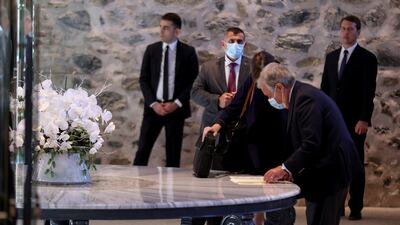
  • UN Secretary General Antonio Guterres, Ukrainian Infrastructure Minister Oleksandr Kubrakov, Turkish President Recep Tayyip Erdogan and Turkish Defence Minister Hulusi Akar attend a signing ceremony in Istanbul, Turkey. Reuters
    UN Secretary General Antonio Guterres, Ukrainian Infrastructure Minister Oleksandr Kubrakov, Turkish President Recep Tayyip Erdogan and Turkish Defence Minister Hulusi Akar attend a signing ceremony in Istanbul, Turkey. Reuters
  • Ukrainian Infrastructure Minister Oleksandr Kubrakov, seated, at the signing ceremony. Reuters
    Ukrainian Infrastructure Minister Oleksandr Kubrakov, seated, at the signing ceremony. Reuters
  • UN Secretary General Antonio Guterres, left, Russia's Defence Minister Sergei Shoigu, second left, Turkish President Recep Tayyip Erdogan, seated, second right, and Turkish Defence Minister Hulusi Akar at the signing ceremony. Reuters
    UN Secretary General Antonio Guterres, left, Russia's Defence Minister Sergei Shoigu, second left, Turkish President Recep Tayyip Erdogan, seated, second right, and Turkish Defence Minister Hulusi Akar at the signing ceremony. Reuters
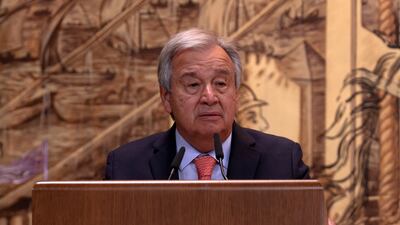
  • Mr Guterres speaks during the signing ceremony. Reuters
    Mr Guterres speaks during the signing ceremony. Reuters
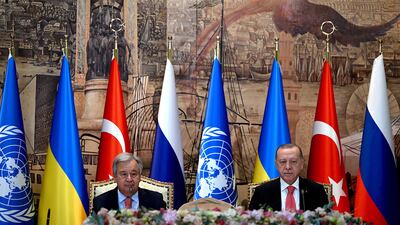
  • Mr Guterres and Mr Erdogan sit at the start of the signature ceremony for an agreement on the safe transportation of grain and foodstuffs from Ukrainian ports. AFP
    Mr Guterres and Mr Erdogan sit at the start of the signature ceremony for an agreement on the safe transportation of grain and foodstuffs from Ukrainian ports. AFP
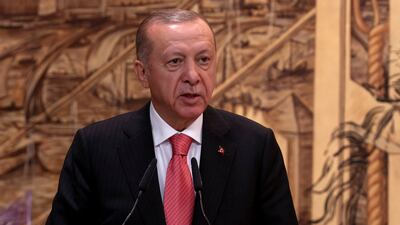
  • Mr Erdogan speaks at the signing ceremony. Reuters
    Mr Erdogan speaks at the signing ceremony. Reuters
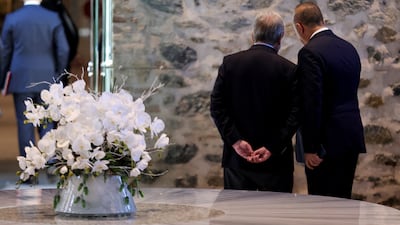
  • Mr Guterres and Turkish Foreign Minister Mevlut Cavusoglu stand together on the day of the deal signing in Istanbul. Reuters
    Mr Guterres and Turkish Foreign Minister Mevlut Cavusoglu stand together on the day of the deal signing in Istanbul. Reuters
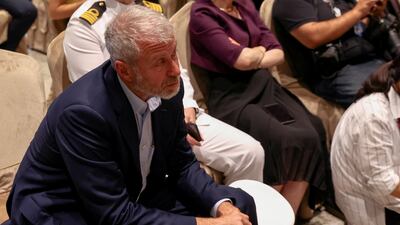
  • Roman Abramovich attends the ceremony in Istanbul. Reuters
    Roman Abramovich attends the ceremony in Istanbul. Reuters
  • Mr Guterres said the deal would clear the way for grain shipments from three Ukrainian ports; Odesa, Chernomorsk and Yuzhny, stabilising runaway prices on the global market. Reuters
    Mr Guterres said the deal would clear the way for grain shipments from three Ukrainian ports; Odesa, Chernomorsk and Yuzhny, stabilising runaway prices on the global market. Reuters
  • The UN chief said a co-ordination centre would be set up in Istanbul to manage Black Sea traffic. Reuters
    The UN chief said a co-ordination centre would be set up in Istanbul to manage Black Sea traffic. Reuters
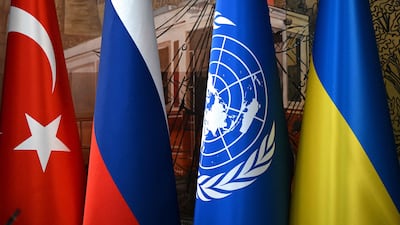
  • A Turkish national flag, a Russian national flag, a United Nations flag and a Ukrainian national flag in Istanbul, before the deal was signed. AFP
    A Turkish national flag, a Russian national flag, a United Nations flag and a Ukrainian national flag in Istanbul, before the deal was signed. AFP

I was reminded of this when the Security Council held a fractious debate in July to barely agree a short-term extension of cross-border aid to Syria from Turkey. But respect for official status is not enough unless underpinned by trust and creativity.

I learnt that in another role as special adviser in the UN Assistance Mission in Afghanistan during a previous bout of internal war that created widescale food insecurity. India’s offer of a million tonnes of wheat trucked cross-border via Pakistan was unpalatable to the latter. Extensive shuttling to build trust between Kabul, New Delhi, Islamabad, Tehran and the Rome headquarters of the World Food Programme followed. This led to swapping India’s gift for WFP stocks held elsewhere that could then be shipped directly into Afghanistan via Iranian ports.

The spirit of that arrangement is in the recent UN and Istanbul-brokered agreement with Moscow and Kyiv to ship out Ukrainian grain to alleviate world hunger.

Cross-border humanitarian operations are considered only when this is practically easier to reach geographically isolated populations, or when it is unavoidable because fighters obstruct aid access across internal frontlines.

Crossing an international border raises sovereignty questions. Hence, the consent of both aid-receiving and aid-channelling countries is needed. Where this is voluntarily given, cross-border programming is uncontentious. But when a host country unreasonably withholds consent despite the urgency and magnitude of a humanitarian crisis, only the Security Council can mandate access.

Cross-border humanitarian delivery used to be fairly routine. The long-suffering populations of many conflict-torn countries such as Afghanistan, Iraq, Cambodia, Somalia and Myanmar received succour from across their borders over many decades when global and regional geopolitics were as contentious then as they are today. But earlier, perhaps there was a greater consensus that, despite other differences, mitigating humanitarian crises was a shared moral duty.

That era has passed as Russia re-asserts itself, China and India rise, and national assertiveness grows everywhere. Humanitarianism is no longer trusted at face value. Although humanitarian compassion is universal to all cultures, its diverse forms of expression are not seen as impartial and, therefore, frequently disputed.

The rules of the traditional western-dominated model of humanitarianism and its institutions and rituals are challenged, as never before. That is partly because how conflicts are fought has changed to become whole-of-society affairs not limited to armed combatants. We see this in the grinding Russia-Ukraine war that has also challenged access by the International Committee of the Red Cross under the Geneva Conventions to protect non-combatants.

Therefore, while crises requiring international co-operation have multiplied, new cross-border humanitarian efforts are rarely approved by the highly polarised Security Council. Without such formal mandates, international humanitarian agencies cannot function legally.

The Syrian cross-border effort got renewed only because it was a previous agreement. Even then, new constraints were added. Whether this will get extended in six months is causing acute anxiety for the 4 million Syrians who depend on this lifeline.

Meanwhile, in Yemen, 23 million depend on humanitarian aid brought across frontlines and borders. Interfering with that has become a deadly art through bureaucratic delays and disruptions, and attacks on aid workers. Turning the humanitarian tap on and off has been co-opted as a tool in the decade-long war.

The situation is even more dire for populations that are completely blockaded by their opponents. Perhaps the most catastrophic plight is that of 7 million Tigrayans, whose homeland is in civil war with the Ethiopian state. Pleas for humanitarian relief corridors have been ignored with only token assistance reaching Tigray on a haphazard basis.

Civilian suffering caused directly and indirectly by armed conflicts is the new normal in our fractured world. A recent analysis by the Geneva-based ACAPS research group suggests that humanitarian access is highly or extremely constrained in at least 37 countries experiencing serious crises. Contemporary global and regional politics mean that multilateral institutions and frameworks are unable to rescue on a reliable basis.

What is then to be done as humanitarian tragedies multiply? There are some tips and tricks to penetrate otherwise impenetrable access barriers. Technology such as low-flying drones is already in use to deliver medicines to cut-off health facilities. Communications through the internet allow supervisors outside the crisis zone to guide relief actions by local humanitarian staff and volunteers. Electronically transferred cash enables needy beneficiaries the dignity of choice in getting what they need with economy and efficiency while also stimulating local enterprise. The days of lumbering aid convoys stuck at hostile checkpoints should be largely over.

A child works at a wheat mill in Syria. AFP

The irony is that the technologies and devices that have revolutionised warfare, so that it can be waged more precisely from a safe distance, can also transform humanitarian action. The main obstacle to a more effective humanitarianism is not just closed borders but the closed mindsets of humanitarians themselves.

They consistently underestimate the resourcefulness of local crisis-affected populations if they get the chance to build their capacities for resilience. However, extant humanitarian business models hinder that because these are geared towards maximising the intermediation roles of billion-dollar humanitarian corporations.

Various shades of inefficiency, corruption, politicisation and monopolistic or self-serving practices have contributed to rising distrust in the humanitarian endeavour. It plays straight into the ruthless schemes of any warring groups looking for excuses to cut off humanitarian access. This makes sense – even if perverted – in an age where battles are generally not won on the battlefield but via inflicting maximum suffering on civilians on the opposing side.

Undoubtedly, traditional norms that limit warfare are being challenged as war-making accommodates present-day geopolitics through new doctrines and novel, no-holds-barred tactics. Correspondingly greater obstacles to humanitarian access are to be expected. Simply lamenting that reality is hardly a solution.

Instead, humanitarians must become smarter than warmakers. They have the tools and technologies to do that, but they must transform their mindsets, trust their beneficiaries more in the same way that they want to be trusted themselves, and reform their processes and institutions to better serve those in need.

Solutions to boundless conflicts may evade us, but limiting human suffering through borderless humanitarianism is well within our grasp.

Key facilities
  • Olympic-size swimming pool with a split bulkhead for multi-use configurations, including water polo and 50m/25m training lanes
  • Premier League-standard football pitch
  • 400m Olympic running track
  • NBA-spec basketball court with auditorium
  • 600-seat auditorium
  • Spaces for historical and cultural exploration
  • An elevated football field that doubles as a helipad
  • Specialist robotics and science laboratories
  • AR and VR-enabled learning centres
  • Disruption Lab and Research Centre for developing entrepreneurial skills
What is the definition of an SME?

SMEs in the UAE are defined by the number of employees, annual turnover and sector. For example, a “small company” in the services industry has six to 50 employees with a turnover of more than Dh2 million up to Dh20m, while in the manufacturing industry the requirements are 10 to 100 employees with a turnover of more than Dh3m up to Dh50m, according to Dubai SME, an agency of the Department of Economic Development.

A “medium-sized company” can either have staff of 51 to 200 employees or 101 to 250 employees, and a turnover less than or equal to Dh200m or Dh250m, again depending on whether the business is in the trading, manufacturing or services sectors. 

Venom

Director: Ruben Fleischer

Cast: Tom Hardy, Michelle Williams, Riz Ahmed

Rating: 1.5/5

Evacuations to France hit by controversy
  • Over 500 Gazans have been evacuated to France since November 2023
  • Evacuations were paused after a student already in France posted anti-Semitic content and was subsequently expelled to Qatar
  • The Foreign Ministry launched a review to determine how authorities failed to detect the posts before her entry
  • Artists and researchers fall under a programme called Pause that began in 2017
  • It has benefited more than 700 people from 44 countries, including Syria, Turkey, Iran, and Sudan
  • Since the start of the Gaza war, it has also included 45 Gazan beneficiaries
  • Unlike students, they are allowed to bring their families to France
ALRAWABI%20SCHOOL%20FOR%20GIRLS
%3Cp%3ECreator%3A%20Tima%20Shomali%3C%2Fp%3E%0A%3Cp%3EStarring%3A%C2%A0Tara%20Abboud%2C%C2%A0Kira%20Yaghnam%2C%20Tara%20Atalla%3C%2Fp%3E%0A%3Cp%3ERating%3A%204%2F5%3C%2Fp%3E%0A
Ten tax points to be aware of in 2026

1. Domestic VAT refund amendments: request your refund within five years

If a business does not apply for the refund on time, they lose their credit.

2. E-invoicing in the UAE

Businesses should continue preparing for the implementation of e-invoicing in the UAE, with 2026 a preparation and transition period ahead of phased mandatory adoption. 

3. More tax audits

Tax authorities are increasingly using data already available across multiple filings to identify audit risks. 

4. More beneficial VAT and excise tax penalty regime

Tax disputes are expected to become more frequent and more structured, with clearer administrative objection and appeal processes. The UAE has adopted a new penalty regime for VAT and excise disputes, which now mirrors the penalty regime for corporate tax.

5. Greater emphasis on statutory audit

There is a greater need for the accuracy of financial statements. The International Financial Reporting Standards standards need to be strictly adhered to and, as a result, the quality of the audits will need to increase.

6. Further transfer pricing enforcement

Transfer pricing enforcement, which refers to the practice of establishing prices for internal transactions between related entities, is expected to broaden in scope. The UAE will shortly open the possibility to negotiate advance pricing agreements, or essentially rulings for transfer pricing purposes. 

7. Limited time periods for audits

Recent amendments also introduce a default five-year limitation period for tax audits and assessments, subject to specific statutory exceptions. While the standard audit and assessment period is five years, this may be extended to up to 15 years in cases involving fraud or tax evasion. 

8. Pillar 2 implementation 

Many multinational groups will begin to feel the practical effect of the Domestic Minimum Top-Up Tax (DMTT), the UAE's implementation of the OECD’s global minimum tax under Pillar 2. While the rules apply for financial years starting on or after January 1, 2025, it is 2026 that marks the transition to an operational phase.

9. Reduced compliance obligations for imported goods and services

Businesses that apply the reverse-charge mechanism for VAT purposes in the UAE may benefit from reduced compliance obligations. 

10. Substance and CbC reporting focus

Tax authorities are expected to continue strengthening the enforcement of economic substance and Country-by-Country (CbC) reporting frameworks. In the UAE, these regimes are increasingly being used as risk-assessment tools, providing tax authorities with a comprehensive view of multinational groups’ global footprints and enabling them to assess whether profits are aligned with real economic activity. 

Contributed by Thomas Vanhee and Hend Rashwan, Aurifer

Dr Afridi's warning signs of digital addiction

Spending an excessive amount of time on the phone.

Neglecting personal, social, or academic responsibilities.

Losing interest in other activities or hobbies that were once enjoyed.

Having withdrawal symptoms like feeling anxious, restless, or upset when the technology is not available.

Experiencing sleep disturbances or changes in sleep patterns.

What are the guidelines?

Under 18 months: Avoid screen time altogether, except for video chatting with family.

Aged 18-24 months: If screens are introduced, it should be high-quality content watched with a caregiver to help the child understand what they are seeing.

Aged 2-5 years: Limit to one-hour per day of high-quality programming, with co-viewing whenever possible.

Aged 6-12 years: Set consistent limits on screen time to ensure it does not interfere with sleep, physical activity, or social interactions.

Teenagers: Encourage a balanced approach – screens should not replace sleep, exercise, or face-to-face socialisation.

Source: American Paediatric Association

((Disclaimer))

The Liechtensteinische Landesbank AG (“Bank”) assumes no liability or guarantee for the accuracy, balance, or completeness of the information in this publication. The content may change at any time due to given circumstances, and the Liechtensteinische Landesbank AG is under no obligation to update information once it has been published. This publication is intended for information purposes only and does not constitute an offer, a recommendation or an invitation by, or on behalf of, Liechtensteinische Landesbank (DIFC Branch), Liechtensteinische Landesbank AG, or any of its group affiliates to make any investments or obtain services. This publication has not been reviewed, disapproved or approved by the United Arab Emirates (“UAE”) Central Bank, Dubai Financial Services Authority (“DFSA”) or any other relevant licensing authorities in the UAE. It may not be relied upon by or distributed to retail clients. Liechtensteinische Landesbank (DIFC Branch) is regulated by the DFSA and this advertorial is intended for Professional Clients (as defined by the DFSA) who have sufficient financial experience and understanding of financial markets, products or transactions and any associated risks.

Details

Through Her Lens: The stories behind the photography of Eva Sereny

Forewords by Jacqueline Bisset and Charlotte Rampling, ACC Art Books

UAE currency: the story behind the money in your pockets
FIGHT%20CARD
%3Cp%3E%3Cstrong%3EFeatherweight%204%20rounds%3A%3C%2Fstrong%3E%3Cbr%3EYousuf%20Ali%20(2-0-0)%20(win-loss-draw)%20v%20Alex%20Semugenyi%20(0-1-0)%3Cbr%3E%3Cstrong%3EWelterweight%206%20rounds%3A%3C%2Fstrong%3E%3Cbr%3EBenyamin%20Moradzadeh%20(0-0-0)%20v%20Rohit%20Chaudhary%20(4-0-2)%3Cbr%3E%3Cstrong%3EHeavyweight%204%20rounds%3A%3C%2Fstrong%3E%3Cbr%3EYoussef%20Karrar%20(1-0-0)%20v%20Muhammad%20Muzeei%20(0-0-0)%3Cbr%3E%3Cstrong%3EWelterweight%206%20rounds%3A%3C%2Fstrong%3E%3Cbr%3EMarwan%20Mohamad%20Madboly%20(2-0-0)%20v%20Sheldon%20Schultz%20(4-4-0)%3Cbr%3E%3Cstrong%3ESuper%20featherweight%208%20rounds%3A%3C%2Fstrong%3E%3Cbr%3EBishara%20Sabbar%20(6-0-0)%20v%20Mohammed%20Azahar%20(8-5-1)%3Cbr%3E%3Cstrong%3ECruiseweight%208%20rounds%3A%3C%2Fstrong%3E%3Cbr%3EMohammed%20Bekdash%20(25-0-0)%20v%20Musa%20N%E2%80%99tege%20(8-4-0)%3Cbr%3E%3Cstrong%3ESuper%20flyweight%2010%20rounds%3A%3C%2Fstrong%3E%3Cbr%3ESultan%20Al%20Nuaimi%20(9-0-0)%20v%20Jemsi%20Kibazange%20(18-6-2)%3Cbr%3E%3Cstrong%3ELightweight%2010%20rounds%3A%3C%2Fstrong%3E%3Cbr%3EBader%20Samreen%20(8-0-0)%20v%20Jose%20Paez%20Gonzales%20(16-2-2-)%3C%2Fp%3E%0A
Updated: August 22, 2022, 11:43 AM