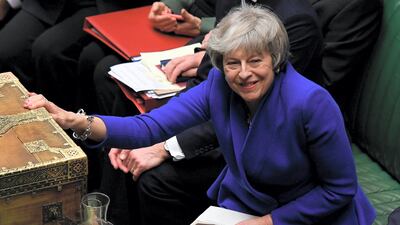
British university history tutors often recommend reading a book called The Strange Death of Liberal England. It’s about the 20th-century demise of the once-great British Liberal party. Nowadays we are witnessing a sequel: the strange death of conservative England. The Conservative party, which ruled Britain for more of my life than any other, is currently 12 years in government and resembles a circular firing squad or political death cult, splitting apart like an over-ripe banana. We could begin with the new Conservative leader, but only if we agree that the leader is not Liz Truss, the nominal prime minister.
After just one month, Ms Truss remains in office, not in power, as the figurehead for a zombie government. The real leader of the UK government is the new Chancellor of the Exchequer, Jeremy Hunt. He is virtually unsackable, brought in to save Ms Truss from her own unbelievable errors. Mr Hunt is an estimable figure, calm, successful in business and may salvage the British economy, but no one can save Ms Truss from herself.
She is the most disastrous choice of prime minister in living memory and now inspires neither respect nor fear nor even pity. Rather than waste time considering her shortcomings, we need to understand that the problem is not one failed person, but the failed system that allowed someone manifestly unsuitable to rise to power in the first place.
Some 40 years ago, the elder statesman of the right wing of the British Conservative party, Enoch Powell, remarked that "all political careers end in failure". What is astonishing about Ms Truss is that her career as prime minister began in failure. Even sober editorial writers of The Economist compared her first few days in office to the shelf life of a supermarket lettuce.
Even if Truss remains in Downing Street she will be like a squatter in someone else’s home
But the real blame lies with the Conservative party itself. They created a system that allowed just 81,000 members to decide who should lead their party, and therefore the country, without the other 68 million British people having a say.
For some extraordinary reason, those 81,000 members loved the Truss message that cutting taxes, most notably on the rich, and cutting public spending would, in an injection of free-market fundamentalism, in some miraculous way create "growth, growth, growth".
They swallowed these political platitudes without once asking the most obvious question: do the numbers add up? They don’t. The Conservative party has, therefore, led the UK into crisis after crisis. A British child aged six will have lived under four Conservative prime ministers, five if Ms Truss is forced out soon, as some believe.
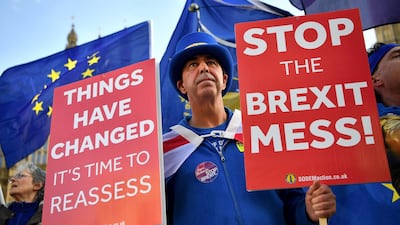
The Tories have already inflicted four chancellors on us in four successive months this year. There are plenty of complicated reasons for their incompetent behaviour, but here is one simple one: Brexit.
The decision to leave the EU came because former prime minister David Cameron worried about an upstart anti-European party, UKIP, taking millions of votes in the 2015 UK general election. He thought he could swallow up UKIP, so he offered the 2016 referendum on leaving the EU. Mr Cameron lost the referendum, lost his job as prime minister, and the infection of Brexit and UKIP-style policies rotted the best brains within the Conservative party.
The result was the jovial but incompetent and law-breaking premiership of Boris Johnson, the utterly inept premiership of Ms Truss, and a UK that is poorer and deeply divided. The union of Scotland, Wales and especially Northern Ireland has been undermined. Virtually every economic indicator – trade, economic growth, the falling pound – shows Britain has failed or is underperforming.
Ms Truss proved to be simply the most virulent form of the post-Brexit failure because she relied in government on groups of advisers from right-wing so-called "think tanks" – more like lobby groups – and adopted their free-market fundamentalist ideas, crashing the economy, crashing her career and crashing the Conservative party too.
Perhaps as they survey the wreckage, Conservatives may consider that their party, the party of Margaret Thatcher, once stood for free markets, fiscal prudence and "sound money". In the 2020s, their party now stands for competing egos, empty slogans and incompetence. Still, there is good news.
For the past few years, a sensible conversation about the damage done to the British economy by Brexit has been impossible. Now it is essential. In one of the many pro-Brexit British newspapers, a distinguished columnist finally came around to admitting that leaving the EU has been exactly the kind of disaster that some of us (me included) predicted years ago.
That, at least, is a start. Instead of worrying about the future of Ms Truss – she probably does not have one, even if she remains in Downing Street she will be like a squatter in someone else’s home – what we need to do is begin a grown-up conversation about how to end the self-harm that Brexit has caused. It will not be easy. It is, however, necessary.
The specs
- Engine: 3.9-litre twin-turbo V8
- Power: 640hp
- Torque: 760nm
- On sale: 2026
- Price: Not announced yet
Britain's travel restrictions
- A negative test 2 days before flying
- Complete passenger locator form
- Book a post-arrival PCR test
- Double-vaccinated must self-isolate
- 11 countries on red list quarantine
Scotland v Ireland:
Scotland (15-1): Stuart Hogg; Tommy Seymour, Huw Jones, Sam Johnson, Sean Maitland; Finn Russell, Greig Laidlaw (capt); Josh Strauss, James Ritchie, Ryan Wilson; Jonny Gray, Grant Gilchrist; Simon Berghan, Stuart McInally, Allan Dell
Replacements: Fraser Brown, Jamie Bhatti, D'arcy Rae, Ben Toolis, Rob Harley, Ali Price, Pete Horne, Blair Kinghorn
Coach: Gregor Townsend (SCO)
Ireland (15-1): Rob Kearney; Keith Earls, Chris Farrell, Bundee Aki, Jacob Stockdale; Jonathan Sexton, Conor Murray; Jack Conan, Sean O'Brien, Peter O'Mahony; James Ryan, Quinn Roux; Tadhg Furlong, Rory Best (capt), Cian Healy
Replacements: Sean Cronin, Dave Kilcoyne, Andrew Porter, Ultan Dillane, Josh van der Flier, John Cooney, Joey Carbery, Jordan Larmour
Coach: Joe Schmidt (NZL)
RESULTS
1.45pm: Maiden Dh75,000 1,200m
Winner: Lady Parma, Richard Mullen (jockey), Satish Seemar (trainer).
2.15pm: Maiden Dh75,000 1,200m
Winner: Tabernas, Connor Beasley, Ahmed bin Harmash.
2.45pm: Handicap Dh95,000 1,200m
Winner: Night Castle, Connor Beasley, Satish Seemar.
3.15pm: Handicap Dh120,000 1,400m
Winner: Mystique Moon, Sam Hitchcott, Doug Watson.
3.45pm: Handicap Dh80,000 1,400m
Winner: Mutawakked, Szczepan Mazur, Musabah Al Muhairi.
4.15pm: Handicap Dh90,000 1,800m
Winner: Tafaakhor, Sandro Paiva, Ali Rashid Al Raihe.
4.45pm: Handicap Dh80,000 1,950m
Winner: Cranesbill, Fabrice Veron, Erwan Charpy.
The specs: 2018 Range Rover Velar R-Dynamic HSE
Price, base / as tested: Dh263,235 / Dh420,000
Engine: 3.0-litre supercharged V6
Power 375hp @ 6,500rpm
Torque: 450Nm @ 3,500rpm
Transmission: Eight-speed automatic
Fuel consumption, combined: 9.4L / 100kms
Kibsons%20Cares
%3Cp%3E%3Cstrong%3ERecycling%3Cbr%3E%3C%2Fstrong%3EAny%20time%20you%20receive%20a%20Kibsons%20order%2C%20you%20can%20return%20your%20cardboard%20box%20to%20the%20drivers.%20They%E2%80%99ll%20be%20happy%20to%20take%20it%20off%20your%20hands%20and%20ensure%20it%20gets%20reused%3C%2Fp%3E%0A%3Cp%3E%3Cstrong%3EKind%20to%20health%20and%20planet%3C%2Fstrong%3E%3Cbr%3ESolar%20%E2%80%93%2025-50%25%20of%20electricity%20saved%3Cbr%3EWater%20%E2%80%93%2075%25%20of%20water%20reused%3Cbr%3EBiofuel%20%E2%80%93%20Kibsons%20fleet%20to%20get%2020%25%20more%20mileage%20per%20litre%20with%20biofuel%20additives%3C%2Fp%3E%0A%3Cp%3E%3Cstrong%3ESustainable%20grocery%20shopping%3C%2Fstrong%3E%3Cbr%3ENo%20antibiotics%3Cbr%3ENo%20added%20hormones%3Cbr%3ENo%20GMO%3Cbr%3ENo%20preservatives%3Cbr%3EMSG%20free%3Cbr%3E100%25%20natural%3C%2Fp%3E%0A
DUNE%3A%20PART%20TWO
%3Cp%3E%3Cstrong%3EDirector%3A%3C%2Fstrong%3E%20Denis%20Villeneuve%3C%2Fp%3E%0A%3Cp%3E%3Cstrong%3EStarring%3A%3C%2Fstrong%3E%20Timothee%20Chamalet%2C%20Zendaya%2C%20Austin%20Butler%3C%2Fp%3E%0A%3Cp%3E%3Cstrong%3ERating%3A%3C%2Fstrong%3E%205%2F5%3C%2Fp%3E%0A
Farasan Boat: 128km Away from Anchorage
Director: Mowaffaq Alobaid
Stars: Abdulaziz Almadhi, Mohammed Al Akkasi, Ali Al Suhaibani
Rating: 4/5
What vitamins do we know are beneficial for living in the UAE
Vitamin D: Highly relevant in the UAE due to limited sun exposure; supports bone health, immunity and mood.
Vitamin B12: Important for nerve health and energy production, especially for vegetarians, vegans and individuals with absorption issues.
Iron: Useful only when deficiency or anaemia is confirmed; helps reduce fatigue and support immunity.
Omega-3 (EPA/DHA): Supports heart health and reduces inflammation, especially for those who consume little fish.
LILO & STITCH
Starring: Sydney Elizebeth Agudong, Maia Kealoha, Chris Sanders
Director: Dean Fleischer Camp
Rating: 4.5/5
ARSENAL IN 1977
Feb 05 Arsenal 0-0 Sunderland
Feb 12 Manchester City 1-0 Arsenal
Feb 15 Middlesbrough 3-0 Arsenal
Feb 19 Arsenal 2-3 West Ham
Feb 26 Middlesbrough 4-1 Arsenal (FA Cup)
Mar 01 Everton 2-1 Arsenal
Mar 05 Arsenal 1-4 ipswich
March 08 Arsenal 1-2 West Brom
Mar 12 QPR 2-1 Arsenal
Mar 23 Stoke 1-1 Arsenal
Apr 02 Arsenal 3-0 Leicester
Pharaoh's curse
British aristocrat Lord Carnarvon, who funded the expedition to find the Tutankhamun tomb, died in a Cairo hotel four months after the crypt was opened.
He had been in poor health for many years after a car crash, and a mosquito bite made worse by a shaving cut led to blood poisoning and pneumonia.
Reports at the time said Lord Carnarvon suffered from “pain as the inflammation affected the nasal passages and eyes”.
Decades later, scientists contended he had died of aspergillosis after inhaling spores of the fungus aspergillus in the tomb, which can lie dormant for months. The fact several others who entered were also found dead withiin a short time led to the myth of the curse.
Tightening the screw on rogue recruiters
The UAE overhauled the procedure to recruit housemaids and domestic workers with a law in 2017 to protect low-income labour from being exploited.
Only recruitment companies authorised by the government are permitted as part of Tadbeer, a network of labour ministry-regulated centres.
A contract must be drawn up for domestic workers, the wages and job offer clearly stating the nature of work.
The contract stating the wages, work entailed and accommodation must be sent to the employee in their home country before they depart for the UAE.
The contract will be signed by the employer and employee when the domestic worker arrives in the UAE.
Only recruitment agencies registered with the ministry can undertake recruitment and employment applications for domestic workers.
Penalties for illegal recruitment in the UAE include fines of up to Dh100,000 and imprisonment
But agents not authorised by the government sidestep the law by illegally getting women into the country on visit visas.
Our legal consultant
Name: Dr Hassan Mohsen Elhais
Position: legal consultant with Al Rowaad Advocates and Legal Consultants.
Dust and sand storms compared
Sand storm
- Particle size: Larger, heavier sand grains
- Visibility: Often dramatic with thick "walls" of sand
- Duration: Short-lived, typically localised
- Travel distance: Limited
- Source: Open desert areas with strong winds
Dust storm
- Particle size: Much finer, lightweight particles
- Visibility: Hazy skies but less intense
- Duration: Can linger for days
- Travel distance: Long-range, up to thousands of kilometres
- Source: Can be carried from distant regions
Brief scores:
Scotland 371-5, 50 overs (C MacLeod 140 no, K Coetzer 58, G Munsey 55)
England 365 all out, 48.5 overs (J Bairstow 105, A Hales 52; M Watt 3-55)
Result: Scotland won by six runs
25%20Days%20to%20Aden
%3Cp%3EAuthor%3A%20Michael%20Knights%3C%2Fp%3E%0A%3Cp%3EPages%3A%20256%3C%2Fp%3E%0A%3Cp%3EAvailable%3A%20January%2026%3C%2Fp%3E%0A
Classification of skills
A worker is categorised as skilled by the MOHRE based on nine levels given in the International Standard Classification of Occupations (ISCO) issued by the International Labour Organisation.
A skilled worker would be someone at a professional level (levels 1 – 5) which includes managers, professionals, technicians and associate professionals, clerical support workers, and service and sales workers.
The worker must also have an attested educational certificate higher than secondary or an equivalent certification, and earn a monthly salary of at least Dh4,000.