Dr Paul Sullivan is a non-resident senior fellow at the Atlantic Council and senior research associate at the King Faisal Centre for Research and Islamic Studies
November 24, 2022
This month, the world reached 8 billion people. If that's not a big enough deal, there is every indication we will reach 9 billion in the next 15 years. To put the population growth in perspective, according to OurWorldinData, there were 1 billion in 1804, 2 billion in 1927, 3 billion in 1960, 4 billion in 1974, 5 billion in 1987, 6 billion in 1998, and 7 billion in 2010.
A world population chart over the long run shows a low population growth rate until about 1500, following which it started to pick up slowly. In the 1800s and 1900s, populations exploded as medical and health advances, industrial and agricultural improvements, and more effective and efficient energy, communications, and transport systems began to take hold in many parts of the world.
The idea of boiling and treating water probably saved uncountable people. Other potent examples are polio and smallpox vaccines and an improved understanding of the cardiovascular systems and cancers. Energy use, industry and agriculture improved the world’s output, too. And as time went on, more people benefited from this in a significant way.
Before these inventions and improvements, life was harsh, brutish and very short for most people. Most lived in underdeveloped and unhealthy rural areas. Most did not understand why people got sick and what could cure them. Only a tiny few were not dreadfully poor rural peasants.
Houses cover a hillside in the Petare neighbourhood of Caracas, Venezuela. The world's population hit an estimated eight billion people on November 15, according to the United Nations. AP
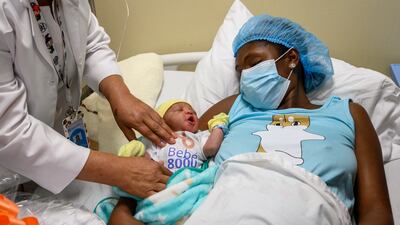
Damaris Ferrera with her baby at Damian Ferrera Altagracia Hospital – in Santo Domingo, Dominican Republic – which symbolically named him the eight billionth inhabitant of the world. AP
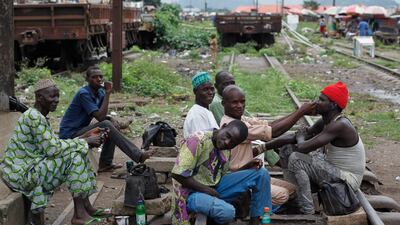
Barbers on an abandoned train track in Abeokuta, about 70km outside Lagos, Nigeria. More than half of the projected increase in the global population up to 2050 will be concentrated in eight countries: the Democratic Republic of Congo, Egypt, Ethiopia, India, Nigeria, Pakistan, the Philippines and Tanzania. EPA
Newborn babies at Hotel Dieu hospital in Beirut, Lebanon, as the world population surges past eight billion. Reuters
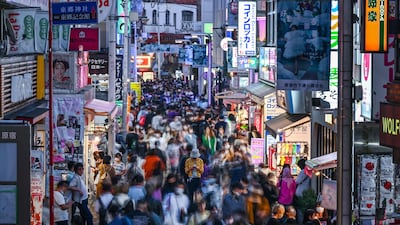
Crowds on Takeshita Street in Tokyo, considered to be the world's most populous metropolitan area. AFP
Nigeria is a significant contributor to world population growth. Countries in sub-Saharan Africa are expected to contribute more than half of the increase anticipated up to 2050, according to the UN. AP
A packed Ipanema beach in Rio de Janeiro, Brazil. AP
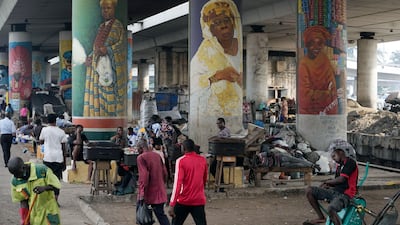
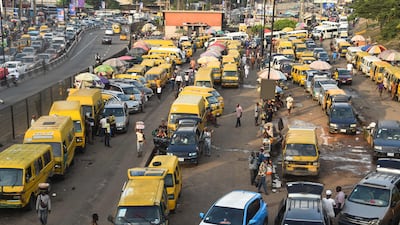
Traffic chaos at Ojodu-Berger bus station in Lagos, Nigeria's commercial capital, which has a population of about 15 million. AFP
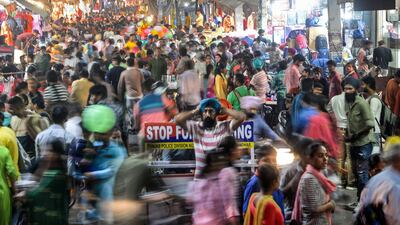
A crowded market in Jalandhar, India. AFP
A family taking pictures at the Temple of Heaven in Beijing. AP
Commuters waiting for buses in Manila, Philippines, where the city's 12 million population swells by three million during working hours. AFP
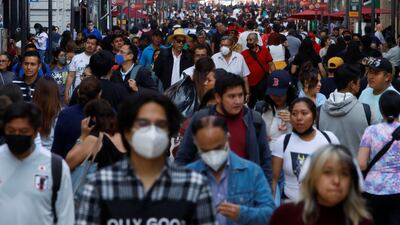
Mexico City is home to more than 20 million people. Reuters
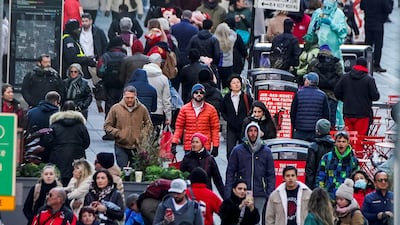
Times Square in Manhattan. About nine million people live in New York's five boroughs. Reuters
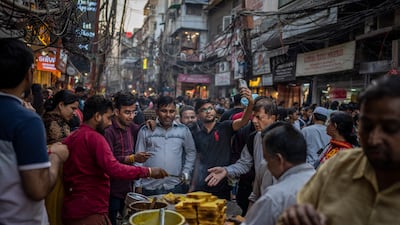
A busy market in New Delhi, India, part of an urban area where the population is estimated to be 32 million. AP
Commuters at a train station in Hong Kong. AFP
Indian commuters get off trains at the Church Gate railway station in Mumbai, India. AP
A subway station in Seoul. The South Korean capital has a population approaching 10 million. AFP
The average lifespan averaged under 40 before 1800, according to OurWorldinData. By 1950, many parts of the world saw lifetimes increase by 20 years. However, there remained places where life expectancy continued to be much lower, such as in sub-Saharan Africa, South-East Asia and Latin America. Improvements were uneven and unequal.
Significant changes for most parts of the world, including Asia and Africa, happened only in the past 70 years. India and China, in particular, have made great strides towards longer and healthier lives since the 1970s. A baby born now in almost all places in the world should expect a much longer and healthier life, on average, than their grandparents and certainly better than earlier generations.
However, there has been a flip side to development.
Global population growth since the Industrial Revolution drove emissions of greenhouse gases, air, water and land pollution, the denuding of forests, a reduction in fish stocks, and the massive increases in monoculture farming and livestock management. It also drove the movement of people from rural areas to cities. Of course, urbanisation has often led to higher incomes and wealth for many, but it has also bred problems such as instability, crime and violence.
Urbanisation continues to grow worldwide, with 56 per cent of humanity living in cities today, according to the World Bank's Urban Development Overview released last month. The development of megacities with huge shanty towns attached to them, especially in sub-Saharan Africa and South Asia, can lead to social problems.
There is, certainly, the counterargument that our population isn't growing as fast as it once did. UN statistics collated in 2021 show that about 60 per cent of the world population live in countries that are at or below the replacement rate of 2.1 children per woman. It was 40 per cent just two years earlier. This lessens the economic, resource and environmental stresses considerably.
The problem, however, is that population growth is uneven across the globe. In fact, we have a somewhat bifurcated world, with some parts having youthful societies and growing populations, such as Nigeria, India and Egypt, while others are ageing societies with declining populations, such as Japan, Italy and Portugal. Most of the coming 1 billion added over the next 15 years are expected to come from India, China, Nigeria, Egypt, Pakistan, and some struggling countries in South Asia and Africa.
When there are too many younger people or too many older people, there are increased stresses on economies and societies due to the very high “dependency ratios", which measure how much the working populations need to take care of the non-working younger and older people. Old-age dependency is highest in the more developed North America, Europe, Australia and Japan. Youth dependency is highest in the less developed sub-Saharan Africa, Yemen, Iraq and Afghanistan.
Both issues could pose significant problems as we head to the 9 billion mark.
Ageing populations put pressure on social insurance schemes, inflation, investments and medical systems. Ageing countries will, therefore, need to adjust as their societies get older. The budgets required to make that happen might not be available due to the unfavourable demographics.
Global food security has been under particular strain in recent months. Bloomberg
Youthful and growing populations, on the other hand, offer countries a chance to develop with the numbers and energy of those people. However, how successful they will be will depend on how those young people will be educated and trained, where the investments will come from to absorb those youthful workers, and how they can keep the per capita incomes and wealth growing to keep peace in their countries.
Rapidly growing and young populations also put stress on food systems. Inheritance laws can also break up farms and other properties into smaller, less efficient ones. Increased youthful populations can cause more, not less, poverty if not appropriately handled. Having a growing young population, therefore, is no guarantee of future success.
When we consider the environmental problems that could result from 1 billion more people globally, climate change could be moving faster towards tipping points when those new 1 billion arrive and begin maturing. Challenges related to economic justice and environmental justice will no doubt arise, particularly for people living in the younger but poorer countries. The lack of a framework to deal with these challenges could pose as constant threats to world peace and prosperity.
Given how interconnected we are, what happens in faraway places can significantly affect our countries, cities, towns and families. This makes dealing with global issues for the sake of the greater good, ourselves and the next billion all the more urgent.
ODI: Tim Paine (capt), Aaron Finch (vice-capt), Ashton Agar, Alex Carey, Josh Hazlewood, Travis Head, Nathan Lyon, Glenn Maxwell, Shaun Marsh, Jhye Richardson, Kane Richardson, D’Arcy Short, Billy Stanlake, Marcus Stoinis, Andrew Tye.
T20: Aaron Finch (capt), Alex Carey (vice-capt), Ashton Agar, Travis Head, Nic Maddinson, Glenn Maxwell, Jhye Richardson, Kane Richardson, D’Arcy Short, Billy Stanlake, Marcus Stoinis, Mitchell Swepson, Andrew Tye, Jack Wildermuth.
Our family matters legal consultant
Name: Hassan Mohsen Elhais
Position: legal consultant with Al Rowaad Advocates and Legal Consultants.
5.30pm: Wathba Stallions Cup Handicap (PA) Dh 70,000 2,200m
6pm: Abu Dhabi Fillies Classic Prestige (PA) Dh110,000 1,400m
6.30pm: Abu Dhabi Colts Classic Prestige (PA) Dh110,000 1,400m
7pm: Handicap (PA) Dh85,000 1,600m
7.30pm: Maiden (PA) Dh80,000 1,600m
The National selections:
5pm: Valcartier
5.30pm: AF Taraha
6pm: Dhafra
6.30pm: Maqam
7pm: AF Mekhbat
7.30pm: Ezz Al Rawasi
Ten tax points to be aware of in 2026
1. Domestic VAT refund amendments: request your refund within five years
If a business does not apply for the refund on time, they lose their credit.
2. E-invoicing in the UAE
Businesses should continue preparing for the implementation of e-invoicing in the UAE, with 2026 a preparation and transition period ahead of phased mandatory adoption.
3. More tax audits
Tax authorities are increasingly using data already available across multiple filings to identify audit risks.
4. More beneficial VAT and excise tax penalty regime
Tax disputes are expected to become more frequent and more structured, with clearer administrative objection and appeal processes. The UAE has adopted a new penalty regime for VAT and excise disputes, which now mirrors the penalty regime for corporate tax.
5. Greater emphasis on statutory audit
There is a greater need for the accuracy of financial statements. The International Financial Reporting Standards standards need to be strictly adhered to and, as a result, the quality of the audits will need to increase.
6. Further transfer pricing enforcement
Transfer pricing enforcement, which refers to the practice of establishing prices for internal transactions between related entities, is expected to broaden in scope. The UAE will shortly open the possibility to negotiate advance pricing agreements, or essentially rulings for transfer pricing purposes.
7. Limited time periods for audits
Recent amendments also introduce a default five-year limitation period for tax audits and assessments, subject to specific statutory exceptions. While the standard audit and assessment period is five years, this may be extended to up to 15 years in cases involving fraud or tax evasion.
8. Pillar 2 implementation
Many multinational groups will begin to feel the practical effect of the Domestic Minimum Top-Up Tax (DMTT), the UAE's implementation of the OECD’s global minimum tax under Pillar 2. While the rules apply for financial years starting on or after January 1, 2025, it is 2026 that marks the transition to an operational phase.
9. Reduced compliance obligations for imported goods and services
Businesses that apply the reverse-charge mechanism for VAT purposes in the UAE may benefit from reduced compliance obligations.
10. Substance and CbC reporting focus
Tax authorities are expected to continue strengthening the enforcement of economic substance and Country-by-Country (CbC) reporting frameworks. In the UAE, these regimes are increasingly being used as risk-assessment tools, providing tax authorities with a comprehensive view of multinational groups’ global footprints and enabling them to assess whether profits are aligned with real economic activity.
Contributed by Thomas Vanhee and Hend Rashwan, Aurifer
Founders: Mounir Nakhla, Ahmed Mohsen and Mohamed Aboulnaga
Based: Cairo, Egypt
Sector: transport and logistics
Size: 150 employees
Investment: approximately $8 million
Investors include: Singapore’s Battery Road Digital Holdings, Egypt’s Algebra Ventures, Uber co-founder and former CTO Oscar Salazar
Know before you go
Jebel Akhdar is a two-hour drive from Muscat airport or a six-hour drive from Dubai. It’s impossible to visit by car unless you have a 4x4. Phone ahead to the hotel to arrange a transfer.
If you’re driving, make sure your insurance covers Oman.
By air: Budget airlines Air Arabia, Flydubai and SalamAir offer direct routes to Muscat from the UAE.
Tourists from the Emirates (UAE nationals not included) must apply for an Omani visa online before arrival at evisa.rop.gov.om. The process typically takes several days.
Flash floods are probable due to the terrain and a lack of drainage. Always check the weather before venturing into any canyons or other remote areas and identify a plan of escape that includes high ground, shelter and parking where your car won’t be overtaken by sudden downpours.
Hydrogen: Market potential
Hydrogen has an estimated $11 trillion market potential, according to Bank of America Securities and is expected to generate $2.5tn in direct revenues and $11tn of indirect infrastructure by 2050 as its production increases six-fold.
"We believe we are reaching the point of harnessing the element that comprises 90 per cent of the universe, effectively and economically,” the bank said in a recent report.
Falling costs of renewable energy and electrolysers used in green hydrogen production is one of the main catalysts for the increasingly bullish sentiment over the element.
The cost of electrolysers used in green hydrogen production has halved over the last five years and will fall to 60 to 90 per cent by the end of the decade, acceding to Haim Israel, equity strategist at Merrill Lynch. A global focus on decarbonisation and sustainability is also a big driver in its development.
Focus on gratitude: And do so deeply, he says. “Think of one to three things a day that you’re grateful for. It needs to be specific, too, don’t just say ‘air.’ Really think about it. If you’re grateful for, say, what your parents have done for you, that will motivate you to do more for the world.”
Know how to fight: Shetty married his wife, Radhi, three years ago (he met her in a meditation class before he went off and became a monk). He says they’ve had to learn to respect each other’s “fighting styles” – he’s a talk it-out-immediately person, while she needs space to think. “When you’re having an argument, remember, it’s not you against each other. It’s both of you against the problem. When you win, they lose. If you’re on a team you have to win together.”
Company Profile
Name: JustClean
Based: Kuwait with offices in other GCC countries
Launch year: 2016
Number of employees: 130
Sector: online laundry service
Funding: $12.9m from Kuwait-based Faith Capital Holding
Fraudsters send an unsolicited email that appears to be from a financial institution or online retailer. The hoax email requests that you provide sensitive information, often by clicking on to a link leading to a fake website.
2) Smishing
The SMS equivalent of phishing. Fraudsters falsify the telephone number through “text spoofing,” so that it appears to be a genuine text from the bank.
3) Vishing
The telephone equivalent of phishing and smishing. Fraudsters may pose as bank staff, police or government officials. They may persuade the consumer to transfer money or divulge personal information.
4) SIM swap
Fraudsters duplicate the SIM of your mobile number without your knowledge or authorisation, allowing them to conduct financial transactions with your bank.
5) Identity theft
Someone illegally obtains your confidential information, through various ways, such as theft of your wallet, bank and utility bill statements, computer intrusion and social networks.
6) Prize scams
Fraudsters claiming to be authorised representatives from well-known organisations (such as Etisalat, du, Dubai Shopping Festival, Expo2020, Lulu Hypermarket etc) contact victims to tell them they have won a cash prize and request them to share confidential banking details to transfer the prize money.
Teaching your child to save
Pre-school (three - five years)
You can’t yet talk about investing or borrowing, but introduce a “classic” money bank and start putting gifts and allowances away. When the child wants a specific toy, have them save for it and help them track their progress.
Early childhood (six - eight years)
Replace the money bank with three jars labelled ‘saving’, ‘spending’ and ‘sharing’. Have the child divide their allowance into the three jars each week and explain their choices in splitting their pocket money. A guide could be 25 per cent saving, 50 per cent spending, 25 per cent for charity and gift-giving.
Middle childhood (nine - 11 years)
Open a bank savings account and help your child establish a budget and set a savings goal. Introduce the notion of ‘paying yourself first’ by putting away savings as soon as your allowance is paid.
Young teens (12 - 14 years)
Change your child’s allowance from weekly to monthly and help them pinpoint long-range goals such as a trip, so they can start longer-term saving and find new ways to increase their saving.
Teenage (15 - 18 years)
Discuss mutual expectations about university costs and identify what they can help fund and set goals. Don’t pay for everything, so they can experience the pride of contributing.
Young adulthood (19 - 22 years)
Discuss post-graduation plans and future life goals, quantify expenses such as first apartment, work wardrobe, holidays and help them continue to save towards these goals.
* JP Morgan Private Bank
Nepotism is the name of the game
Salman Khan’s father, Salim Khan, is one of Bollywood’s most legendary screenwriters. Through his partnership with co-writer Javed Akhtar, Salim is credited with having paved the path for the Indian film industry’s blockbuster format in the 1970s. Something his son now rules the roost of. More importantly, the Salim-Javed duo also created the persona of the “angry young man” for Bollywood megastar Amitabh Bachchan in the 1970s, reflecting the angst of the average Indian. In choosing to be the ordinary man’s “hero” as opposed to a thespian in new Bollywood, Salman Khan remains tightly linked to his father’s oeuvre. Thanks dad.