The blue and purple show the hole in Earth's ozone layer over Antarctica last October. The protective layer is slowly but noticeably healing. AP Photo


Why the ozone layer's healing should be a cause for celebration


  • English
  • Arabic

January 20, 2023

There must be something about the human condition that even when good news arrives, we are almost unwilling to enjoy it. How else would you explain the relatively muted global response to the UN announcement this month that the hole in the ozone layer, a serious environmental concern for several decades, is shrinking and will be fully repaired within years?

Perhaps it is because this rare piece of demonstrable environmental progress arrived within the context of a daily news cycle often dominated by death, destruction and devastation.

Or it may be, as others will argue, that it is hard to invest too much time or emotion into a situation that may never happen when there are so many pressing threats to everyday life clearly evident in societies, economies and communities.

Whatever the case, many people will have simply shrugged and got on with their lives when the UN made its pronouncement on January 9 that the hole in the ozone layer will be healed by 2066.

The repair of the ozone layer is worth marking for several reasons: a catastrophic threat to our existence has been averted and that tells us a lot about international treaties and the power of the collective will. Further, the case study provides broader takeaways for staying the course, as well as reflections on the power of research.

Scientists Mario Molina and Sherwood Rowland first noted that chlorofluorocarbons or CFC gasses – which in the 1970s were typically found in hairspray and in the cooling mechanisms of refrigerators – posed a significant threat to the ozone layer.

Their work helped create the conditions for the concerted international action that resulted in the Montreal Protocol, a transformative 1980s treaty to significantly reduce the release of ozone-depleting substances.

Its introduction was the result of years of action, beginning with the original Vienna Convention monitoring ozone depletion, signed at the height of the Cold War in the mid-1980s.

Solar panels display at SunPure stand during Abu Dhabi Sustainability Week in Adnec, Abu Dhabi. Khushnum Bhandari / The National
The historical precedent that the Montreal protocol provides is, perhaps, its greatest antidote to the doubters

The subsequent Montreal Protocol, which phased out the production of ozone-depleting substances, would go on to be ratified by all UN members and later offered solidarity support from richer nations to less developed countries to help meet international compliance, a further example of progressive international policymaking.

Years later, Molina and Rowland won the Nobel Prize for Chemistry for their work, along with Paul Crutzen, who had earlier made important ground on the effects of nitrogen oxide emissions upon ozone reduction.

Little wonder that the protocol was described by the late Kofi Annan as the “most successful environmental treaty ever”, while then US president Ronald Reagan called it a “monumental achievement” at the time of its introduction 34 years ago on January 1, 1989.

If the protocol is an exercise in global co-operation and scientific endeavour working in symphony, it also provided an example of staying the course even against a backdrop of setbacks and challenges.

The largest hole in the Antarctic ozone layer wasn’t recorded until 2006, according to AFP, and it would be another decade before scientists could confirm, in 2016, that the hole was shrinking. There was to be no comfortable straight line between discovery, action and resolution.

Sceptics argue that there are few parallels to be drawn between the requirement today for urgent climate action and the successful path charted via the Montreal Protocol.

They say that the evidence of ozone layer depletion was so well defined that it limited the space for obfuscating deniers, who have occasionally risen to prominence in the climate space in more recent times, thus making it easier to take action back then and forge that collective will for change.

Pessimists (they may prefer the term realists) say that finding solutions to current climate issues will be far harder than gathering the momentum that led to the Montreal Protocol, in essence because multiple levers will have to be pulled to make genuine progress. In addition, the here-and-now of conflict and crisis often presents far greater problems than the need for change at some distant point in the future.

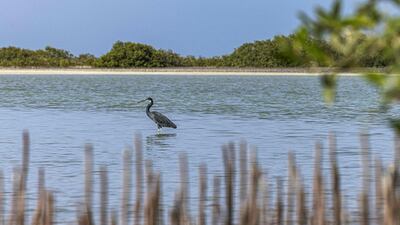
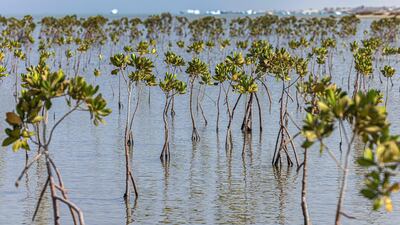
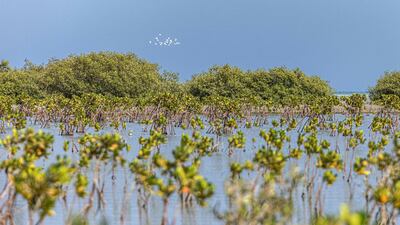
  • On Egypt's Red Sea coast, fish swim and herons wade among thousands of newly planted mangroves. All photos: AFP
    On Egypt's Red Sea coast, fish swim and herons wade among thousands of newly planted mangroves. All photos: AFP
  • Birds fly above the mangrove forest, planted as part of a programme to boost biodiversity and fight climate change.
    Birds fly above the mangrove forest, planted as part of a programme to boost biodiversity and fight climate change.
  • During decades of destruction, the mangroves in the Hamata area were cleared.
    During decades of destruction, the mangroves in the Hamata area were cleared.
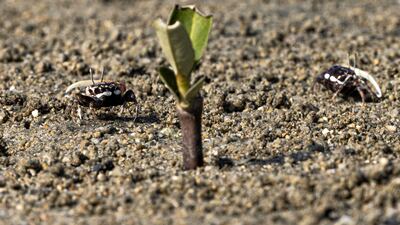
  • All that remained of the mangroves, where crabs make their homes, were fragmented patches covering about 500 hectares.
    All that remained of the mangroves, where crabs make their homes, were fragmented patches covering about 500 hectares.
  • Crabs scuttle from one plant to another.
    Crabs scuttle from one plant to another.
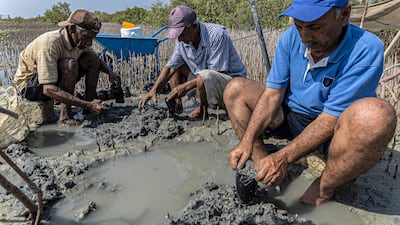
  • Workers replant trees as part of the state-sponsored mangrove reforestation project.
    Workers replant trees as part of the state-sponsored mangrove reforestation project.
  • Not a cloud in the sky - only a flock of white birds.
    Not a cloud in the sky - only a flock of white birds.
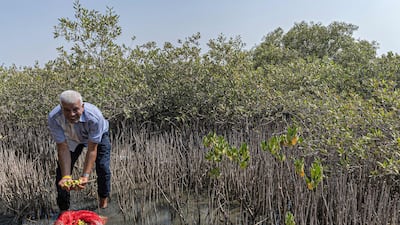
  • Project leader Sayed Khalifa, the head of Egypt's Syndicate of Agriculture, inspects the fruits of his labour.
    Project leader Sayed Khalifa, the head of Egypt's Syndicate of Agriculture, inspects the fruits of his labour.
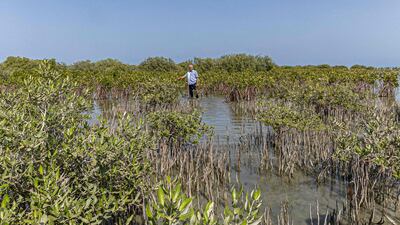
  • A walk on the wild side for Mr Khalifa.
    A walk on the wild side for Mr Khalifa.
  • Mangrove seedlings grow in a nursery at the site south of Marsa Alam.
    Mangrove seedlings grow in a nursery at the site south of Marsa Alam.
  • Protecting coastlines is another of the project's aims.
    Protecting coastlines is another of the project's aims.

Even taking all that into account, the historical precedent that the protocol provides is, perhaps, its greatest antidote to the doubters.

With Abu Dhabi Sustainability Week in full flow in the capital, we have also been reminded this month of the work the world needs to accomplish to meet its climate target of limiting the rise in global temperatures to 1.5°C above pre-industrial levels.

Cop28 President-designate Dr Sultan Al Jaber told delegates that “we need to go much further and faster if we are to hit our targets.

“Despite the progress that the world is making, we need to be honest with ourselves. We are way off track,” he said.

In a separate address, the Cop28 President-designate also spoke earlier this week about making this year’s conference of the parties in Dubai a “Cop of solidarity” that bridges divides between sectors, societies and scientists.

The great hope for the general observer is that the “monumental achievement” of past protocols can and will be revived, and that we can go further and faster to reach our goals. The alternative does not bear thinking about.

COMPANY%20PROFILE
%3Cp%3E%3Cstrong%3EName%3A%20%3C%2Fstrong%3EKinetic%207%3Cbr%3E%3Cstrong%3EStarted%3A%3C%2Fstrong%3E%202018%3Cbr%3E%3Cstrong%3EFounder%3A%3C%2Fstrong%3E%20Rick%20Parish%3Cbr%3E%3Cstrong%3EBased%3A%3C%2Fstrong%3E%20Abu%20Dhabi%2C%20UAE%3Cbr%3E%3Cstrong%3EIndustry%3A%3C%2Fstrong%3E%20Clean%20cooking%3Cbr%3E%3Cstrong%3EFunding%3A%3C%2Fstrong%3E%20%2410%20million%3Cbr%3E%3Cstrong%3EInvestors%3A%3C%2Fstrong%3E%20Self-funded%3C%2Fp%3E%0A
What are the GCSE grade equivalents?
 
  • Grade 9 = above an A*
  • Grade 8 = between grades A* and A
  • Grade 7 = grade A
  • Grade 6 = just above a grade B
  • Grade 5 = between grades B and C
  • Grade 4 = grade C
  • Grade 3 = between grades D and E
  • Grade 2 = between grades E and F
  • Grade 1 = between grades F and G
Key figures in the life of the fort

Sheikh Dhiyab bin Isa (ruled 1761-1793) Built Qasr Al Hosn as a watchtower to guard over the only freshwater well on Abu Dhabi island.

Sheikh Shakhbut bin Dhiyab (ruled 1793-1816) Expanded the tower into a small fort and transferred his ruling place of residence from Liwa Oasis to the fort on the island.

Sheikh Tahnoon bin Shakhbut (ruled 1818-1833) Expanded Qasr Al Hosn further as Abu Dhabi grew from a small village of palm huts to a town of more than 5,000 inhabitants.

Sheikh Khalifa bin Shakhbut (ruled 1833-1845) Repaired and fortified the fort.

Sheikh Saeed bin Tahnoon (ruled 1845-1855) Turned Qasr Al Hosn into a strong two-storied structure.

Sheikh Zayed bin Khalifa (ruled 1855-1909) Expanded Qasr Al Hosn further to reflect the emirate's increasing prominence.

Sheikh Shakhbut bin Sultan (ruled 1928-1966) Renovated and enlarged Qasr Al Hosn, adding a decorative arch and two new villas.

Sheikh Zayed bin Sultan (ruled 1966-2004) Moved the royal residence to Al Manhal palace and kept his diwan at Qasr Al Hosn.

Sources: Jayanti Maitra, www.adach.ae

Key findings of Jenkins report
  • Founder of the Muslim Brotherhood, Hassan al Banna, "accepted the political utility of violence"
  • Views of key Muslim Brotherhood ideologue, Sayyid Qutb, have “consistently been understood” as permitting “the use of extreme violence in the pursuit of the perfect Islamic society” and “never been institutionally disowned” by the movement.
  • Muslim Brotherhood at all levels has repeatedly defended Hamas attacks against Israel, including the use of suicide bombers and the killing of civilians.
  • Laying out the report in the House of Commons, David Cameron told MPs: "The main findings of the review support the conclusion that membership of, association with, or influence by the Muslim Brotherhood should be considered as a possible indicator of extremism."
VEZEETA PROFILE

Date started: 2012

Founder: Amir Barsoum

Based: Dubai, UAE

Sector: HealthTech / MedTech

Size: 300 employees

Funding: $22.6 million (as of September 2018)

Investors: Technology Development Fund, Silicon Badia, Beco Capital, Vostok New Ventures, Endeavour Catalyst, Crescent Enterprises’ CE-Ventures, Saudi Technology Ventures and IFC

How to apply for a drone permit
  • Individuals must register on UAE Drone app or website using their UAE Pass
  • Add all their personal details, including name, nationality, passport number, Emiratis ID, email and phone number
  • Upload the training certificate from a centre accredited by the GCAA
  • Submit their request
What are the regulations?
  • Fly it within visual line of sight
  • Never over populated areas
  • Ensure maximum flying height of 400 feet (122 metres) above ground level is not crossed
  • Users must avoid flying over restricted areas listed on the UAE Drone app
  • Only fly the drone during the day, and never at night
  • Should have a live feed of the drone flight
  • Drones must weigh 5 kg or less
Boulder shooting victims

• Denny Strong, 20
• Neven Stanisic, 23
• Rikki Olds, 25
• Tralona Bartkowiak, 49
• Suzanne Fountain, 59
• Teri Leiker, 51
• Eric Talley, 51
• Kevin Mahoney, 61
• Lynn Murray, 62
• Jody Waters, 65

The bio

Favourite vegetable: Broccoli

Favourite food: Seafood

Favourite thing to cook: Duck l'orange

Favourite book: Give and Take by Adam Grant, one of his professors at University of Pennsylvania

Favourite place to travel: Home in Kuwait.

Favourite place in the UAE: Al Qudra lakes

Brahmastra%3A%20Part%20One%20-%20Shiva
%3Cp%3E%3Cstrong%3EDirector%3A%20%3C%2Fstrong%3EAyan%20Mukerji%3C%2Fp%3E%0A%3Cp%3E%3Cstrong%3EStars%3A%20%3C%2Fstrong%3ERanbir%20Kapoor%2C%20Alia%20Bhatt%20and%20Amitabh%20Bachchan%3C%2Fp%3E%0A%3Cp%3E%3Cstrong%3ERating%3A%3C%2Fstrong%3E%202%2F5%3C%2Fp%3E%0A

Company Profile

Company name: NutriCal

Started: 2019

Founder: Soniya Ashar

Based: Dubai

Industry: Food Technology

Initial investment: Self-funded undisclosed amount

Future plan: Looking to raise fresh capital and expand in Saudi Arabia

Total Clients: Over 50

The specs: 2018 Renault Koleos

Price, base: From Dh77,900
Engine: 2.5L, in-line four-cylinder
Transmission: Continuously variable transmission
Power: 170hp @ 6,000rpm
Torque: 233Nm @ 4,000rpm
Fuel economy, combined: 8.3L / 100km

Updated: January 20, 2023, 5:00 AM