

For American presidents visiting Ireland, the undertaking resonates like no other foreign visit the White House sets up. To be sure, there are the happy images that play well on campaign trails, rallying the estimated 40 million people in the US who tick the box that says Irish heritage.
There is also how it goes down in Ireland. Yes, there are the familiar pillars of such trips, an address to the Irish parliament and handshakes in the presidential parlour. There is also the impact for the Irish in renewing the bond with America. Since the Good Friday Agreement, there is also the specific US presence in the relationship between the North and South of the divided island.
Joe Biden is so avowedly Irish in identity that he watches keenly when the Irish rugby team is playing in the big games. (One very Irish aspect of this is that his cousins Rob and Dave Kearney have been star players in the team.)
You’d be hard put to get an American president so close to his Irish roots. But Mr Biden has some big shoes to fill on his trip this week.
John Fitzgerald Kennedy set a high watermark for all presidents visiting Ireland in the 1960s. Such was the impact of the glamorous presidential couple that for decades afterwards, ceramic plates with JFK’s image would hang on the walls of Irish homes. Certainly many of the houses during my youth, 20 years later, had a Kennedy looking down.

Richard Nixon and Jimmy Carter visited in the 1970s. Then Ronald Reagan, the great communicator, set a Kennedy-style spell during his 1984 trip to Ballyporeen in County Tipperary. As the presidential helicopter circled to land, the MC on the makeshift stage told the crowd: “Whatever your views of the president, this is his best view of you.” A hint there was that sympathies lay more with Democratic presidents than Republican ones, but as the dancers did their stuff in the summer sun, Mr Reagan was warmly received.
Mr Reagan used the Irish element of his heritage to mitigate the fierce rivalry with then US House of Representatives speaker Tip O’Neill on Capitol Hill. When Mr O’Neill gibed that Ballyporeen translated into English as “valley of the small potatoes”, Mr Reagan took the joke heartily. The Irish bond between the two was such that Mr Reagan said if he had a ticket to heaven and Mr O’Neill did not, he’d throw it away to go to hell with him.
Tammany Hall is a byword for the political machine in the US, but it rings familiar and reassuring in Irish ears. This is partly because Bill Clinton took the most active role in Ireland in modern times. He said last week that the signing of the Good Friday Agreement 25 years ago was the happiest day of his life.
Barack Obama conducted a happy visit during his presidency, too, when part of his mother’s family were traced to a place called Moneygall. As Mr Obama noted during his time in the White House – designed and built by an Irishman called James Hoban – there is only one foreign leader with a fixed date in the calendar for a visit, and that is the Irish leader for St Patrick’s Day.
Mr Biden’s trip this week will take him to Belfast for the 25th anniversary celebrations. In a ceremony on Friday, Mr Biden’s senate contemporary George Mitchell was celebrated as an architect of that agreement. Mr Mitchell did indeed play an instrumental role to reconcile the republican and unionist traditions to a point of history where all could agree on local power sharing. But while the deal is honoured this week, the power sharing is no longer functioning. The unionists are alienated by the post-Brexit fallout that saw Northern Ireland retain economic ties to the rest of the island through the EU.
The US leader’s next stop is Carlingford, a harbour village that looks across the peninsula to Northern Ireland. It is between these two that Mr Biden can provide some unifying focus on his trip.
There are strong Irish ties established to 17 of the 46 US presidents. These are marked both in the North and the South. The homestead of Ulysses S Grant sits in the hills of Tyrone. Not far away from there is the Ulster-American Folk Park that monumentalises the Irish-American relationship with an Ulster-Scots twist. It is the ancestral property of Andrew Mellon, the Depression-era US treasury secretary and the scion of a banking family.
-

Former British prime minister Tony Blair and former Taoiseach Bertie Ahern sign the Good Friday agreement on April 10, 1998. This year marks 25 years since the signing of the historic agreement. PA -
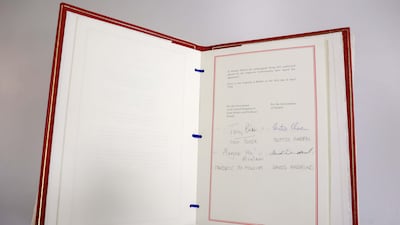
The original Good Friday agreement. PA -
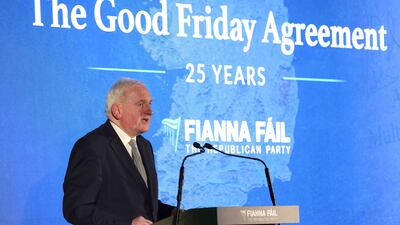
Mr Ahern speaking at University College Dublin at an event organised by the Fianna Fail party to commemorate the 25th anniversary of the Good Friday Agreement in Dublin. PA -
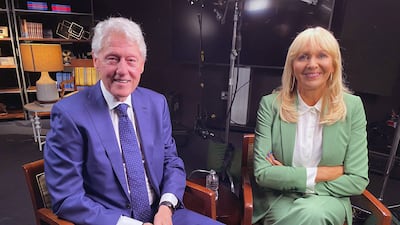
RTE television presenter Miriam O'Callaghan with former US president Bill Clinton, who appeared on Prime Time in April to mark 25 years of the agreement. PA -

Erin McArdle, left, who was born on April 10, 1998, and her mother Caroline, hold The Telegraph which was published on the same day, at her home in Ballymena in Northern Ireland. EPA -
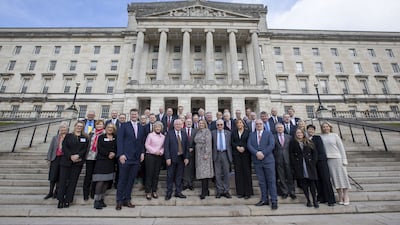
Attendees of the 63rd Plenary of the British-Irish Parliamentary Assembly pose together in March on the steps of Parliament Buildings in Stormont in Belfast, to mark the 25th anniversary of the agreement. PA -
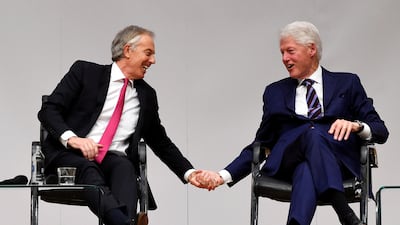
Mr Blair and Mr Clinton hold hands an event to celebrate the 20th anniversary of the Good Friday Agreement in Belfast, Northern Ireland, on April 10, 2018. Reuters -
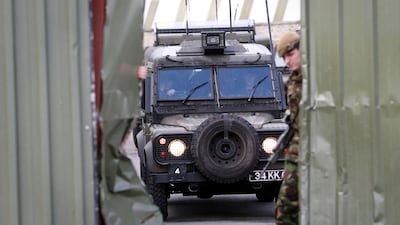
British army soldiers from 2nd Battalion, The Prince of Wales Royal Regiment, leave Bessbrook British army base for the last time in South Armagh in Northern Ireland, on June 25, 2007. AP -

Mr Blair, former US Senator George Mitchell and Mr Ahern, at Downing Street, London, to announce a review of the Northern Ireland peace process in July 1999. PA -
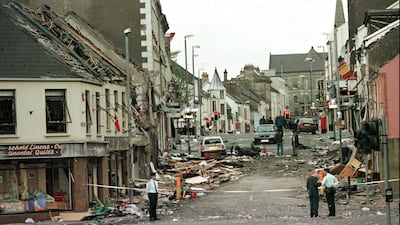
Royal Ulster Constabulary Police officers stand on Market Street after a car bombing in the centre of Omagh in Northern Ireland, in August 1998. AP -
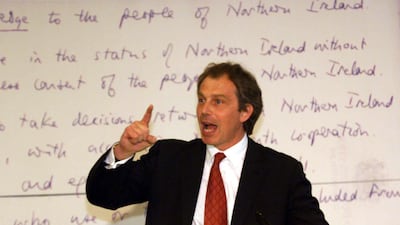
Mr Blair argues his case for the Yes vote in the peace referendum at the University of Ulster in Northern Ireland in May 1998. PA -
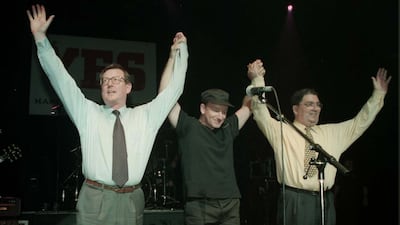
Ulster Unionist leader David Trimble, U2 singer Bono, and SDLP leader John Hume on stage for the 'YES' concert at the Waterfront Hall in Belfast in May 1998. PA -
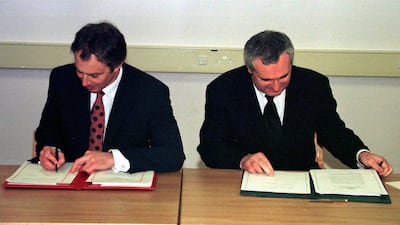
Mr Blair and Mr Ahern sign the Good Friday Agreement on April 10, 1998. PA -

Mr Blair, former US senator George Mitchell, and Mr Ahern pose after signing the agreement. AP -
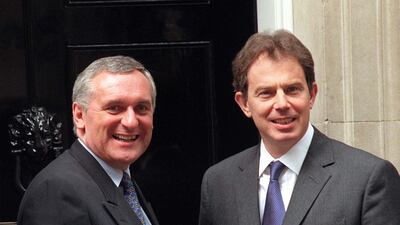
Mr Blair greets Mr Ahern at Downing Street, London, in July 1997. PA -
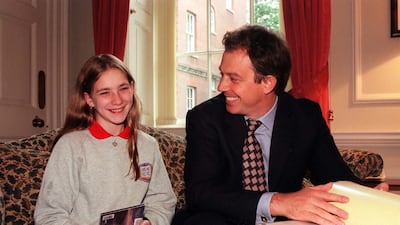
Mr Blair and a Belfast schoolgirl, Margaret Gibney, inside 10 Downing Street in June 1997. Ms Gibney had become popular around the world after she asked Mr Blair to bring peace to Northern Ireland. PA -
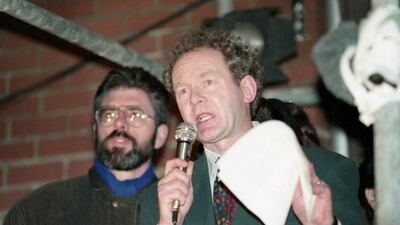
The Sinn Fein's deputy leader, Martin McGuinness, and leader Gerry Adams at a rally in Belfast in December 1994. AP -
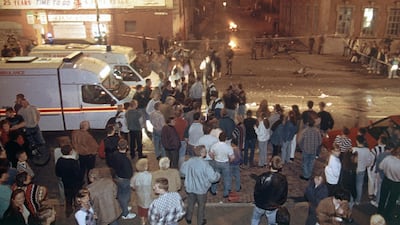
People gather at the scene of a car bomb explosion outside the Sinn Fein headquarters in West Belfast in Northern Ireland in September 1994. AP -
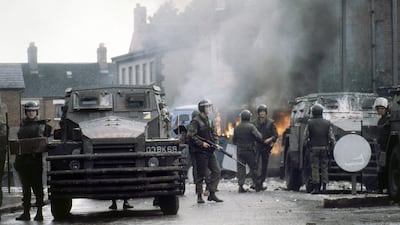
British troops with armoured vehicles surround a blazing barricade near the Andersonstown Police Station in Belfast in 1979. AP -
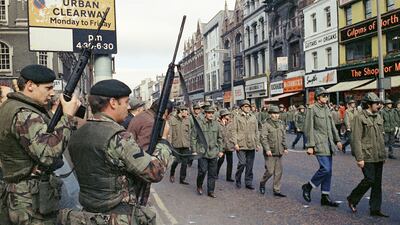
British troops look on as members of the Ulster Defence Association march through Belfast in 1972. AP


Mr Clinton straddled the Northern divisions, or at least he was more touched by them than most. In 1995, as his interests grew, there was what was described as a tussle between the Catholic side of his heritage in Fermanagh (Cassidys) and the Protestant side (Blythe) in Armagh. So confident was Mr Clinton in the Irish scene that he once quipped that he could still see the scars in the White House left by William Ross of County Down, who was commander of the British forces that sacked Washington in 1812.
The space for jokes is narrower today. The Belfast realities mean that Mr Biden’s trip there will have a curtailed feel while his reception in the South is cued up to be an open-armed celebration. The Carlingford stop is a chance for Mr Biden to draw together the political and the personal by reinforcing his messages from Belfast.
The last leg of the visit is on the western side in County Mayo, and is likely to be a repeat of his stopover as vice president to Mr Obama. The bid for a second presidential term for the 80-year-old will shape this part of the trip, too. His message from there would be that the US is, in local terms, the “next parish over the Atlantic”. Indeed, the millions who began their voyage from County Mayo to America ended up playing an outside role in US politics and business over centuries. Their descendants, such as Mr Biden, are paying it back.
Mr Biden likes to quote the Irish poet Seamus Heaney to provide inspiration to his audiences that hope and history can meet at the same point. And the Irish are again in need of some American balm for the island’s sores.

