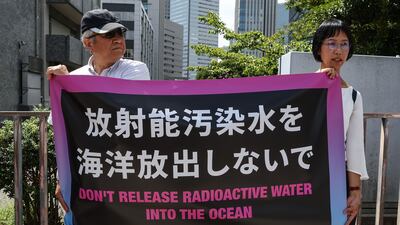
A protester holds a sign that reads "Don't throw radiation-contaminated water into the sea", during a rally against discharging of treated radioactive water the ocean, in front of Prime Minister Fumio Kishida's official residence in Tokyo, Japan, on August 25. Reuters
A protester holds a sign that reads "Don't throw radiation-contaminated water into the sea", during a rally against discharging of treated radioactive water the ocean, in front of Prime Minister Fumio Kishida's official residence in Tokyo, Japan, on August 25. Reuters
A protester holds a sign that reads "Don't throw radiation-contaminated water into the sea", during a rally against discharging of treated radioactive water the ocean, in front of Prime Minister Fumio
Sholto Byrnes is an East Asian affairs columnist for The National
August 29, 2023
How much tritium, carbon-14, strontium-90 and iodine-129 would you like in your sushi? None at all, appears to be the response of the Chinese public, which has been strongly supportive of Beijing’s decision to ban all seafood imports from Japan after more than 1 million tonnes of water from the wrecked Fukushima Daiichi nuclear power plant began discharging into the Pacific Ocean.
The decision has so outraged opinion in China that Tokyo has advised any citizens visiting or living in China to “try to be cautious, such as not speaking Japanese loudly unnecessarily”. The concern is real: last week, a brick was thrown at the Japanese embassy in Beijing, and the country’s diplomats have apparently been deluged by “crank calls” from Chinese telephone numbers.
It is never hard to provoke anti-Japanese feeling in China or South Korea (where people are also upset) given the historical record of the Second World War and the previous decades of Tokyo’s imperial expansion. This has nothing to do with the issue of nuclear power – both countries have plenty of nuclear power plants, and even many hardcore environmentalists have come round to the view that the technology is one of the cleanest and most sustainable when all is working correctly.
Kim Gi-hyeon (R), chief of the ruling People Power Party, and the party's floor leader, Yun Jae-ok, eat slices of raw 'mineo,' or croaker fish, for lunch at a raw fish restaurant in Incheon, west of Seoul, South Korea, on August 29, to promote sales of fish amid Japan's release of radioactive water into the ocean. EPA
Neither has the outrage been mollified by the fact that the UN’s International Atomic Energy Agency has approved the release, which will take place over 30 to 40 years, and that the discharge has been thoroughly cleaned – the levels of tritium, a radioactive isotope of hydrogen, are far below those that the World Health Organisation mandates for drinking water.
“The ocean is the common property of all humanity, and forcibly starting the discharge of Fukushima’s nuclear wastewater into the ocean is an extremely selfish and irresponsible act that ignores international public interests,” said a statement from China’s foreign ministry. The Japanese government disputes that, but really this is a communications fiasco arising from the failure to recognise that for most people the words “nuclear contaminated” and “perfectly safe” do not belong in the same sentence.
Rightly or wrongly, this is an issue to which people have an emotional, not a rational, response
It reminds me of 1990, when Britain was in a frenzy about “mad cow disease”, which could be spread from infected meat to humans. The then environment secretary, John Gummer, attempted to reassure the public there was little or no risk from local produce by posing for a photoshoot while feeding his four-year-old daughter a beef burger. No one was convinced. It only raised questions about the minister’s style of parenting. (Years later, I met Mr Gummer’s by then grown-up daughter at a dinner party. I am pleased to report that she appeared to be unscathed by the experience.)
Rightly or wrongly, this is an issue to which people have an emotional, not a rational, response. Would you swim in the sea next to the site of a nuclear disaster – Fukushima was the world’s worst since Chernobyl after it was struck by a tsunami in 2011 – or in any area where water from the ruined plant was released? I know I wouldn’t. And even if the risk would be minimal, this decision does tap into entirely legitimate fears about humanity’s custodianship of our oceans.
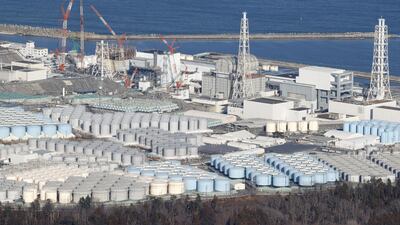
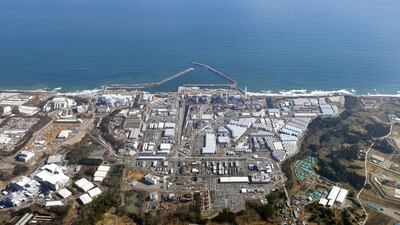
Part of the facility for the releasing treated radioactive water to sea. On August 24, Japan started the discharge of treated radioactive water from the Fukushima nuclear power plant into the Pacific Ocean. It will take 30 years to complete the release. EPA/ Pool
A study published in March estimated that there may be more than 170 trillion plastic particles in the world’s seas, and that there had been a “rapid and unprecedented” increase in plastic pollution since 2005. A global plastic treaty is in the works, but cleaning up just what we have produced so far will be a gargantuan task – only 9 per cent of the historic total has ever been recycled, according to the UN Environment Programme.
To take another example, at the beginning of August, Britain’s team for the World Triathlon Championship finals said they had been forced to stop training in the sea – because there was too much sewage off the coast of Lancashire, where they are based.
These are very troubling news stories for all of us who relish spending time in the water. Some of my happiest memories are of braving chilly British shores, snorkelling in the Red Sea near Jeddah and the Bismarck Sea off Papua New Guinea, and swimming with turtles and baby sharks near the east coast of peninsular Malaysia. But there are serious health costs, too, for both marine and human life. How have we managed to take such a laissez-faire attitude to one of the planet’s most precious resources?
So releasing water from the Fukushima nuclear plant just sets a very bad example – that the ocean continues to be where we offload our refuse. Yes, we have been told that it is safe – although there have been countless times over the decades when professionals were confident that something that turned out to be harmful was not, or the impression was given that it wasn’t too bad. There was an advertising slogan in the 1940s that went: “More doctors smoke Camels than any other cigarette.”
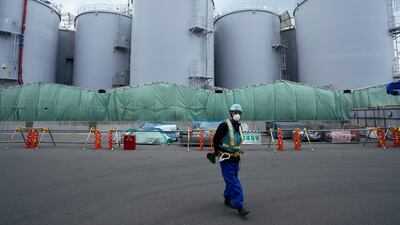
Storage tanks for treated water at the Fukushima nuclear power plant in Okuma, Japan. Reuters
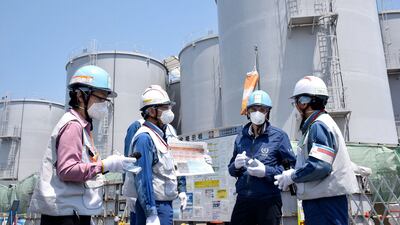
Authorities are set to begin pumping more than a million tonnes of treated radioactive water from the nuclear power plant into the sea. AFP
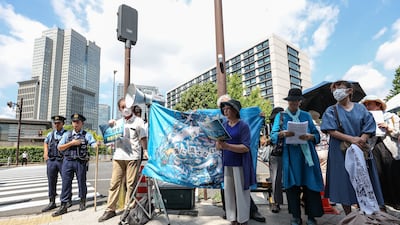
The move has drawn criticism, such as from these protesters outside the Japanese prime minister's official residence. Getty Images
Japan's government plans to release water stored at Fukushima into the Pacific. Getty Images
Neighbouring countries have objected, citing fears of radioactive contamination. Reuters
The accumulating water has been stored in tanks at Fukushima since 2011 and Japan says it needs to start releasing it as those containers are full. AP
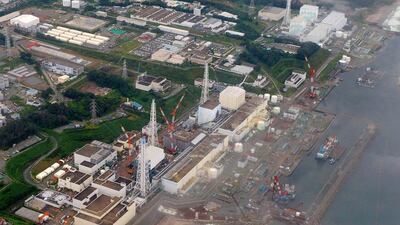
The nuclear meltdown at Fukushima in March 2011 was sparked by a tsunami that swept away towns and cities after a 9.0-magnitude earthquake, leaving more than 20,000 people dead or missing. AP
But there is not a 100 per cent consensus on the issue. Greenpeace International issued a statement saying: “Scientists have warned that the radiological risks from the discharges have not been fully assessed, and the biological impacts of tritium, carbon-14, strontium-90 and iodine-129, which will be released in the discharges, have been ignored.” Those scientists include members of the US National Association of Marine Laboratories, who would have no reason other than their expertise to side with China over Japan.
So is it really safe? Not everyone is certain that it is, which should have been sufficient cause to put a halt to the release. But above all, it is a matter of common sense, and of appreciating – or rather not appreciating in this case – the widespread and understandable fears associated with any materials that have passed through a plant that suffered the worst nuclear disaster for decades.
The question the Japanese authorities should be asking themselves is not, “how did we not communicate this issue better to our neighbouring countries?”, but “was this at all a good idea in the first place?”
GROUPS
Group Gustavo Kuerten
Novak Djokovic (x1)
Alexander Zverev (x3)
Marin Cilic (x5)
John Isner (x8)
Group Lleyton Hewitt
Roger Federer (x2)
Kevin Anderson (x4)
Dominic Thiem (x6)
Kei Nishikori (x7)
Mercer, the investment consulting arm of US services company Marsh & McLennan, expects its wealth division to at least double its assets under management (AUM) in the Middle East as wealth in the region continues to grow despite economic headwinds, a company official said.
Mercer Wealth, which globally has $160 billion in AUM, plans to boost its AUM in the region to $2-$3bn in the next 2-3 years from the present $1bn, said Yasir AbuShaban, a Dubai-based principal with Mercer Wealth.
“Within the next two to three years, we are looking at reaching $2 to $3 billion as a conservative estimate and we do see an opportunity to do so,” said Mr AbuShaban.
Mercer does not directly make investments, but allocates clients’ money they have discretion to, to professional asset managers. They also provide advice to clients.
“We have buying power. We can negotiate on their (client’s) behalf with asset managers to provide them lower fees than they otherwise would have to get on their own,” he added.
Mercer Wealth’s clients include sovereign wealth funds, family offices, and insurance companies among others.
From its office in Dubai, Mercer also looks after Africa, India and Turkey, where they also see opportunity for growth.
Wealth creation in Middle East and Africa (MEA) grew 8.5 per cent to $8.1 trillion last year from $7.5tn in 2015, higher than last year’s global average of 6 per cent and the second-highest growth in a region after Asia-Pacific which grew 9.9 per cent, according to consultancy Boston Consulting Group (BCG). In the region, where wealth grew just 1.9 per cent in 2015 compared with 2014, a pickup in oil prices has helped in wealth generation.
BCG is forecasting MEA wealth will rise to $12tn by 2021, growing at an annual average of 8 per cent.
Drivers of wealth generation in the region will be split evenly between new wealth creation and growth of performance of existing assets, according to BCG.
Another general trend in the region is clients’ looking for a comprehensive approach to investing, according to Mr AbuShaban.
“Institutional investors or some of the families are seeing a slowdown in the available capital they have to invest and in that sense they are looking at optimizing the way they manage their portfolios and making sure they are not investing haphazardly and different parts of their investment are working together,” said Mr AbuShaban.
Some clients also have a higher appetite for risk, given the low interest-rate environment that does not provide enough yield for some institutional investors. These clients are keen to invest in illiquid assets, such as private equity and infrastructure.
“What we have seen is a desire for higher returns in what has been a low-return environment specifically in various fixed income or bonds,” he said.
“In this environment, we have seen a de facto increase in the risk that clients are taking in things like illiquid investments, private equity investments, infrastructure and private debt, those kind of investments were higher illiquidity results in incrementally higher returns.”
The Abu Dhabi Investment Authority, one of the largest sovereign wealth funds, said in its 2016 report that has gradually increased its exposure in direct private equity and private credit transactions, mainly in Asian markets and especially in China and India. The authority’s private equity department focused on structured equities owing to “their defensive characteristics.”
Under ‘snapback’, measures imposed on Iran by the UN Security Council in six resolutions would be restored, including:
An arms embargo
A ban on uranium enrichment and reprocessing
A ban on launches and other activities with ballistic missiles capable of delivering nuclear weapons, as well as ballistic missile technology transfer and technical assistance
A targeted global asset freeze and travel ban on Iranian individuals and entities
Authorisation for countries to inspect Iran Air Cargo and Islamic Republic of Iran Shipping Lines cargoes for banned goods
What can victims do?
Always use only regulated platforms
Stop all transactions and communication on suspicion
Save all evidence (screenshots, chat logs, transaction IDs)