

With global calls for a ceasefire in Gaza growing and criticism intensifying of US President Joe Biden’s handling of the conflict, his administration is sounding a tougher tone with Israel on trying to reduce civilian casualties in the Gaza Strip.
“We need do more to protect the Palestinian civilians,” Secretary of State Antony Blinken said on his visit to Israel on Friday. “We’ve been clear that, as Israel conducts its campaign to defeat Hamas, how it does so matters.”
With the reported death toll across Gaza closing in on 10,000 people, the question must be asked: is Israel listening?
The same day Mr Blinken was in Tel Aviv, an Israeli air strike on an ambulance near a Gaza hospital killed 15 people. Israel said the strike was aimed at Hamas. Then on Sunday, Israeli air strikes hit two refugee camps in the central Gaza Strip, killing scores of people, according to Gaza health officials.
After the horrors of the Hamas attacks on southern Israel on October 7, when militants murdered about 1,400 people and took about 240 hostage, Mr Biden was quick to stress America’s “forever” backing of Israel.
But as it rushed to defend its ally, the US also said there could be no “red lines” for the Israeli military’s campaign in Gaza, where it says the Hamas leadership is hiding in tunnels under schools, hospitals and homes. Any civilians that die are therefore Hamas’s sole responsibility, goes Israel's thinking.

With such unequivocal support, the Israeli military appears to know it can brush off global calls for a ceasefire, or even for watered-down “humanitarian pauses”, and face few consequences from its top benefactor, America.
The Pentagon provides more than $3 billion in annual military aid to Israel, and the US is working to send much more than that in emergency funding for the Gaza campaign.
Among the weapons the US provides are artillery shells, small diameter bombs, and Joint Direct Attack Munition kits that convert dumb bombs into precision-guided explosives. None of these come with any sort of end-use monitoring or accountability, so we don't know how they are being used.
Often when the US sells weapons to foreign governments, there are requirements that they not be used on civilians. It’s the same for Britain, another significant arms supplier to Israel. It also has no conditions about how Israel uses its weapons.
Last week, a Pentagon spokesman repeated the Defence Department’s talking points when pressed on the mounting civilian death toll in the Gaza Strip. “We continue to talk [to the Israeli military] about the importance of applying the laws of war, which includes proportionality, which includes taking into account civilians on the ground,” he said.
Yet at the same time, the Pentagon is also stressing it has no conditions on how Israel uses US weapons.
The disconnect between the purported pressure on Israel to avoid civilian deaths and the reality on the ground is impossible to ignore.

If civilians are killed with American bombs, that is just the unfortunate reality of fighting a designated terror group, appears to be the Biden administration's rationale. “I’m sure innocents have been killed and it’s the price of waging a war,” Mr Biden said in comments last month that outraged the Arab-American community.
He also sought to cast doubt on the numbers of civilians being killed in Gaza, saying he had “no notion” that the Hamas-controlled Health Ministry was telling the truth about how many people were dying.
Mr Biden, whose life has been beset with personal tragedy, was elected president in 2020 partly on the perceived strength of his common touch and compassion.
But comments such as the ones above have proven to be alienating for progressive and Arab-American voters whose support he will need if he is to beat Donald Trump, the putative Republican candidate, in the 2024 presidential election that is exactly one year away.
A new poll on Sunday showed that Mr Biden is losing ground in six of America’s most important battleground states, with Mr Trump siphoning off support on vital issues including the economy and foreign policy.
The former president, who last month criticised Israeli Prime Minister Benjamin Netanyahu and called Hezbollah “very smart”, scored better by 11 points over Mr Biden on the Palestinian-Israeli conflict. Arab Americans may not vote for Mr Trump, given his “Muslim ban” and support for white supremacists, but a lack of turnout could prove devastating for Mr Biden’s re-election campaign.
If Mr Biden wants to show that he is serious about pressuring Israel to do more to prevent civilian deaths, he must direct the State Department and Pentagon to impose end-use monitoring of US bombs.
Only then can there be a real conversation about which targets are being struck and why.
The latest from the Israel-Gaza war – in pictures
-
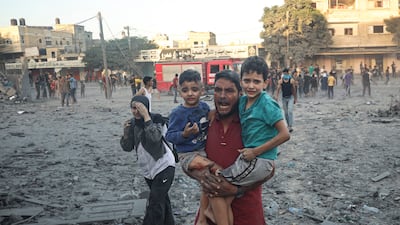
Palestinians cry as they walk away after an area hit by Israeli missiles in Rafah, the Gaza Strip. AP -
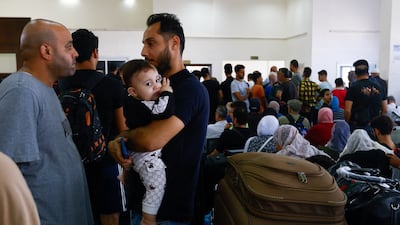
Palestinians with foreign passports wait for permission to leave Gaza at the Rafah border crossing with Egypt. Reuters -
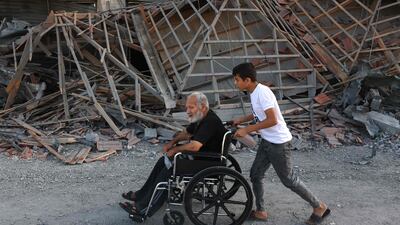
A Palestinian boy pushes a man on a wheelchair past debris in Rafah. AFP -

A paramedic holds an injured bird as he searches through buildings destroyed during Israeli air raids in Khan Younis, in the southern Gaza Strip. Getty Images -

Israeli soldiers take part in ground operations at a location given as Gaza. Reuters -
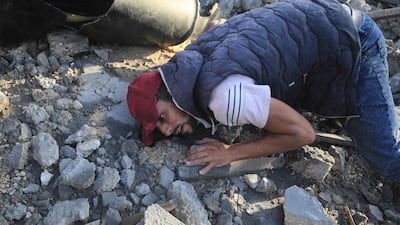
A man listens for any potential sounds of life following an Israeli air strike on the Maghazi refugee camp in Gaza. AFP -
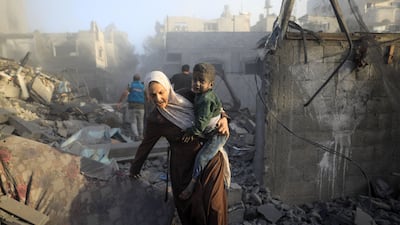
People flee after Israeli air strikes on the Maghazi refugee camp. AFP -

An Israeli soldier arranges artillery shells near the border with the Gaza Strip. AFP -

Relatives and friends of those kidnapped during the October 7 Hamas attack hold photos of their loved ones during a protest calling for their return outside Israel's parliament. AP -
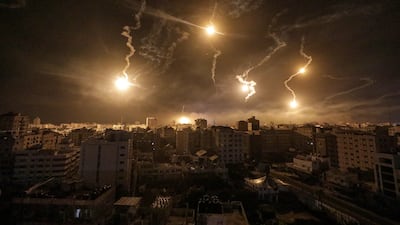
Israeli flares illuminate the sky over west Gaza in the northern Gaza Strip. EPA -
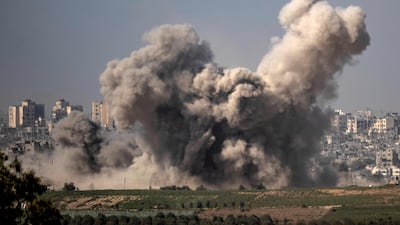
Smoke rises from northern Gaza after Israeli pounded the besieged enclave. AFP -

Ambulances queue at the Rafah border as they wait to cross into Gaza to transport the injured back to Egypt for treatment. Getty Images -

Women cry as one of them holds an injured toddler outside Shuhada Al Aqsa hospital after an Israeli bombardment of Deir Balah, in the central Gaza Strip. AFP -
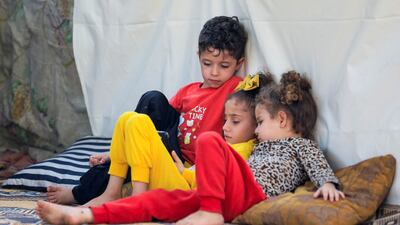
Displaced Palestinian children sit in a makeshift shelter at Al Shifa hospital, amid the Israel-Gaza war. Reuters -
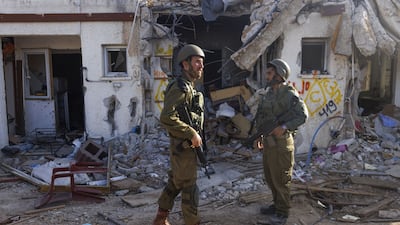
Israeli soldiers patrol outside a house destroyed during fighting with Hamas militants, in the kibbutz of Kfar Aza. Bloomberg -

Palestinians from Bureij refugee camp use Salah Al Din street as they flee the southern Gaza Strip. AP -
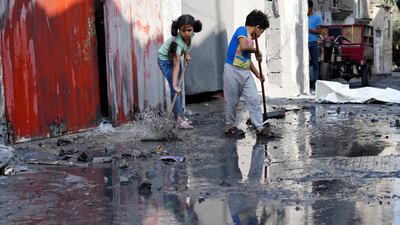
Palestinian children clean up outside their home after Israel struck Maghazi refugee camp in the Gaza Strip. AP -
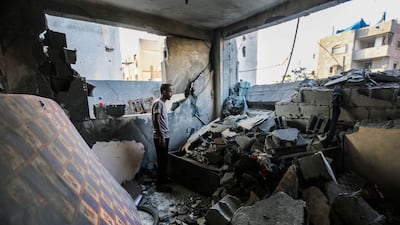
Khan Younis residents search through buildings destroyed during Israeli air raids. Getty Images -
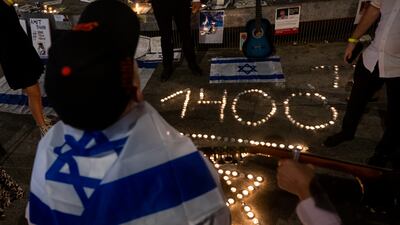
People take part in a candlelight vigil in Dizengoff Square, in Tel Aviv. Getty Images -
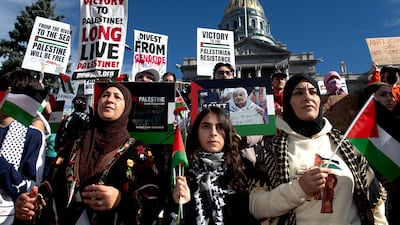
Demonstrators rally in support of Palestinians in Denver, Colorado. AFP -

Galya David, the mother of hostage Evyatar David, takes part in the 'Bring them home' event organised by the Greek Israeli Community in Athens. EPA -

Lebanese parademics show the blood-stained high-vis jackets of four of their colleagues wounded after their ambulances were hit in a strike on the Lebanese town of Tayr Harfa. AFP -
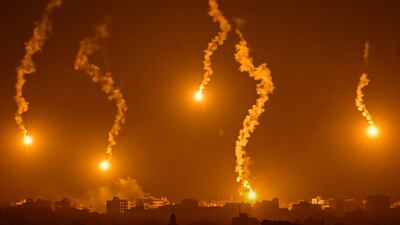
Flares are dropped by Israeli forces above Gaza, as seen from Sderot, near the border with the Palestinian enclave. AFP -

Israeli forces at a position along the the border with Gaza. AFP -

Palestinians search for bodies and survivors at Magazi refugee camp in Gaza after an Israeli air strike. Reuters -

Leaflets are dropped by the Israeli army over Gaza city asking people to evacuate towards the south of the Palestinian enclave. AFP -
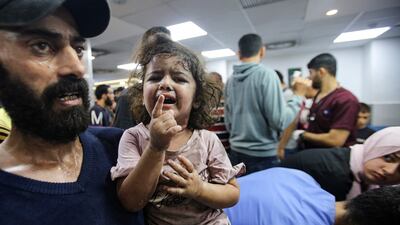
An injured toddler awaits treatment at the emergency ward of Al-Shifa Hospital following an Israeli strike, in Gaza city. AFP -

A Palestinian man wails amid a search for casualties after an Israeli strike on houses, at Magazi refugee camp, Gaza. Reuters -
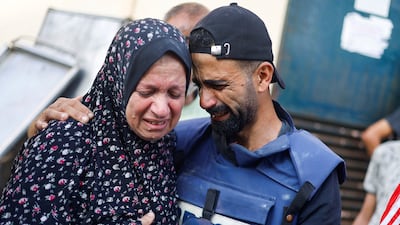
Anadolu news agency cameraman Mohammed El Aloul pictured after several of his children and siblings were killed in Israeli strikes. Reuters -

Israeli soldiers walk past debris and damaged buildings at a location given as Gaza by Israel's military. Reuters -

Protesters rally outside the White House in support of Palestinians in Gaza, Washington. Reuters -
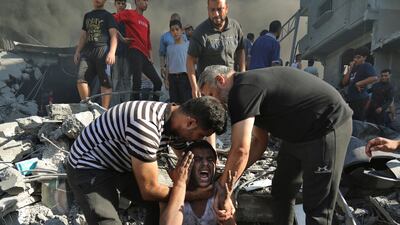
A man mourns after losing relatives following an Israeli air strike in Gaza city. AP -
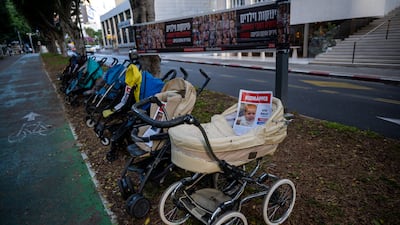
An art installation of prams with the faces of kidnapped children on display in Tel Aviv. Getty Images -

An Israeli woman calls for a ceasefire in the Gaza Strip. AP -

A Palestinian man stands on a collapsed building following a strike by the Israeli military on Khan Yunis in the southern Gaza Strip. AFP -
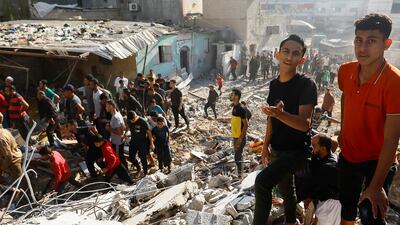
Palestinians gather at the site of Israeli strikes on a residential building in Khan Younis. Reuters -

Thousands of civilians, both Palestinians and Israelis, have died since October 7, 2023. AFP -

A Palestinian woman sits in the rubble as rescuers look for her relatives following the Israeli bombardment of Khan Younis. AFP -
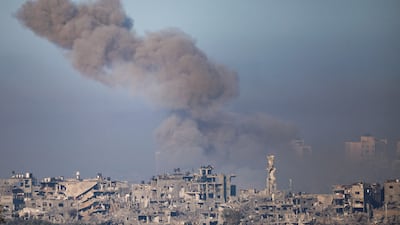
Smoke rises from Gaza as the conflict between Israel and Palestinian group Hamas continues. Reuters -

Mourners at the funeral of Druze Israeli Lt Col Salman Habaka in the village of Yanuh Jat, northern Israel. AP -
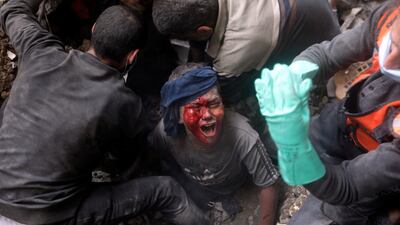
A Palestinian boy pulled from the rubble of a building following an Israeli air attack on Bureij refugee camp, in the Gaza Strip. AP -

A survivor calls from Nasser Hospital in Khan Younis following Israeli air attacks. EPA -
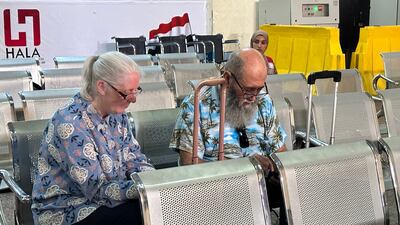
People wait on the Egyptian side of the border after passing the Rafah border crossing between the Gaza Strip and Egypt. EPA -
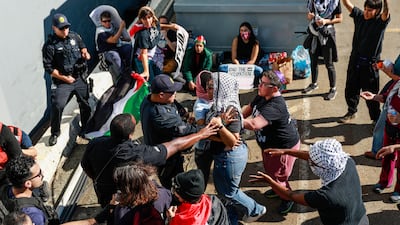
Pro-Palestinian supporters during a demonstration near a US military transport vessel at the Port of Oakland in California. AP



