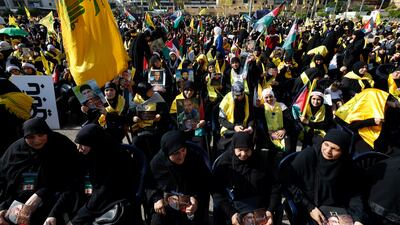
Hezbollah and Iran supporters in Tehran on Friday. EPA


Will Hamas or Hezbollah get a seat at the Middle East negotiating table?


  • English
  • Arabic

November 05, 2023

A “grand bargain” often results from a major event that altered the status quo.

Hamas’s October 7 attack on Israel altered the status quo, in part because it exposed structural weaknesses in Israel’s military and intelligence establishment. Then, Israel’s retaliatory actions against Palestinians living in Gaza, in violation of international law, eroded some of the global goodwill towards the country and triggered protests and condemnations against its government.

If, indeed, there is a grand bargain to be had, neither Hamas nor Israeli Prime Minister Benjamin Netanyahu is likely to be a part of it. For both have effectively removed themselves from the broader equation, even though both are involved in “the event” that could precipitate the grand bargain.

Both have previously served each other’s interests since the rise of Hamas as a challenger to the Fatah movement and the Palestinian Authority. Today, both Mr Netanyahu and Hamas are weaker, and both are obstacles to achieving a lasting peace.

Of course, during this transitional phase, they are both necessary to complete a prisoner and hostage exchange deal. Therefore, they will be able to buy time until further notice.

A necessary distinction worth pointing out is that, while the Israeli public will decide Mr Netanyahu’s fate, the Palestinian people will not be the ones deciding Hamas’s future. That will probably be in the hands of the Iranian regime, which has made some gains following the October 7 attack.

Hamas and Hezbollah, which also relies on Tehran’s support, and are now figuring out how to sustain their old positions in the new Iranian context. In other words, both realise that the Iranian regime could be a party to behind-the-scenes talks, primarily with the US and with the regional powers, with a view to establish a new security system in which it has a voice.

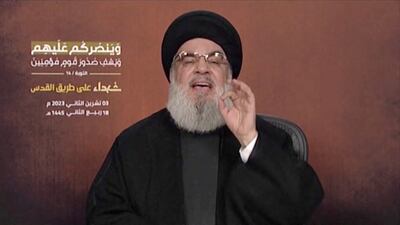
  • Hezbollah leader Hassan Nasrallah delivers his first address since the start of the Israel-Gaza war on October 7, from an unspecified location in Lebanon. Reuters
    Hezbollah leader Hassan Nasrallah delivers his first address since the start of the Israel-Gaza war on October 7, from an unspecified location in Lebanon. Reuters
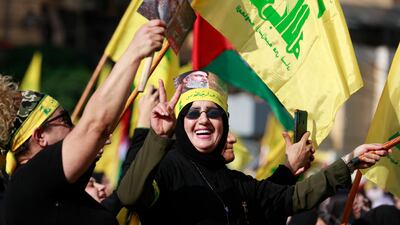
  • Hezbollah supporters at a rally in southern Beirut, ahead of Mr Nasrallah's speech. AFP
    Hezbollah supporters at a rally in southern Beirut, ahead of Mr Nasrallah's speech. AFP
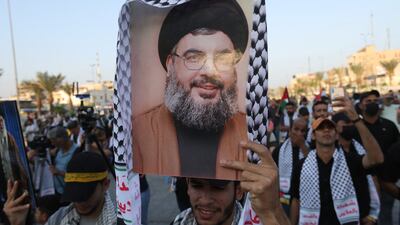
  • Supporters of Iraqi Shiite armed groups gather in Baghdad's Tahrir Square to watch the speech by Mr Nasrallah. Reuters
    Supporters of Iraqi Shiite armed groups gather in Baghdad's Tahrir Square to watch the speech by Mr Nasrallah. Reuters
  • Hezbollah supporters in southern Beirut. Mr Nasrallah's address was eagerly awaited by followers. EPA
    Hezbollah supporters in southern Beirut. Mr Nasrallah's address was eagerly awaited by followers. EPA
  • In his address, Mr Nasrallah said the conflict in Gaza was ‘a crucial and fateful war’. Reuters
    In his address, Mr Nasrallah said the conflict in Gaza was ‘a crucial and fateful war’. Reuters
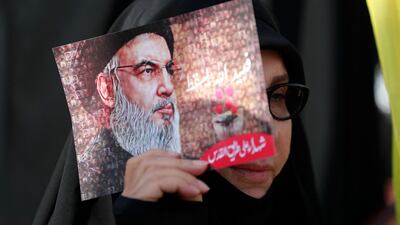
  • A woman holds up an image of Mr Nasrallah at a pro-Hezbollah rally in southern Beirut. AFP
    A woman holds up an image of Mr Nasrallah at a pro-Hezbollah rally in southern Beirut. AFP
  • Hezbollah supporters attend a ceremony in Beirut to honour fighters killed in recent exchanges with Israeli forces on the Israel-Lebanon border. Reuters
    Hezbollah supporters attend a ceremony in Beirut to honour fighters killed in recent exchanges with Israeli forces on the Israel-Lebanon border. Reuters
  • Hezbollah supporters hold up pictures of Mr Nasrallah in Beirut, ahead of his address. EPA
    Hezbollah supporters hold up pictures of Mr Nasrallah in Beirut, ahead of his address. EPA
Hezbollah secretary general Hassan Nasrallah has navigated between war and warnings, making it seem as if he holds the initiative

Iran does not want to dispense with either group despite a backlash against them in recent weeks. Hezbollah and Hamas appear to be contemplating how to renew their own futures, in order to keep themselves viable in a possibly emerging regional-strategic situation, within the context of the grand bargain.

Hezbollah secretary general Hassan Nasrallah has navigated between war and warnings, making it seem as if he holds the initiative. In exchanging fire with Israel, the group has violated the sovereignty of the Lebanese state, undermined the security of its citizens, and put itself at the mercy of Nasrallah’s agenda.

Worse still, Hezbollah opened the Lebanese-Israeli border to Hamas, Islamic Jihad and other Palestinian armed factions in the name of unifying the Axis of Resistance, violating – again – Lebanon’s sovereignty but also the will of the people, who refuse to be dragged into the “resistance” war.

If Nasrallah is seeking to revitalise his group in light of Iran’s move towards a new regional security system that safeguards its interests, perhaps now is the time to present the group as a Lebanese political entity first and foremost. The context for regional peace has no space for an armed entity that serves Tehran’s interests.

In other words, it is time for Hezbollah to reconsider its position.

This is the time for Hezbollah’s leadership to listen to the Lebanese people, who reject the idea of hosting Hamas leaders in the country, especially as the Palestinian refugee camps have turned into armed camps.

Israel is negotiating with Egypt, Qatar, Turkey and other countries regarding hosting Hamas leaders, whose continued presence in Gaza is now rejected by Israel. It’s worth pointing out that these are sovereign states that decide the presence of Hamas leaders inside their territories. As for Lebanon, it lacks state sovereignty, and Hezbollah seems to be the one determining the boundaries of sovereignty and the presence of Palestinian leaders and armed factions in the country.

Hamas, meanwhile, has chosen the path to save itself through concessions over the path of self-destruction. Before Nasrallah’s speech on Friday, Hamas appeared to move towards some sort of compromise.

It informed intermediaries that it is ready to agree to Israel releasing half of the prisoners in exchange for the hostages it is holding. In return, it requested a ceasefire, and for Israel to halt its military operation against the movement, which has been successful despite its high human cost.

Israeli Prime Minister Benjamin Netanyahu speaks during a press conference in Tel Aviv last week. AP

The timing of Hamas’s efforts to save itself by showing flexibility sends a signal to Hezbollah to tone down its own rhetoric. It appears Nasrallah did just that in his speech over the weekend.

And as Iran tries to secure its place at the table for restructuring the Middle East, both in terms of security and politics, it seems to acknowledge that there is no place for Hezbollah or Hamas in major negotiations for permanent solutions.

During his trip to the region, US Secretary of State Antony Blinken focused on putting in place transitional arrangements, particularly relating to the release of hostages, and sought to restrain Israel from destroying the civilian infrastructure in Gaza.

But he also aimed to envision the post-Israel-Gaza war scenario. Who will govern the enclave in the absence of Hamas? Is it possible to place it under temporary international-Arab administration until a clear roadmap for a lasting peace emerges?

Hamas has been as much of an obstacle to the two-state solution as Israel has been. But if the Biden administration succeeds in pushing post-Netanyahu and post-October 7 Israel to finally accept the case for it, the latter might be able to pave the way for a historic breakthrough in the Middle East and achieve a lasting peace with most Arab countries.

Moreover, Iran might surprise everyone by participating in the grand bargain that secures its interests in exchange for renouncing its commitment to destroying Israel.

All of this might seem premature right now, and developments – whether intentional or unintentional – could shatter any notion of a lasting peace. However, practical indicators and political pressures suggest that Arab countries involved in normalising relations with Israel are willing to assist the Biden administration in finding the necessary formula for such a peace.

Iran might not be too far from the dynamics of a grand bargain. It all depends on America’s determination to convince Israel that the time has indeed come to choose a lasting peace. Not doing so could make the threat of more attacks of the kind the world saw on October 7 even greater.


Mercer, the investment consulting arm of US services company Marsh & McLennan, expects its wealth division to at least double its assets under management (AUM) in the Middle East as wealth in the region continues to grow despite economic headwinds, a company official said.

Mercer Wealth, which globally has $160 billion in AUM, plans to boost its AUM in the region to $2-$3bn in the next 2-3 years from the present $1bn, said Yasir AbuShaban, a Dubai-based principal with Mercer Wealth.

Within the next two to three years, we are looking at reaching $2 to $3 billion as a conservative estimate and we do see an opportunity to do so,” said Mr AbuShaban.

Mercer does not directly make investments, but allocates clients’ money they have discretion to, to professional asset managers. They also provide advice to clients.

“We have buying power. We can negotiate on their (client’s) behalf with asset managers to provide them lower fees than they otherwise would have to get on their own,” he added.

Mercer Wealth’s clients include sovereign wealth funds, family offices, and insurance companies among others.

From its office in Dubai, Mercer also looks after Africa, India and Turkey, where they also see opportunity for growth.

Wealth creation in Middle East and Africa (MEA) grew 8.5 per cent to $8.1 trillion last year from $7.5tn in 2015, higher than last year’s global average of 6 per cent and the second-highest growth in a region after Asia-Pacific which grew 9.9 per cent, according to consultancy Boston Consulting Group (BCG). In the region, where wealth grew just 1.9 per cent in 2015 compared with 2014, a pickup in oil prices has helped in wealth generation.

BCG is forecasting MEA wealth will rise to $12tn by 2021, growing at an annual average of 8 per cent.

Drivers of wealth generation in the region will be split evenly between new wealth creation and growth of performance of existing assets, according to BCG.

Another general trend in the region is clients’ looking for a comprehensive approach to investing, according to Mr AbuShaban.

“Institutional investors or some of the families are seeing a slowdown in the available capital they have to invest and in that sense they are looking at optimizing the way they manage their portfolios and making sure they are not investing haphazardly and different parts of their investment are working together,” said Mr AbuShaban.

Some clients also have a higher appetite for risk, given the low interest-rate environment that does not provide enough yield for some institutional investors. These clients are keen to invest in illiquid assets, such as private equity and infrastructure.

“What we have seen is a desire for higher returns in what has been a low-return environment specifically in various fixed income or bonds,” he said.

“In this environment, we have seen a de facto increase in the risk that clients are taking in things like illiquid investments, private equity investments, infrastructure and private debt, those kind of investments were higher illiquidity results in incrementally higher returns.”

The Abu Dhabi Investment Authority, one of the largest sovereign wealth funds, said in its 2016 report that has gradually increased its exposure in direct private equity and private credit transactions, mainly in Asian markets and especially in China and India. The authority’s private equity department focused on structured equities owing to “their defensive characteristics.”

2.0

Director: S Shankar

Producer: Lyca Productions; presented by Dharma Films

Cast: Rajnikanth, Akshay Kumar, Amy Jackson, Sudhanshu Pandey

Rating: 3.5/5 stars

Know your cyber adversaries

Cryptojacking: Compromises a device or network to mine cryptocurrencies without an organisation's knowledge.

Distributed denial-of-service: Floods systems, servers or networks with information, effectively blocking them.

Man-in-the-middle attack: Intercepts two-way communication to obtain information, spy on participants or alter the outcome.

Malware: Installs itself in a network when a user clicks on a compromised link or email attachment.

Phishing: Aims to secure personal information, such as passwords and credit card numbers.

Ransomware: Encrypts user data, denying access and demands a payment to decrypt it.

Spyware: Collects information without the user's knowledge, which is then passed on to bad actors.

Trojans: Create a backdoor into systems, which becomes a point of entry for an attack.

Viruses: Infect applications in a system and replicate themselves as they go, just like their biological counterparts.

Worms: Send copies of themselves to other users or contacts. They don't attack the system, but they overload it.

Zero-day exploit: Exploits a vulnerability in software before a fix is found.

Salah in numbers

€39 million: Liverpool agreed a fee, including add-ons, in the region of 39m (nearly Dh176m) to sign Salah from Roma last year. The exchange rate at the time meant that cost the Reds £34.3m - a bargain given his performances since.

13: The 25-year-old player was not a complete stranger to the Premier League when he arrived at Liverpool this summer. However, during his previous stint at Chelsea, he made just 13 Premier League appearances, seven of which were off the bench, and scored only twice.

57: It was in the 57th minute of his Liverpool bow when Salah opened his account for the Reds in the 3-3 draw with Watford back in August. The Egyptian prodded the ball over the line from close range after latching onto Roberto Firmino's attempted lob.

7: Salah's best scoring streak of the season occurred between an FA Cup tie against West Brom on January 27 and a Premier League win over Newcastle on March 3. He scored for seven games running in all competitions and struck twice against Tottenham.

3: This season Salah became the first player in Premier League history to win the player of the month award three times during a term. He was voted as the division's best player in November, February and March.

40: Salah joined Roger Hunt and Ian Rush as the only players in Liverpool's history to have scored 40 times in a single season when he headed home against Bournemouth at Anfield earlier this month.

30: The goal against Bournemouth ensured the Egyptian achieved another milestone in becoming the first African player to score 30 times across one Premier League campaign.

8: As well as his fine form in England, Salah has also scored eight times in the tournament phase of this season's Champions League. Only Real Madrid's Cristiano Ronaldo, with 15 to his credit, has found the net more often in the group stages and knockout rounds of Europe's premier club competition.

Credits

Produced by: Colour Yellow Productions and Eros Now
Director: Mudassar Aziz
Cast: Sonakshi Sinha, Jimmy Sheirgill, Jassi Gill, Piyush Mishra, Diana Penty, Aparshakti Khurrana
Star rating: 2.5/5

Monster

Directed by: Anthony Mandler

Starring: Kelvin Harrison Jr., John David Washington 

3/5


World Cup warm-up fixtures

Friday, May 24:

  • Pakistan v Afghanistan (Bristol)
  • Sri Lanka v South Africa (Cardiff)

Saturday, May 25

  • England v Australia (Southampton)
  • India v New Zealand (The Oval, London)

Sunday, May 26

  • South Africa v West Indies (Bristol)
  • Pakistan v Bangladesh (Cardiff)

Monday, May 27

  • Australia v Sri Lanka (Southampton)
  • England v Afghanistan (The Oval, London)

Tuesday, May 28

  • West Indies v New Zealand (Bristol)
  • Bangladesh v India (Cardiff)
UAE central contracts

Full time contracts

Rohan Mustafa, Ahmed Raza, Mohammed Usman, Chirag Suri, Mohammed Boota, Sultan Ahmed, Zahoor Khan, Junaid Siddique, Waheed Ahmed, Zawar Farid

Part time contracts

Aryan Lakra, Ansh Tandon, Karthik Meiyappan, Rahul Bhatia, Alishan Sharafu, CP Rizwaan, Basil Hameed, Matiullah, Fahad Nawaz, Sanchit Sharma

South and West: From a Notebook
Joan Didion
Fourth Estate 

Updated: November 05, 2023, 2:44 PM