Raghida Dergham is the founder and executive chairwoman of the Beirut Institute, and a columnist for The National
January 28, 2024
The US administration under President Joe Biden is taking a risk by betting on the Iranian regime’s pragmatism and its readiness for regional co-operation even as Tehran’s involvement in Iraq, Yemen, Syria and Lebanon through its proxies challenges American interests in the region.
The success so far in deterring Iran through a carrot-and-stick approach should be seen as part of temporary breakthroughs rather than reflecting a fundamental shift in Tehran’s strategy and ideology. It should also be viewed through the prism of America’s waning influence over the Israeli government.
The Biden White House has effectively placed the fate of its foreign policies in the hands of the ideological extremists in Israel and Iran, where the currency of trust has little value.
Meanwhile, former US president Donald Trump – Mr Biden’s presumptive rival in the November election – is pushing the narrative that the challenger stands for peace while the incumbent stands for war. The implicit suggestion is that Mr Trump’s presidency from 2017 to 2021 was conflict-free, while Mr Biden’s term has been saddled with conflicts in Ukraine, Gaza and the Red Sea.
Regardless of Iran’s denial, the Houthis have disrupted international navigation in the Red Sea with Tehran’s blessing. The Houthis’ military capabilities are not homegrown but provided by Iran’s Islamic Revolutionary Guard Corps with help from Hezbollah in Lebanon. The goal is to execute Iran’s agendas under the pretext of supporting Palestinians in Gaza.
The Biden administration’s problem is that it is attempting to take the middle ground between diplomacy and ultimatums, hoping to avoid having to carry out its threats. But the limited US and UK military operations against the Houthis this month are unlikely to eliminate the group or its considerable arsenal, if the White House avoids directly holding Tehran responsible.
Houthi troopers take part in a military exercise on the outskirts of Sanaa, Yemen, on Saturday. EPA
Former US president Donald Trump during a campaign event in Las Vegas, Nevada, on Saturday. Bloomberg
While diplomacy might be a useful tool to avert conflict across the Middle East, it does not amount to a strategy
Washington has demonstrated a need for Iranian goodwill and a readiness to reward it. It believes Mr Biden’s efforts have succeeded in containing the Gaza war and prevented its escalation into a regional war. But the Trump campaign team accuses the Biden administration of political naivety.
They say the main reasons behind Tehran’s co-operation is its inability to engage in a military confrontation with an Israel that has US support. Second, Iran does not have to get itself directly involved in a war with Israel and against American interests as long as its proxies can do this job for it. Third, Tehran requires strategic patience until it completes its nuclear weapons programme, perhaps within a year. Therefore, Iranian goodwill should be seen as an investment that buys time to develop nuclear capabilities.
The Biden administration is constrained by its desire to negotiate a peace settlement in Yemen that would require appeasing the Houthis. It had removed the Houthis from the terrorist list three years ago in the hope of enticing them into a deal, but also to illustrate what it believed to be recklessness on the previous Trump administration’s part when it designated the Houthis as terrorists and tore up the nuclear agreement with Iran.
Today, the Biden administration finds itself between a rock and a hard place.
On the one hand, it cannot sit idly by as the Houthis disrupt shipping and trade. As a result, it has opted to launch limited strikes on the group rather than have an outright war against it. On the other, it realises that its operations will not eliminate Houthi military capabilities, which limits the effectiveness of its strikes.
More significantly, Washington appears willing to go with Tehran’s claim that it has no direct involvement in Houthi operations and that it has not provided new weapons to the group. The reason behind Mr Biden’s reluctance to challenge Iran’s deniability is its determination to ensure that the latter continues to refrain from escalation in the region.
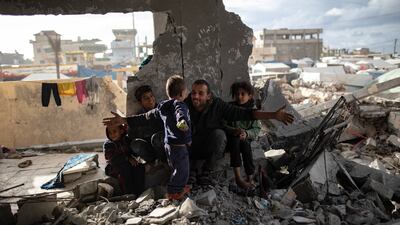
Palestinian Muhammad Al Durra with his children in the ruins of a house in Rafah where they sheltered on January 11, 2024. EPA
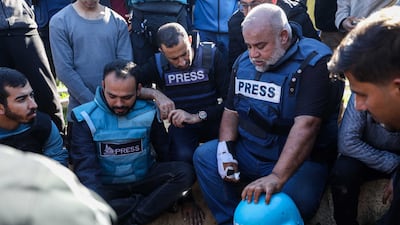
Family and friends at the funerals of journalists Hamza Al Dahdouh and Mustafa Thuraya on January 7, 2024 in Rafah, Gaza. Getty Images
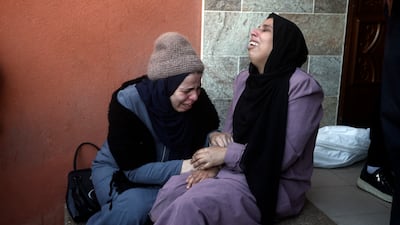
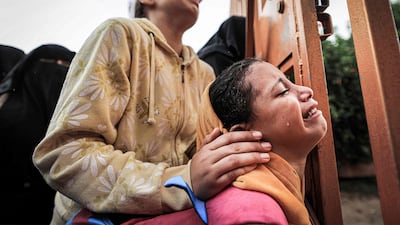
Palestinians mourn relatives killed by Israeli bombardment of the Gaza Strip outside a mortuary in Khan Younis January 4, 2024. AP Photo
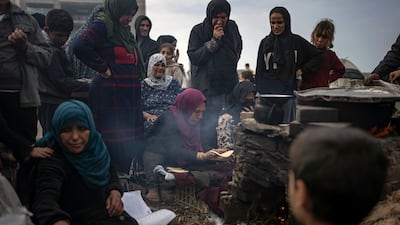
Displaced Palestinians queue to bake bread at a camp in the Muwasi area of Rafah, Gaza Strip, on December 23, 2023. AP Photo
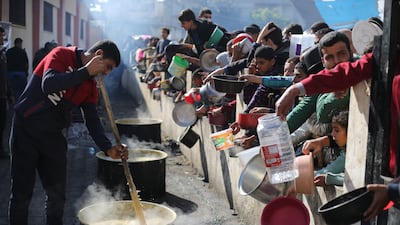
Palestinians queue for food in Rafah, the Gaza Strip, on December 20, 2023. AP Photo
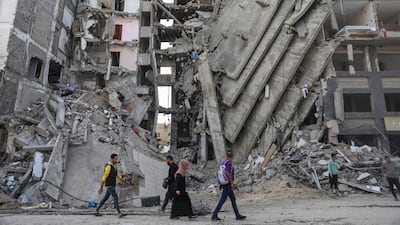
The ruins of Rafah on December 14, 2023. AFP
Palestinians wounded in the Israeli bombardment of the Gaza Strip arrive at a hospital in Khan Younis on December 8, 2023. AP Photo
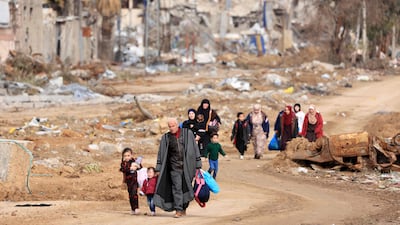
Palestinians flee Israeli bombing along the Salaheddine Road in the Zeitoun district of Gaza city on November 28, 2023. AFP
A Red Cross vehicle takes Israeli hostages from the Gaza Strip into Egypt in Rafah on November 25, 2023. AP
The ruins of buildings in Gaza city on November 24, 2023, as a temporary truce between Israel and Hamas took effect. AP Photo
A woman and her cat return home to eastern Khan Younis in the southern Gaza Strip during the first hours of a four-day truce between Israel and Hamas forces on November 24, 2023. AFP
Mourning the dead of Israeli bombardment outside the mortuary at Nasser Hospital in Khan Younis on November 14, 2023. AFP
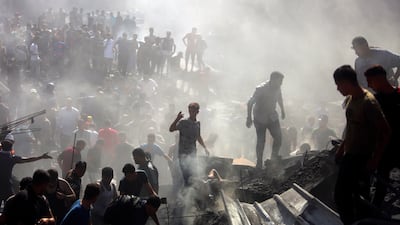
Civilians and rescuers look for survivors in the rubble of a building after Israeli bombing of Khan Younis in the southern Gaza Strip on November 12, 2023. AFP
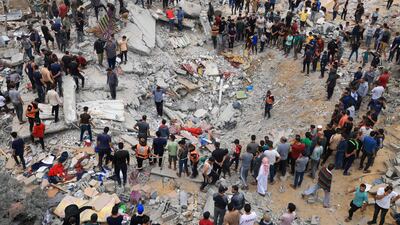
November 7, 2023, a month to the day after Hamas attacked Israel, a victim of an Israeli bombardment in Rafah is moved from the rubble. AFP
Searching the rubble after Israeli air strikes on the town of Khan Younis, southern Gaza Strip, on October 26, 2023. AP Photo
Mourning the Kotz family at their funeral in Gan Yavne, Israel, on October 17, 2023. AP Photo
An Israeli firefighter composes himself after he and his colleagues extinguished cars set on fire by a rocket fired from the Gaza Strip in Ashkelon, Israel, on October 9, 2023. AP Photo
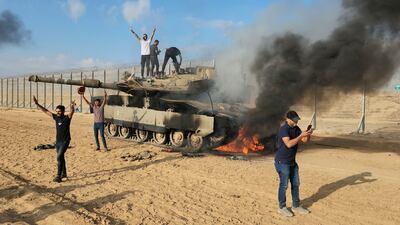
Palestinians with the wreckage of an Israeli tank at the Gaza Strip fence east of the city of Khan Younis on October 7, 2023, the day Hamas forces swept unopposed into Israel. AP Photo
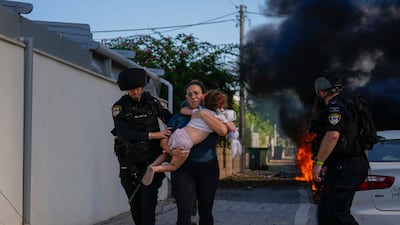
Israeli police officers evacuate a woman and a child from a site hit by a rocket fired from the Gaza Strip, in Ashkelon, southern Israel, on October 7, 2023. AP Photo
The Trump team paints this strategy as effectively surrendering to Iranian blackmail, which, it says, reflects the weakness of the Democratic Party itself. But Democrats like to remind Republicans that it was one of their leaders, former president George W Bush, who effectively allowed a weakened Iraq to come under the Iranian regime’s influence by invading and occupying it. When Mr Bush “purged” Iraq and its army of the governing Baathists, he effectively contributed to the creation of ISIS. Iran used its own offensives against ISIS as an excuse to expand its control over Iraq through proxies.
Tehran has over the years “institutionalised” its influence within the Iraqi government. It continues to violate its neighbour’s sovereignty and that of other countries in the region, such as Syria and Yemen, providing military and political support to non-state forces and militias under its command.
The problem with the Biden administration is that it has chosen diplomatic investment with Iran, while Tehran still invests militarily with the purpose of causing problems for Washington. It continues to support factions and militias vehemently opposed to the American presence in the region.
While diplomacy might be a useful tool to avert conflict across the Middle East, it does not amount to a strategy. For as long as the Biden administration treads cautiously in its policies towards both Israel and Iran, it is likely to struggle to make the necessary leap from transitional arrangements to the grand deal it dreams of for regional settlement.
Of course, some believe diplomacy is the only effective way forward, and that the Biden administration might be able to build on its efforts to eventually create a grand settlement. Whether it succeeds in this regard, only time will tell.
How to wear a kandura
Dos
Wear the right fabric for the right season and occasion
Always ask for the dress code if you don’t know
Wear a white kandura, white ghutra / shemagh (headwear) and black shoes for work
Wear 100 per cent cotton under the kandura as most fabrics are polyester
Don’ts
Wear hamdania for work, always wear a ghutra and agal
Buy a kandura only based on how it feels; ask questions about the fabric and understand what you are buying
Related
The chef's advice
Troy Payne, head chef at Abu Dhabi’s newest healthy eatery Sanderson’s in Al Seef Resort & Spa, says singles need to change their mindset about how they approach the supermarket.
“They feel like they can’t buy one cucumber,” he says. “But I can walk into a shop – I feed two people at home – and I’ll walk into a shop and I buy one cucumber, I’ll buy one onion.”
Mr Payne asks for the sticker to be placed directly on each item, rather than face the temptation of filling one of the two-kilogram capacity plastic bags on offer.
The chef also advises singletons not get too hung up on “organic”, particularly high-priced varieties that have been flown in from far-flung locales. Local produce is often grown sustainably, and far cheaper, he says.
The specs
Engine: 2.0-litre 4-cylinder turbo
Power: 258hp from 5,000-6,500rpm
Torque: 400Nm from 1,550-4,000rpm
Transmission: Eight-speed auto
Fuel consumption: 6.1L/100km
Price: from Dh362,500
On sale: now
THE BIO: Martin Van Almsick
Hometown: Cologne, Germany
Family: Wife Hanan Ahmed and their three children, Marrah (23), Tibijan (19), Amon (13)
Favourite dessert: Umm Ali with dark camel milk chocolate flakes
1. Domestic VAT refund amendments: request your refund within five years
If a business does not apply for the refund on time, they lose their credit.
2. E-invoicing in the UAE
Businesses should continue preparing for the implementation of e-invoicing in the UAE, with 2026 a preparation and transition period ahead of phased mandatory adoption.
3. More tax audits
Tax authorities are increasingly using data already available across multiple filings to identify audit risks.
4. More beneficial VAT and excise tax penalty regime
Tax disputes are expected to become more frequent and more structured, with clearer administrative objection and appeal processes. The UAE has adopted a new penalty regime for VAT and excise disputes, which now mirrors the penalty regime for corporate tax.
5. Greater emphasis on statutory audit
There is a greater need for the accuracy of financial statements. The International Financial Reporting Standards standards need to be strictly adhered to and, as a result, the quality of the audits will need to increase.
6. Further transfer pricing enforcement
Transfer pricing enforcement, which refers to the practice of establishing prices for internal transactions between related entities, is expected to broaden in scope. The UAE will shortly open the possibility to negotiate advance pricing agreements, or essentially rulings for transfer pricing purposes.
7. Limited time periods for audits
Recent amendments also introduce a default five-year limitation period for tax audits and assessments, subject to specific statutory exceptions. While the standard audit and assessment period is five years, this may be extended to up to 15 years in cases involving fraud or tax evasion.
8. Pillar 2 implementation
Many multinational groups will begin to feel the practical effect of the Domestic Minimum Top-Up Tax (DMTT), the UAE's implementation of the OECD’s global minimum tax under Pillar 2. While the rules apply for financial years starting on or after January 1, 2025, it is 2026 that marks the transition to an operational phase.
9. Reduced compliance obligations for imported goods and services
Businesses that apply the reverse-charge mechanism for VAT purposes in the UAE may benefit from reduced compliance obligations.
10. Substance and CbC reporting focus
Tax authorities are expected to continue strengthening the enforcement of economic substance and Country-by-Country (CbC) reporting frameworks. In the UAE, these regimes are increasingly being used as risk-assessment tools, providing tax authorities with a comprehensive view of multinational groups’ global footprints and enabling them to assess whether profits are aligned with real economic activity.
Contributed by Thomas Vanhee and Hend Rashwan, Aurifer
Hometown: Bogota, Colombia Favourite place to relax in UAE: the desert around Al Mleiha in Sharjah or the eastern mangroves in Abu Dhabi The one book everyone should read: 100 Years of Solitude by Gabriel Garcia Marquez. It will make your mind fly Favourite documentary: Chasing Coral by Jeff Orlowski. It's a good reality check about one of the most valued ecosystems for humanity
Dhadak 2
Director: Shazia Iqbal
Starring: Siddhant Chaturvedi, Triptii Dimri
Rating: 1/5
UAE currency: the story behind the money in your pockets
Global events: Much of the UK’s economic woes were blamed on “increased global uncertainty”, which can be interpreted as the economic impact of the Ukraine war and the uncertainty over Donald Trump’s tariffs.
Growth forecasts: Cut for 2025 from 2 per cent to 1 per cent. The OBR watchdog also estimated inflation will average 3.2 per cent this year
Welfare: Universal credit health element cut by 50 per cent and frozen for new claimants, building on cuts to the disability and incapacity bill set out earlier this month
Spending cuts: Overall day-to day-spending across government cut by £6.1bn in 2029-30
Tax evasion: Steps to crack down on tax evasion to raise “£6.5bn per year” for the public purse
Defence: New high-tech weaponry, upgrading HM Naval Base in Portsmouth
Housing: Housebuilding to reach its highest in 40 years, with planning reforms helping generate an extra £3.4bn for public finances
Mercer, the investment consulting arm of US services company Marsh & McLennan, expects its wealth division to at least double its assets under management (AUM) in the Middle East as wealth in the region continues to grow despite economic headwinds, a company official said.
Mercer Wealth, which globally has $160 billion in AUM, plans to boost its AUM in the region to $2-$3bn in the next 2-3 years from the present $1bn, said Yasir AbuShaban, a Dubai-based principal with Mercer Wealth.
“Within the next two to three years, we are looking at reaching $2 to $3 billion as a conservative estimate and we do see an opportunity to do so,” said Mr AbuShaban.
Mercer does not directly make investments, but allocates clients’ money they have discretion to, to professional asset managers. They also provide advice to clients.
“We have buying power. We can negotiate on their (client’s) behalf with asset managers to provide them lower fees than they otherwise would have to get on their own,” he added.
Mercer Wealth’s clients include sovereign wealth funds, family offices, and insurance companies among others.
From its office in Dubai, Mercer also looks after Africa, India and Turkey, where they also see opportunity for growth.
Wealth creation in Middle East and Africa (MEA) grew 8.5 per cent to $8.1 trillion last year from $7.5tn in 2015, higher than last year’s global average of 6 per cent and the second-highest growth in a region after Asia-Pacific which grew 9.9 per cent, according to consultancy Boston Consulting Group (BCG). In the region, where wealth grew just 1.9 per cent in 2015 compared with 2014, a pickup in oil prices has helped in wealth generation.
BCG is forecasting MEA wealth will rise to $12tn by 2021, growing at an annual average of 8 per cent.
Drivers of wealth generation in the region will be split evenly between new wealth creation and growth of performance of existing assets, according to BCG.
Another general trend in the region is clients’ looking for a comprehensive approach to investing, according to Mr AbuShaban.
“Institutional investors or some of the families are seeing a slowdown in the available capital they have to invest and in that sense they are looking at optimizing the way they manage their portfolios and making sure they are not investing haphazardly and different parts of their investment are working together,” said Mr AbuShaban.
Some clients also have a higher appetite for risk, given the low interest-rate environment that does not provide enough yield for some institutional investors. These clients are keen to invest in illiquid assets, such as private equity and infrastructure.
“What we have seen is a desire for higher returns in what has been a low-return environment specifically in various fixed income or bonds,” he said.
“In this environment, we have seen a de facto increase in the risk that clients are taking in things like illiquid investments, private equity investments, infrastructure and private debt, those kind of investments were higher illiquidity results in incrementally higher returns.”
The Abu Dhabi Investment Authority, one of the largest sovereign wealth funds, said in its 2016 report that has gradually increased its exposure in direct private equity and private credit transactions, mainly in Asian markets and especially in China and India. The authority’s private equity department focused on structured equities owing to “their defensive characteristics.”
How to avoid crypto fraud
Use unique usernames and passwords while enabling multi-factor authentication.
Use an offline private key, a physical device that requires manual activation, whenever you access your wallet.
Avoid suspicious social media ads promoting fraudulent schemes.
Only invest in crypto projects that you fully understand.
Critically assess whether a project’s promises or returns seem too good to be true.
Only use reputable platforms that have a track record of strong regulatory compliance.
Store funds in hardware wallets as opposed to online exchanges.
The flights
The closest international airport to the TMB trail is Geneva (just over an hour’s drive from the French ski town of Chamonix where most people start and end the walk). Direct flights from the UAE to Geneva are available with Etihad and Emirates from about Dh2,790 including taxes.
The trek
The Tour du Mont Blanc takes about 10 to 14 days to complete if walked in its entirety, but by using the services of a tour operator such as Raw Travel, a shorter “highlights” version allows you to complete the best of the route in a week, from Dh6,750 per person. The trails are blocked by snow from about late October to early May. Most people walk in July and August, but be warned that trails are often uncomfortably busy at this time and it can be very hot. The prime months are June and September.