Michael Sercan Daventry is a British-Turkish journalist, broadcaster and political commentator
February 06, 2024
I heard the most harrowing anecdote about Turkey’s worst-ever natural disaster a couple of weeks after it happened.
“It got to the point where we would walk the devastated streets in silence, not daring to dislodge rubble or utter a sound. We didn’t want the people trapped underneath to hear a sound, because if they did, they would call out to us. There simply wasn’t anything we could do to help them.”
The words belonged not to a survivor, but a journalist sent to cover the aftermath.
Thousands of people – we will never know precisely how many – survived the initial tremor when it struck shortly after four o’clock in the morning. We know this because of the phone calls, WhatsApp messages and shrieks that came from those trapped beneath the wreckage of what used to be their bedrooms.
A collapsed building in Hatay, southern Turkey. EPA
Indeed, one of those who was reported to have called for help was a member of parliament for the governing Justice and Development Party (AKP), Yakup Tas. He and his family perished at home in the town of Adiyaman.
It was the result of two tremors, the largest of which measured 7.8 – a magnitude never before recorded in Turkey. The two quakes struck within nine hours of each other.
That helps to explain why the scale of devastation was so vast. More than 50,000 people died. Over 100,000 were injured. Many more who survived suddenly had no place to live, because three quarters of a million of homes either collapsed or were damaged beyond repair, according to the government department overseeing the rebuilding effort.
Perhaps no country could have been fully prepared for a natural disaster like this one, but there is consensus across Turkey that the initial response was not quick enough. Just one of the unbearable tragedies from those colossal earthquakes in February last year is that the help did not come quickly enough.
Turkish President Recep Tayyip Erdogan said as much himself five days after the earthquake when he told reporters on a visit to the disaster zone: “Our interventions have not reached the speed we want.”
It was true. Additional heavy machinery capable of lifting rubble took days to reach the area. There was a shortage of basic supplies like food, water and fuel, and often the aid and volunteers that did arrive would be sent to places where the need was not necessarily the most urgent.
The events in the south-east have served to focus political minds in the opposite, most populous end of the country: Istanbul
Then there was the poor co-ordination. There were times when government agencies, charities and private individuals appeared to compete with each other in the rescue effort. It meant there were locations that received a glut of attention, while other areas – like those devastated streets toured by the journalists – echoed with voices calling for help that would never come.
A year has passed, and the tours of the earthquake disaster zone have resumed. This time, ministers are in triumphant mood: on Saturday, keys to the first reconstructed homes were handed over to earthquake victims – whose names were drawn out of a hat – in Turkey’s southernmost city, Antakya.
Inevitably, given the gargantuan task ahead to rebuild, not everyone who lost their home has yet got one back. Many thousands live in temporary accommodation – guest houses, shipping containers and tents are all still in use.
Mr Erdogan’s pre-election promise last year was to build 319,000 homes within 12 months of the disaster. The pledge has only been partially met – 46,000 homes are ready so far, and this week the president said he hoped to quadruple that figure by the end of 2024.
The provinces that make up the disaster zone are a political microcosm of Turkey: Mr Erdogan and the AKP are a dominant force, as they have been for the past two decades, but parties representing the centre left, opposition-minded nationalists, religious conservatives and Kurds were all in with a shout.
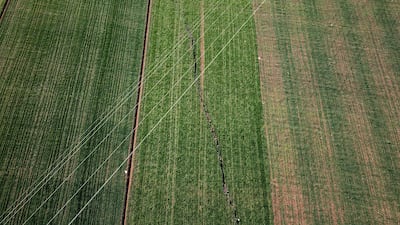
Cracks on a farm in Kahramanmaras, the epicentre of the first 7.8-magnitude earthquake, in south-eastern Turkey. AFP
The ground has cracked open in various areas as a result of the earthquake in Turkey and neighbouring Syria. AFP
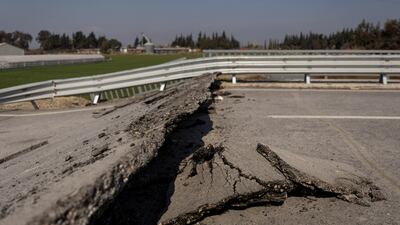
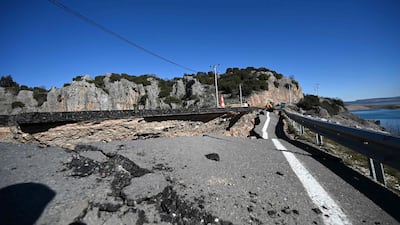
A motorway damaged by the quake, in Hatay, Turkey. Reuters
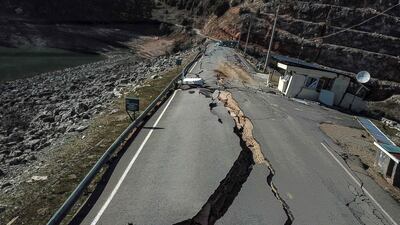
A destroyed road near Koseli village, in Kahramanmaras. AP
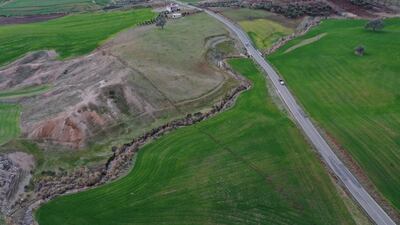
Grasslands and a motorway split in two, near Tevekkeli village, in Kahramanmaras. Reuters
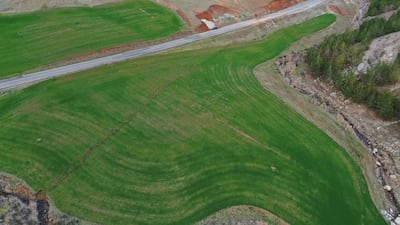
Cracks in the ground, near Tevekkeli village, in Kahramanmaras. Reuters
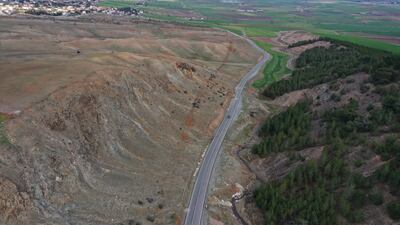
A road near the quake’s epicentre, in Pazarcik, Kahramanmaras. AFP
Land on either side of the ruptures moved in opposite directions up to seven metres in some locations, according to data from the California Institute of Technology. AFP
Villages such as Tevekkeli, above, and small towns directly above the fault line suffered some of the most severe shaking. Reuters
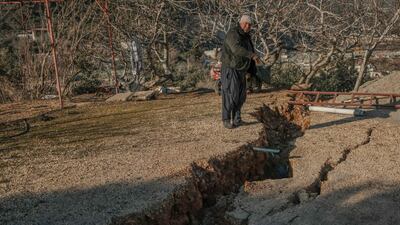
A resident shows the giant cracks next to his home in Nurdagi. AFP
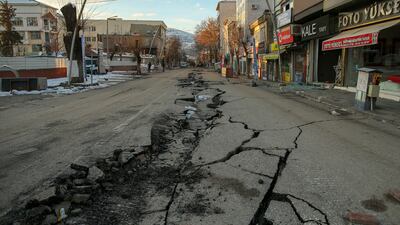
A damaged road in Golbasi, Adiyaman province. AP
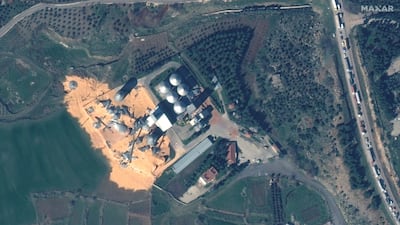
Grain silos damaged by the earthquake, in Nurdagi. Reuters
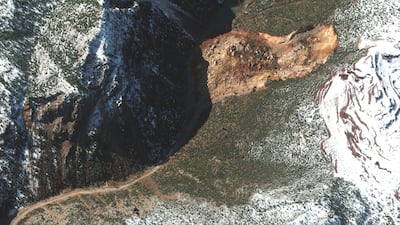
A blocked road after a landslide caused by the earthquake, in the Islahiye region of Turkey's Gaziantep. AP
Just 12 weeks after the disaster, they were given the opportunity to respond to ineffective relief efforts. Voters chose not to take it. It was a clear sign they saw Mr Erdogan, not his rival – who also promised a rebuilding effort but not on the same timescale – as the best hope they had to rebuild their lives.
Another opportunity is coming at the end of next month when voting takes place for local mayors, assemblies and neighbourhood leaders. There is little sign of a dramatic electoral shift then, either.
Yet the events in the south-east have served to focus political minds in the opposite, most populous end of the country: Istanbul. The sprawling metropolis was last struck by an earthquake of similar magnitude in 1999, when official records say 20,000 people died. Most experts expect another tremor of similar magnitude within three decades of it.
The prophesied Great Istanbul Earthquake would strike a city of about 16 million residents, many of whom live in dangerous housing. Mehmet Ozhaseki, the minister for Environment, Urbanisation and Climate Change, said last year that one tenth of the city’s six million homes were at “great risk” and needed to change immediately. This is also a part of the country that, unlike the south-east, is close to the sea, presenting a grave risk of tsunamis.
That is why the two frontrunners in Istanbul’s mayoral election on March 31 have placed earthquake preparedness at the centre of their campaigns.
The pledges from Mr Erdogan’s candidate, Murat Kurum, closely resemble those of the president: he promises to build hundreds of thousands of new quake-resistant homes in a single five-year term as mayor.
In doing so he hopes to unseat the incumbent Ekrem Imamoglu, a member of the opposition Republican People’s Party, or CHP, who says it’s still not clear how vulnerable Istanbul is to an earthquake – because his municipal teams haven’t been able to inspect existing buildings.
He claims the government is obstructing this work; Mr Kurum makes an identical claim about municipal institutions run by Mr Imamoglu. The two men represent either side of the big line that divides everybody in Turkey today: do you support Mr Erdogan, or oppose him?
Ultimately it will be for voters to decide which side’s election promises to believe – and, when Istanbul’s earthquake inevitably strikes, which they will trust to rebuild.
Fixtures
Tuesday - 5.15pm: Team Lebanon v Alger Corsaires; 8.30pm: Abu Dhabi Storms v Pharaohs
Wednesday - 5.15pm: Pharaohs v Carthage Eagles; 8.30pm: Alger Corsaires v Abu Dhabi Storms
Thursday - 4.30pm: Team Lebanon v Pharaohs; 7.30pm: Abu Dhabi Storms v Carthage Eagles
Friday - 4.30pm: Pharaohs v Alger Corsaires; 7.30pm: Carthage Eagles v Team Lebanon
Saturday - 4.30pm: Carthage Eagles v Alger Corsaires; 7.30pm: Abu Dhabi Storms v Team Lebanon
Ten tax points to be aware of in 2026
1. Domestic VAT refund amendments: request your refund within five years
If a business does not apply for the refund on time, they lose their credit.
2. E-invoicing in the UAE
Businesses should continue preparing for the implementation of e-invoicing in the UAE, with 2026 a preparation and transition period ahead of phased mandatory adoption.
3. More tax audits
Tax authorities are increasingly using data already available across multiple filings to identify audit risks.
4. More beneficial VAT and excise tax penalty regime
Tax disputes are expected to become more frequent and more structured, with clearer administrative objection and appeal processes. The UAE has adopted a new penalty regime for VAT and excise disputes, which now mirrors the penalty regime for corporate tax.
5. Greater emphasis on statutory audit
There is a greater need for the accuracy of financial statements. The International Financial Reporting Standards standards need to be strictly adhered to and, as a result, the quality of the audits will need to increase.
6. Further transfer pricing enforcement
Transfer pricing enforcement, which refers to the practice of establishing prices for internal transactions between related entities, is expected to broaden in scope. The UAE will shortly open the possibility to negotiate advance pricing agreements, or essentially rulings for transfer pricing purposes.
7. Limited time periods for audits
Recent amendments also introduce a default five-year limitation period for tax audits and assessments, subject to specific statutory exceptions. While the standard audit and assessment period is five years, this may be extended to up to 15 years in cases involving fraud or tax evasion.
8. Pillar 2 implementation
Many multinational groups will begin to feel the practical effect of the Domestic Minimum Top-Up Tax (DMTT), the UAE's implementation of the OECD’s global minimum tax under Pillar 2. While the rules apply for financial years starting on or after January 1, 2025, it is 2026 that marks the transition to an operational phase.
9. Reduced compliance obligations for imported goods and services
Businesses that apply the reverse-charge mechanism for VAT purposes in the UAE may benefit from reduced compliance obligations.
10. Substance and CbC reporting focus
Tax authorities are expected to continue strengthening the enforcement of economic substance and Country-by-Country (CbC) reporting frameworks. In the UAE, these regimes are increasingly being used as risk-assessment tools, providing tax authorities with a comprehensive view of multinational groups’ global footprints and enabling them to assess whether profits are aligned with real economic activity.
Contributed by Thomas Vanhee and Hend Rashwan, Aurifer
The National's picks
4.35pm: Tilal Al Khalediah 5.10pm: Continous 5.45pm: Raging Torrent 6.20pm: West Acre 7pm: Flood Zone 7.40pm: Straight No Chaser 8.15pm: Romantic Warrior 8.50pm: Calandogan 9.30pm: Forever Young
The specs
Engine: 3.6 V6
Transmission: 8-speed auto
Power: 295bhp
Torque: 353Nm
Price: Dh155,000
On sale: now
The specs
Engine: 2.0-litre 4cyl turbo
Power: 261hp at 5,500rpm
Torque: 405Nm at 1,750-3,500rpm
Transmission: 9-speed auto
Fuel consumption: 6.9L/100km
On sale: Now
Price: From Dh117,059
Key findings of Jenkins report
Founder of the Muslim Brotherhood, Hassan al Banna, "accepted the political utility of violence"
Views of key Muslim Brotherhood ideologue, Sayyid Qutb, have “consistently been understood” as permitting “the use of extreme violence in the pursuit of the perfect Islamic society” and “never been institutionally disowned” by the movement.
Muslim Brotherhood at all levels has repeatedly defended Hamas attacks against Israel, including the use of suicide bombers and the killing of civilians.
Laying out the report in the House of Commons, David Cameron told MPs: "The main findings of the review support the conclusion that membership of, association with, or influence by the Muslim Brotherhood should be considered as a possible indicator of extremism."
The line up
Friday: Giggs, Sho Madjozi and Masego
Saturday: Nas, Lion Bbae, Roxanne Shante and DaniLeigh
Sole DXB runs from December 6 to 8 at Dubai Design District. Weekend pass is Dh295 while a one day pass is Dh195. Tickets are available from www.soledxb.com
There are different types of travel available for pets:
Manifest cargo
Excess luggage in the hold
Excess luggage in the cabin
Each option is safe. The feasibility of each option is based on the size and breed of your pet, the airline they are traveling on and country they are travelling to.
2. What is the difference between my pet traveling as manifest cargo or as excess luggage?
If traveling as manifest cargo, your pet is traveling in the front hold of the plane and can travel with or without you being on the same plane. The cost of your pets travel is based on volumetric weight, in other words, the size of their travel crate.
If traveling as excess luggage, your pet will be in the rear hold of the plane and must be traveling under the ticket of a human passenger. The cost of your pets travel is based on the actual (combined) weight of your pet in their crate.
3. What happens when my pet arrives in the country they are traveling to?
As soon as the flight arrives, your pet will be taken from the plane straight to the airport terminal.
If your pet is traveling as excess luggage, they will taken to the oversized luggage area in the arrival hall. Once you clear passport control, you will be able to collect them at the same time as your normal luggage. As you exit the airport via the ‘something to declare’ customs channel you will be asked to present your pets travel paperwork to the customs official and / or the vet on duty.
If your pet is traveling as manifest cargo, they will be taken to the Animal Reception Centre. There, their documentation will be reviewed by the staff of the ARC to ensure all is in order. At the same time, relevant customs formalities will be completed by staff based at the arriving airport.
4. How long does the travel paperwork and other travel preparations take?
This depends entirely on the location that your pet is traveling to. Your pet relocation compnay will provide you with an accurate timeline of how long the relevant preparations will take and at what point in the process the various steps must be taken.
In some cases they can get your pet ‘travel ready’ in a few days. In others it can be up to six months or more.
5. What vaccinations does my pet need to travel?
Regardless of where your pet is traveling, they will need certain vaccinations. The exact vaccinations they need are entirely dependent on the location they are traveling to. The one vaccination that is mandatory for every country your pet may travel to is a rabies vaccination.
Other vaccinations may also be necessary. These will be advised to you as relevant. In every situation, it is essential to keep your vaccinations current and to not miss a due date, even by one day. To do so could severely hinder your pets travel plans.
Source: Pawsome Pets UAE
Ammar 808:
Maghreb United Sofyann Ben Youssef
Glitterbeat
Uefa Champions League semi-final, first leg
Bayern Munich v Real Madrid When: April 25, 10.45pm kick-off (UAE) Where: Allianz Arena, Munich Live: BeIN Sports HD Second leg: May 1, Santiago Bernabeu, Madrid
The specs
Engine: 4 liquid-cooled permanent magnet synchronous electric motors placed at each wheel
Highest individual score: 175 not out – Chris Gayle (for Royal Challengers Bangalore against Pune Warriors in 2013)
Highest strike-rate: 177.29 – Andre Russell
Highest strike-rate in an innings: 422.22 – Chris Morris (for Delhi Daredevils against Rising Pune Supergiant in 2017)
Highest average: 52.16 – Vijay Shankar
Most centuries: 6 – Chris Gayle
Most fifties: 36 – Gautam Gambhir
Fastest hundred (balls faced): 30 – Chris Gayle (for Royal Challengers Bangalore against Pune Warriors in 2013)
Fastest fifty (balls faced): 14 – Lokesh Rahul (for Kings XI Punjab against Delhi Daredevils in 2018)
How will Gen Alpha invest?
Mark Chahwan, co-founder and chief executive of robo-advisory firm Sarwa, forecasts that Generation Alpha (born between 2010 and 2024) will start investing in their teenage years and therefore benefit from compound interest.
“Technology and education should be the main drivers to make this happen, whether it’s investing in a few clicks or their schools/parents stepping up their personal finance education skills,” he adds.
Mr Chahwan says younger generations have a higher capacity to take on risk, but for some their appetite can be more cautious because they are investing for the first time. “Schools still do not teach personal finance and stock market investing, so a lot of the learning journey can feel daunting and intimidating,” he says.
He advises millennials to not always start with an aggressive portfolio even if they can afford to take risks. “We always advise to work your way up to your risk capacity, that way you experience volatility and get used to it. Given the higher risk capacity for the younger generations, stocks are a favourite,” says Mr Chahwan.
Highlighting the role technology has played in encouraging millennials and Gen Z to invest, he says: “They were often excluded, but with lower account minimums ... a customer with $1,000 [Dh3,672] in their account has their money working for them just as hard as the portfolio of a high get-worth individual.”
THE DETAILS
Director: Milan Jhaveri Producer: Emmay Entertainment and T-Series Cast: John Abraham, Manoj Bajpayee Rating: 2/5
The lowdown
Badla
Rating: 2.5/5
Produced by: Red Chillies, Azure Entertainment
Director: Sujoy Ghosh
Cast: Amitabh Bachchan, Taapsee Pannu, Amrita Singh, Tony Luke
The flights
Emirates (www.emirates.com) and Etihad (www.etihad.com) both fly direct to Bengaluru, with return fares from Dh 1240. From Bengaluru airport, Coorg is a five-hour drive by car.
The hotels
The Tamara (www.thetamara.com) is located inside a working coffee plantation and offers individual villas with sprawling views of the hills (tariff from Dh1,300, including taxes and breakfast).
When to go
Coorg is an all-year destination, with the peak season for travel extending from the cooler months between October and March.
Key figures in the life of the fort
Sheikh Dhiyab bin Isa (ruled 1761-1793) Built Qasr Al Hosn as a watchtower to guard over the only freshwater well on Abu Dhabi island.
Sheikh Shakhbut bin Dhiyab (ruled 1793-1816) Expanded the tower into a small fort and transferred his ruling place of residence from Liwa Oasis to the fort on the island.
Sheikh Tahnoon bin Shakhbut (ruled 1818-1833) Expanded Qasr Al Hosn further as Abu Dhabi grew from a small village of palm huts to a town of more than 5,000 inhabitants.
Sheikh Khalifa bin Shakhbut (ruled 1833-1845) Repaired and fortified the fort.
Sheikh Saeed bin Tahnoon (ruled 1845-1855) Turned Qasr Al Hosn into a strong two-storied structure.
Sheikh Zayed bin Khalifa (ruled 1855-1909) Expanded Qasr Al Hosn further to reflect the emirate's increasing prominence.
Sheikh Shakhbut bin Sultan (ruled 1928-1966) Renovated and enlarged Qasr Al Hosn, adding a decorative arch and two new villas.
Sheikh Zayed bin Sultan (ruled 1966-2004) Moved the royal residence to Al Manhal palace and kept his diwan at Qasr Al Hosn.
British aristocrat Lord Carnarvon, who funded the expedition to find the Tutankhamun tomb, died in a Cairo hotel four months after the crypt was opened. He had been in poor health for many years after a car crash, and a mosquito bite made worse by a shaving cut led to blood poisoning and pneumonia. Reports at the time said Lord Carnarvon suffered from “pain as the inflammation affected the nasal passages and eyes”. Decades later, scientists contended he had died of aspergillosis after inhaling spores of the fungus aspergillus in the tomb, which can lie dormant for months. The fact several others who entered were also found dead withiin a short time led to the myth of the curse.
Venom
Director: Ruben Fleischer
Cast: Tom Hardy, Michelle Williams, Riz Ahmed
Rating: 1.5/5
Barings Bank
Barings, one of Britain’s oldest investment banks, was founded in 1762 and operated for 233 years before it went bust after a trading scandal.
Barings Bank collapsed in February 1995 following colossal losses caused by rogue trader Nick Lesson.
Leeson gambled more than $1 billion in speculative trades, wiping out the venerable merchant bank’s cash reserves.
Turkish Ladies
Various artists, Sony Music Turkey
Who's who in Yemen conflict
Houthis: Iran-backed rebels who occupy Sanaa and run unrecognised government
Yemeni government: Exiled government in Aden led by eight-member Presidential Leadership Council
Southern Transitional Council: Faction in Yemeni government that seeks autonomy for the south
Habrish 'rebels': Tribal-backed forces feuding with STC over control of oil in government territory
Moment of the day Dimuth Karunaratne had batted with plenty of pluck, and no little skill, in getting to within seven runs of a first-day century. Then, while he ran what he thought was a comfortable single to mid-on, his batting partner Dinesh Chandimal opted to stay at home. The opener was run out by the length of the pitch.
Stat of the day – 1 One six was hit on Day 1. The boundary was only breached 18 times in total over the course of the 90 overs. When it did arrive, the lone six was a thing of beauty, as Niroshan Dickwella effortlessly clipped Mohammed Amir over the square-leg boundary.
The verdict Three wickets down at lunch, on a featherbed wicket having won the toss, and Sri Lanka’s fragile confidence must have been waning. Then Karunaratne and Chandimal's alliance of precisely 100 gave them a foothold in the match. Dickwella’s free-spirited strokeplay meant the Sri Lankans were handily placed at 227-4 at the close.