

Only now – after all the destruction, displacement and the deaths of about 35,000 Palestinians by Israeli aggression, in response to Hamas’s “calculated” assault on October 7 – are the group’s leaders saying that they will lay down their weapons if the two-state solution is implemented.
Nonetheless, prominent Hamas leader Khalil Al Hayya’s recent remarks made in an interview could be interpreted as a significant concession on the group’s part.
Mr Al Hayya affirmed that Hamas would potentially agree to a five-year ceasefire with Israel, disarm and transition into a political party if an independent Palestinian state is established on the borders that stood before 1967.
He said his movement would accept a sovereign state in the West Bank and Gaza, and the return of Palestinian refugees in accordance with international resolutions on the 1967 borders. Were this to happen, he added, the group would dissolve its military wing.
So are Hamas leaders, both within and outside Gaza, starting to regret its self-proclaimed “achievements” of October 7 as Israel stands ready for a major attack on Rafah to dismantle the group’s infrastructure? Is Hamas genuinely prepared for a fundamental shift in its doctrine, or is it simply biding its time?
Enduring inter-party disputes lie at the core of the Palestinian troubles and the failure of its collective leadership to secure the national rights of the people. The priority for the various factions has always been their positioning against rivals, rather than what they refer to as the “Palestinian cause”.
While the late Yasser Arafat once embodied the national aspirations with his keffiyeh and military uniform, he ultimately prioritised the Fatah movement and its recognition over what national interest necessitated. The Palestine Liberation Organisation is making the same kind of mistake by focusing on the recognition of Palestine’s membership in the UN – despite its importance – while rejecting available opportunities, in response to intra-national rivalries.
Mr Al Hayya said that Hamas seeks to join the PLO to form a unified government for Gaza and the West Bank – a scenario that appears unrealistic as of today.
First, it is essential to remember that these were the same stances that the PLO and the Palestinian Authority had taken for years but had been rejected by Hamas, which had accused Fatah of treason for adopting them in the first place. Hamas had at the time missed an opportunity to help build a promising future for all Palestinians had it not embraced rejectionism and obstructed the solution that it is proposing today.
It’s no secret that Israel had for years facilitated Hamas’s rise as a counterweight to the PA, hindered the two-state solution promised by the Oslo Accords, and, most importantly, fuelled and perpetuated intra-Palestinian divisions.
Munir Al Jaghoub, a Fatah official, said that Israel seeks to keep a rump Hamas in Gaza to ensure the continuity of such divisions. He added that Hamas now wants to enter the PLO just to ensure its survival. He stressed that Hamas’s popularity in Gaza has plummeted and that the territory has fallen back under Israel’s control due to the group’s actions.
The situation now, as Mr Al Jaghoub described it, is such that Palestinians have been forced to negotiate with Israel – not on final-status issues, but simply on its withdrawal from Gaza – because of Hamas.
Mr Al Jaghoub did affirm that Fatah will go to China to meet a Hamas delegation despite knowing that it won’t yield positive outcomes. In short, the scattered Palestinian leadership moves between Moscow and Beijing in search of common ground and to try to end the division within the movement, all while the Palestinian people continue to pay the price for it.
Regrettable, meanwhile, are the shameful calls made by leaders of Ezzedine Al Qassam Brigades and others to incite the Arab populations across the region against their governments. This is an attempt to implement the historical Israeli demand that Jordan be the alternative homeland for Palestinians.
There is little logic in providing such Palestinian service to the Israeli doctrine of the “alternative homeland” involving the forced displacement of Palestinians from the West Bank to Jordan and from Gaza to Sinai.
The current moment’s misery is dire: nearly one and a half million Palestinians have been displaced by Israeli brutalities. Their homes in the northern Gaza Strip have turned into a wasteland amid the discovery of mass graves. Regardless of Israel’s claims that the Rafah operation will prioritise civilian safety, it will almost certainly lead to genocide.
-

Activists and students take part in an encampment protest at George Washington University, in Washington. AFP -

Students and faculty of Drexel University and University of Pennsylvania erect an encapment to protest against the war in Gaza, at the University of Pennsylvania campus, in Philadelphia. AFP -

Columbia University students continue their demonstration on campus afterlast week's arrest of more than 100 protesters, in New York City. Getty Images -
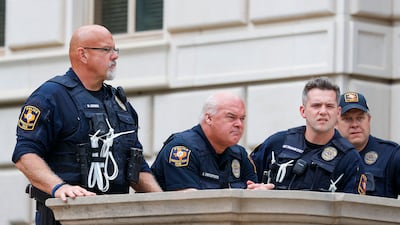
Police watch as students and faculty show support at a Protect Palestine Rally at the University of Texas, in Austin. EPA -

A student is arrested during a pro-Palestine demonstration at the University of Texas at Austin. Getty Images -
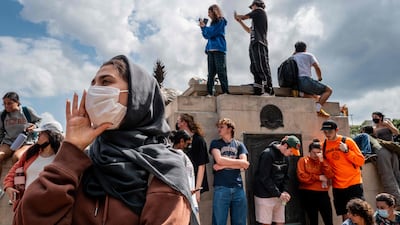
Students rally at the University of Texas at Austin, where police arrested scores of protesters. Getty images -

Mounted police confront students protesting against the war in Gaza, at the University of Texas at Austin. Getty Images -

Pro-Palestine demonstrators argue with University of Southern California officials, who attempted to take down an encampment set up in support of Gaza, at the institution in Los Angeles. Getty images -
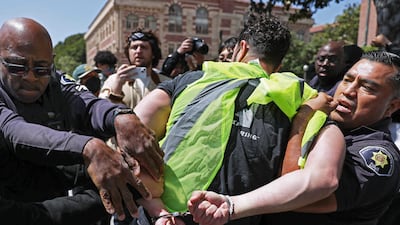
University of Southern California police officers detain a pro-Palestine demonstrator. Getty Images -
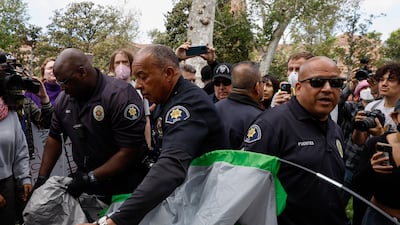
University of Southern California officers dismantle protesters' tents. EPA -
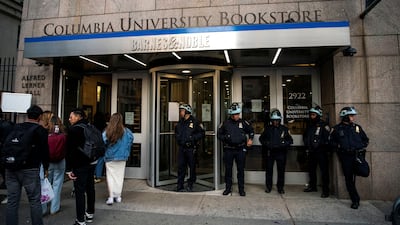
Police stand guard at an entrance to Columbia University, in New York City, where students continue to protest in support of Palestinians, amid the war in Gaza. Reuters -

Najla Said, daughter of Palestinian-American academic and literary critic Edward Said, and Motaz Azaiza, a Palestinian photojournalist from Gaza, join the Gaza solidarity encampment at Columbia University. Photo: Columbia Students for Justice in Palestine -

As the campus protests continue, Columbia has moved its classes online. AFP -

Workers erect a wooden barrier at New York University Stern School of Business after an encampment set up by students was cleared out on Monday night. Getty Images -
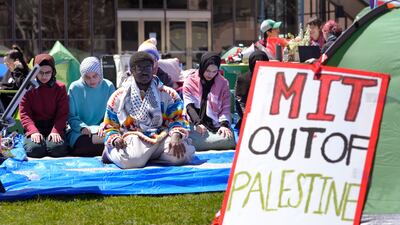
Massachusetts Institute of Technology student Isa Liggans, front left, takes part in Muslim prayer with others, at an encampment of tents at the college, in Cambridge, Massachusetts. AP -

Police officers disperse pro-Palestinian students and protesters who set up an encampment on the campus of New York University. AFP -
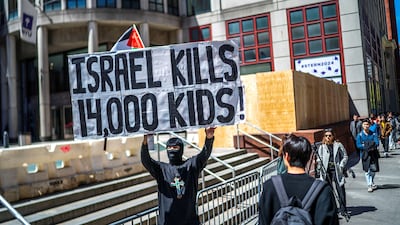
A protester outside New York University. Reuters -
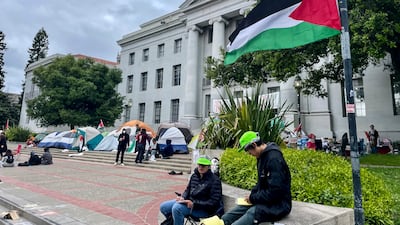
Pro-Palestinian protesters gather in front of Sproul Hall on the campus of the University of California, Berkeley. AP -

Pro-Israeli demonstrators chant 'shame' after Columbia University assistant professor Shai Davidai was denied access to the main campus. AP -
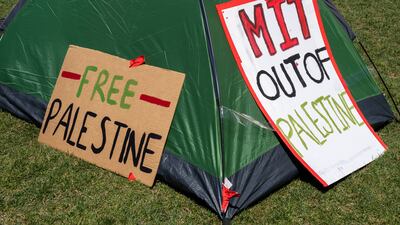
A tent used by pro-Palestinian demonstrators at MIT. Bloomberg -

A coalition of University of Michigan students rally to pressure the university to divest its endowment from companies that support Israel. Reuters -
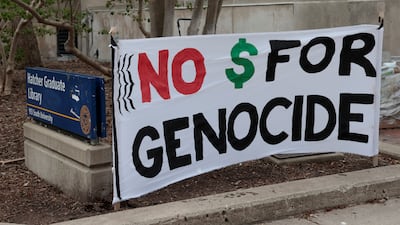
A sign at the University of Michigan. Reuters -
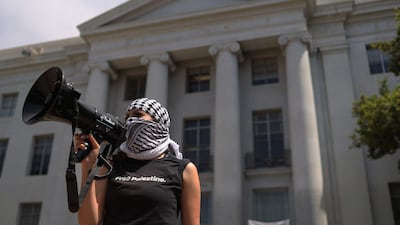
A pro-Palestinian protester in front of Sproul Hall in Berkeley, California. Getty Images / AP -
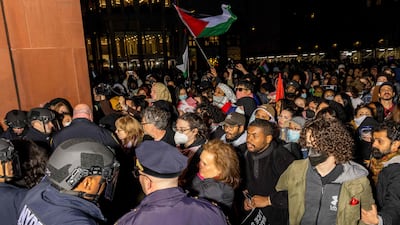
Police officers detain pro-Palestinian students and protesters at New York University. AFP -
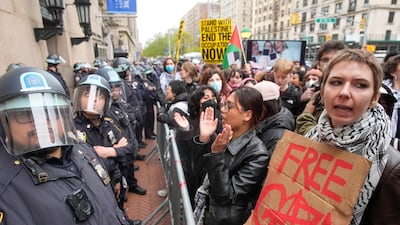
Police in Riot gear stand guard as demonstrators chant slogans outside the Columbia University campus. AP -
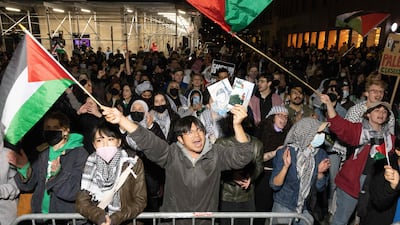
Pro-Palestinian students and activists protest against the Israel-Gaza war on the campus of New York University. AFP


Today, we hear that Egypt has denied reaching arrangements with Israel to receive Palestinian civilians from Rafah. This means that if the Israeli war machine is allowed to prey on Palestinian civilians, Egypt is likely to be unfairly blamed. But if, on the other hand, a significant number of civilians are absorbed into the Negev and Sinai, Cairo will be unfairly considered complicit.
Even the UN worries about the possibility of being accused of betrayal and abandonment. UN spokesman Stephane Dujarric has been keen to say that the organisation won’t be a party to any forced displacement in Gaza, reaffirming its rejection of any ground offensive in Rafah.
But Israeli Prime Minister Benjamin Netanyahu has been emphasising for weeks that this operation is necessary to eliminate Hamas, claiming that Rafah is the last remaining stronghold of its leaders in Gaza. His war cabinet is exploring means to destroy the last units, according to a government spokesman.
The international community, including the US, continues to warn against the operation. However, Washington as well as key European governments agree with Israel on the necessity of crushing Hamas.
Ordinary Palestinians, meanwhile, have nothing to hold on to except their wish to return to the status quo ante before October 7.
If there is any excessive optimism – particularly among those who point to the protests at American universities and a possible shift in public opinion in the US and around the world as a watershed moment for how Palestinian rights are viewed – then it risks being misplaced.
This kind of sympathy is not a qualitative leap or a revival of the memory of the 1968 protests in Paris. Those who hope to see significant breakthroughs could end up being disappointed after their momentum eventually recedes.
Some of these protesters, especially those who raise Hamas flags instead of the Palestinian flag, may regret their actions. For raising the Hamas flag harms the Palestinian international position, where the PLO is the sole legitimate representative of the cause.
And yet these protests are necessary. Rejecting forced displacement while insisting on the international responsibility to return Palestinians to their homes must be sustained and built upon with serious steps. It shouldn’t remain as a youth-led outcry or as ammunition in the hands of the “woke” American left.
In another interview, Mr Al Hayya said that Israel’s plans to invade Rafah, where it believes the remaining four battalions of Hamas are entrenched, won’t succeed in destroying the group. He boasted that after all these months, Israeli forces have destroyed no more than 20 per cent of its capabilities.
If Hamas achieves more than its survival, despite the enormous cost to the Palestinian people, it may think it has the right to boast. But after all this, we cannot be sure whether the group’s new stance is simply an act of self-preservation, or if it is genuinely ready to rectify its mistakes.
Either way, this supposed contrition could have been beneficial had it come much sooner.

