

I will never forget the moment Hassan Nasrallah walked on to the makeshift stage in Dahieh to the shrieks of thousands of ardent fans and supporters. It was hot and humid, a typical July evening in Beirut, and sundown had done little to alleviate the heat.
It was 2008 and Nasrallah had not been seen in public for more than two years, since Hezbollah fought Israel to a draw after 34 days of war. But on that evening, Nasrallah decided to risk a public sighting in order to celebrate what he saw as his latest victory over Israel.
He had just negotiated the release of Samir Kuntar, who was convicted by an Israeli court of murdering five people, and four others in exchange for the bodies of Israeli soldiers Ehud Goldwasser and Eldad Regev, whose capture sparked the 2006 war.
As I stood in the press box surrounded by thousands of people, I was immediately struck by the idea that I was witnessing history. I was in university at the time back in Canada and was spending the summer interning at the Daily Star, Lebanon’s English-language newspaper. Halfway through my internship, I knew I loved the Middle East but hadn’t yet committed to journalism.
That changed the moment Nasrallah took to the stage. Sweat seeped through my shirt and chills ran down my back. I was hooked. The charged atmosphere, the thrill of watching history unfolding and a slight undercurrent of danger – I distinctly remember looking up to the sky and hoping that no Israeli jets were passing by.
I realised then that few professions offered the same mix of excitement and importance. Chronicling history matters and witnessing and speaking to those who shape it and are shaped by it matters.
-

In a speech in December 1992, the late Hezbollah leader Hassan Nasrallah urges Palestinians to take up arms during the First Intifada. Reuters -

Nasrallah is received by Iranian Supreme Leader Ayatollah Ali Khamenei during a visit to Tehran in July 2000. Reuters -

Nasrallah holds talks with Jawad Al Shahristani, the official representative of Iraq's top Shiite cleric Ayatollah Ali Al Sistani, in April 2016. Reuters -

Nasrallah attends a rally at the Yarmouk refugee camp near Damascus in May 1998, with Hamas founder Ahmed Yassin, late Hamas leader Khaled Mashal, PFLP leader Ahmad Jebril and Palestinian Islamic Jihad leader Ramadan Shalah. Reuters -
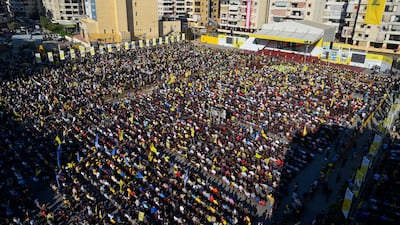
Nasrallah addresses Hezbollah supporters during an election rally in Beirut in May 2022. EPA -
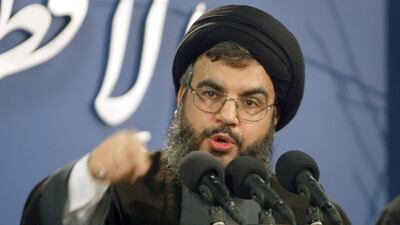
Nasrallah delivers a speech in a southern suburb of Beirut in November 2003. AFP -

Shiite scouts march with portraits of Iran's Supreme Leader Ayatollah Ali Khamenei and Hassan Nasrallah during the funeral of a Hezbollah member in Adloun, southern Lebanon, on September 19, 2024. AFP -
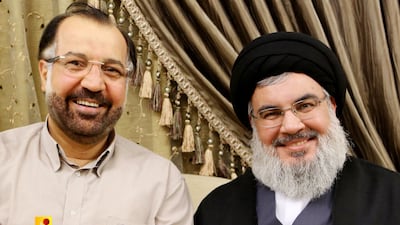
Hassan Nasrallah and Hezbollah commander Fouad Shukr, who was killed in an Israeli strike on Beirut in July 2024. Photo: Hezbollah -
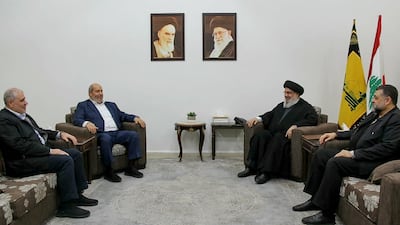
Hassan Nasrallah receives a Hamas delegation led by Khalil Al Hayya in Lebanon in July 2024. AFP


In many ways on that July night, Nasrallah – and by extension Hezbollah – were at the peak of their powers. Under Nasrallah, Hezbollah had transformed from a fringe militant group, created in large part in opposition to Israel’s 1982 invasion of Lebanon, into a ferocious militia and political juggernaut.
Nasrallah was still basking in the glow of the 2006 war, which despite ending in a stalemate on the battlefield, was seen as a significant victory for Hezbollah and solidified its place at the top of Lebanon’s complex political hierarchy. But as its successes mounted, the group’s ambitions grew and its regional role as Iran’s biggest proxy, saw it weigh in on the side of Syrian President Bashar Al Assad in that country’s devastating civil war.
Hezbollah played an instrumental role in helping Mr Al Assad stay in power and brutally repel rebel efforts. The group’s involvement in the war changed the way many in the region perceived it. For many, it was an unforgivable stance that risked dragging Lebanon, a country that was still grappling with the ghosts of its own civil war, back into the fray.
As Lebanon’s own economic and political crisis has worsened in recent years, much of the people’s anger, which manifested in widespread protests in 2019 and 2020, has been directed at Nasrallah and Hezbollah. The charismatic leader leaves behind a complicated legacy, having been instrumental in undermining the Lebanese state.
I have spent the better part of the past two decades fuelled by that night in Dahieh and dozens since that remind me that we live in an amazing, challenging world and it needs to be witnessed, chronicled and reported.
Love him or hate him – and many Lebanese did both – Nasrallah mattered. He controlled the most powerful army and party in the country and his death marks the end of a difficult chapter in the country’s rich but painful history and the beginning of something new.

