Trump’s message is clear: US free speech principles don’t apply to Palestine supporters


  • English
  • Arabic

February 20, 2025

“Free speech for me, but not for thee” is a double standard dating back to the earliest days of the American republic and the free speech rights guaranteed by the First Amendment to the US Constitution.

Historically, American democracy has compared favourably with societies such as Britain and Canada. US Vice President JD Vance even made a speech at the Munich Security Conference accusing European leaders of censoring free speech on the continent. Yet there are always exceptions, and harsh criticism of Israel has always been difficult and dangerous in most US contexts.

Recent years have seen increasing efforts to go beyond the informal methods of suppressing pro-Palestinian perspectives such as often false accusations of anti-Semitism, ostracism, or negative professional consequences. States and state-run institutions have been increasingly attempting to legislate financial, professional, contractual and other penalties for criticism of Israel and its occupation that began in 1967.

During last year’s election campaign, US President Donald Trump vowed to crush such views. He described student opposition to the Gaza war as part of a “radical revolution” that “has to be stopped now”, so “we’re going to set that movement back 25 or 30 years”. This did not appear to faze the numerous Arab and Muslim Americans who voted for Mr Trump or, at least, helped him by staying home or supporting irrelevant candidates.

In a new executive order, Mr Trump has banned entry into, or deportation from, the country by foreign nationals deemed to “espouse the hateful ideology” of anti-Semitism, which it appears to equate with protests against the Gaza war. An accompanying fact sheet claims that following the October 7, 2023 attack on southern Israel, “pro-Hamas aliens and left-wing radicals began a campaign of intimidation, vandalism, and violence on the campuses and streets of America”.

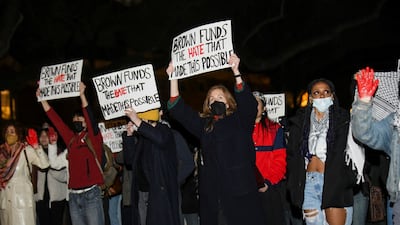
Some of that certainly happened, but much of the worst violence – including a prolonged mob attack on peaceful anti-war protesters, unprotected for hours by apparently unconcerned police officers, at UCLA in May last year, or the shooting of three Palestinian-American students, one of whom remains paralysed, at Brown University in December 2023, to cite only two such instances – were directed against, not by, protesters.

Mr Trump’s edicts ignore that there has been a documented and demonstrable rise in both anti-Semitic and anti-Arab/Muslim hate crimes and intimidation. They don’t acknowledge that the overwhelming majority of anti-war protests were peaceful, orderly and often within the best traditions of civic engagement and responsible citizenship – or that many of the protesters are Jewish. Genuine anti-Semitism is an unacceptable moral outrage, but so is silence and apathy in the face of such carnage.

US President Donald Trump's daughter Ivanka Trump converted to Judaism before marrying Jared Kushner. Reuters

Universities have come under heavy pressure to do everything possible to stop public opposition to Israel’s rampage of vengeance in Gaza. Their responses range from the vicious and petty to the downright absurd.

Harvard faculty lost library privileges for taping anti-war signs on to their laptops or even silently reading books about free speech, Palestine or similar intolerable topics. Harvard claimed that such silent, virtually invisible, gestures constituted disruptive protesting because they were “designed to capture people’s attention”. It was a miserable capitulation to pro-Israel political correctness by cowardly administrators at an institution (that’s yet again) prepared to corrupt its dignity and educational mission to escape criticism because many students and faculty were appalled by the horrors in Gaza.

Mr Trump’s executive order will exacerbate this national atmosphere of attempted repression, but it’s not just coming from the political right. There’s a generational divide roiling the US left, with many liberals under the age of 30 (including many Jewish Americans) largely or entirely unaffected by the emotional, ideological or religious attachment their parents and grandparents often feel towards Israel.

Right-wing criticism of Israel comes primarily from avowed racists and neo-Nazis. But there’s a common phenomenon of conservative Americans who are in certain ways anti-Semitic, harbouring stereotypes of Jewish Americans, yet who are also passionately pro-Israel.

Many of them may not like Jews much, yet they see Israel as key to a war of Armageddon that will initiate the second coming of Jesus Christ – or, in a secular vein, as an admirably “civilised” and essentially western society that should be emulated in its disregard for the UN, international law, global opinion and the rights of a colonised people.

Mr Trump himself embodies a particularly complex, subtle version of such cognitive dissonance, having made numerous anti-Semitic comments and addressing Jewish Americans as if they were Israelis, while happily allowing his daughter to convert to Judaism.

Younger liberals, however, are often neither interested in Armageddon nor supportive of colonisation and the virtual apartheid system Israel imposes in the occupied territories. This is a problem for their elders, though, because incisive criticism of Israel has been effectively a taboo in much of American society, especially outside of academia, for decades. So, both the left and the right have been attempting to use institutional, and increasingly governmental, power to enforce a moribund and intellectually indefensible political correctness.

Over the past decade, important efforts have united left, right and centre activists to counter efforts by liberals to “cancel” speech they deem racist, sexist, homophobic or otherwise intolerant, and by the right to use the power of state, and now the federal, government to prohibit primary and secondary schools from teaching about past and present racism. Unfortunately, even in these circles, a Palestinian exception is normative.

They don’t acknowledge that the overwhelming majority of anti-war protests were peaceful

Usually the right to vociferously criticise Israel passes unmentioned, though that is by far the largest target of attempted suppression in the contemporary US, or, when the subject is forced, it typically elicits a distinct lack of enthusiasm, efforts to change the subject or explain the carve-out. But that’s cowardice and hypocrisy.

Arabs and Muslims everywhere, as a top priority, must zealously and vigilantly reject and denounce genuine anti-Semitism, which is both an intellectual and a moral poison and a disaster for the Palestinian cause. But they must not be silenced either. There’s no basis in US law, culture or tradition for singling out Israel as virtually immune from harsh criticism, especially when it behaves atrociously, or viewing Palestinians as less valuable humans.

More than 200 years of US history demonstrates that the censorious position is ultimately, and almost invariably, the losing one. Mr Trump, various governors, university administrators and others may hope to force this genie back into its bottle. But they, and their Israeli friends, will discover in fairly short order that an honest American national conversation about Israel and the Palestinians is, at long last, rapidly and inexorably approaching.

THE SPECS

Engine: Four-cylinder 2.5-litre

Transmission: Seven-speed auto

Power: 165hp

Torque: 241Nm

Price: Dh99,900 to Dh134,000

On sale: now

Ferrari 12Cilindri specs

Engine: naturally aspirated 6.5-liter V12

Power: 819hp

Torque: 678Nm at 7,250rpm

Price: From Dh1,700,000

Available: Now

About Takalam

Date started: early 2020

Founders: Khawla Hammad and Inas Abu Shashieh

Based: Abu Dhabi

Sector: HealthTech and wellness

Number of staff: 4

Funding to date: Bootstrapped

The candidates

Dr Ayham Ammora, scientist and business executive

Ali Azeem, business leader

Tony Booth, professor of education

Lord Browne, former BP chief executive

Dr Mohamed El-Erian, economist

Professor Wyn Evans, astrophysicist

Dr Mark Mann, scientist

Gina MIller, anti-Brexit campaigner

Lord Smith, former Cabinet minister

Sandi Toksvig, broadcaster


It Was Just an Accident

Director: Jafar Panahi

Stars: Vahid Mobasseri, Mariam Afshari, Ebrahim Azizi, Hadis Pakbaten, Majid Panahi, Mohamad Ali Elyasmehr

Rating: 4/5

Classification of skills

A worker is categorised as skilled by the MOHRE based on nine levels given in the International Standard Classification of Occupations (ISCO) issued by the International Labour Organisation. 

A skilled worker would be someone at a professional level (levels 1 – 5) which includes managers, professionals, technicians and associate professionals, clerical support workers, and service and sales workers.

The worker must also have an attested educational certificate higher than secondary or an equivalent certification, and earn a monthly salary of at least Dh4,000. 

Who was Alfred Nobel?

The Nobel Prize was created by wealthy Swedish chemist and entrepreneur Alfred Nobel.

  • In his will he dictated that the bulk of his estate should be used to fund "prizes to those who, during the preceding year, have conferred the greatest benefit to humankind".
  • Nobel is best known as the inventor of dynamite, but also wrote poetry and drama and could speak Russian, French, English and German by the age of 17. The five original prize categories reflect the interests closest to his heart.
  • Nobel died in 1896 but it took until 1901, following a legal battle over his will, before the first prizes were awarded.
Wonka
%3Cp%3E%3Cstrong%3EDirector%3A%3C%2Fstrong%3E%C2%A0Paul%20King%3C%2Fp%3E%0A%3Cp%3E%3Cstrong%3EStarring%3A%C2%A0%3C%2Fstrong%3ETimothee%20Chalamet%2C%20Olivia%20Colman%2C%20Hugh%20Grant%3C%2Fp%3E%0A%3Cp%3E%3Cstrong%3ERating%3A%3C%2Fstrong%3E%202%2F5%3C%2Fp%3E%0A
Racecard

6pm: Al Maktoum Challenge Round 2 Group 1 (PA) $55,000 (Dirt) 1,900m  

6.35pm: Oud Metha Stakes Rated Conditions (TB) $60,000 (D) 1,200m  

7.10pm: Jumeirah Classic Listed (TB) $150,000 (Turf) 1,600m  

7.45pm: Firebreak Stakes Group 3 (TB) $150,000 (D) 1,600m  

8.20pm: Al Maktoum Challenge Round 2 Group 2 (TB) $350,000 (D) 1,900m  

8.55pm: Al Bastakiya Trial Conditions (TB) $60,000 (D) 1,900m  

9.30pm: Balanchine Group 2 (TB) $180,000 (T) 1,800m   

The rules on fostering in the UAE

A foster couple or family must:

  • be Muslim, Emirati and be residing in the UAE
  • not be younger than 25 years old
  • not have been convicted of offences or crimes involving moral turpitude
  • be free of infectious diseases or psychological and mental disorders
  • have the ability to support its members and the foster child financially
  • undertake to treat and raise the child in a proper manner and take care of his or her health and well-being
  • A single, divorced or widowed Muslim Emirati female, residing in the UAE may apply to foster a child if she is at least 30 years old and able to support the child financially
Company profile

Name:​ One Good Thing ​

Founders:​ Bridgett Lau and Micheal Cooke​

Based in:​ Dubai​​ 

Sector:​ e-commerce​

Size: 5​ employees

Stage: ​Looking for seed funding

Investors:​ ​Self-funded and seeking external investors

Basquiat in Abu Dhabi

One of Basquiat’s paintings, the vibrant Cabra (1981–82), now hangs in Louvre Abu Dhabi temporarily, on loan from the Guggenheim Abu Dhabi. 

The latter museum is not open physically, but has assembled a collection and puts together a series of events called Talking Art, such as this discussion, moderated by writer Chaedria LaBouvier. 

It's something of a Basquiat season in Abu Dhabi at the moment. Last week, The Radiant Child, a documentary on Basquiat was shown at Manarat Al Saadiyat, and tonight (April 18) the Guggenheim Abu Dhabi is throwing the re-creation of a party tonight, of the legendary Canal Zone party thrown in 1979, which epitomised the collaborative scene of the time. It was at Canal Zone that Basquiat met prominent members of the art world and moved from unknown graffiti artist into someone in the spotlight.  

“We’ve invited local resident arists, we’ll have spray cans at the ready,” says curator Maisa Al Qassemi of the Guggenheim Abu Dhabi. 

Guggenheim Abu Dhabi's Canal Zone Remix is at Manarat Al Saadiyat, Thursday April 18, from 8pm. Free entry to all. Basquiat's Cabra is on view at Louvre Abu Dhabi until October

Mercer, the investment consulting arm of US services company Marsh & McLennan, expects its wealth division to at least double its assets under management (AUM) in the Middle East as wealth in the region continues to grow despite economic headwinds, a company official said.

Mercer Wealth, which globally has $160 billion in AUM, plans to boost its AUM in the region to $2-$3bn in the next 2-3 years from the present $1bn, said Yasir AbuShaban, a Dubai-based principal with Mercer Wealth.

Within the next two to three years, we are looking at reaching $2 to $3 billion as a conservative estimate and we do see an opportunity to do so,” said Mr AbuShaban.

Mercer does not directly make investments, but allocates clients’ money they have discretion to, to professional asset managers. They also provide advice to clients.

“We have buying power. We can negotiate on their (client’s) behalf with asset managers to provide them lower fees than they otherwise would have to get on their own,” he added.

Mercer Wealth’s clients include sovereign wealth funds, family offices, and insurance companies among others.

From its office in Dubai, Mercer also looks after Africa, India and Turkey, where they also see opportunity for growth.

Wealth creation in Middle East and Africa (MEA) grew 8.5 per cent to $8.1 trillion last year from $7.5tn in 2015, higher than last year’s global average of 6 per cent and the second-highest growth in a region after Asia-Pacific which grew 9.9 per cent, according to consultancy Boston Consulting Group (BCG). In the region, where wealth grew just 1.9 per cent in 2015 compared with 2014, a pickup in oil prices has helped in wealth generation.

BCG is forecasting MEA wealth will rise to $12tn by 2021, growing at an annual average of 8 per cent.

Drivers of wealth generation in the region will be split evenly between new wealth creation and growth of performance of existing assets, according to BCG.

Another general trend in the region is clients’ looking for a comprehensive approach to investing, according to Mr AbuShaban.

“Institutional investors or some of the families are seeing a slowdown in the available capital they have to invest and in that sense they are looking at optimizing the way they manage their portfolios and making sure they are not investing haphazardly and different parts of their investment are working together,” said Mr AbuShaban.

Some clients also have a higher appetite for risk, given the low interest-rate environment that does not provide enough yield for some institutional investors. These clients are keen to invest in illiquid assets, such as private equity and infrastructure.

“What we have seen is a desire for higher returns in what has been a low-return environment specifically in various fixed income or bonds,” he said.

“In this environment, we have seen a de facto increase in the risk that clients are taking in things like illiquid investments, private equity investments, infrastructure and private debt, those kind of investments were higher illiquidity results in incrementally higher returns.”

The Abu Dhabi Investment Authority, one of the largest sovereign wealth funds, said in its 2016 report that has gradually increased its exposure in direct private equity and private credit transactions, mainly in Asian markets and especially in China and India. The authority’s private equity department focused on structured equities owing to “their defensive characteristics.”

Ovo's tips to find extra heat
  • Open your curtains when it’s sunny 
  • Keep your oven open after cooking  
  • Have a cuddle with pets and loved ones to help stay cosy 
  • Eat ginger but avoid chilli as it makes you sweat 
  • Put on extra layers  
  • Do a few star jumps  
  • Avoid alcohol   
Updated: February 21, 2025, 5:22 AM