

The Covid-19 landscape is littered with fractured experiences, many of which are shaped by the profound implications of isolation. One such implication is the rise of extremism.
The pandemic hasn’t introduced problems like extremism or terrorism but it has become clear that the situation is bound to intensify challenges posed by them. And experts tracking the activities of extremists, especially online, are sounding warnings.
According to them, the pool of vulnerable people has grown, time to fester with resentful thoughts is limitless, and the propensity to buy into extremist messages is growing.
For many people, the pandemic has been a great enabler. Positives include working from home, digital learning, video socialising and grocery deliveries. As the Davos summit goes viral this week, it is worth pointing out that a newly released 28-country World Economic Forum/Ipsos survey showed a broad level of support for digital communications during the crisis.
According to the poll, a majority of adults believed that the use of digital tools, training or technology would improve in the year ahead. However, most respondents viewed deteriorating mental and physical health as among the biggest personal risks.
By its very definition, the flipside of extremism is that it is a minority obsession; that is to say, the extremism is on the extremes. But as the political and social crises in America have shown, this is a menacing moment in world history. The risk of blowback from these corners is what is growing.
Last week, researcher Richard Burchill told a seminar organised by the Brussels-based think tank Bussola Institute that the widespread uncertainty of the pandemic changed the calculus for the spread of extremism. There are suggestions that the ordeal and struggle to cope with a new pathogen was the starting point of new radicalisation in 2020. Government messaging around the virus sowed uncertainty in many countries, especially those going through stop-start lockdowns – although the scope of the threat posed by the virus could not be pinpointed consistently by officials.
Then there is the unending nature of the pandemic. The danger has not gone away. Uncertainty, therefore, breeds distrust. And this distrust fuels the propensity towards hatred and polarising social trends.
Spending more time at home is not directly a recipe for extremism. As much as anything, the lack of opportunity to mix with others can be seen as the most dangerous element. Without mixing in schools, community centres and neighbourhood plazas, there is no casual defraying of resentments. The minor mental obsessions that melt away in normal times remain sticky. What is worse, echo chambers become the default setting for people to cultivate their views.
Meanwhile, it appears that extremist groups quickly cottoned on to the uncertainty and the advantages it presented for spreading their messages. As early as February, organisations such as Al Qaeda presented the pandemic first as a punishment for non-believers or heretics. Soon the messages changed to portraying governments that did not share their ideology as ineffective.
-
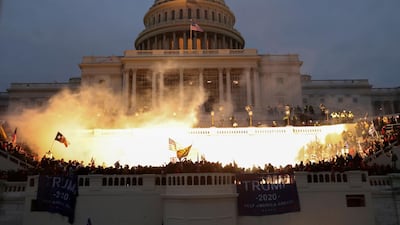
An explosion caused by a police munition is seen while supporters of former president Donald Trump gather in front of the US Capitol Building in Washington, US, January 6, 2021. Reuters -

A supporter of US President Donald J. Trump sits on the desk of US House Speaker Nancy Pelosi, after supporters of US President Donald J. Trump breached the US Capitol security in Washington. EPA -
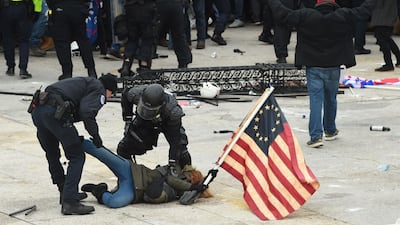
Police detain a person as supporters of US President Donald Trump protest outside the US Capitol. AFP -

Protesters enter the US Capitol Building. AFP -

A protester holds a Trump flag inside the US Capitol Building near the Senate Chamber. AFP -
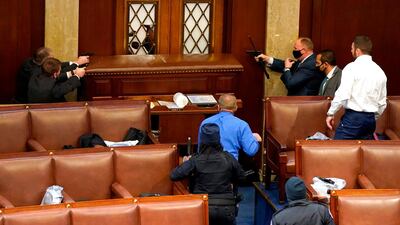
US Capitol police officers point their guns at a door that was vandalized in the House Chamber during a joint session of Congress. AFP -

Members of congress run for cover as protesters try to enter the House Chamber during a joint session of Congress. AFP -
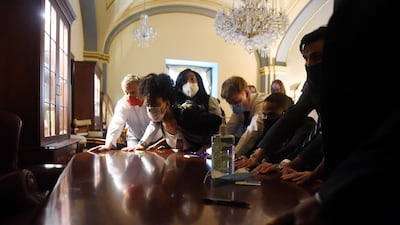
Congress staffers barricade themselves after Trump supporters stormed inside the US Capitol. AFP -

Congress staffers barricade themselves after Trump supporters stormed inside the US Capitol. AFP -

Congress staffers hold up their hands while Capitol Police Swat teams check everyone in the room as they secure the floor of Trump supporters. AFP -
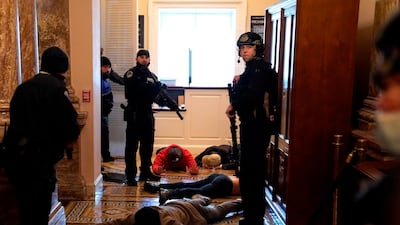
US Capitol Police stand detain protesters outside of the House Chamber during a joint session of Congress. AFP -

A supporter of US President Donald Trump sits at a desk after invading the Capitol Building. AFP -
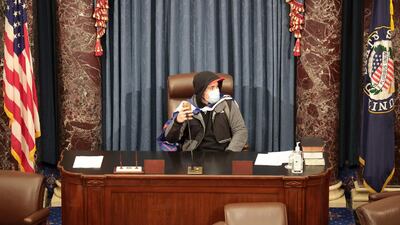
A protester sits in the Senate Chamber. AFP -
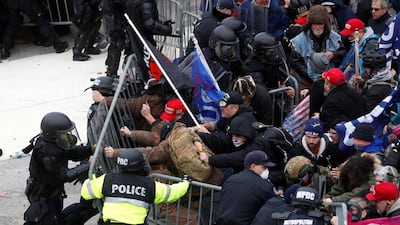
Pro-Trump protesters tear down a barricade as they clash with Capitol police during a rally to contest the certification of the 2020 US presidential election results by the US Congress. Reuters -
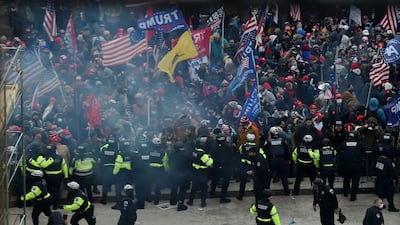
Police hold back supporters of US President Donald Trump as they gather outside the US Capitol's Rotunda. AFP -

Supporters of US President Donald Trump enter the US Capitol's Rotunda. AFP -
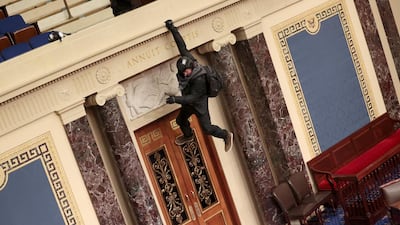
A protester is seen hanging from the balcony in the Senate Chamber. AFP -
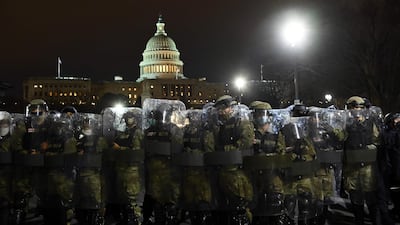
Riot police prepare to move demonstrators away from the US Capitol. AFP -
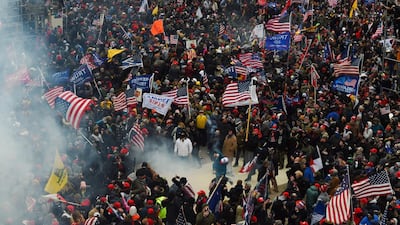
Trump supporters clash with police and security forces as they storm the US Capitol. AFP -
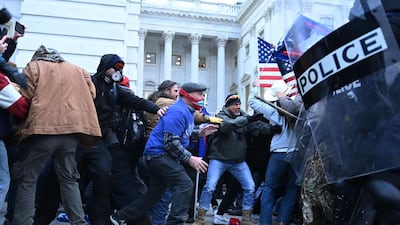
Trump supporters clash with police and security forces, as they storm the US Capitol. AFP -
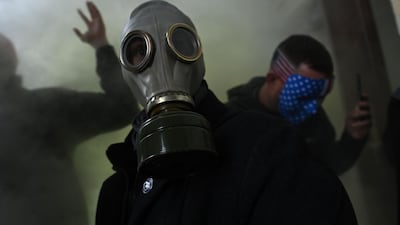
A supporter of US President Donald Trump wears a gas mask as he protests after storming the US Capitol. AFP -
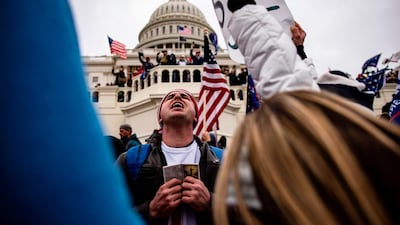
Pro-Trump supporters storm the US Capitol following a rally. AFP -
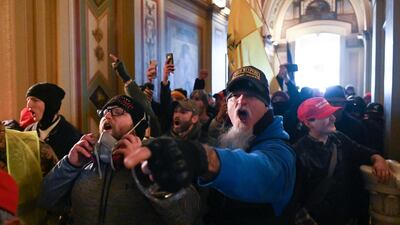
Supporters of US President Donald Trump protest inside the US Capitol. AFP -
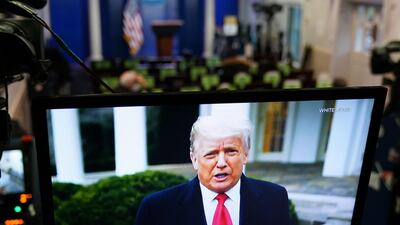
US President Donald Trump is seen on TV from a video message released on Twitter addressing rioters at the US Capitol, in the Brady Briefing Room at the White House in Washington, DC. AFP -
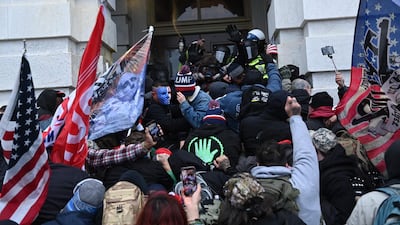
Trump supporters clash with police and security forces as they storm the US Capitol in Washington, DC. AFP -

Supporters of US President Donald Trump protest in the US Capitol Rotunda. AFP -
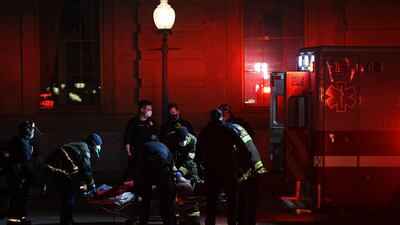
Paramedics perform cardiopulmonary resuscitation on a patient. AFP -
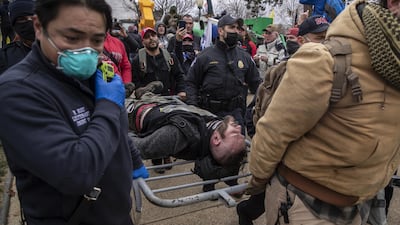
A wounded protester is carried on barricade as demonstrators breach the US Capital building grounds. Bloomberg -
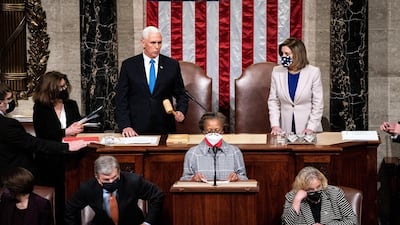
US Vice President Mike Pence and House Speaker Nancy Pelosi preside over a joint session of Congress to certify the 2020 Electoral College results after supporters of President Donald Trump stormed the Capitol earlier in the day on Capitol Hill in Washington, DC. EPA -
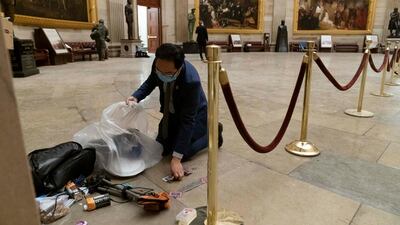
Rep. Andy Kim, D-N.J., cleans up debris and personal belongings strewn across the floor of the Rotunda in the early morning hours of the morning, after protesters stormed the Capitol in Washington. AP


Offensives by these groups have taken ground, including dramatic gains by ISIS in Africa. There have also been terror attacks in Europe and fundraising scams in the US by supporters of terrorism.
Sara Zeiger of the UAE-based Hedayah, an organisation dedicated to countering violent extremism, pointed out that with large numbers of children out of school and learning online, there is a new vulnerability in the younger generation. Schools need to ensure the resilience of pupils, especially those driven to rely on digital tools for learning, and to make sure that children are accessing material that is not tainted by extremist narratives. There is also a need to help children cope with material when they are stripped of the school-based safe space.
Far-right groups, meanwhile, have thrived on anti-Semitic tropes about elite-level conspiracies originating the virus. Related to this has been the messaging about the vaccine as a means to microchip the entire population and the targeting of 5G telecoms infrastructure again as a means of control.
The problem is, spreading blame and promoting division as a means of allowing people to find meaning turns the curious into committed followers. Mr Burchill said the situation was that multiple narratives were allowing people to pick and choose their resentments on their journey along the path to radicalisation. “The shelves are stocked full of very dangerous narratives that people can relate to,” he said.
Last week, another researcher who has surveyed the netherworld of extremism presented her findings at a Cambridge University event. Bettina Rottweiler studied the relationship between conspiracy beliefs and violent extremism. She found powerful links. She also discovered that 21 per cent of Germans and 37 per cent of British respondents scored at the highest levels of susceptibility to believe in conspiracy theories.
One danger is that when individuals are deprived of basic human needs, they are more likely to act on unrelated grievances. The vulnerable fall into dogmatic thinking, which is then linked to stronger conspiracy thinking and eventually violent extremist intentions. Alienation comes from a sense of collective deprivation, where people start seeing themselves as victimised. It is then obvious that such people want to fight back and support groups that have a platform against oppression.
As the week came to a close, US President Joe Biden was setting up a review of his country's domestic extremism threat. This is a sensible move, given that the US continues to lack sound domestic counter-extremism capabilities. For instance, tackling the gateway abuses that radicalise and nurture extremism is sorely missing – and necessary.
There is much to do. In the meantime, as grim as this sounds, the pandemic is about to unleash some terrible demons.
Damien McElroy is the London bureau chief at The National


