Saad Hariri, who was re-designated Prime Minister of Lebanon on Thursday, seems to have the tacit backing of a variety of local, regional and international actors. This means that, in return for the chance to form a government, he will inevitably expose himself to pressures from all those actors, including France, Iran and the US. Chief among them, of course, is the Iranian regime, which seeks to consolidate its interests in the country.
For its part, the Trump administration has just two priorities when it comes to this troubled Arab state. One is the ongoing talks between Lebanon and Israel to demarcate a maritime border to facilitate oil and gas exploration by both countries. The other is accountability of all the local political players aligned with Hezbollah, a proxy of Tehran that happens to be a formidable political party in Lebanon but is deemed a terrorist organisation by Washington.
The latter, however, makes Mr Hariri’s task of leading his country out of economic disrepair extremely difficult, given that Tehran remains determined to keep Lebanon in its cold embrace and resist the West’s attempts to draw Beirut closer to it with the help of economic assistance from the International Monetary Fund.
French President Emmanuel Macron and US President Donald Trump will have a tacit understanding with regard to Lebanon. EPA
Mr Hariri has opted to return to the traditional practice of government formation in Lebanon, even if this means disregarding popular opposition to it. Indeed, the public has long tired of the "confessional" system, whereby the highest offices are proportionately reserved for representatives from certain religious communities. Despite its shortcomings, the year-long protest movement across Lebanon has made clear its rejection of the entire political class, which continues to hold on to power despite bringing the country to its knees.
The movement, which forced Mr Hariri's resignation in January, will have its doubts about his stated mission of forming a technocratic government. After all, he is part of the political system that the uprising rejects. One doesn't doubt Mr Hariri's ability to include "fresh faces" in his upcoming cabinet, as his Iranian backers will understand his need to portray himself as a reformer. But he will struggle to enact much-needed economic and political reforms, given how beholden he and his fellow ministers will be to vested interests in Beirut and Tehran.
Mr Hariri may already have conceded to a key demand made by Hezbollah and the Amal Movement to pick a finance minister from the Shiite community (which forms their voter base). It was a point of contention that forced Mustapha Adib to resign as prime minister-designate last month. If the influential French and US governments have indeed backed Mr Hariri’s expected concession in this regard – as a trade-off to facilitate the success of the so-called “French Initiative” to rescue the country – then one might well wave goodbye to any hopes of a new Lebanon. Handing over control of the finance ministry to someone with the support of the so-called “Shiite Duo” will effectively mean shelving any hopes of establishing accountability and transparency with regard to how business is done in the country.
Saad Hariri announces the resignation of his government. AFP
Mr. Hariri hands President Michel Aoun his government's resignation at the Baabda presidential palace. Dalati and Nohra / AFP
Protesters celebrate the resignation of Prime Minister Saad Hariri in Beirut, Lebanon. AFP
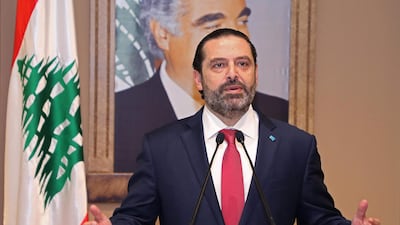
Mr Hariri speaks during an address to the nation. AP Photo
Protesters celebrate after Mr Hariri announced his resignation, in Sidon. Reuters
Protesters celebrate the resignation of Mr Hariri in Beirut. AFP
A protester calms another who was overwhelmed with tears in Beirut. AP Photo
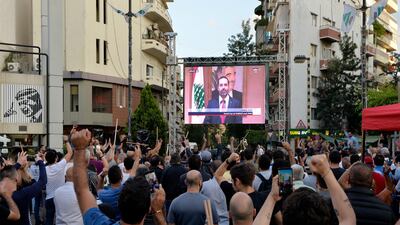
Protesters react as they watch a televised speech by Mr Hariri in the Ashrafieh area in Beirut. EPA
Protesters react as they watch a televised speech by Mr Hariri. EPA
Protestors watch a television broadcast of Mr Hariri speaking, in Sidon. Reuters
Mr Hariri walks to the podium to announce the resignation of his government. AFP
Lebanon's Prime Minister Saad Hariri leaves after a news conference. Reuters
America's position may be problematic. The Trump administration is naturally suspicious of the ties that exist between Mr Hariri and Hezbollah, but it is unwilling to obstruct the French initiative at this stage. If it, however, ends up legitimising Iran's strategy in Lebanon – based on the consolidation of Hezbollah's dominance over the government and perhaps even the army – then Washington is likely to stand up to Paris. Mr Hariri's position is unenviable and might even become untenable – even though he may believe that he is on a rescue mission.
It is important to remember that Iran's strategy for "renewal" in Lebanon essentially translates to the formation of a stable government that would cement Beirut's subordination to Tehran. But it would be carried out through a non-provocative formula that includes the introduction of new names to the government who are ultimately loyal to Hezbollah. This also includes the removal of the Lebanese army from politics and its eventual subjugation. Call it a "soft and flexible" hegemony, if you like.
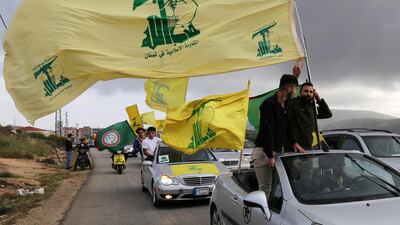
A supporter of Lebanon's Hezbollah gestures as he holds a Hezbollah flag in Marjayoun, Lebanon May 7, 2018. Reuters
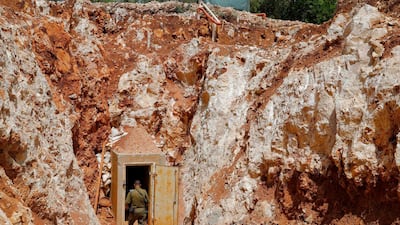
In 2019, Israel said this was a Hezbollah-dug tunnel under the "blue line", a demarcation line drawn by the UN to mark Israel's withdrawal from southern Lebanon in 2000. AFP
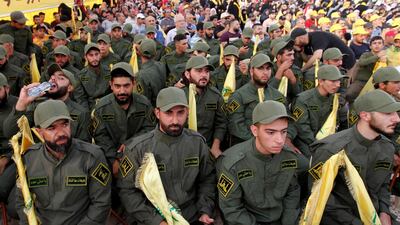
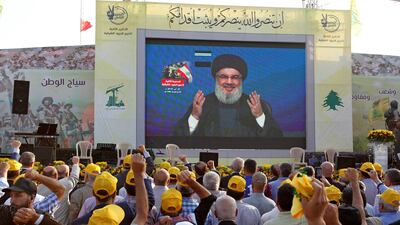
Lebanon's Hezbollah members hold party flags as they listen to their leader Sayyed Hassan Nasrallah. Reuters
A banner depicting Hezbollah leader Sayyed Hassan Nasrallah and an United Nation's post in Lebanon. Reuters
Hezbollah leader Hassan Nasrallah has direct ties with Iran's supreme leader Ayatollah Ali Khamenei. Reuters
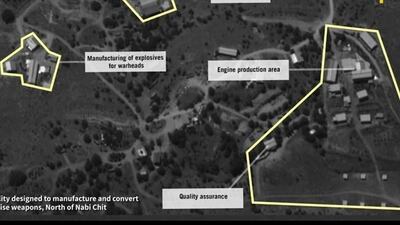
The Israeli military claimed that Hezbollah, with Iranian assistance, had been bringing specialised equipment to a weapons factory in southern Lebanon. Screengrab/YouTube
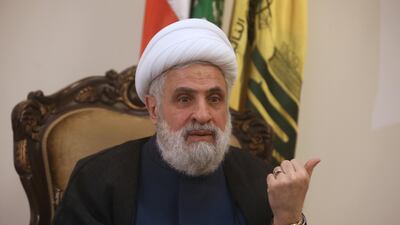
Lebanon's Hezbollah deputy leader Sheikh Naim Qassem gestures as he speaks during an interview with Reuters in Beirut, Lebanon March 15, 2018. Reuters
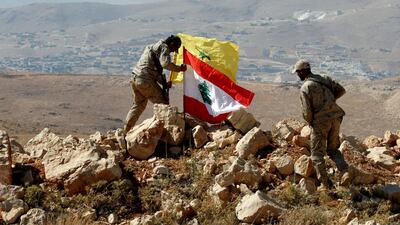
Hezbollah fighters put Lebanese and Hezbollah flags at Juroud Arsal, Syria-Lebanon border, July 25, 2017. Reuters
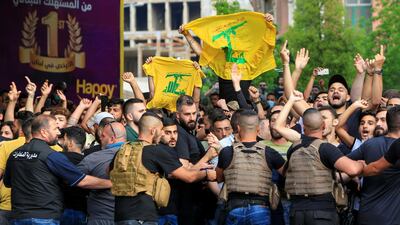
Lebanese soldiers try to block Hezbollah supporters as they gesture and chant slogans against anti-government demonstrators, in Beirut. Reuters
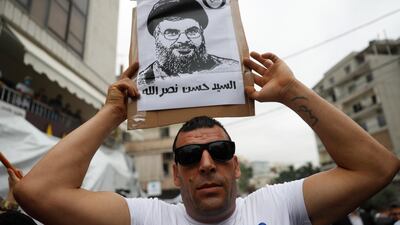
A Hezbollah supporter holds a placard of its leader Hassan Nasrallah, during a protest against the US in Beirut. AP Photo
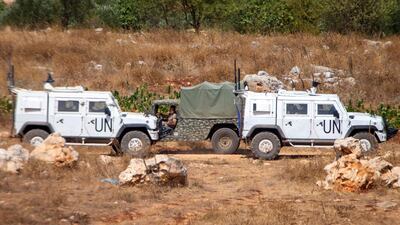
Lebanese soldiers on patrol drive by UN vehicles on the border with Israel on July 28, 2020. AP
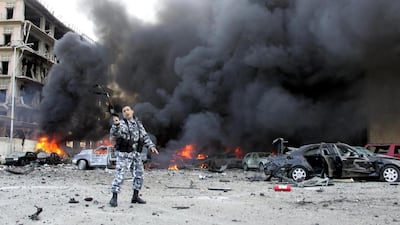
A Lebanese police officer gesturing on the site of an explosion in Beirut that killed ex-premier Rafik Hariri in 2005. AFP
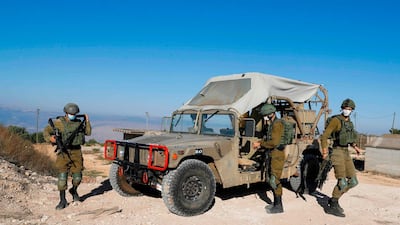
Israeli soldiers monitor the country's border with Lebanon near the northern town of Metula, in July 14, 2020. AFP
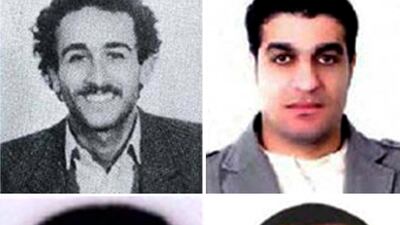
In this file photo obtained on July 29, 2011 from the Special Tribunal for Lebanon shows a combo of pictures showing four Hezbollah suspects indicted in the assassination case of former Lebanese prime minister Rafiq Hariri. AFP
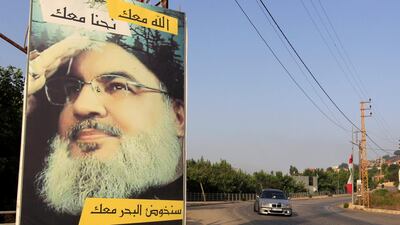
A car drives past a poster depicting Lebanon's Hezbollah leader Sayyed Hassan Nasrallah in Adaisseh village, near the Lebanese-Israeli border, Lebanon July 28, 2020. REUTERS/Aziz Taher
Mr Hariri's balancing act will therefore be a tricky one, especially as he banks on continued regional and international support, as well as pledges of economic assistance and financial aid from the West. He will also be aware that the next few months will be critical for Lebanon, and his own political fortunes, irrespective of whether Donald Trump wins re-election or is succeeded by Joe Biden. US sanctions on Iran, Hezbollah and their allies in Beirut will continue, at least for the foreseeable future.
As for the US presidential election itself, there is increasing uncertainty over which candidate will secure victory – or whether victory will be decisive. With less than two weeks to go, pollsters remain cautious, particularly after many of them erroneously predicted a Hillary Clinton win in the 2016 election.
Experts I recently spoke to are divided, too, although there is little doubt regarding US strategy in the Middle East, should Mr Trump get re-elected.
Paula Dobriansky, the former under secretary of state for democracy and global affairs, predicted a Trump win. Re-election, she said, would naturally mean the continuation of his administration’s “maximum pressure” campaign against Tehran. Michael Gfoeller, the former political adviser and regional co-ordinator for South Central Iraq in the erstwhile Coalition Provisional Authority, said as much. In fact, he even predicted an escalation in sanctions on Iran that would continue to curtail its oil exports and cripple its economy.
Carl Bildt, the former prime minister of Sweden, predicted a Biden victory, which he said would enable a return by all of the world's stakeholders to the negotiating table in the new president's bid to secure a new nuclear deal with Iran.
How exactly this will affect the future of Lebanon, only time will tell.
Raghida Dergham is the founder and executive chairwoman of the Beirut Institute
Starring: George MacKay, Jannis Niewohner, Jeremy Irons
Rating: 3/5
The specs
Engine: 3.8-litre twin-turbo flat-six
Power: 650hp at 6,750rpm
Torque: 800Nm from 2,500-4,000rpm
Transmission: 8-speed dual-clutch auto
Fuel consumption: 11.12L/100km
Price: From Dh796,600
On sale: now
The biog
Favourite books: 'Ruth Bader Ginsburg: A Life' by Jane D. Mathews and ‘The Moment of Lift’ by Melinda Gates
Favourite travel destination: Greece, a blend of ancient history and captivating nature. It always has given me a sense of joy, endless possibilities, positive energy and wonderful people that make you feel at home.
Favourite pastime: travelling and experiencing different cultures across the globe.
Favourite quote: “In the future, there will be no female leaders. There will just be leaders” - Sheryl Sandberg, COO of Facebook.
Favourite Movie: Mona Lisa Smile
Favourite Author: Kahlil Gibran
Favourite Artist: Meryl Streep
Ten tax points to be aware of in 2026
1. Domestic VAT refund amendments: request your refund within five years
If a business does not apply for the refund on time, they lose their credit.
2. E-invoicing in the UAE
Businesses should continue preparing for the implementation of e-invoicing in the UAE, with 2026 a preparation and transition period ahead of phased mandatory adoption.
3. More tax audits
Tax authorities are increasingly using data already available across multiple filings to identify audit risks.
4. More beneficial VAT and excise tax penalty regime
Tax disputes are expected to become more frequent and more structured, with clearer administrative objection and appeal processes. The UAE has adopted a new penalty regime for VAT and excise disputes, which now mirrors the penalty regime for corporate tax.
5. Greater emphasis on statutory audit
There is a greater need for the accuracy of financial statements. The International Financial Reporting Standards standards need to be strictly adhered to and, as a result, the quality of the audits will need to increase.
6. Further transfer pricing enforcement
Transfer pricing enforcement, which refers to the practice of establishing prices for internal transactions between related entities, is expected to broaden in scope. The UAE will shortly open the possibility to negotiate advance pricing agreements, or essentially rulings for transfer pricing purposes.
7. Limited time periods for audits
Recent amendments also introduce a default five-year limitation period for tax audits and assessments, subject to specific statutory exceptions. While the standard audit and assessment period is five years, this may be extended to up to 15 years in cases involving fraud or tax evasion.
8. Pillar 2 implementation
Many multinational groups will begin to feel the practical effect of the Domestic Minimum Top-Up Tax (DMTT), the UAE's implementation of the OECD’s global minimum tax under Pillar 2. While the rules apply for financial years starting on or after January 1, 2025, it is 2026 that marks the transition to an operational phase.
9. Reduced compliance obligations for imported goods and services
Businesses that apply the reverse-charge mechanism for VAT purposes in the UAE may benefit from reduced compliance obligations.
10. Substance and CbC reporting focus
Tax authorities are expected to continue strengthening the enforcement of economic substance and Country-by-Country (CbC) reporting frameworks. In the UAE, these regimes are increasingly being used as risk-assessment tools, providing tax authorities with a comprehensive view of multinational groups’ global footprints and enabling them to assess whether profits are aligned with real economic activity.
Contributed by Thomas Vanhee and Hend Rashwan, Aurifer
SolarWinds supply chain attack: Came to light in December 2020 but had taken root for several months, compromising major tech companies, governments and its entities
Microsoft Exchange server exploitation: March 2021; attackers used a vulnerability to steal emails
Kaseya attack: July 2021; ransomware hit perpetrated REvil, resulting in severe downtime for more than 1,000 companies
Log4j breach: December 2021; attackers exploited the Java-written code to inflitrate businesses and governments
Neymar's bio
Total club appearances 411
Total goals scored 241
Appearances for Barca 186
Goals scored for Barca 105
How to apply for a drone permit
Individuals must register on UAE Drone app or website using their UAE Pass
Add all their personal details, including name, nationality, passport number, Emiratis ID, email and phone number
Upload the training certificate from a centre accredited by the GCAA
Submit their request
What are the regulations?
Fly it within visual line of sight
Never over populated areas
Ensure maximum flying height of 400 feet (122 metres) above ground level is not crossed
Users must avoid flying over restricted areas listed on the UAE Drone app
Only fly the drone during the day, and never at night
The Nobel Prize was created by wealthy Swedish chemist and entrepreneur Alfred Nobel.
In his will he dictated that the bulk of his estate should be used to fund "prizes to those who, during the preceding year, have conferred the greatest benefit to humankind".
Nobel is best known as the inventor of dynamite, but also wrote poetry and drama and could speak Russian, French, English and German by the age of 17. The five original prize categories reflect the interests closest to his heart.
Nobel died in 1896 but it took until 1901, following a legal battle over his will, before the first prizes were awarded.
Know your camel milk: Flavour: Similar to goat’s milk, although less pungent. Vaguely sweet with a subtle, salty aftertaste. Texture: Smooth and creamy, with a slightly thinner consistency than cow’s milk. Use it: In your morning coffee, to add flavour to homemade ice cream and milk-heavy desserts, smoothies, spiced camel-milk hot chocolate. Goes well with: chocolate and caramel, saffron, cardamom and cloves. Also works well with honey and dates.
There’s increased scrutiny on the tricks being used to keep commodities flowing to and from blacklisted countries. Here’s a description of how some work.
1 Going Dark
A common method to transport Iranian oil with stealth is to turn off the Automatic Identification System, an electronic device that pinpoints a ship’s location. Known as going dark, a vessel flicks the switch before berthing and typically reappears days later, masking the location of its load or discharge port.
2. Ship-to-Ship Transfers
A first vessel will take its clandestine cargo away from the country in question before transferring it to a waiting ship, all of this happening out of sight. The vessels will then sail in different directions. For about a third of Iranian exports, more than one tanker typically handles a load before it’s delivered to its final destination, analysts say.
3. Fake Destinations
Signaling the wrong destination to load or unload is another technique. Ships that intend to take cargo from Iran may indicate their loading ports in sanction-free places like Iraq. Ships can keep changing their destinations and end up not berthing at any of them.
4. Rebranded Barrels
Iranian barrels can also be rebranded as oil from a nation free from sanctions such as Iraq. The countries share fields along their border and the crude has similar characteristics. Oil from these deposits can be trucked out to another port and documents forged to hide Iran as the origin.
From Dubai-based clinical psychologist Daniella Salazar:
1. Solitary Play: This is where Infants and toddlers start to play on their own without seeming to notice the people around them. This is the beginning of play.
2. Onlooker play: This occurs where the toddler enjoys watching other people play. There doesn’t necessarily need to be any effort to begin play. They are learning how to imitate behaviours from others. This type of play may also appear in children who are more shy and introverted.
3. Parallel Play: This generally starts when children begin playing side-by-side without any interaction. Even though they aren’t physically interacting they are paying attention to each other. This is the beginning of the desire to be with other children.
4. Associative Play: At around age four or five, children become more interested in each other than in toys and begin to interact more. In this stage children start asking questions and talking about the different activities they are engaging in. They realise they have similar goals in play such as building a tower or playing with cars.
5. Social Play: In this stage children are starting to socialise more. They begin to share ideas and follow certain rules in a game. They slowly learn the definition of teamwork. They get to engage in basic social skills and interests begin to lead social interactions.