

When the European Council meets later today, its agenda will have been completely rewritten by events of the past 24 hours.
On Sunday afternoon, a Ryanair flight from Athens to Vilnius was diverted to Minsk – officially Belarusian authorities claimed there was a bomb threat, a fighter jet was scrambled to escort the plane – which was closer to four other airports.
Among the passengers was Roman Protasevich, a journalist who by appearances would have been a most unlikely fugitive but is regarded as a terrorist in the eyes of the Belarusian state. It is now obvious the bomb threat was all a ploy, taking advantage of Protasevich transiting Belarusian airspace to bring the flight to the ground and arrest him.
If there is any doubt about the seriousness of the situation, Ryanair chief executive Michael O’Leary called the act a “state-sponsored hijacking”. It is an unprecedented event in European aviation history.

Protasevich was more than a simple journalist. He was one of the brains behind what is perhaps the Belarus opposition’s most potent weapons – a channel on the mobile app Telegram.
Protests gripped the country last summer when an election widely viewed throughout Europe as rigged saw President Alexander Lukashenko returned to power.
What ensued was months of peaceful demonstrations, civil disobedience and a crackdown. Thousands were jailed, and there were tails of torture in regime jails. At least four protesters were killed. The crackdown continues to this day.
Last week, Vitold Ashurok, a 50-year-old man serving a five-year sentence for participating in protests, died at a penal colony in the east. On Tuesday, the country’s main independent news outlet Tut.by had its offices raided and its website was blocked.
Managing and directing the outpouring of anger last summer was Nexta, the Telegram channel Protasevich helped to run. It has immense reach in the small country, with almost 2 million followers in a country of fewer than 10 million people. Any call to demonstrate issued on the app could mobilise hundreds of thousand people at just 24 hours’ notice.
-
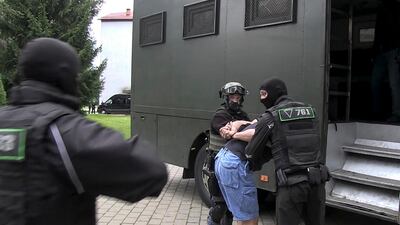
Belarus says the detained Russian men are facing a criminal probe on charges of plotting riots during the country's presidential election campaign. State TV and Radio via AP -
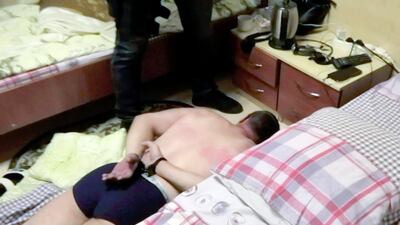
Belarus says the detained Russian men are facing a criminal probe on charges of plotting riots during the country's presidential election campaign. State TV and Radio via AP -
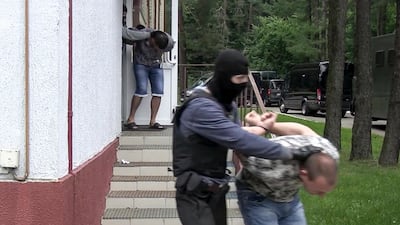
Belarus says the detained Russian men are facing a criminal probe on charges of plotting riots during the country's presidential election campaign. State TV and Radio via AP -
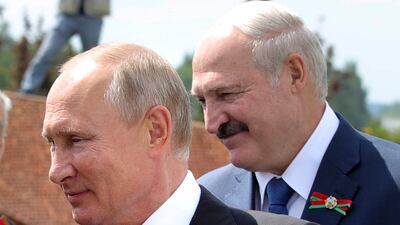
Russian President Vladimir Putin, left, and Belarusian President Alexander Lukashenko greet WWII veterans in June. AP -
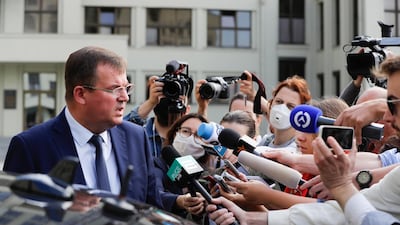
Andrei Ravkov, the head of State Secretary of the Security Council of Belarus, speaks reporters after the arrests. AP -
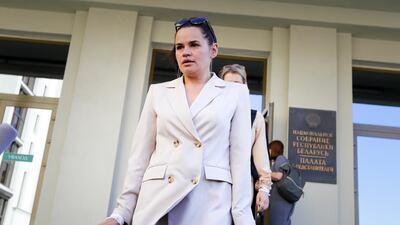
Svetlana Tikhanovskaya, a candidate in the presidential elections, is also being investigated. AP


It was also used to publicise the crimes of security forces, and at other times it shared the identities and personal information of figures within the country’s security forces.
Although it is not an EU member, Belarus was already a major foreign policy challenge with which the EU had struggled to grapple. With the diversion of Protasevich's Ryanair flight, the challenge has grown more acute.
A new round of sanctions will almost certainly follow, though existing sanctions, issued in the aftermath of the Belarusian election, so far have proved largely ineffective, as have statements of solidarity with the opposition.
The immediate reaction from EU leaders to Protasevich's arrest indicates there may already be consensus for the bloc to react more strongly. Lithuania’s President, Gaitanas Nauseda, has suggested banning EU flights over Belarusian airspace, and a complete ban on Belavia – the Belarusian state carrier – from flying to the EU. This would isolate Minsk within the continent significantly.
A joint letter signed by lawmakers chairing foreign affairs committees in Germany, Latvia, Poland, Ireland, Estonia, Lithuania, the UK and the US calls for the International Civil Aviation Organisation to issue an even wider ban on any flights over Belarus. Consensus is building in the West for such a move.
But the EU’s design does not lend itself to decisive action. In September, Cyprus blocked a sanctions package on Minsk over an unrelated dispute. In other cases, Hungary has wielded its veto as a favour to authoritatrian states outside the bloc.

If the EU cannot act decisively on a major violation of international law and norms by a relatively small country on its immediate eastern border, then it is a struggle to see how it can square up to the wider geopolitical challenges of the day.
A weak response would set a damaging precedent. Belarus may feel emboldened to chase dissidents further into the EU, and other countries that would wish to pursue journalists and others abroad may take inspiration, too.
The bloc's member states, particularly Lithuania, have fared better with unilateral policy. Vilnius, the Lithuanian capital, is barely 200 kilometres from Minsk and is now home to much of the Belarusian opposition. Similarly, Poland has acted robustly in the crisis, hosting to the team behind Nexta, and other independent media outlets. Estonia has used its temporary seat on the UN Security Council to get the issue on the table in New York.
The case of Roman Protasevich requires the EU to come out swinging in defence of international norms and laws; measures must be firm, and their loosening dependent on Protasevich's release. If they aren’t, there surely will be similar cases.
Gareth Browne is a correspondent for The National in Beirut
-

A Belarusian dog handler checks luggage off a Ryanair plane parked at Minsk International Airport. AFP -
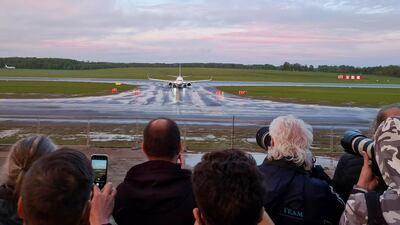
A Ryanair aircraft, which was carrying Belarusian opposition blogger and activist Roman Protasevich and diverted to Belarus, lands at Vilnius Airport in Vilnius, Lithuania. Reuters -
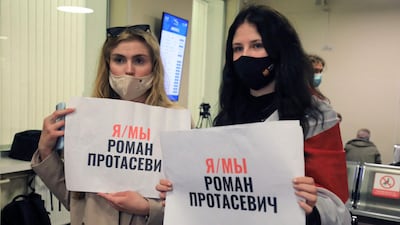
Women stand with posters reading 'I am, we are Roman Protasevich' in the arrival area as passengers disembark at the airport in Vilnius, its initial destination. AFP -
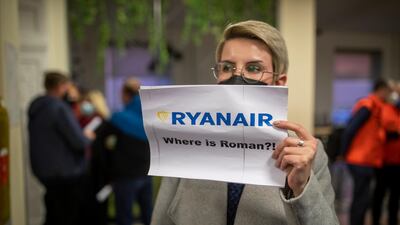
A woman holds a poster reads "where is Roman Protasevich?!" as she waits to see passengers at the International Airport outside Vilnius. AP Photo -
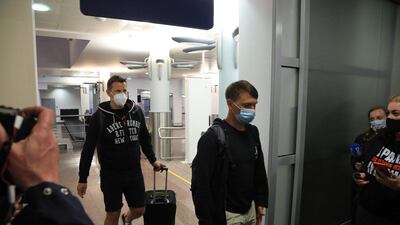
Passengers are greeted as they disembark from the Ryanair passenger plane in Vilnius. AFP -
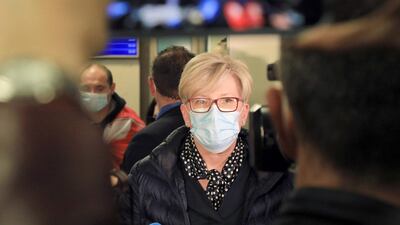
Lithuanian Prime Minister Ingrida Simonyte speaks to journalists at Vilnius International Airport. AFP -
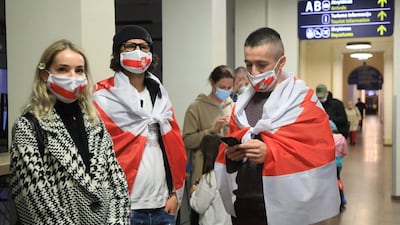
Young men and a woman wear the Belarus flag as passengers disembark from the Ryanair plane in Vilnius. AFP -
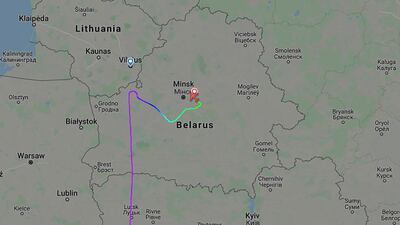
A graphic shows the flightpath the Ryanair Fflight flying from Athens to Vilnius and carrying Belarusian opposition activist and blogger Roman Protasevich, diverting and landing in Minsk. Reuters



