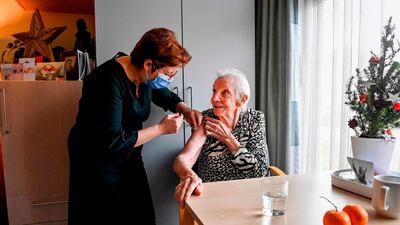
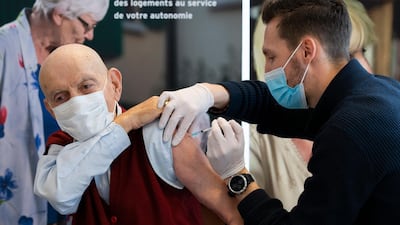
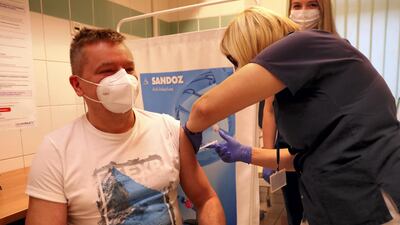
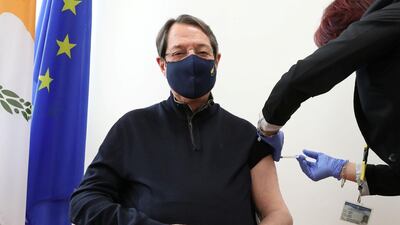
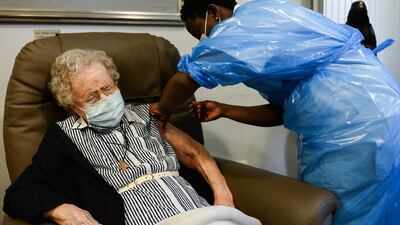
Things seemed in place late last year. There was good news: human trials of the Pfizer-BioNTech and Moderna vaccines were successful, we found out in late November. As a result, rich countries ordered vaccine doses multiple times their population.
These countries could afford to make bets on different vaccine manufacturers, hedging against failure in the race against the coronavirus. The plan was to inoculate most people by spring and achieve close to universal coverage by fall.
Meanwhile, developing countries would have to scrounge through the remnants. An alliance called Covax, spearheaded by the World Health Organisation, would procure and distribute vaccines to them but it would only be able to do so for a small percentage of the population early on. Universal vaccination would have to wait, probably until well into 2022.
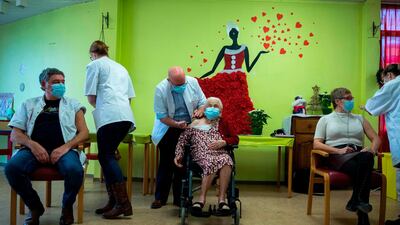
But it was all wishful thinking. Vaccine deliveries were delayed – partly because the vaccine roll-out was poorly planned and partly because companies experienced difficulties ramping up production to cater to their sovereign customers.
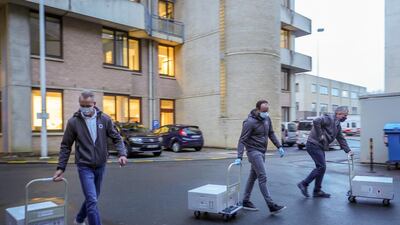
An agonising wait in Canada has begun until deliveries can resume at the scale needed to arrest the pandemic. Pfizer and Moderna deliveries have slowed, and the EU has introduced export controls that require countries in the bloc to seek authorisation before exporting vaccines. Canada's Pfizer doses are manufactured in Belgium. And while Ottawa has obtained verbal assurances that its shipments will not be affected, it really is a free for all that could change from one day to the next, and constitutes a garroting of the concept of international trade and solidarity, especially because the crisis was caused by the EU's slow, bureaucratic vaccine roll-out.
Of course, Canada has itself bungled the roll-out of whatever doses it has procured, because for some reason the crisis is not being treated with the urgency it deserves. According to figures compiled by the University of Oxford, Canada has administered 2.6 doses of the vaccines for every 100 people in the country, a figure that puts it far behind Israel, the UAE and the UK, Serbia, Malta, Slovenia, Lithuania, Poland, and Estonia.
Inequality has always led to the poorest paying a disproportionate price
There are many logistical challenges to distribution in a country as vast as Canada. The provinces are largely in charge of administering the vaccines, rather than the federal government, which only allocated them to the provinces. And special syringes had to be ordered to allow the extraction of six doses from each vial of Pfizer vaccine rather than five, to maximise supplies.
What should we glean from this? First, the competition over resources that was sparked by the pandemic, when countries tried to hoard personal protective equipment like masks, is in full force again over the vaccines. It is an ugly race, one that has highlighted the inequality between rich and poor on a global scale, and the miserliness of even the greatest proponents of co-operation and globalisation, such as the EU.
Perhaps it should not has come as a surprise that Europe, the fortress that entered a state of hysteria at the prospect of refugees seeking shelter on its shores, would now seek to limit the export of a vaccine that was developed by immigrants in Europe. But such is the irony of this zeitgeist. As some commentators in the European press noted, the EU’s actions are the best advertisement for Brexit.
The protectionism that is now the order of the day has pushed Canada into taking matters into its own hands. On Tuesday, Prime Minister Justin Trudeau announced a deal with pharmaceutical giant Novavax, whose vaccine candidate was submitted for approval late last week in the country. The deal will allow it to manufacture millions of doses of the vaccine at a plant in Montreal by fall. It is the first Covid-19 vaccine candidate that will be manufactured in Canada, that had so far relied on the usual rules of international trade to procure vaccines.
These struggles may as well be taking place in an alternate universe compared to the experiences of the rest of the world. Most developing countries, particularly in the Middle East, cannot afford the costly lockdowns that have been instituted in the West to limit to the spread of the virus. Nor do they have access to the vast resources that allow a country like Canada to pre-order vaccine doses multiple times its population. Instead they wait, with little to do but attempt to carry on with their lives, as the coronavirus ravages their communities.
The pandemic has re-ordered the lives, social structures and economies of much of the world, but it has not changed one key thing: the inequality that has always led to the poorest and most vulnerable paying a disproportionate price for our crises and failures endures. Rather than spark global solidarity against a common foe, too many have instead turned inward and miserly, and continue to act as if the reigning inequality is the natural order of things. It would a shame if this disease endured beyond the defeat of the coronavirus.
Kareem Shaheen is a veteran Middle East correspondent in Canada and a columnist for The National

AL%20BOOM
%3Cp%20style%3D%22text-align%3Ajustify%3B%22%3E%26nbsp%3B%26nbsp%3B%26nbsp%3BDirector%3AAssad%20Al%20Waslati%26nbsp%3B%3C%2Fp%3E%0A%3Cp%20style%3D%22text-align%3Ajustify%3B%22%3E%0DStarring%3A%20Omar%20Al%20Mulla%2C%20Badr%20Hakami%20and%20Rehab%20Al%20Attar%0D%3Cbr%3E%0D%3Cbr%3EStreaming%20on%3A%20ADtv%0D%3Cbr%3E%0D%3Cbr%3ERating%3A%203.5%2F5%0D%3Cbr%3E%0D%3Cbr%3E%3C%2Fp%3E%0A
The specs
Engine: Long-range single or dual motor with 200kW or 400kW battery
Transmission: Single-speed automatic
Max touring range: 620km / 590km
Price: From Dh250,000 (estimated)
The specs
Engine: 1.5-litre 4-cylinder petrol
Power: 154bhp
Torque: 250Nm
Transmission: 7-speed automatic with 8-speed sports option
Price: From Dh79,600
On sale: Now
%3Cp%3E%3Cstrong%3EDirector%3A%3C%2Fstrong%3E%20Nag%20Ashwin%3C%2Fp%3E%0A%3Cp%3E%3Cstrong%3EStarring%3A%20%3C%2Fstrong%3EPrabhas%2C%20Saswata%20Chatterjee%2C%20Deepika%20Padukone%2C%20Amitabh%20Bachchan%2C%20Shobhana%3C%2Fp%3E%0A%3Cp%3E%3Cstrong%3ERating%3A%20%3C%2Fstrong%3E%E2%98%85%E2%98%85%E2%98%85%E2%98%85%3C%2Fp%3E%0A
Who was Alfred Nobel?
The Nobel Prize was created by wealthy Swedish chemist and entrepreneur Alfred Nobel.
- In his will he dictated that the bulk of his estate should be used to fund "prizes to those who, during the preceding year, have conferred the greatest benefit to humankind".
- Nobel is best known as the inventor of dynamite, but also wrote poetry and drama and could speak Russian, French, English and German by the age of 17. The five original prize categories reflect the interests closest to his heart.
- Nobel died in 1896 but it took until 1901, following a legal battle over his will, before the first prizes were awarded.
Living in...
This article is part of a guide on where to live in the UAE. Our reporters will profile some of the country’s most desirable districts, provide an estimate of rental prices and introduce you to some of the residents who call each area home.
UK’s AI plan
- AI ambassadors such as MIT economist Simon Johnson, Monzo cofounder Tom Blomfield and Google DeepMind’s Raia Hadsell
- £10bn AI growth zone in South Wales to create 5,000 jobs
- £100m of government support for startups building AI hardware products
- £250m to train new AI models
What vitamins do we know are beneficial for living in the UAE
Vitamin D: Highly relevant in the UAE due to limited sun exposure; supports bone health, immunity and mood.
Vitamin B12: Important for nerve health and energy production, especially for vegetarians, vegans and individuals with absorption issues.
Iron: Useful only when deficiency or anaemia is confirmed; helps reduce fatigue and support immunity.
Omega-3 (EPA/DHA): Supports heart health and reduces inflammation, especially for those who consume little fish.
Benefits of first-time home buyers' scheme
- Priority access to new homes from participating developers
- Discounts on sales price of off-plan units
- Flexible payment plans from developers
- Mortgages with better interest rates, faster approval times and reduced fees
- DLD registration fee can be paid through banks or credit cards at zero interest rates
Omar Yabroudi's factfile
Born: October 20, 1989, Sharjah
Education: Bachelor of Science and Football, Liverpool John Moores University
2010: Accrington Stanley FC, internship
2010-2012: Crystal Palace, performance analyst with U-18 academy
2012-2015: Barnet FC, first-team performance analyst/head of recruitment
2015-2017: Nottingham Forest, head of recruitment
2018-present: Crystal Palace, player recruitment manager
Expo details
Expo 2020 Dubai will be the first World Expo to be held in the Middle East, Africa and South Asia
The world fair will run for six months from October 20, 2020 to April 10, 2021.
It is expected to attract 25 million visits
Some 70 per cent visitors are projected to come from outside the UAE, the largest proportion of international visitors in the 167-year history of World Expos.
More than 30,000 volunteers are required for Expo 2020
The site covers a total of 4.38 sqkm, including a 2 sqkm gated area
It is located adjacent to Al Maktoum International Airport in Dubai South
Trump v Khan
2016: Feud begins after Khan criticised Trump’s proposed Muslim travel ban to US
2017: Trump criticises Khan’s ‘no reason to be alarmed’ response to London Bridge terror attacks
2019: Trump calls Khan a “stone cold loser” before first state visit
2019: Trump tweets about “Khan’s Londonistan”, calling him “a national disgrace”
2022: Khan’s office attributes rise in Islamophobic abuse against the major to hostility stoked during Trump’s presidency
July 2025 During a golfing trip to Scotland, Trump calls Khan “a nasty person”
Sept 2025 Trump blames Khan for London’s “stabbings and the dirt and the filth”.
Dec 2025 Trump suggests migrants got Khan elected, calls him a “horrible, vicious, disgusting mayor”
Dhadak
Director: Shashank Khaitan
Starring: Janhvi Kapoor, Ishaan Khattar, Ashutosh Rana
Stars: 3
Mercer, the investment consulting arm of US services company Marsh & McLennan, expects its wealth division to at least double its assets under management (AUM) in the Middle East as wealth in the region continues to grow despite economic headwinds, a company official said.
Mercer Wealth, which globally has $160 billion in AUM, plans to boost its AUM in the region to $2-$3bn in the next 2-3 years from the present $1bn, said Yasir AbuShaban, a Dubai-based principal with Mercer Wealth.
“Within the next two to three years, we are looking at reaching $2 to $3 billion as a conservative estimate and we do see an opportunity to do so,” said Mr AbuShaban.
Mercer does not directly make investments, but allocates clients’ money they have discretion to, to professional asset managers. They also provide advice to clients.
“We have buying power. We can negotiate on their (client’s) behalf with asset managers to provide them lower fees than they otherwise would have to get on their own,” he added.
Mercer Wealth’s clients include sovereign wealth funds, family offices, and insurance companies among others.
From its office in Dubai, Mercer also looks after Africa, India and Turkey, where they also see opportunity for growth.
Wealth creation in Middle East and Africa (MEA) grew 8.5 per cent to $8.1 trillion last year from $7.5tn in 2015, higher than last year’s global average of 6 per cent and the second-highest growth in a region after Asia-Pacific which grew 9.9 per cent, according to consultancy Boston Consulting Group (BCG). In the region, where wealth grew just 1.9 per cent in 2015 compared with 2014, a pickup in oil prices has helped in wealth generation.
BCG is forecasting MEA wealth will rise to $12tn by 2021, growing at an annual average of 8 per cent.
Drivers of wealth generation in the region will be split evenly between new wealth creation and growth of performance of existing assets, according to BCG.
Another general trend in the region is clients’ looking for a comprehensive approach to investing, according to Mr AbuShaban.
“Institutional investors or some of the families are seeing a slowdown in the available capital they have to invest and in that sense they are looking at optimizing the way they manage their portfolios and making sure they are not investing haphazardly and different parts of their investment are working together,” said Mr AbuShaban.
Some clients also have a higher appetite for risk, given the low interest-rate environment that does not provide enough yield for some institutional investors. These clients are keen to invest in illiquid assets, such as private equity and infrastructure.
“What we have seen is a desire for higher returns in what has been a low-return environment specifically in various fixed income or bonds,” he said.
“In this environment, we have seen a de facto increase in the risk that clients are taking in things like illiquid investments, private equity investments, infrastructure and private debt, those kind of investments were higher illiquidity results in incrementally higher returns.”
The Abu Dhabi Investment Authority, one of the largest sovereign wealth funds, said in its 2016 report that has gradually increased its exposure in direct private equity and private credit transactions, mainly in Asian markets and especially in China and India. The authority’s private equity department focused on structured equities owing to “their defensive characteristics.”
Museum of the Future in numbers
- 78 metres is the height of the museum
- 30,000 square metres is its total area
- 17,000 square metres is the length of the stainless steel facade
- 14 kilometres is the length of LED lights used on the facade
- 1,024 individual pieces make up the exterior
- 7 floors in all, with one for administrative offices
- 2,400 diagonally intersecting steel members frame the torus shape
- 100 species of trees and plants dot the gardens
- Dh145 is the price of a ticket
The Dark Blue Winter Overcoat & Other Stories From the North
Edited and Introduced by Sjón and Ted Hodgkinson
Pushkin Press