Whether they continue the lockdown and prioritise public health, or ease measures to avoid an economic collapse that will be devastating for their current and future financial and psychological wellbeing, nations and their leaders will be forced to reinvent themselves. Certainly, it will not be possible for them to return to the broad-based policies that had been put in place before Covid-19, with the virus having already altered the globalised landscape and upended nations’ geopolitical plans.
Even as the large, rich and powerful countries currently struggle to contain the coronavirus pandemic, the International Committee of the Red Cross (ICRC) has warned of its dire consequences on the future of vulnerable countries in the Middle East.
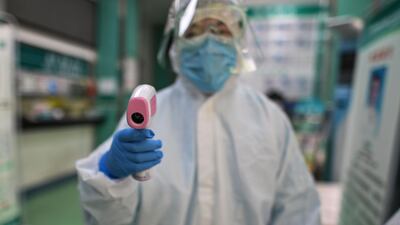
A medical worker prepares to check the temperature of an AFP photojournalist before a COVID-19 coronavirus test in Wuhan in China's central Hubei province. AFP
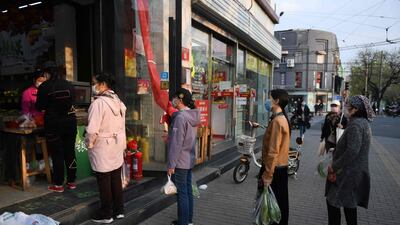
People queue up outside a fruit shop in Beijing. AFP
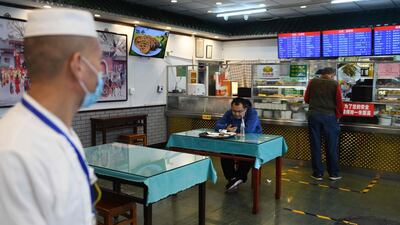
A man eats in a restaurant that has only one seat per table and markings on the floor to enforce social distancing in Beijing. AFP
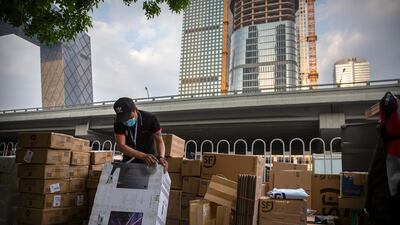
A delivery courier tapes a package along a road in the central business district in Beijing. AP Photo
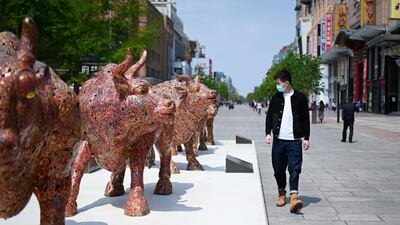
A man walks past bronze bull statues along a business street in Beijing. AFP
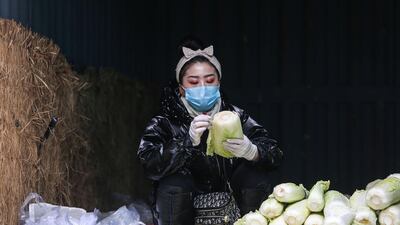
A vendor waits for customers at a market in Shenyang in China's northeastern Liaoning province. AFP
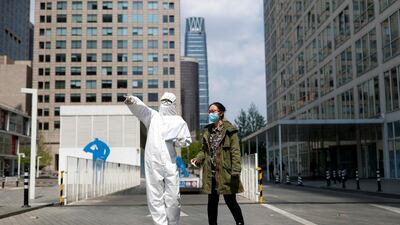
A security guard in Personal Protective Equipment suit gives directions to a passerby during lunch hour in Beijing's Central Business District. Reuters
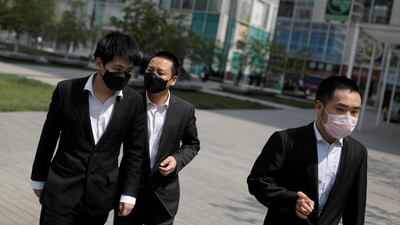
Office workers wear protective during lunch hour near Beijing’s Central Business District. Reuters
Office workers wearing protective masks walk in a park as people practice boxing during lunch hour near Beijing's Central Business District. Reuters
A worker produces face masks at a factory in Shenyang in China's northeastern Liaoning province. AFP
The ICRC has also noted that these nations are vulnerable not just due to their poor health and social infrastructure, but also because they are susceptible to violent social and political unrest as a reaction to their respective governments’ inadequate response to the crisis.
Iran, despite being one of the first countries in the Middle East to be hit by the coronavirus, has discovered that even in these circumstances, the US will not lift sanctions and Europe will not circumvent them. Tehran could well be upset by this reality, but it may also have concluded that unless it changes its regional policies, as well as its nuclear and ballistic missile programmes, the sanctions will remain in place.
The question, therefore, is whether the pandemic will force the region’s countries to reconsider their policies and reinvent themselves in order to save themselves. One problem is that global powers will be less capable of coming to their rescue due to their focus on the devastation in their own backyards.
In the post-Covid-19 brave new era, countries such as China, Russia and the US – as well as members of the EU and the G20 – will be forced to submit to radical reforms, both locally and globally.
Reform could also be waiting to happen within global institutions, such as the United Nations and its various agencies – including the World Health Organisation. President Donald Trump’s decision to suspend US funding for the WHO – in a protest against its alleged bias towards China – has been met with positive and negative responses within that country. The reaction outside the US has mostly been negative – irrespective of whether Mr Trump was justified or not in taking such action – given the realisation that we are all in this together.
Supranational groups such as the European Union have also been seen to be wanting in their ability to deliver solutions. The 27-nation bloc can no longer pretend as if nothing has changed following Brexit and the spread of Covid-19. Few will doubt the EU is facing huge economic, political and social challenges at the moment.
The dynamics that prevailed before the pandemic within the Group of 20, or G20, cannot continue to exist either, while the Gulf Cooperation Council (GCC) will find an opportunity to review some of its policies amid shrinking oil prices – due in large part to the glut in oil supplies, which can be attributed to a collapse in the demand for hydrocarbons in the wake of the global viral outbreak.
GCC ministers met via video link. Wam
Dr Andrei Fedorov, former deputy foreign minister of Russia and chairman of the Fund for Political Research, expects oil reservoirs to be nearly full in Russia, the US and everywhere else in the world – to the extent that these countries will be “obliged to get rid of it at any price even if the oil price goes down to zero” and the reason is that “you cannot stop production in the pipelines”. He added that this could happen in four weeks, and therefore, “by the end or mid-May, there will be a new oil crisis if it is not possible to go back to oil production”. He warned that if we get to the zero-point in May, “there will be no chance to restart the world economy without heavy losses”.
Most world leaders are moving with extreme caution, fearing they could squander a chance to restart the world economy, and expedite collapse.
May seems to be the month when most leaders hope to see a return to work and a gradual reduction in unemployment that has especially been devastating for the US, where more than 20 million people are claiming jobless allowances. The stakes are high, including Mr Trump’s re-election chances later this year. There is also concern of the adverse impact of America’s continued lockdown on other economies around the globe. “If the US economy is not reopened soon, this will kill the world economy,” Dr Fedorov said.
Iranian army commander-in-chief Abdolrahim Mousavi speaking during an army parade in Tehran. AFP
For its part, he added, “Russia is unable to play a role in the global economic agenda because of oil as well as the impact of the global economic crisis”. For this reason, there is talk in Moscow about reformulating the priorities of Russian foreign policy as the global conversation focuses on assessing how the coronavirus has impacted globalisation and the world economy.
There is, of course, an opportunity to restart the economy between the months of May and September – instead of keeping everything on lockdown indefinitely. But with fears of a second wave of the pandemic in China in the autumn season, many world leaders will be expected to formulate plans accordingly but also fearing for the future.
Raghida Dergham is the founder and executive chairwoman of the Beirut Institute
Manikarnika: The Queen of Jhansi
Director: Kangana Ranaut, Krish Jagarlamudi
Producer: Zee Studios, Kamal Jain
Cast: Kangana Ranaut, Ankita Lokhande, Danny Denzongpa, Atul Kulkarni
Rating: 2.5/5
RESULTS
6.30pm: Longines Conquest Classic Dh150,000 Maiden 1,200m.
Winner: Halima Hatun, Antonio Fresu (jockey), Ismail Mohammed (trainer).
7.05pm: Longines Gents La Grande Classique Dh155,000 Handicap 1,200m.
Winner: Moosir, Dane O’Neill, Doug Watson.
7.40pm: Longines Equestrian Collection Dh150,000 Maiden 1,600m.
Winner: Mazeed, Richard Mullen, Satish Seemar.
Devesh Mamtani from Century Financial believes the cash-hoarding tendency of each generation is influenced by what stage of the employment cycle they are in. He offers the following insights:
Baby boomers (those born before 1964): Owing to market uncertainty and the need to survive amid competition, many in this generation are looking for options to hoard more cash and increase their overall savings/investments towards risk-free assets.
Generation X (born between 1965 and 1980): Gen X is currently in its prime working years. With their personal and family finances taking a hit, Generation X is looking at multiple options, including taking out short-term loan facilities with competitive interest rates instead of dipping into their savings account.
Millennials (born between 1981 and 1996): This market situation is giving them a valuable lesson about investing early. Many millennials who had previously not saved or invested are looking to start doing so now.
Decide on your emergency fund target and once that's achieved, assign your savings to another financial goal such as saving for a house or investing for retirement.
Decide on a financial goal that is important to you and put your savings to work for you.
It's important to have a purpose for your savings as it helps to keep you motivated to continue while also reducing the temptation to spend your savings.
- Carol Glynn, founder of Conscious Finance Coaching
Company profile
Date started: 2015
Founder: John Tsioris and Ioanna Angelidaki
Based: Dubai
Sector: Online grocery delivery
Staff: 200
Funding: Undisclosed, but investors include the Jabbar Internet Group and Venture Friends
Use unique usernames and passwords while enabling multi-factor authentication.
Use an offline private key, a physical device that requires manual activation, whenever you access your wallet.
Avoid suspicious social media ads promoting fraudulent schemes.
Only invest in crypto projects that you fully understand.
Critically assess whether a project’s promises or returns seem too good to be true.
Only use reputable platforms that have a track record of strong regulatory compliance.
Store funds in hardware wallets as opposed to online exchanges.
Classification of skills
A worker is categorised as skilled by the MOHRE based on nine levels given in the International Standard Classification of Occupations (ISCO) issued by the International Labour Organisation.
A skilled worker would be someone at a professional level (levels 1 – 5) which includes managers, professionals, technicians and associate professionals, clerical support workers, and service and sales workers.
The worker must also have an attested educational certificate higher than secondary or an equivalent certification, and earn a monthly salary of at least Dh4,000.
Living in...
This article is part of a guide on where to live in the UAE. Our reporters will profile some of the country’s most desirable districts, provide an estimate of rental prices and introduce you to some of the residents who call each area home.
Favorite quote: To be or not to be, that is the question, from William Shakespeare's Hamlet
Favorite food: seafood
Favorite place to travel: Lebanon
Favorite movie: Braveheart
What it means to be a conservationist
Who is Enric Sala?
Enric Sala is an expert on marine conservation and is currently the National Geographic Society's Explorer-in-Residence. His love of the sea started with his childhood in Spain, inspired by the example of the legendary diver Jacques Cousteau. He has been a university professor of Oceanography in the US, as well as working at the Spanish National Council for Scientific Research and is a member of the World Economic Forum’s Global Future Council on Biodiversity and the Bio-Economy. He has dedicated his life to protecting life in the oceans. Enric describes himself as a flexitarian who only eats meat occasionally.
What is biodiversity?
According to the United Nations Environment Programme, all life on earth – including in its forests and oceans – forms a “rich tapestry of interconnecting and interdependent forces”. Biodiversity on earth today is the product of four billion years of evolution and consists of many millions of distinct biological species. The term ‘biodiversity’ is relatively new, popularised since the 1980s and coinciding with an understanding of the growing threats to the natural world including habitat loss, pollution and climate change. The loss of biodiversity itself is dangerous because it contributes to clean, consistent water flows, food security, protection from floods and storms and a stable climate. The natural world can be an ally in combating global climate change but to do so it must be protected. Nations are working to achieve this, including setting targets to be reached by 2020 for the protection of the natural state of 17 per cent of the land and 10 per cent of the oceans. However, these are well short of what is needed, according to experts, with half the land needed to be in a natural state to help avert disaster.