One of my clearest memories from my time working as a journalist in Beirut was covering the aftermath of a twin suicide bombing in early 2014. A string of terrorist bombings had taken place in the city, particularly in Shia-majority areas, by extremist groups who targeted civilians in retaliation for Hezbollah's involvement in the war in Syria.
This particular bombing had taken place in a heavily populated area, and one of the cars exploded in front of an orphanage. (Mercifully, all the children there survived.) After covering the attack, I went back the next day to see how residents were coping with the aftermath. I climbed the stairs to an apartment that was directly across from one of the car bombs, and found a home that was completely destroyed, debris and wood and concrete everywhere - a lifetime of memories shattered in an instant.
An elderly man who lived in the apartment was there. His wife was being treated in the hospital. His daughter was there to help them pack and drive them to their hometown. On the balcony outside, the railing had been blown off. But they had set up two chairs and a rakwah or pot of Turkish coffee. I snapped a picture of the scene. In the rubble of their apartment, they were determined to hold on to something – perhaps it was beauty, perhaps a measure of comfort and solace in familiar rituals, perhaps joy. It was an image that epitomised a strength I had never seen in humans.
The balcony railing of an apartment I visited In 2014 had been partially destroyed by bomb blast the previous day. That the family living in this apartment was determined to get on with their lives epitomised a strength I had never seen in humans. Courtesy of Kareem Shaheen
Lebanon itself was like that to me. Surrounded by an unstable region, with a war in Syria, the refugee crisis, sectarianism, the rivalry between regional powers that played out every day – it wasn’t an oasis of calm by any means, the currents driving the country here and there, its people suffering under the corruption and ineptitude of its ruling class. But it nevertheless found ways to be alive, to be a refuge.
Come to think of it, it felt like being on the Titanic and listening to the orchestra play as the ship sank beneath the waves.
But now, the Titanic is underwater. Beirut was brought down by 2,700 tonnes of ammonium nitrate that were left in the city's port, so close to so many homes. Calling it criminal negligence is too kind.
I still can't quite comprehend the level of devastation, the cataclysm brought on by an explosion that large. I keep looking at videos of the shockwave, and my jaw keeps dropping. The wave of white oblivion that crashes over the buildings. Looking at the images of Mar Mikhail and Gemmayze, neighbourhoods I had lived in that used to be vibrant with night life, landmarks I recognised, streets I had walked, now covered in broken glass and debris, shingles torn off the roofs of houses, or homes collapsed all together.
Every friend I had there posted images of their broken homes. Another told us about watching the wave come in from the port and panicking as she searched for her son who was playing downstairs. The pictures of broken children’s rooms got to me the most now that I have a son of my own. I keep imagining what it would have been like had we stayed.
'Aftermath' by Tom Young, an artist who lives between London and Beirut. A number of Young's paintings were damaged following the blast on August 4. Tom Young
I didn’t need to imagine it for very long, because the friend who rented our old apartment near the port posted photos of the broken everything.
I left Beirut at the end of 2016 to take up another post, before moving halfway across the world to Canada. I thought doing so would inure me against the heartbreak that I navigated every day working as a journalist in the Middle East. But it turns out I never really left. Because the grief was all-encompassing and debilitating, and my heart still shattered into a thousand pieces.
I owe everything to the city. I met the love of my life there, at a little cafe in Mar Mikhail called Bar Tartine, along a stretch of road devastated by its proximity to the blast. I proposed to her at a spot overlooking Beirut’s marina. I made friendships in this city that will last a lifetime, and which made me who I am today. I owe to it my career in journalism.
But more importantly, I owe to it everything I learned about love, courage, hope, sacrifice, grief, hatred, dance, music, suffering and violence. Everything about life and meaning. The kind of yearning for life that finds the lone grass shoot in the desert, the diamond in the rough, the steaming pot of coffee on the balcony after the suicide bombing.
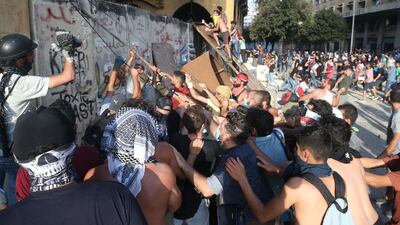
Lebanese anti-government protesters pull a protection wall leading to the Parliament square during a protest in Beirut. EPA
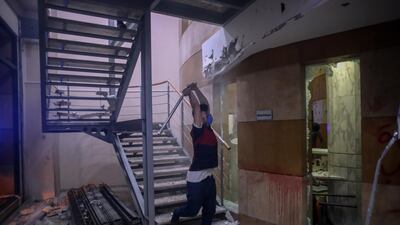
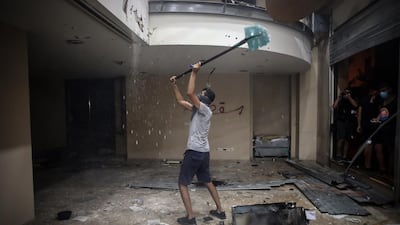
A protester strikes a wall with a metal bar inside the Lebanese Banks Association (ABL) headquarters. Bloomberg
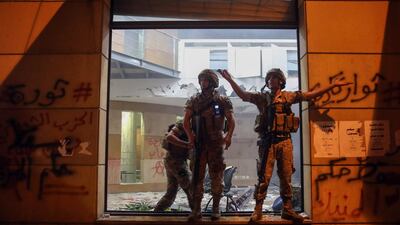
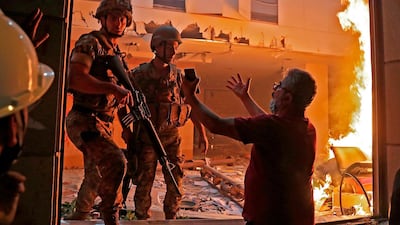
Lebanese army soldiers stand guard by a shattered window inside the Lebanese Banks Association (ABL) headquarters during a demonstration. Bloomberg
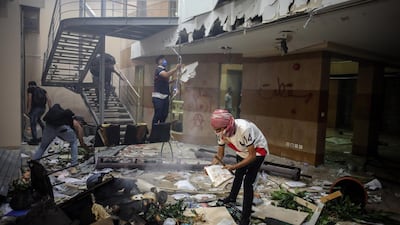
Protesters break into the Lebanese Banks Association (ABL) headquarters during a demonstration. Bloomberg
A protester strikes the ceiling inside the Lebanese Banks Association (ABL) headquarters during a demonstration. Bloomberg
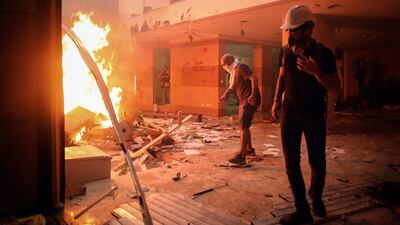
Protesters light fires inside the Lebanese Banks Association (ABL) headquarters during a demonstration. Bloomberg
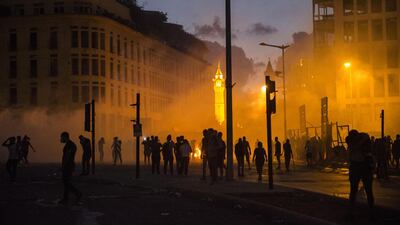
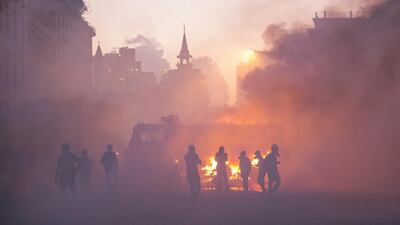
A cloud of tear gas drifts through a crowd of protesters during a protest at Martyrs Square. Getty Images
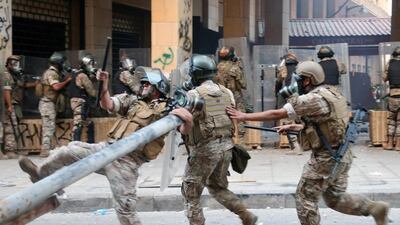
Lebanese security forces run during clashes with anti-government protesters. EPA
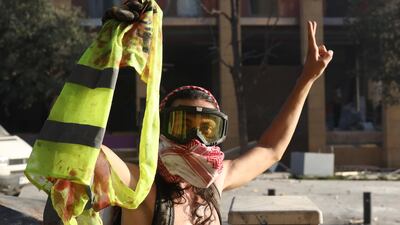
A Lebanese anti-government protester flashes a victory sign and holds a blood-stained yellow jacket of a fellow protester during clashes with riot police. EPA
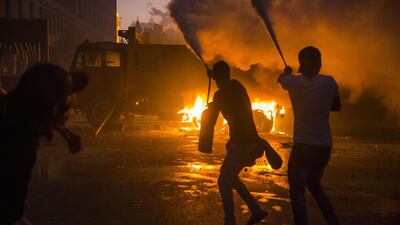
Protesters use fire extinguishers to block protesters' movements from the Internal Security Forces, not pictured, during a protest at Martyrs Square. Getty Images
Protesters move through a cloud of tear gas during a protest at Martyrs Square. Getty Images
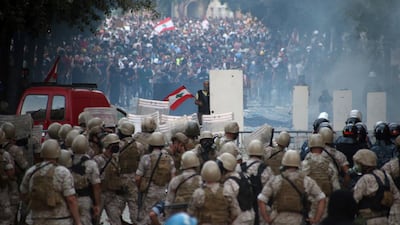
Lebanese anti-government protesters face off with riot police. EPA
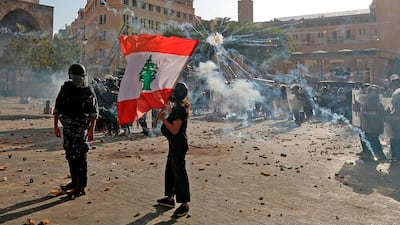
A Lebanese protester waves the national flag during clashes with security forces in downtown Beirut. AFP
A Lebanese protester speaks to soldiers at the headquarters of the Lebanese association of banks in downtown Beirut. AFP
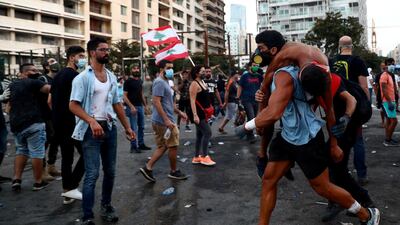
An injured demonstrator is evacuated during a protest. Reuters
I don't know what comes next. This is only the latest in a battery of crises for the Lebanese people, though it is more monumental. It follows a currency crash, hyperinflation, collapsing economy, coronavirus resurgence, poverty, and hunger. You only rise again after so many beatings. Lebanon's ruling elite deserve the harshest of punishment, but I don't know if they'll get away with it again. I don't know if things can change, or if people will reach the conclusion I reached, that they should just leave everything behind.
I don’t know any of that. I’m not there, though I find myself wishing I could be there. All I have are memories of Beirut that aren’t scarred by the shattered glass, and the tears that well up unprompted. And a dark sadness that has made it impossible to smile.
Kareem Shaheen is a former Middle East correspondent based in Canada
How to get exposure to gold
Although you can buy gold easily on the Dubai markets, the problem with buying physical bars, coins or jewellery is that you then have storage, security and insurance issues.
A far easier option is to invest in a low-cost exchange traded fund (ETF) that invests in the precious metal instead, for example, ETFS Physical Gold (PHAU) and iShares Physical Gold (SGLN) both track physical gold. The VanEck Vectors Gold Miners ETF invests directly in mining companies.
Alternatively, BlackRock Gold & General seeks to achieve long-term capital growth primarily through an actively managed portfolio of gold mining, commodity and precious-metal related shares. Its largest portfolio holdings include gold miners Newcrest Mining, Barrick Gold Corp, Agnico Eagle Mines and the NewMont Goldcorp.
Brave investors could take on the added risk of buying individual gold mining stocks, many of which have performed wonderfully well lately.
London-listed Centamin is up more than 70 per cent in just three months, although in a sign of its volatility, it is down 5 per cent on two years ago. Trans-Siberian Gold, listed on London's alternative investment market (AIM) for small stocks, has seen its share price almost quadruple from 34p to 124p over the same period, but do not assume this kind of runaway growth can continue for long
However, buying individual equities like these is highly risky, as their share prices can crash just as quickly, which isn't what what you want from a supposedly safe haven.
Stop all transactions and communication on suspicion
Save all evidence (screenshots, chat logs, transaction IDs)
Report to local authorities
Warn others to prevent further harm
Courtesy: Crystal Intelligence
Breaking News: The Remaking of Journalism and Why It Matters Now
Alan Rushbridger, Canongate
Jetour T1 specs
Engine: 2-litre turbocharged
Power: 254hp
Torque: 390Nm
Price: From Dh126,000
Available: Now
Mercer, the investment consulting arm of US services company Marsh & McLennan, expects its wealth division to at least double its assets under management (AUM) in the Middle East as wealth in the region continues to grow despite economic headwinds, a company official said.
Mercer Wealth, which globally has $160 billion in AUM, plans to boost its AUM in the region to $2-$3bn in the next 2-3 years from the present $1bn, said Yasir AbuShaban, a Dubai-based principal with Mercer Wealth.
“Within the next two to three years, we are looking at reaching $2 to $3 billion as a conservative estimate and we do see an opportunity to do so,” said Mr AbuShaban.
Mercer does not directly make investments, but allocates clients’ money they have discretion to, to professional asset managers. They also provide advice to clients.
“We have buying power. We can negotiate on their (client’s) behalf with asset managers to provide them lower fees than they otherwise would have to get on their own,” he added.
Mercer Wealth’s clients include sovereign wealth funds, family offices, and insurance companies among others.
From its office in Dubai, Mercer also looks after Africa, India and Turkey, where they also see opportunity for growth.
Wealth creation in Middle East and Africa (MEA) grew 8.5 per cent to $8.1 trillion last year from $7.5tn in 2015, higher than last year’s global average of 6 per cent and the second-highest growth in a region after Asia-Pacific which grew 9.9 per cent, according to consultancy Boston Consulting Group (BCG). In the region, where wealth grew just 1.9 per cent in 2015 compared with 2014, a pickup in oil prices has helped in wealth generation.
BCG is forecasting MEA wealth will rise to $12tn by 2021, growing at an annual average of 8 per cent.
Drivers of wealth generation in the region will be split evenly between new wealth creation and growth of performance of existing assets, according to BCG.
Another general trend in the region is clients’ looking for a comprehensive approach to investing, according to Mr AbuShaban.
“Institutional investors or some of the families are seeing a slowdown in the available capital they have to invest and in that sense they are looking at optimizing the way they manage their portfolios and making sure they are not investing haphazardly and different parts of their investment are working together,” said Mr AbuShaban.
Some clients also have a higher appetite for risk, given the low interest-rate environment that does not provide enough yield for some institutional investors. These clients are keen to invest in illiquid assets, such as private equity and infrastructure.
“What we have seen is a desire for higher returns in what has been a low-return environment specifically in various fixed income or bonds,” he said.
“In this environment, we have seen a de facto increase in the risk that clients are taking in things like illiquid investments, private equity investments, infrastructure and private debt, those kind of investments were higher illiquidity results in incrementally higher returns.”
The Abu Dhabi Investment Authority, one of the largest sovereign wealth funds, said in its 2016 report that has gradually increased its exposure in direct private equity and private credit transactions, mainly in Asian markets and especially in China and India. The authority’s private equity department focused on structured equities owing to “their defensive characteristics.”
The Byblos iftar in numbers
29 or 30 days – the number of iftar services held during the holy month
50 staff members required to prepare an iftar
200 to 350 the number of people served iftar nightly
160 litres of the traditional Ramadan drink, jalab, is served in total
500 litres of soup is served during the holy month
200 kilograms of meat is used for various dishes
350 kilograms of onion is used in dishes
5 minutes – the average time that staff have to eat
1. Domestic VAT refund amendments: request your refund within five years
If a business does not apply for the refund on time, they lose their credit.
2. E-invoicing in the UAE
Businesses should continue preparing for the implementation of e-invoicing in the UAE, with 2026 a preparation and transition period ahead of phased mandatory adoption.
3. More tax audits
Tax authorities are increasingly using data already available across multiple filings to identify audit risks.
4. More beneficial VAT and excise tax penalty regime
Tax disputes are expected to become more frequent and more structured, with clearer administrative objection and appeal processes. The UAE has adopted a new penalty regime for VAT and excise disputes, which now mirrors the penalty regime for corporate tax.
5. Greater emphasis on statutory audit
There is a greater need for the accuracy of financial statements. The International Financial Reporting Standards standards need to be strictly adhered to and, as a result, the quality of the audits will need to increase.
6. Further transfer pricing enforcement
Transfer pricing enforcement, which refers to the practice of establishing prices for internal transactions between related entities, is expected to broaden in scope. The UAE will shortly open the possibility to negotiate advance pricing agreements, or essentially rulings for transfer pricing purposes.
7. Limited time periods for audits
Recent amendments also introduce a default five-year limitation period for tax audits and assessments, subject to specific statutory exceptions. While the standard audit and assessment period is five years, this may be extended to up to 15 years in cases involving fraud or tax evasion.
8. Pillar 2 implementation
Many multinational groups will begin to feel the practical effect of the Domestic Minimum Top-Up Tax (DMTT), the UAE's implementation of the OECD’s global minimum tax under Pillar 2. While the rules apply for financial years starting on or after January 1, 2025, it is 2026 that marks the transition to an operational phase.
9. Reduced compliance obligations for imported goods and services
Businesses that apply the reverse-charge mechanism for VAT purposes in the UAE may benefit from reduced compliance obligations.
10. Substance and CbC reporting focus
Tax authorities are expected to continue strengthening the enforcement of economic substance and Country-by-Country (CbC) reporting frameworks. In the UAE, these regimes are increasingly being used as risk-assessment tools, providing tax authorities with a comprehensive view of multinational groups’ global footprints and enabling them to assess whether profits are aligned with real economic activity.
Contributed by Thomas Vanhee and Hend Rashwan, Aurifer
New process leads to panic among jobseekers
As a UAE-based travel agent who processes tourist visas from the Philippines, Jennifer Pacia Gado is fielding a lot of calls from concerned travellers just now. And they are all asking the same question.
“My clients are mostly Filipinos, and they [all want to know] about good conduct certificates,” says the 34-year-old Filipina, who has lived in the UAE for five years.
Ms Gado contacted the Philippines Embassy to get more information on the certificate so she can share it with her clients. She says many are worried about the process and associated costs – which could be as high as Dh500 to obtain and attest a good conduct certificate from the Philippines for jobseekers already living in the UAE.
“They are worried about this because when they arrive here without the NBI [National Bureau of Investigation] clearance, it is a hassle because it takes time,” she says.
“They need to go first to the embassy to apply for the application of the NBI clearance. After that they have go to the police station [in the UAE] for the fingerprints. And then they will apply for the special power of attorney so that someone can finish the process in the Philippines. So it is a long process and more expensive if you are doing it from here.”
The biog
Hometown: Cairo
Age: 37
Favourite TV series: The Handmaid’s Tale, Black Mirror
Favourite anime series: Death Note, One Piece and Hellsing
The Nobel Prize was created by wealthy Swedish chemist and entrepreneur Alfred Nobel.
In his will he dictated that the bulk of his estate should be used to fund "prizes to those who, during the preceding year, have conferred the greatest benefit to humankind".
Nobel is best known as the inventor of dynamite, but also wrote poetry and drama and could speak Russian, French, English and German by the age of 17. The five original prize categories reflect the interests closest to his heart.
Nobel died in 1896 but it took until 1901, following a legal battle over his will, before the first prizes were awarded.